Version 1.0.0-alpha.1latest
Chapter 1.1
What Nexus is, and who it's for
What Adverant Nexus does for an organisation, who it is built for, and how its parts fit together, told in plain words with Harrow Port Authority as the example. It ends with the three editions in one paragraph.
Ciara Holloway runs harbour operations at Harrow Port Authority. On a Tuesday morning she wants to know whether the dredging contractor's last survey changed the depth limits on the outer berths. A year ago that question meant three emails, a shared drive nobody trusted and a phone call to the one engineer who remembered. Now she types it into Nexus. The answer comes back in a few sentences, and each sentence points to the page of the survey and the clause of the contract it came from. If something was held back because she isn't allowed to see it, the answer says so.
None of it left Harrow's own servers. The port runs Nexus on its own hardware with no connection to the internet, and the model that wrote the answer runs there too.
That small exchange is most of what Nexus is for. Adverant's vision for it is short: every organisation thinking at its best. Its one-line summary is shorter still: bring your knowledge home.
A sovereign AI workspace
Nexus is a workspace for a whole organisation, built around artificial intelligence (AI) that the organisation controls. People ask questions and get answers drawn from what the organisation already knows. They talk in channels and threads, keep notebooks and hand routine jobs to workflows and agents. Every part shares the same people and the same access rules, and every part writes to the same record of what happened.
"Sovereign" is the word that sets it apart, and it means three practical things. Nexus runs where your rules say it may: in Adverant's cloud in the European Union, on your own Kubernetes cluster, on a site with no internet at all, or out in the field on a ship or a drone. It uses the models you choose, whether hosted ones you hold a key for or local ones on your own graphics cards. And the knowledge stays yours. It's read where it lives, it isn't copied off to someone else's cloud, and you can take all of it with you if you leave.
Who it's for
Nexus is built for regulated European organisations that must keep control of what they know. Insurers and banks are the obvious fit. So are public bodies and law firms, and ports like Harrow. They share a problem: sooner or later somebody will ask who allowed an AI to act, and on what evidence. It might be a supervisor or an auditor, or in a bad year a court. Most AI tools can't answer that question well, because the logs belong to the vendor and the data sits in the vendor's cloud.
Inside such an organisation, different people care about different parts. The executive who signs the budget wants to know AI costs won't run away and that the vendor can't hold the data hostage. The compliance officer wants every consequential decision to wait for a named person, and wants the evidence ready before the auditor asks. The head of IT wants something that runs on their own infrastructure without another fragile platform to nurse at three in the morning. And the people who use it every day want answers that show their sources, and an assurance that nobody is reading over their shoulder.
At Harrow, Aoife Brennan, head of IT, was the one who had to be convinced first. Her question was where the data would live. Her platform engineer, Tomás Reilly, wanted to know what happens when a model goes down. Both questions have plain answers, and you'll find them in chapter 1.4, AI on your terms, and chapter 1.8, Where Nexus runs.
The problem it solves
Most organisations already hold the answers their people are looking for. The trouble is where those answers sit: in mail, in shared drives, in a dozen line-of-business systems and in the heads of people who are on leave. AI pilots promise to fix this, and many never get past the demo. The ones that do usually take one of two shapes.
The first is to rent a workspace from a large US vendor, bundled with office licences. It works, but the organisation's knowledge moves onto someone else's cloud and is tied to one vendor's models. For a regulated buyer whose procurement rules now ask where data lives and who can reach it, that's a hard sell.
The second is to build it yourself. A team of engineers joins search and chat to models, then adds access rules, then an audit trail, then budgets, project by project, for years. Every industry ends up rebuilding the same parts.
Nexus takes a third route. The parts every AI project needs around the model come ready: the knowledge, the access rules, the record, the routing of model calls and the budgets. It installs beside the systems an organisation already runs and reads them without changing them. Nothing has to be replaced to start, and a single team can go first.
How it's put together
Underneath, Nexus has five parts that work together. You don't need to know how they're built to use them, but it helps to know what each one promises.
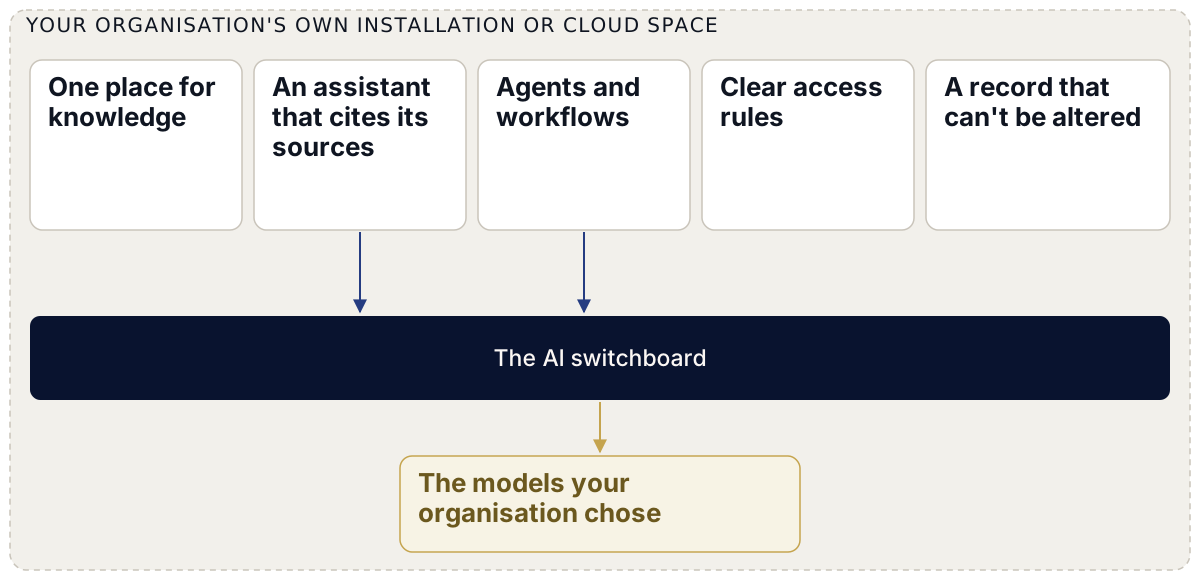
One place for knowledge
Your documents and mail feed one knowledge graph, along with records from the systems you connect. Think of it as your own search engine for the business, except that it follows connections. A question about a contractor reaches its contracts and invoices, and the mail about them, even when none of them use the same words. Every file that comes in is opened in its own sealed machine first, so a dangerous attachment never touches anything else. And search shows each person only what they're allowed to open. Things they can't open are left out of both the results and the counts.
An assistant that cites its sources
Every answer lists what it was read with, like a bibliography, and each claim links to the page or record behind it. If the rules held something back, the answer says so in a plate beside it. The assistant says when it doesn't know instead of guessing.
Agents and workflows
Workflows start from things that happen in your business: a mail arrives, a hold is placed, a month ends. They run where you can watch them and stop for a named person at any step that needs a decision. Agents go a step further and work on their own, but every agent has an owner, a budget and an off switch, and none starts above "ask first".
Clear access rules
You set who may see and do what once, for the organisation and its units, and every part of Nexus follows those rules, the AI included. Administrators govern without reading anyone's work. They see names, counts and states, never content. Chapter 1.3, Your organisation, its people, and what stays private, walks through this in detail.
A record that can't be altered
Every question and answer is written down as it happens, and so is every decision. Important decisions go into a sealed record with a time stamp from outside the installation. Change one character later and the check fails, and an auditor can run that check with a free verifier, no account needed.
Beside these sits the AI switchboard. Apps and agents never call a model directly. They ask the switchboard, which sends each call to a model and a place your rules allow, counts it against a budget someone owns, and never reads what was asked. Chapter 1.4, AI on your terms, is about it.
What it takes from you
A few things are worth knowing before you start.
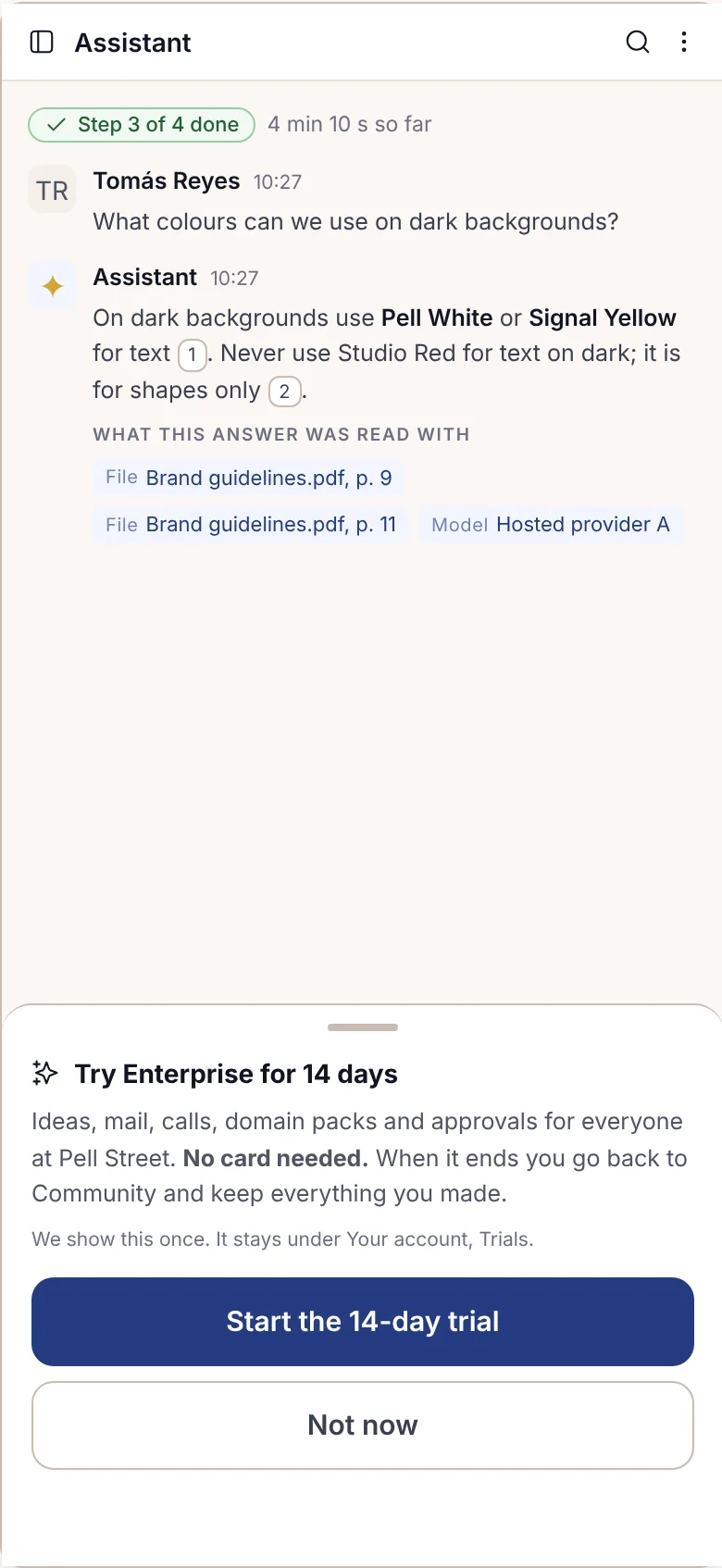
It needs a model. An organisation that hasn't connected a model key or a local model gets no AI answers, and the screen tells you so plainly, with the way to connect one. There's no shared Adverant key quietly filling the gap.
It needs owners. Someone has to decide the access rules and budgets, and which steps should wait for a person. Nexus makes those decisions easy to set and easy to read back, but it can't make them for you.
And some early choices are permanent. When Nexus is installed on your own infrastructure, a handful of settings are marked as fixed during set-up, the installation's name among them, because changing them later would break the records that depend on them. Your IT team will see them flagged before anyone signs in.
The editions in one paragraph
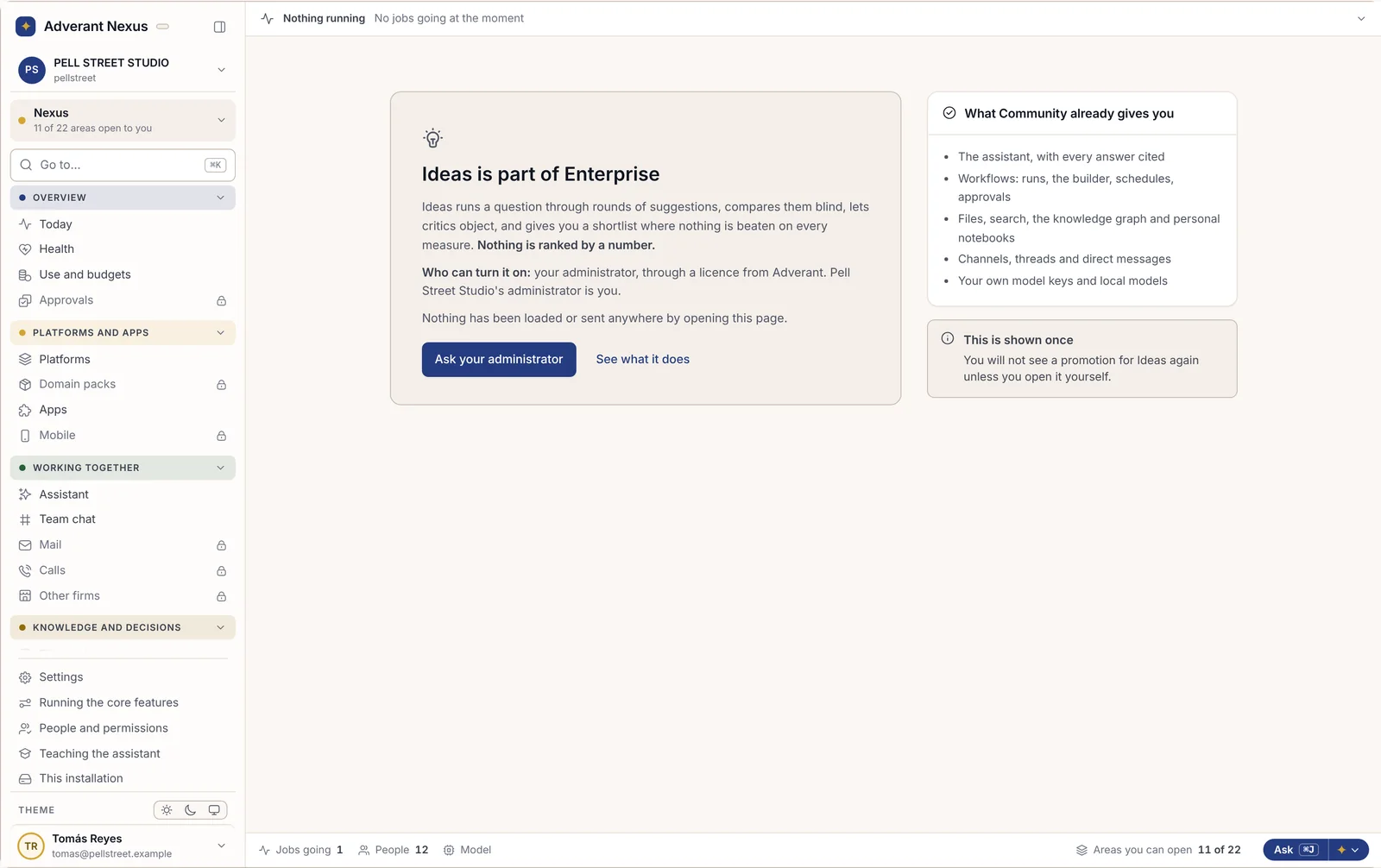
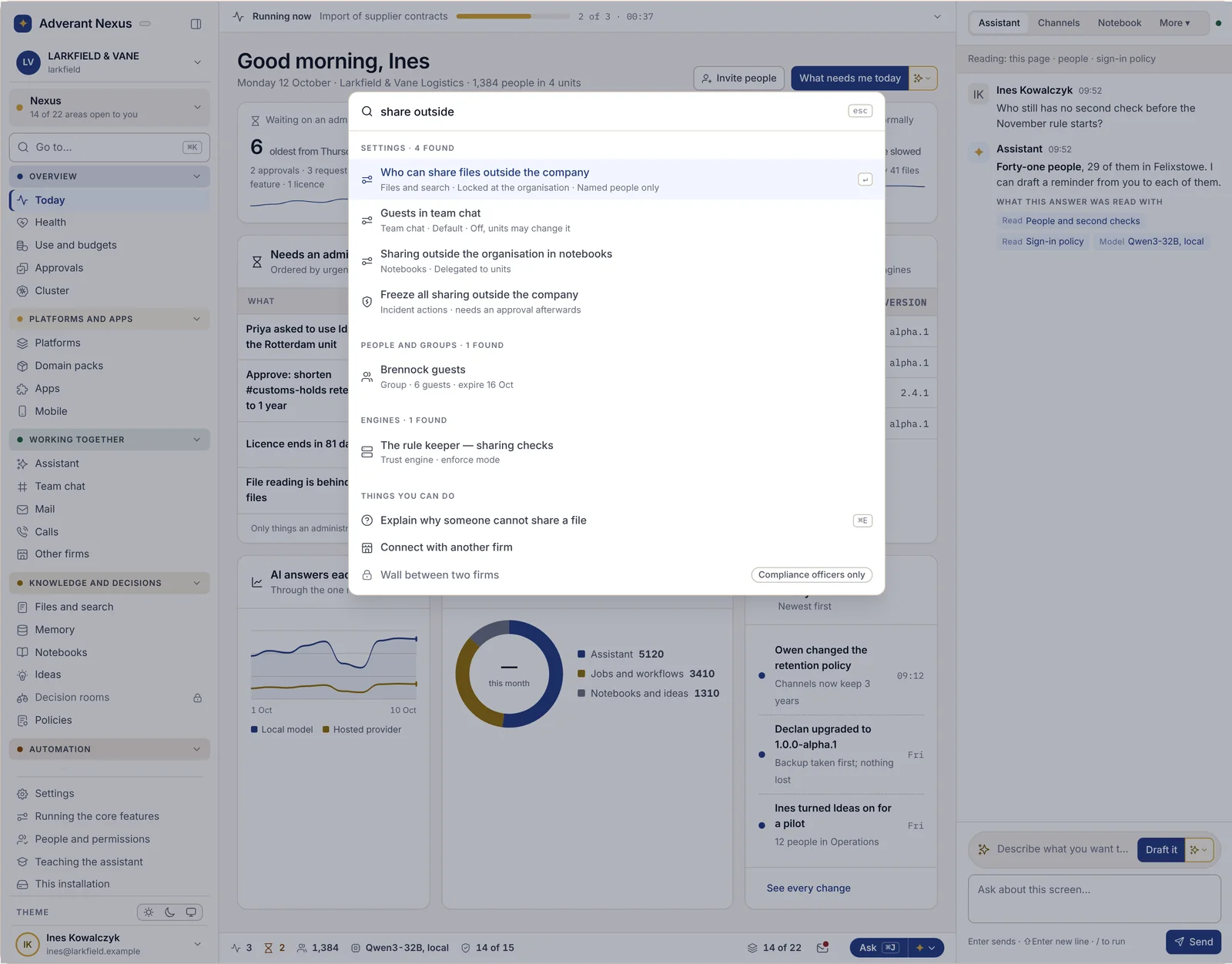
Nexus comes in three editions that share the same screens. Community is free and open source under the Apache-2.0 licence. It gives one organisation the assistant and search over its files, plus personal notebooks, basic channels and workflows, with a 30-day audit log. Team runs in Adverant's cloud and adds what a team shares: the work panel docked beside every page, for example, and shared notebooks. Enterprise is licensed. It brings business units and four-eyes approvals, enforced company sign-in, long audit retention and the compliance pages, along with the ways of running Nexus on your own infrastructure. Add-ons and industry domain packs sit on top of it. A signed licence decides what is switched on, never a different build. Chapter 1.6, Editions and licences in plain terms, explains the editions and how a licence works for a business.