

Every move, played out first. One simulation engine for the whole platform.
Plans are usually tested against one guess about the future. Nexus tests them against thousands, and against rivals who answer back.
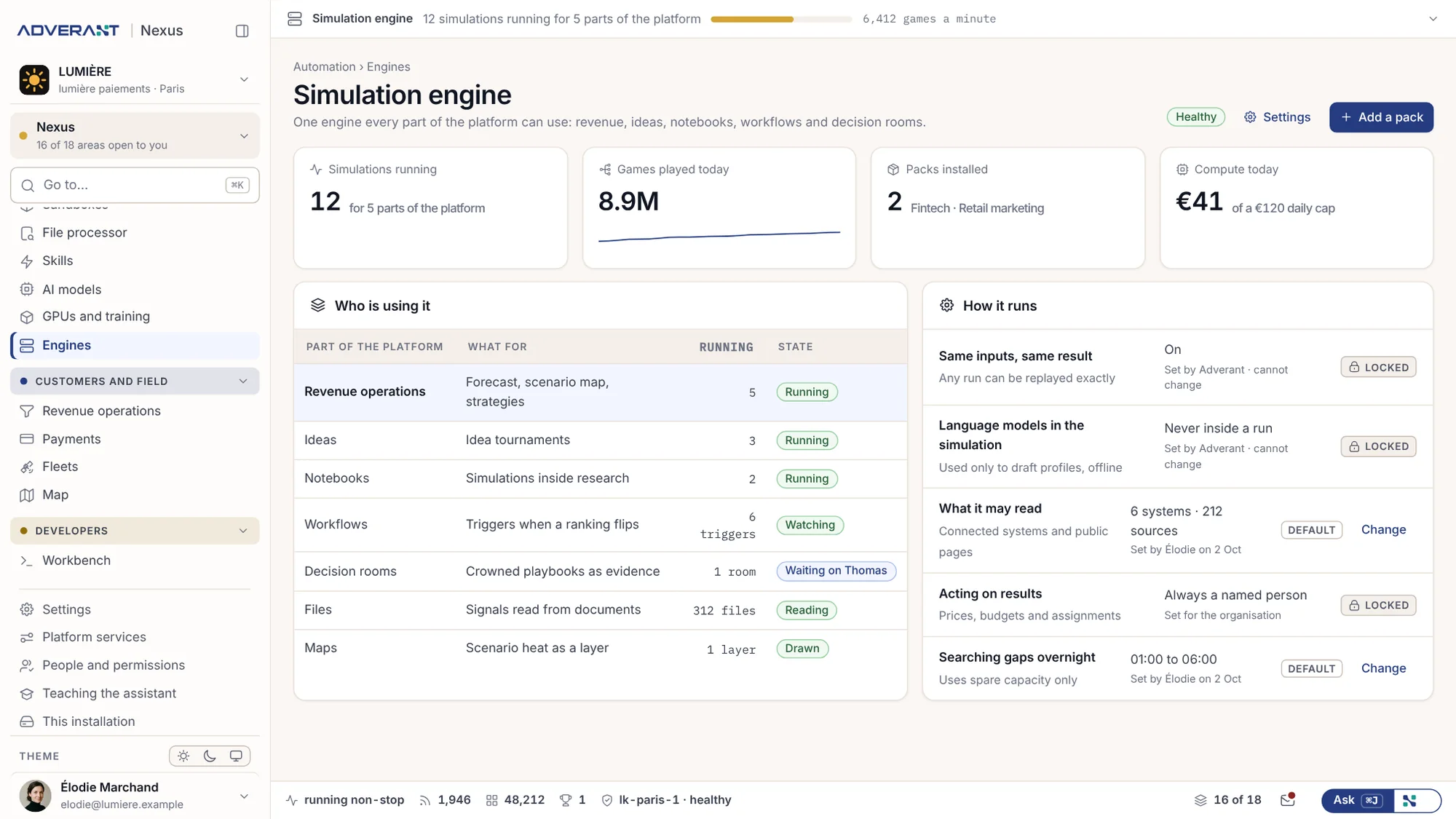
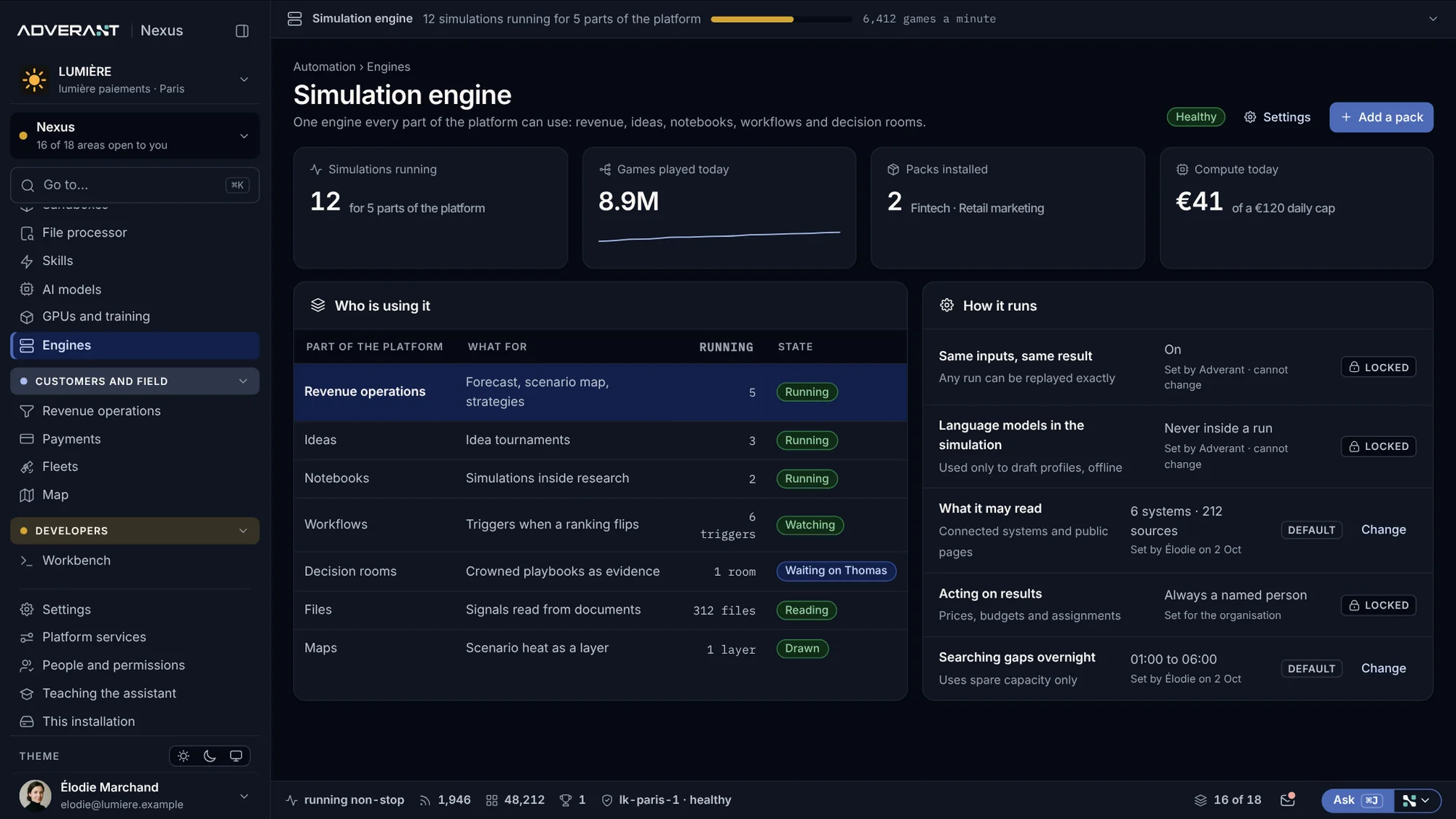
The simulation engine plays out what rivals, customers, partners and rule-makers could do, on your live data and on what is happening outside. It keeps the best answer for every situation, tests each strategy against every way rivals adapt, and hands people a playbook they can approve. Revenue, ideas, notebooks, workflows and decision rooms all use the same engine.
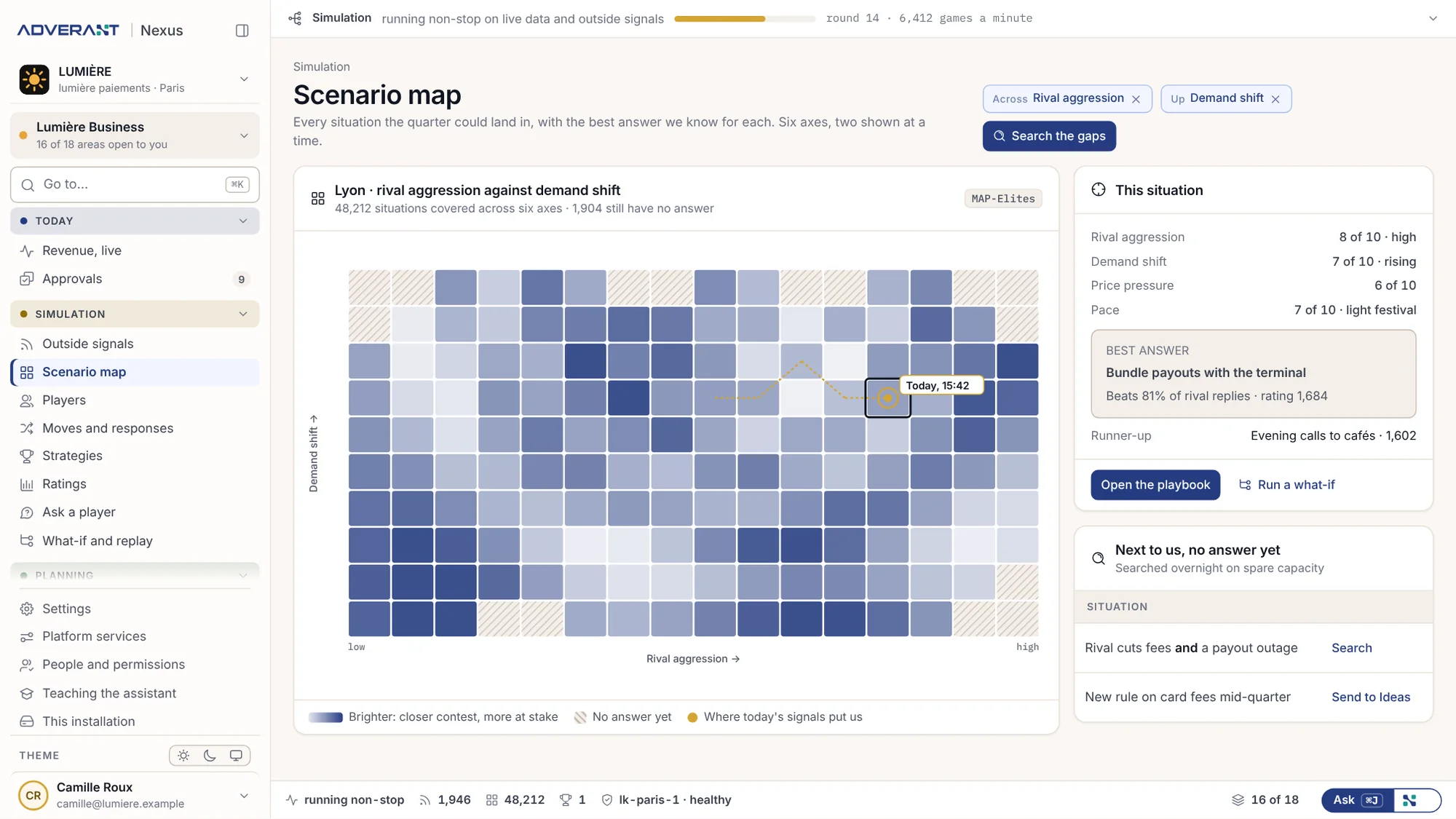
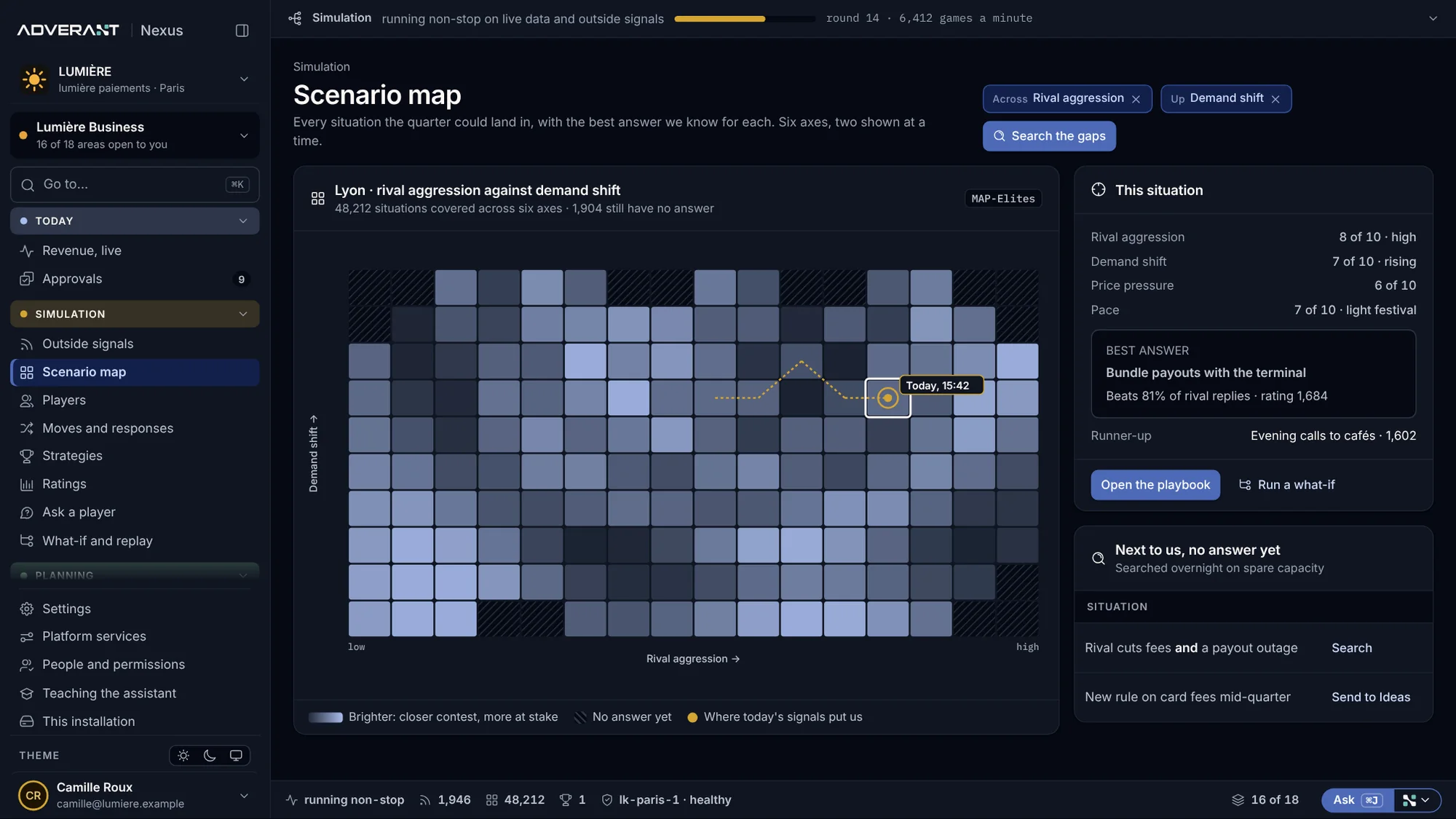
A rival cuts its prices. Here is what happens next.
These screens come from Lumière Business, the business side of a French money app built on Nexus. Every platform built on Nexus gets the same engine, in its own words. Lumière is a made-up business, shown for demonstration.
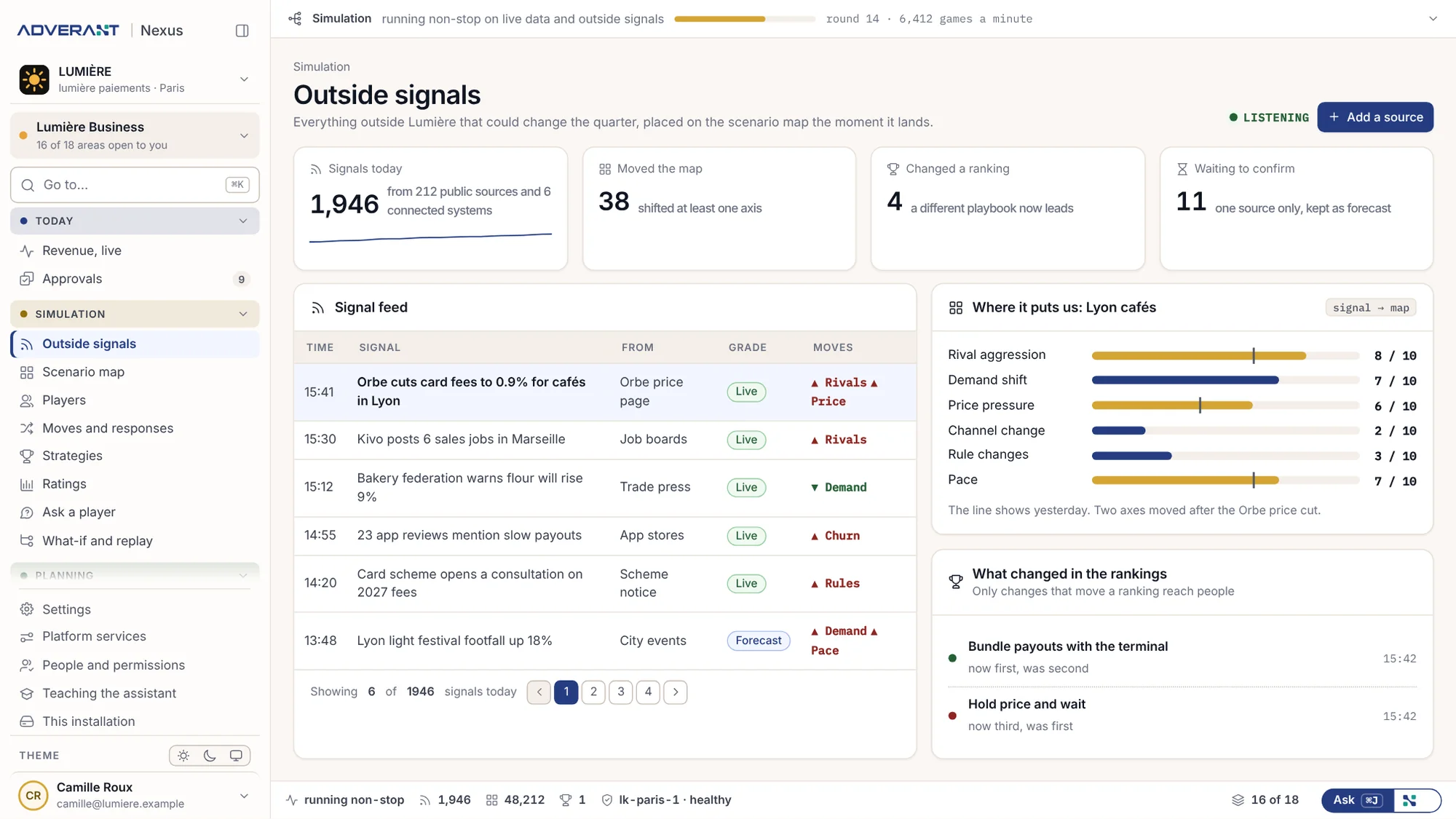
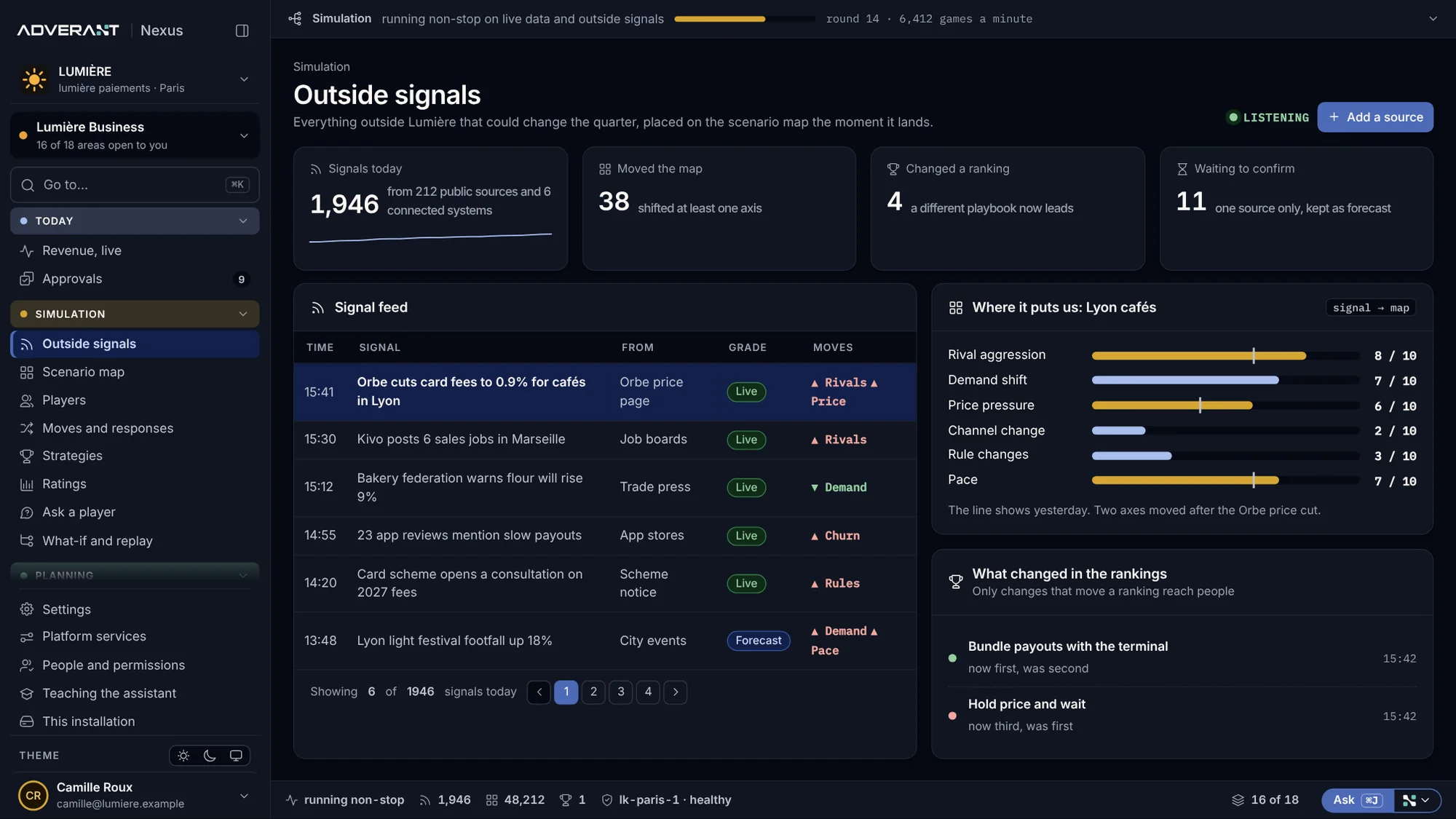
Outside signals, as they land
Rival price changes, job posts, reviews, rules and local events are picked up as they happen. Each one moves the scenario map and keeps its source.
- Source and grade on every signal
- Only changes that move a ranking reach people
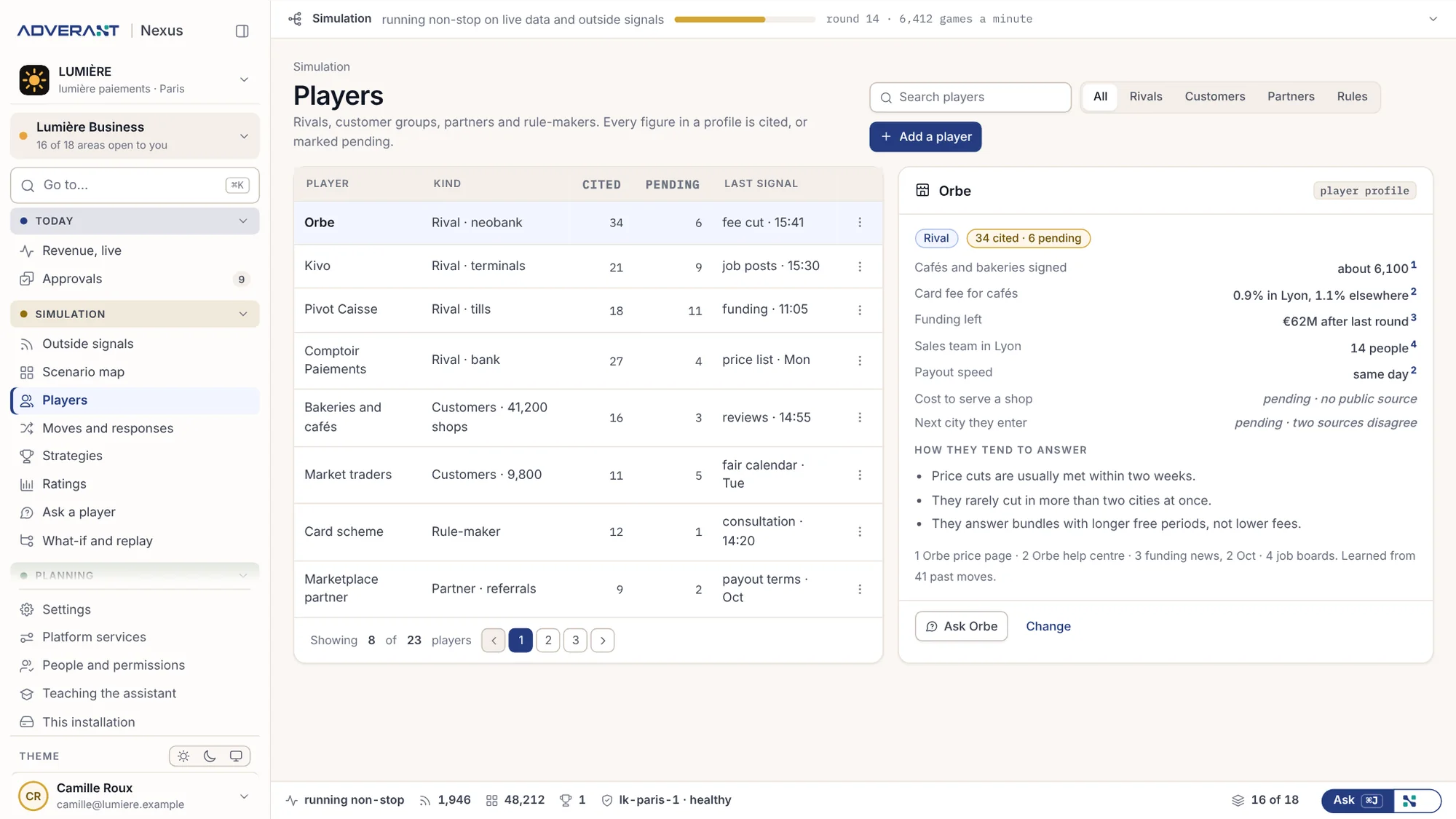
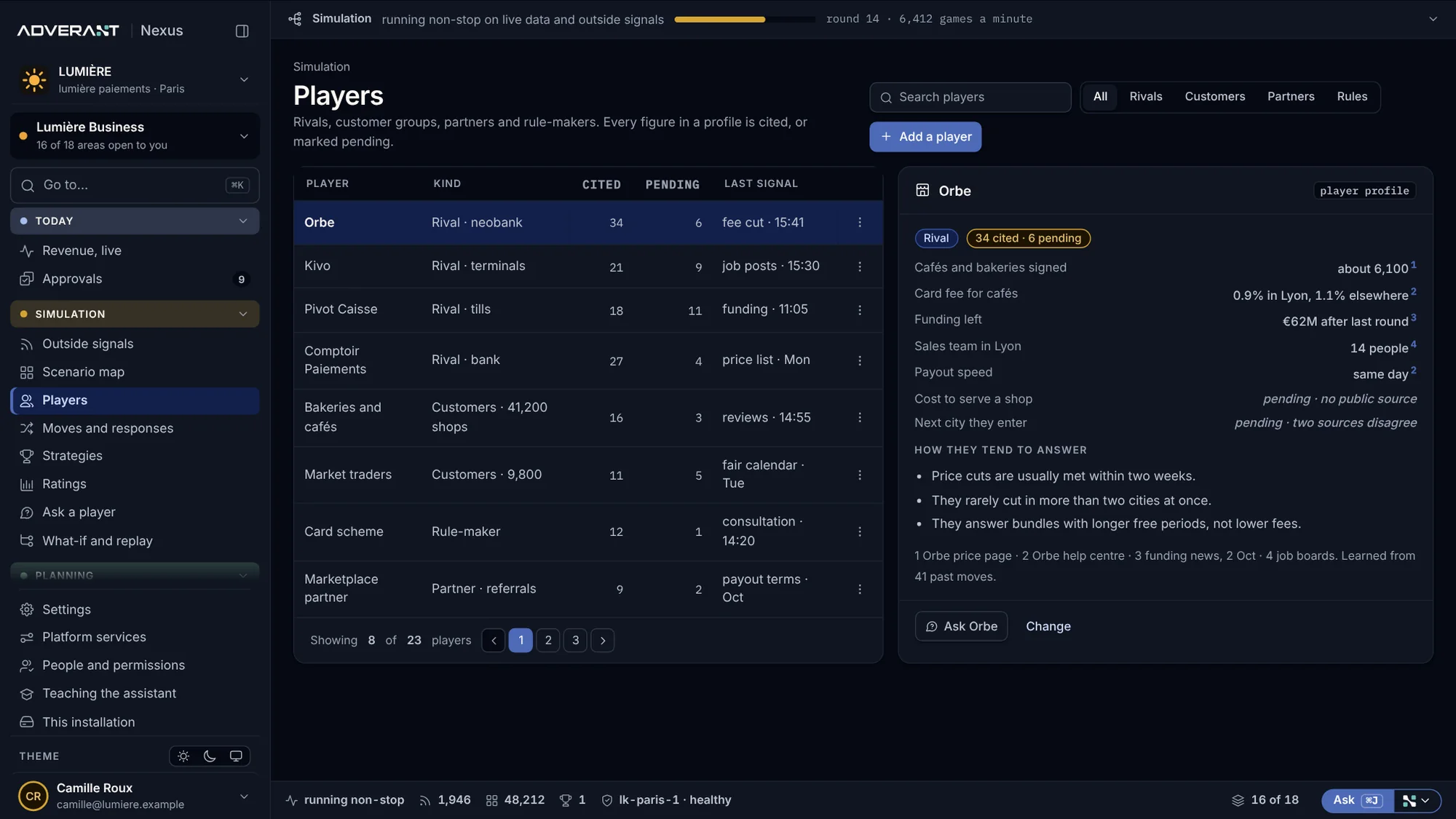
Players, with sources
Rivals, customer groups, partners and rule-makers each have a profile. Every figure is cited, or marked pending. It never fills a gap by guessing.
- Cited or pending, never guessed
- Learned from past moves
Moves and responses
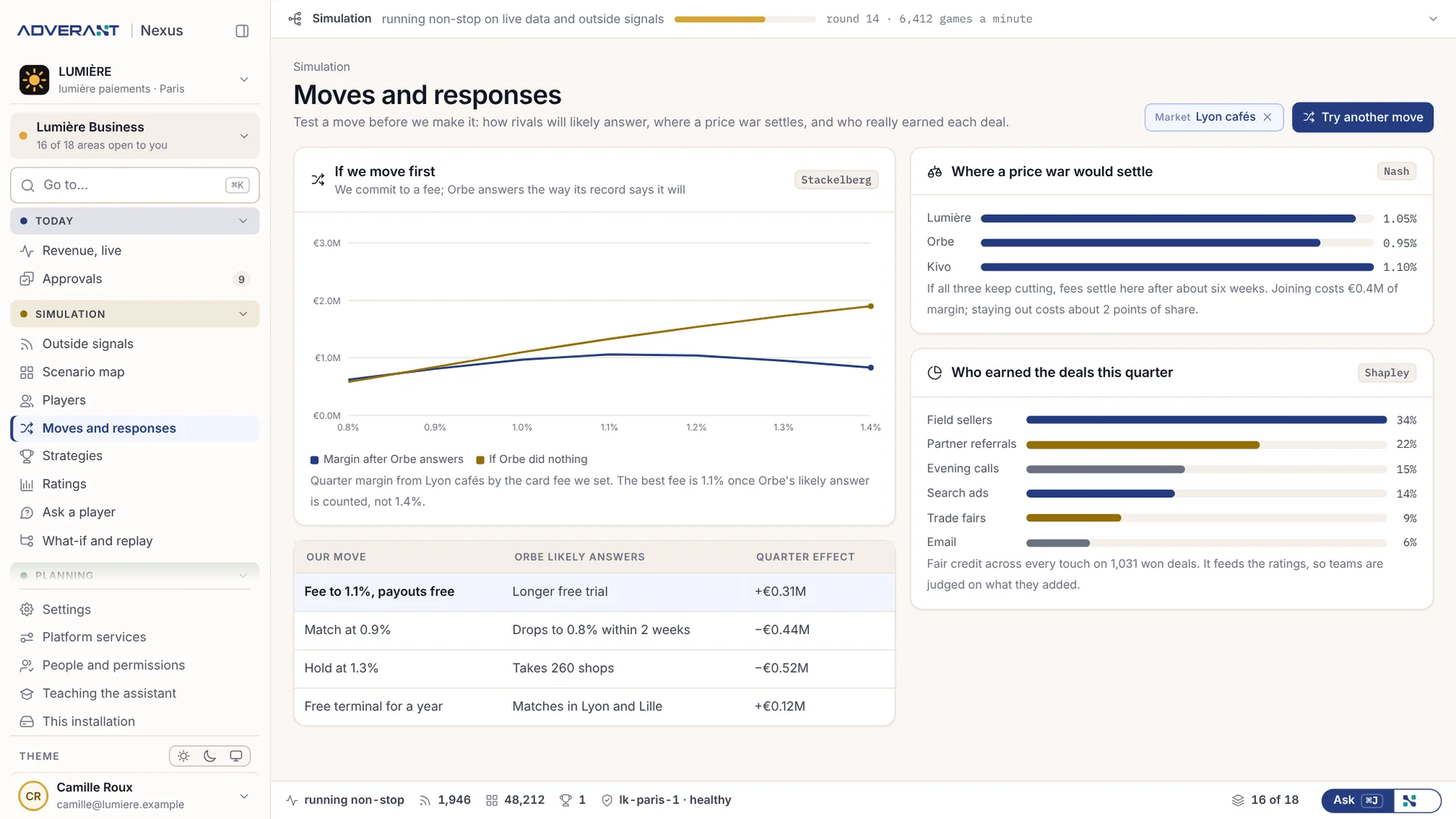
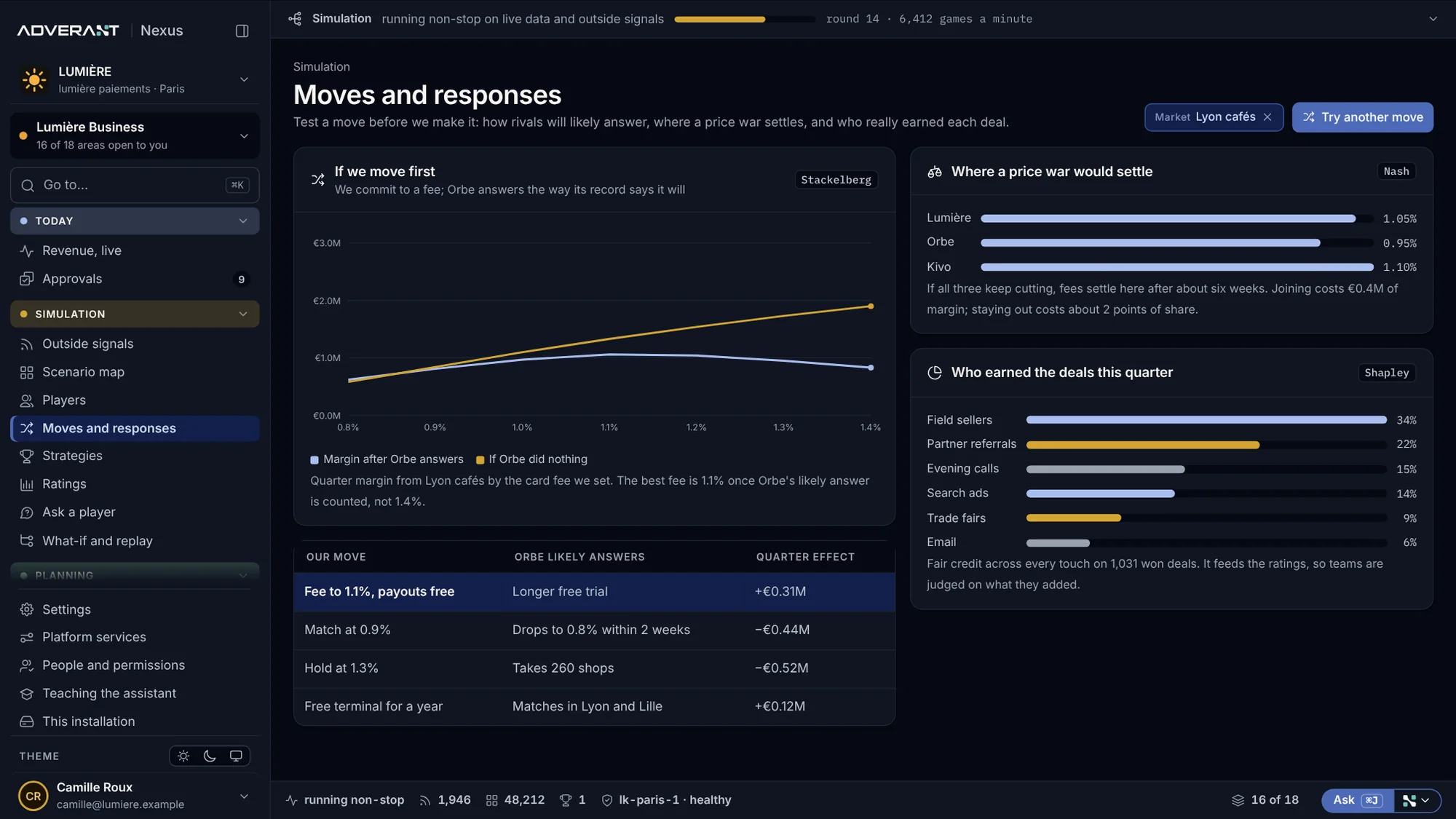
Test a move before you make it: how a rival will likely answer if you move first, where a price war would settle, and who really earned each deal.
- If we move first, how they answer
- Where a price war settles
- Fair credit for every deal
Strategies that survive the reply
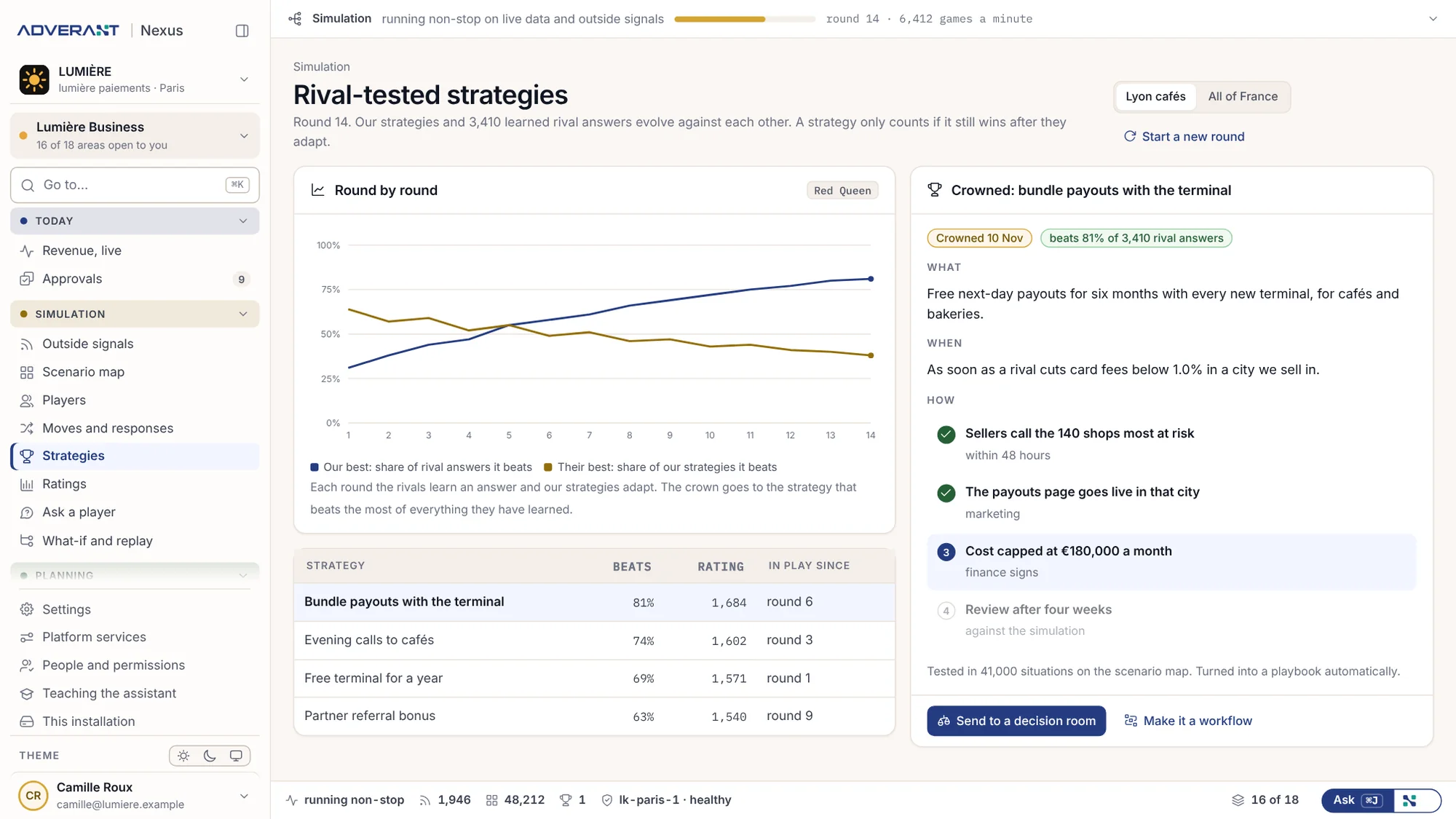
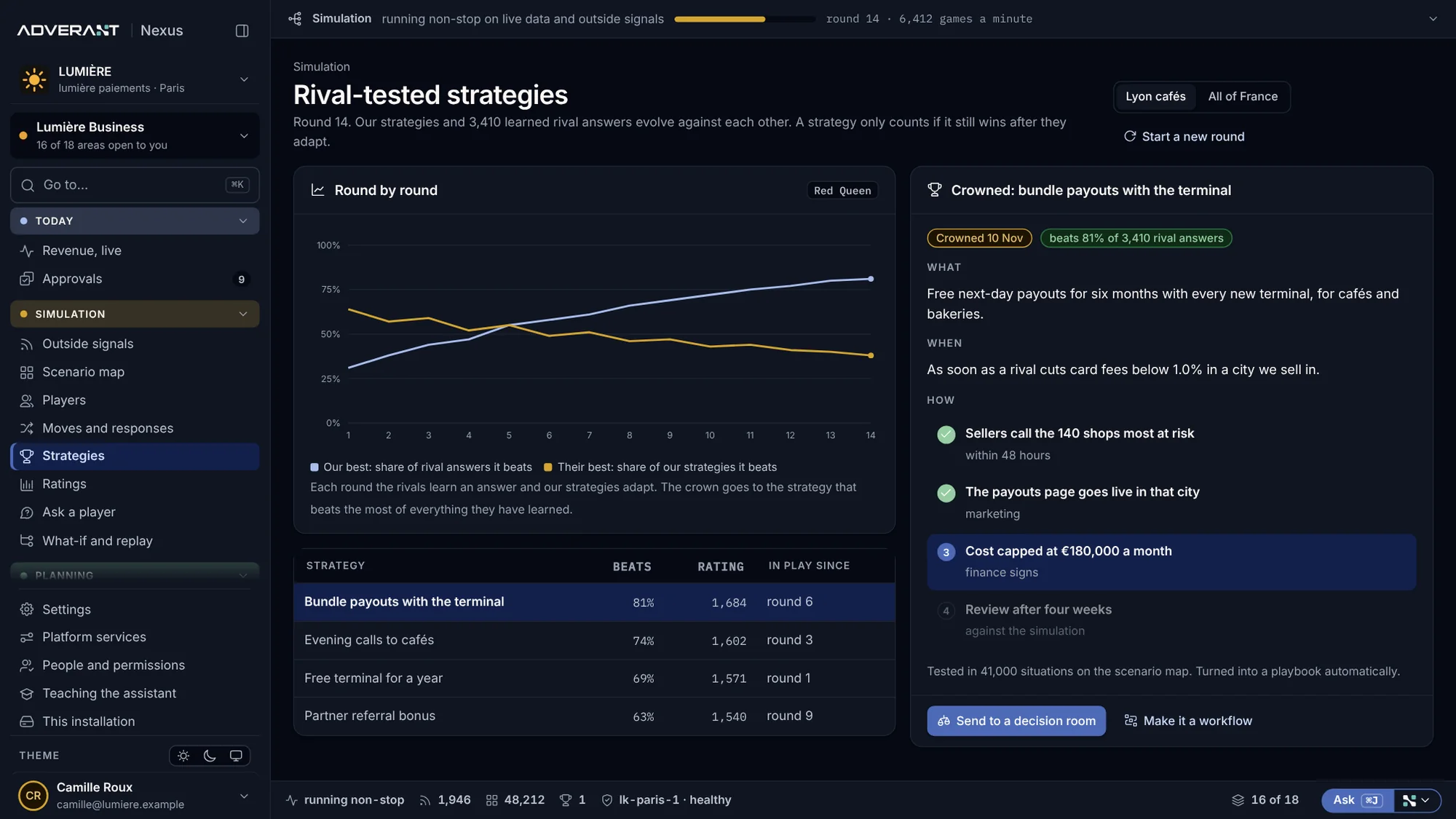
Strategies and rivals' answers evolve against each other, round after round. The one that still wins after they adapt is crowned and written up as a playbook.
- What, when and how, ready to approve
- Sent to a decision room or a workflow
Rated like chess players
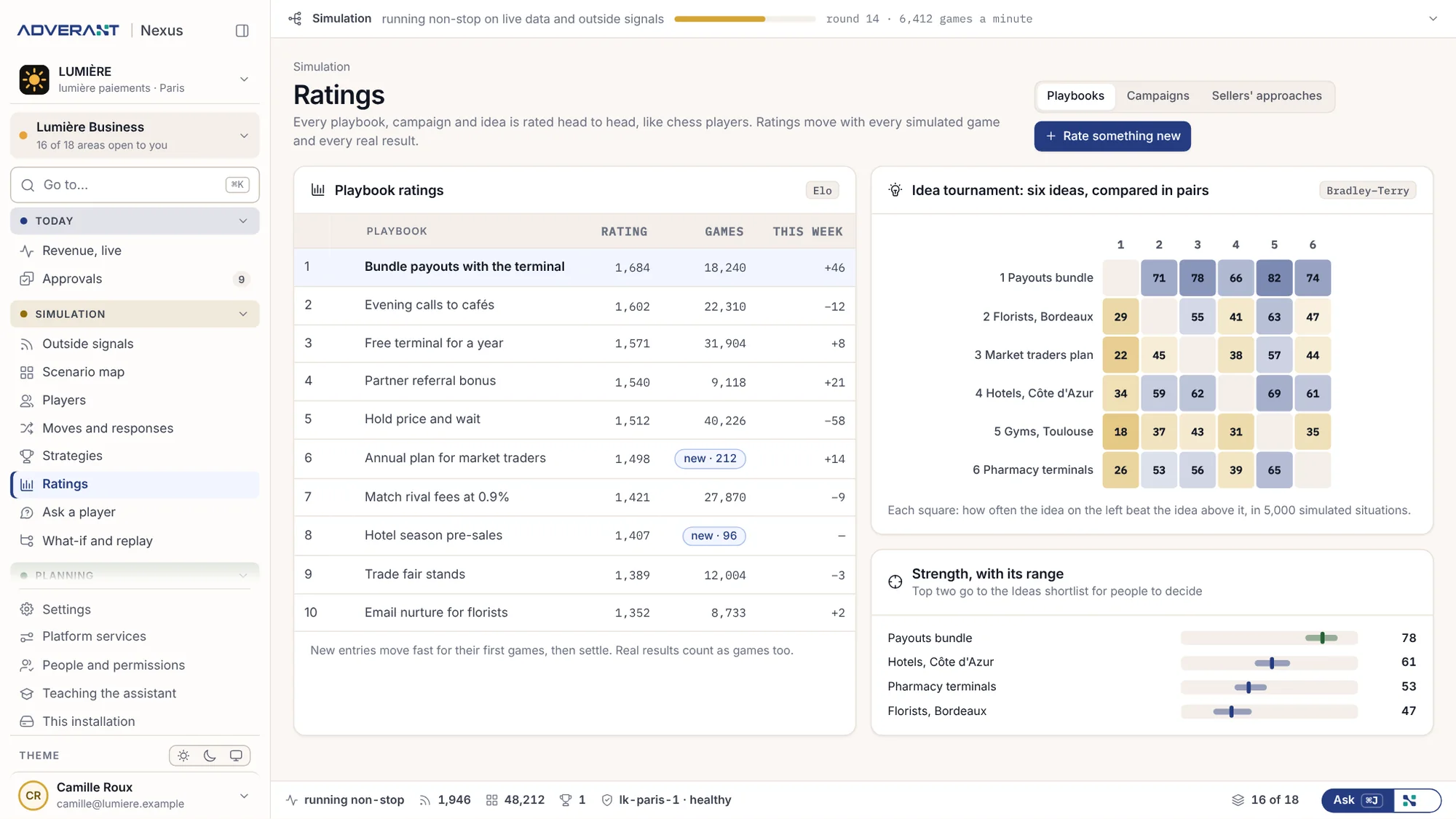
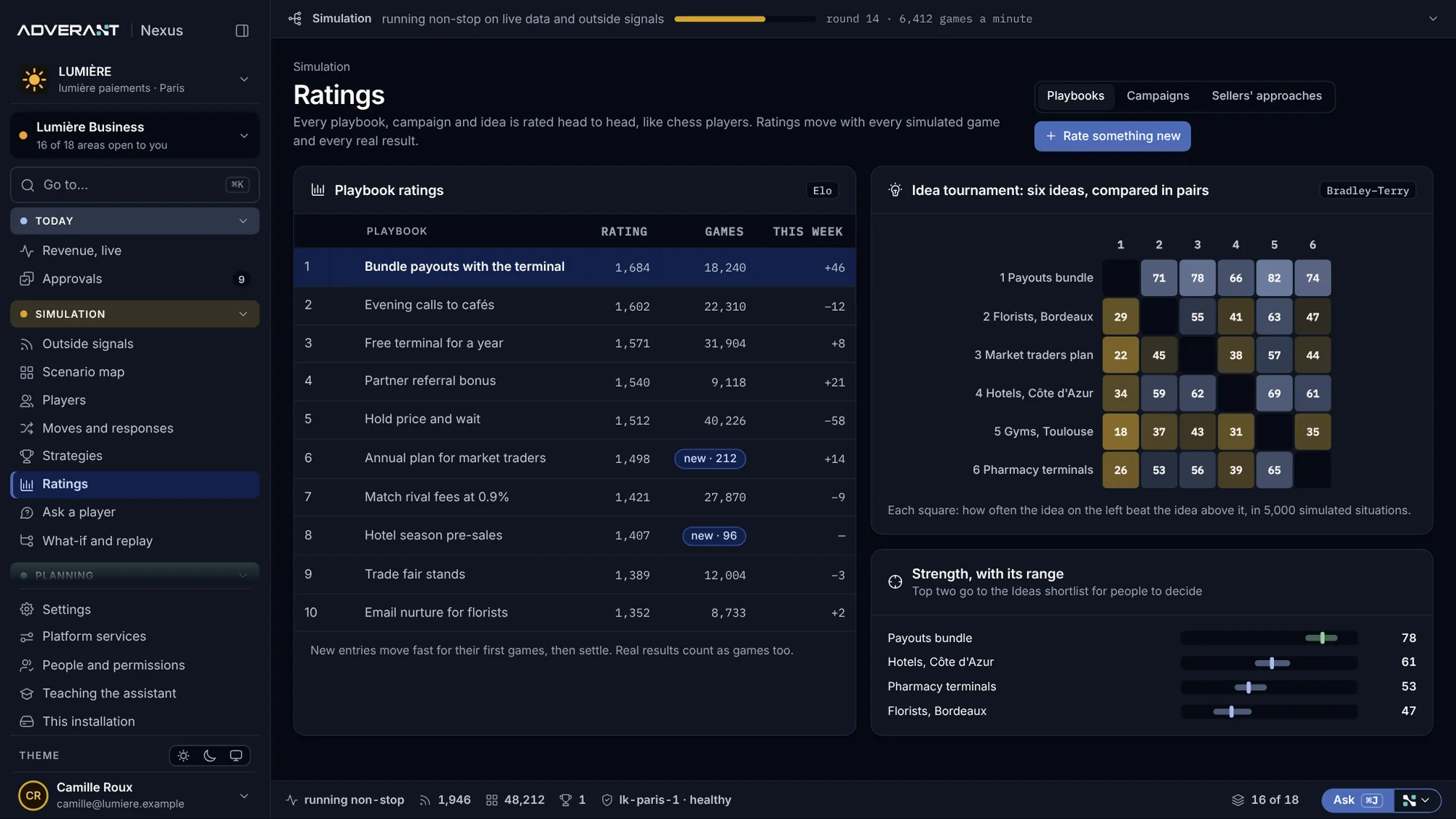
Playbooks, campaigns and ideas are rated head to head. Real results count as games too, so ratings keep moving with the business.
- Ratings move with every result
- Ideas compared in pairs
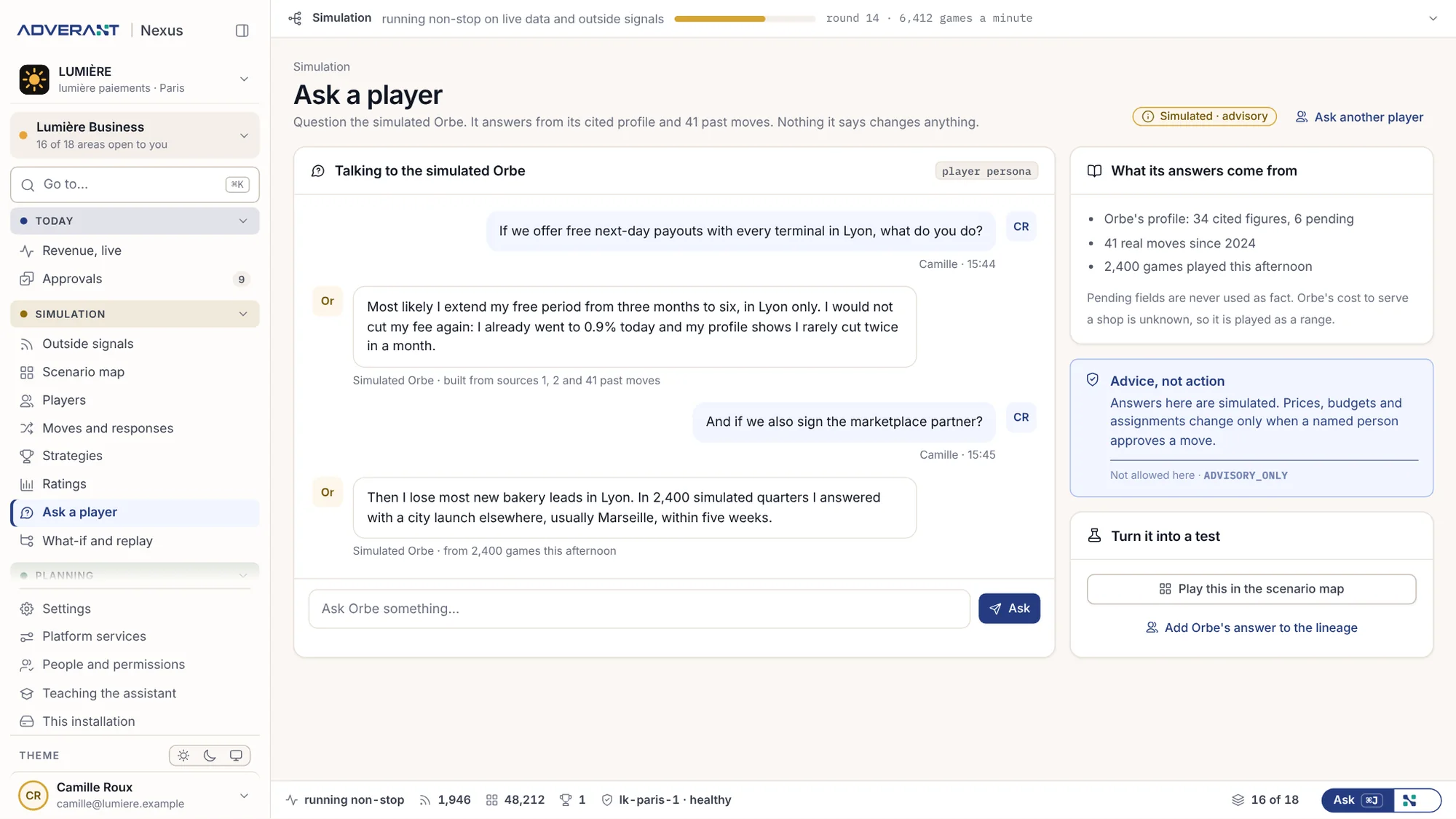
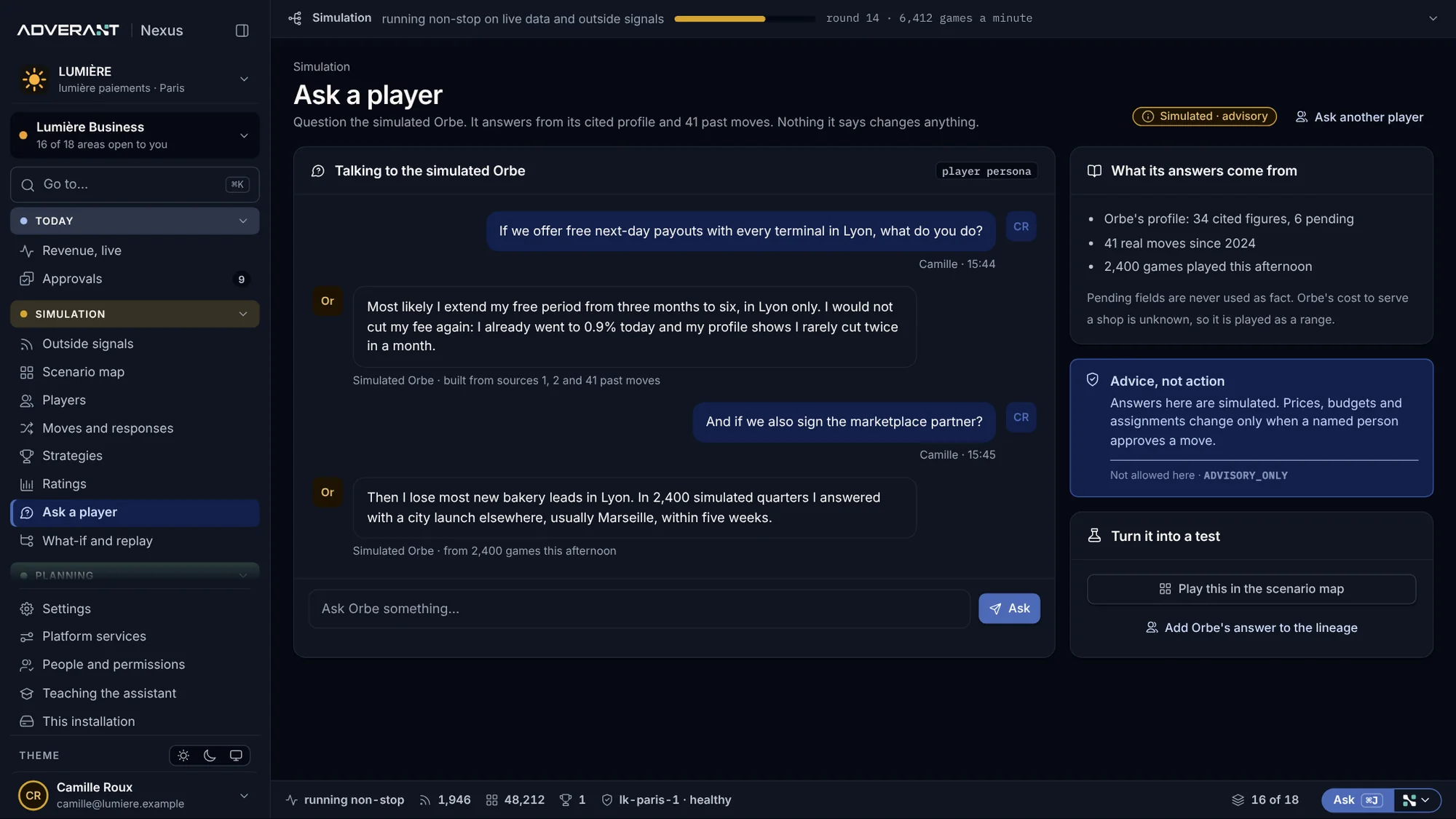
Ask the rival what it would do
Question a simulated rival about its likely next move. It answers from its profile and past moves, and every answer is labelled advice.
- Every answer shows what it came from
- Nothing changes until a person approves
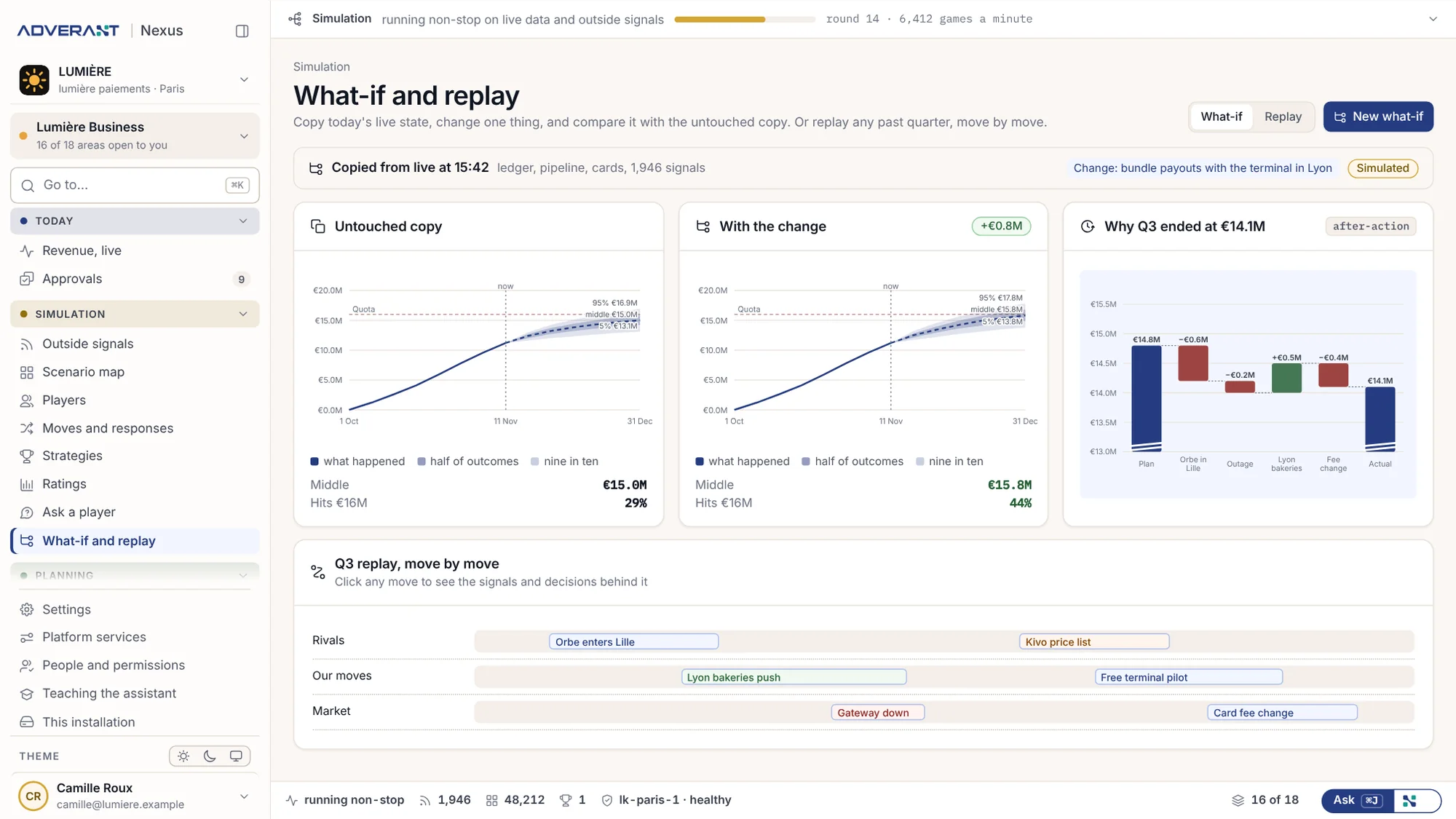
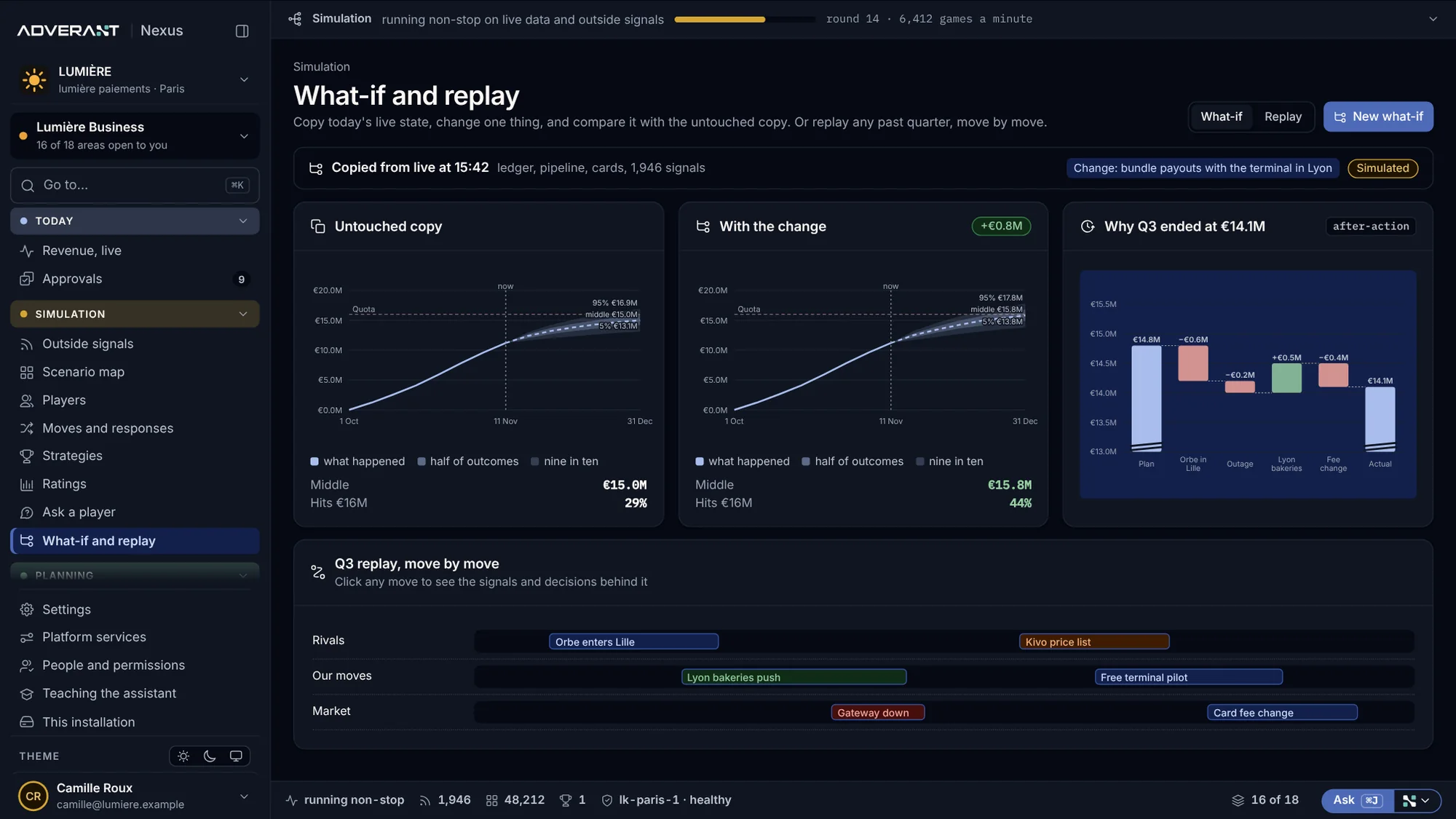
What-if and replay
Copy the live business, change one thing and compare it with the untouched copy. Or replay any quarter, move by move, to see what drove the result.
- A copy of live, not a guess
- Any quarter, replayed
Proven game theory, in plain words on screen.
Each method answers a different question. People see the answer in plain words; the method's name sits beside it as a small label for anyone who wants to check.
Every situation, mapped
The engine keeps the best answer for every kind of situation, not just one forecast, and searches the gaps nobody has a plan for.
Strategies that keep up
Our strategies and rivals' answers evolve together. A strategy only counts if it beats most of what rivals have learned.
Rated like chess players
Playbooks and campaigns gain or lose rating with every simulated game and every real result.
Ideas, compared in pairs
Ideas are compared two at a time across thousands of situations, and the strongest rise to the shortlist.
If we move first
We commit to a price or offer, and the engine plays the rival's likely, imperfect answer.
Where a price war settles
When everyone keeps cutting, it shows where prices end up and whether joining pays.
Who really earned it
Credit for each deal is shared fairly across sellers, partners, campaigns and channels.
Who works with whom
Which partners to team up with, and which sellers, budgets and stock go where.
One engine, like files or notebooks.
The simulation engine is part of Nexus itself. Any part of the platform, and any platform built on Nexus, can start a simulation, feed it, or act on what it finds.
- Revenue operations: forecasts, scenario maps and strategies
- Ideas: tested across every situation, not one case
- Notebooks: run a simulation inside research, sources kept
- Workflows: start when a playbook's ranking flips
- Decision rooms: the crowned playbook as evidence
- Files and maps: signals from documents, scenario heat on the map
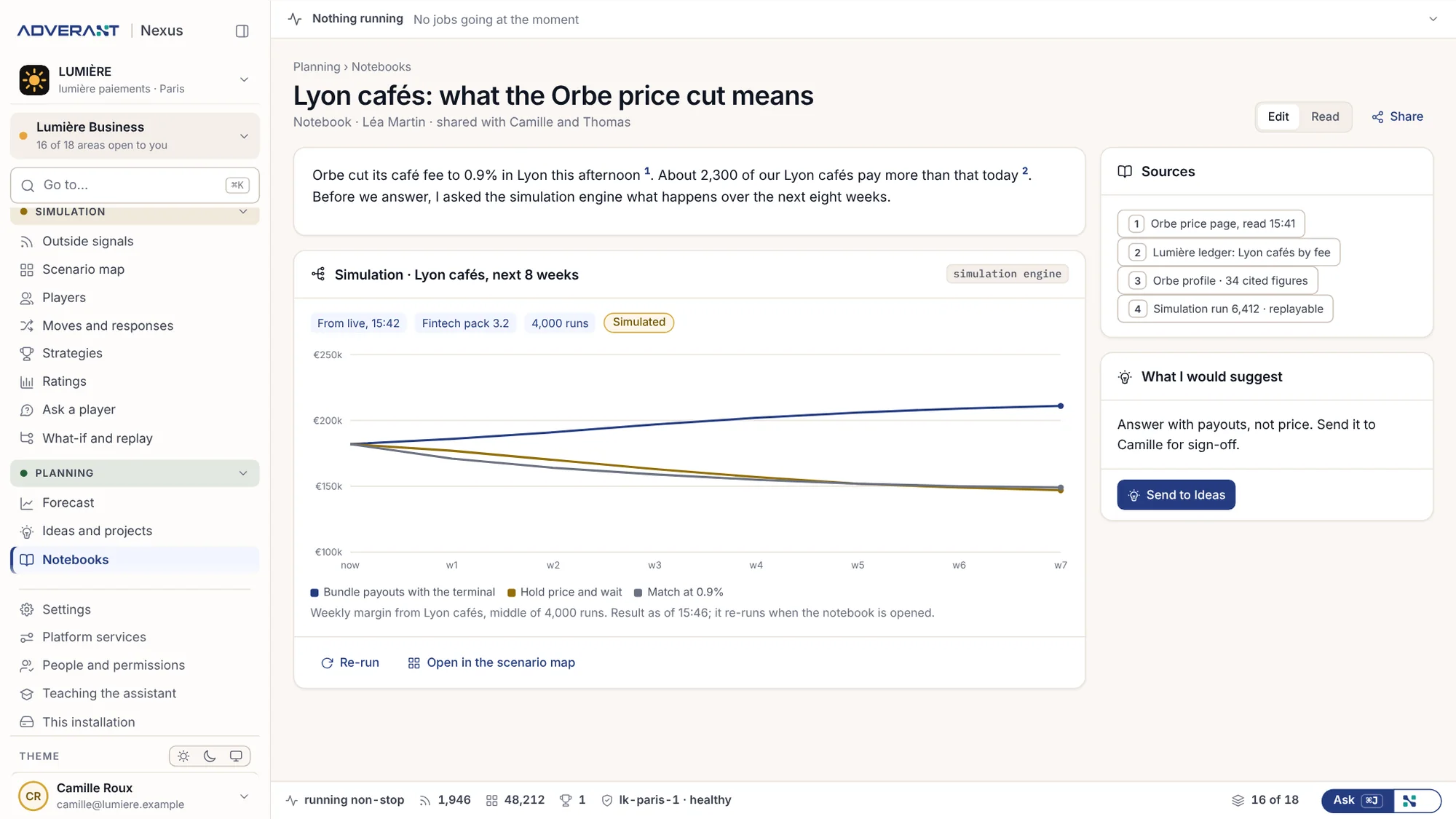
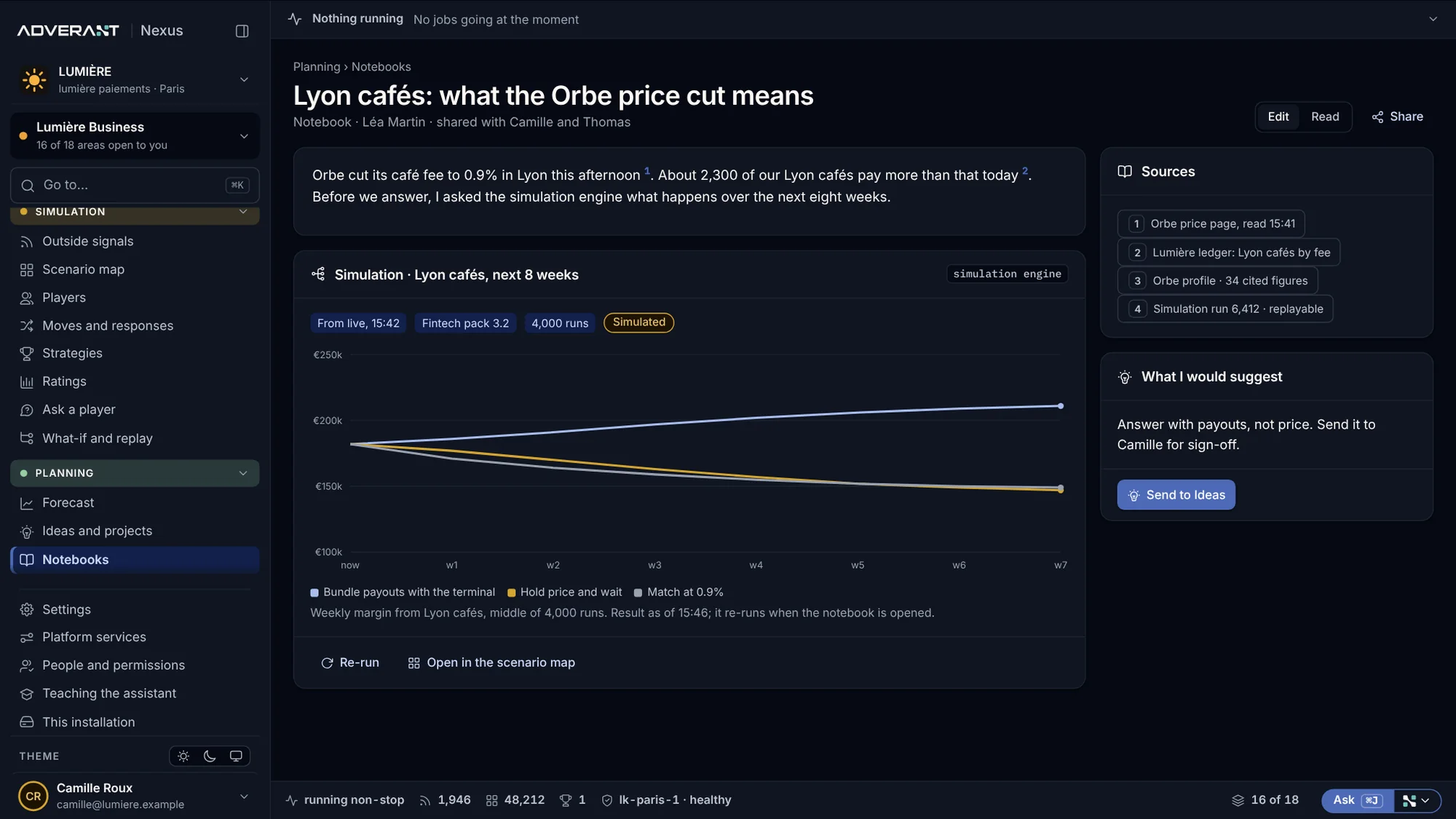
Run it from a notebook, with the sources beside it.
A sales lead asks the engine what a rival's price cut means for the next eight weeks, right inside her notebook. The result keeps its inputs and sources, and re-runs when the notebook is opened.
- Result, inputs and sources together
- Every run can be replayed
- One click to the scenario map
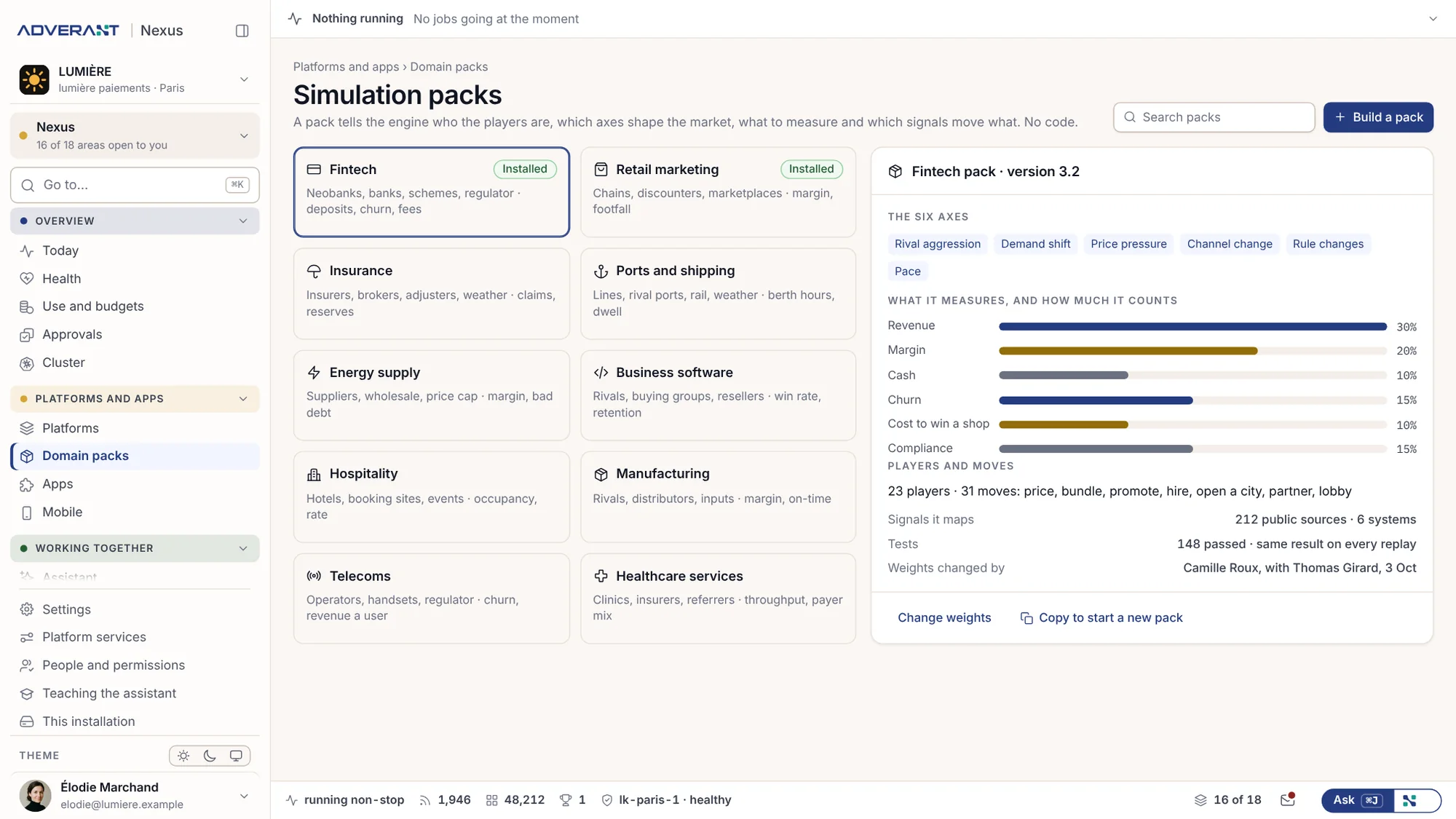
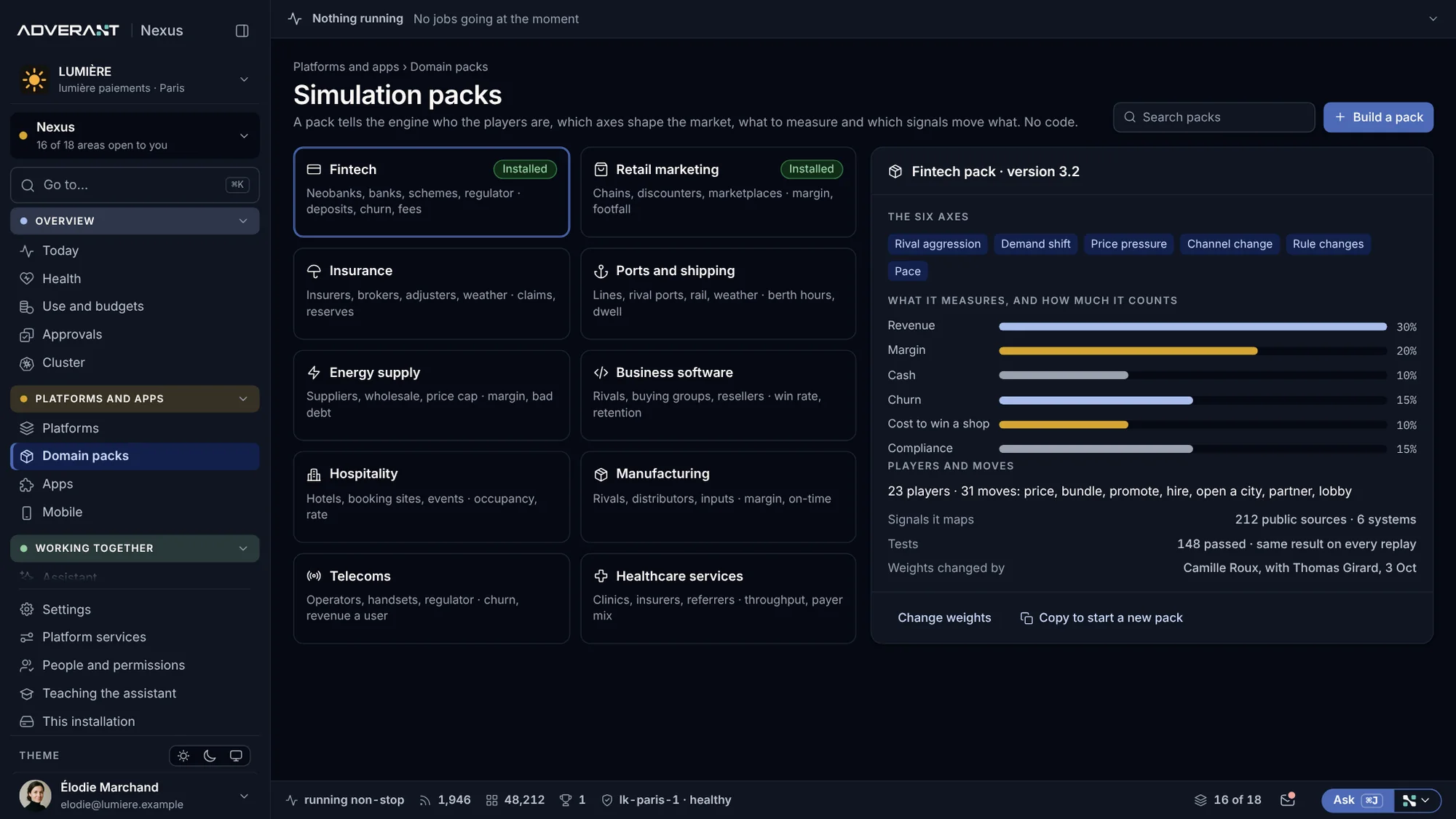
Change the pack, change the game.
A pack tells the engine who the players are, what shapes the market, what to measure and which signals matter. It is settings, not code, and any pack can be copied to start a new one.
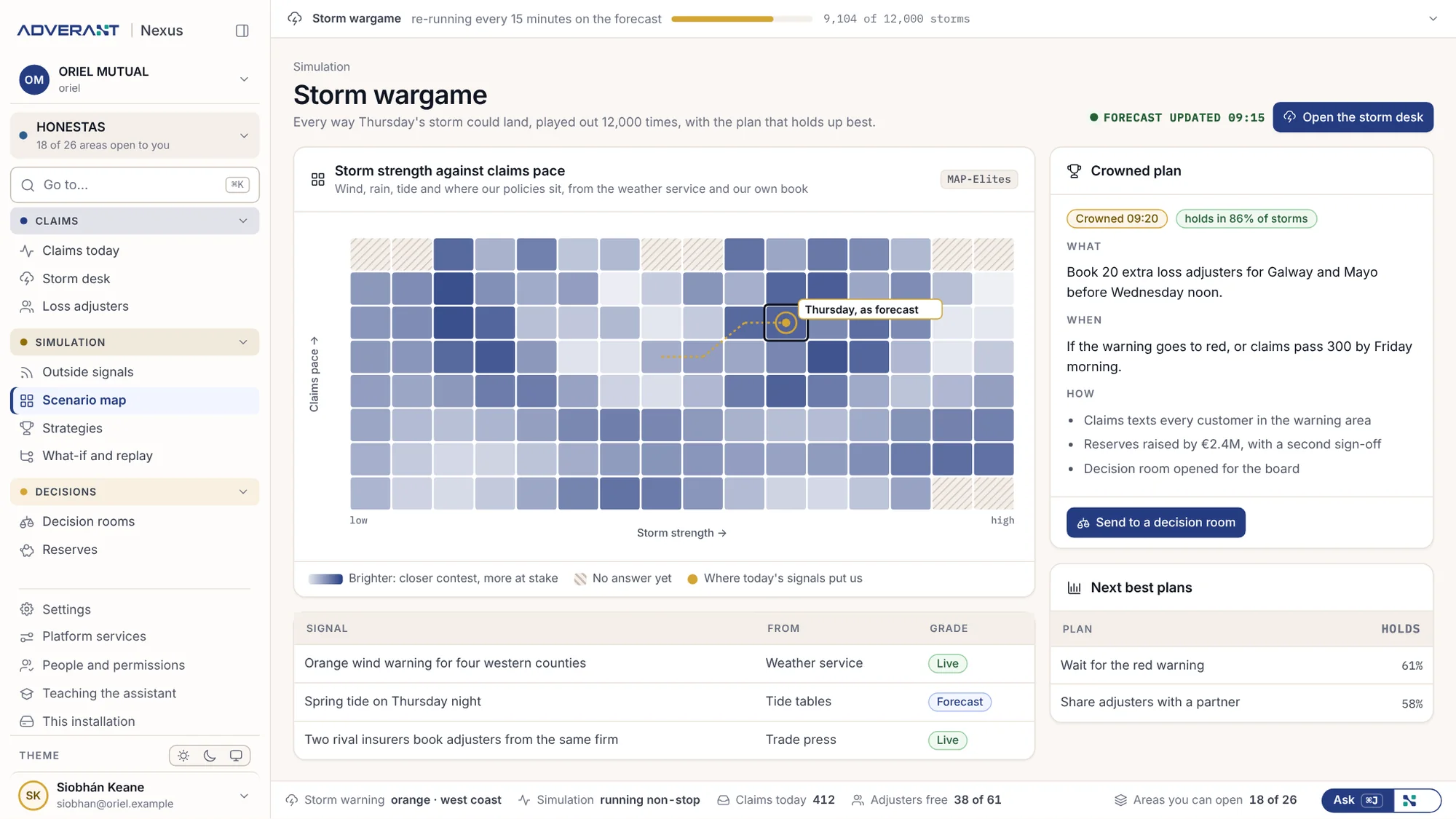
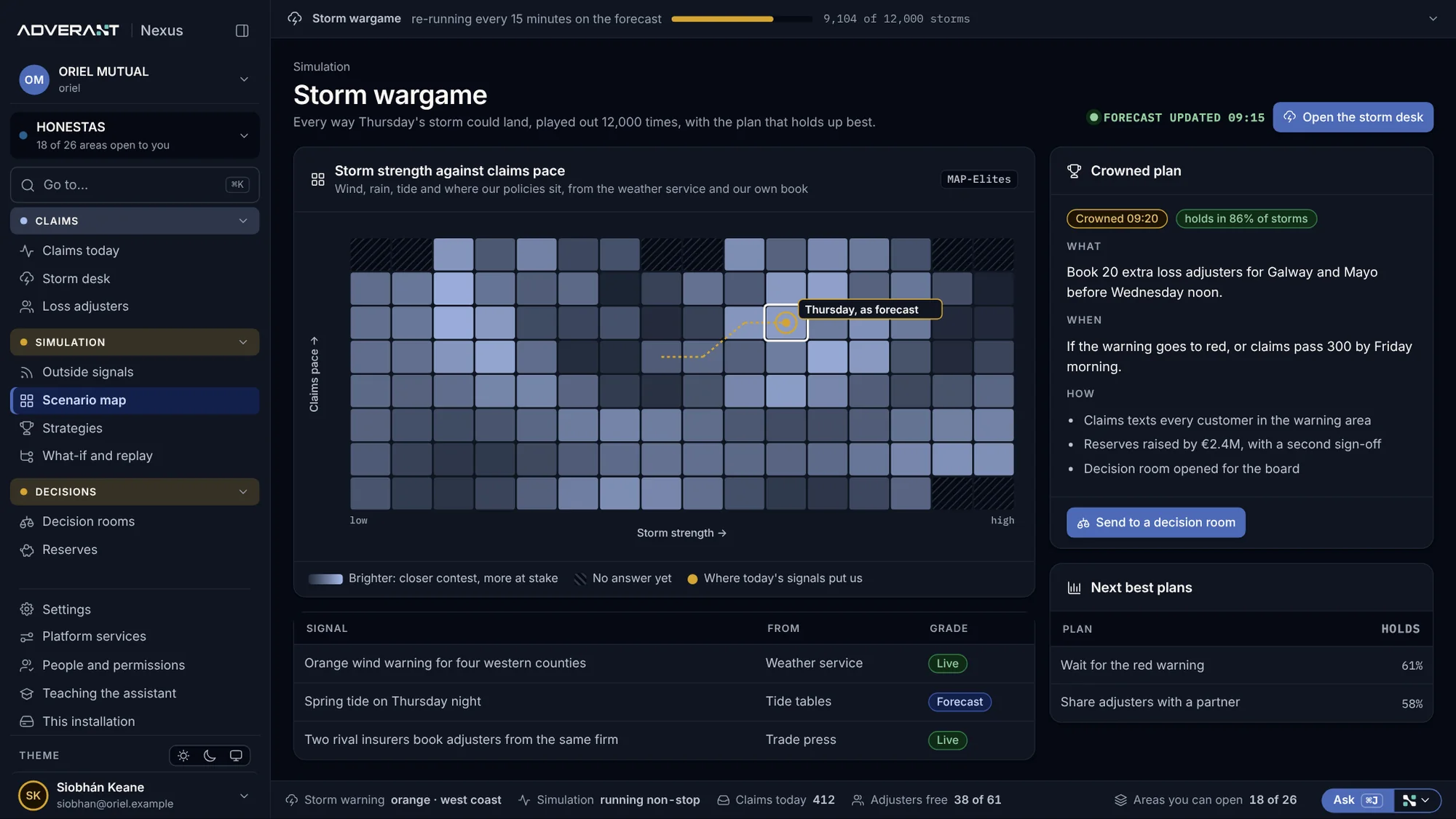
A storm, played out 12,000 times
Weather, tides and where policies sit become the scenario map. The plan that holds up best is ready before the storm lands.
- Loss adjusters booked in time
- Reserves raised with a second sign-off
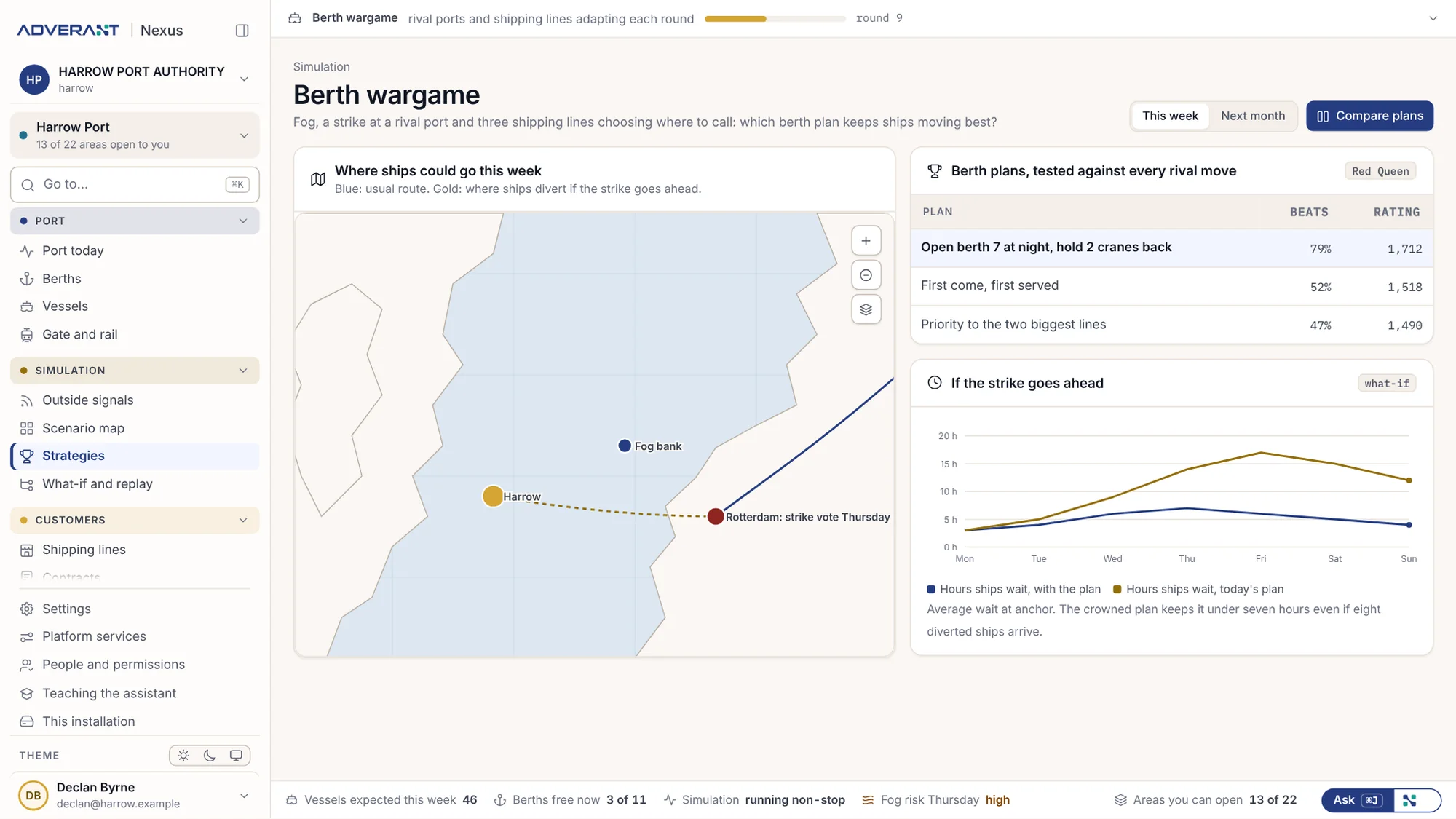
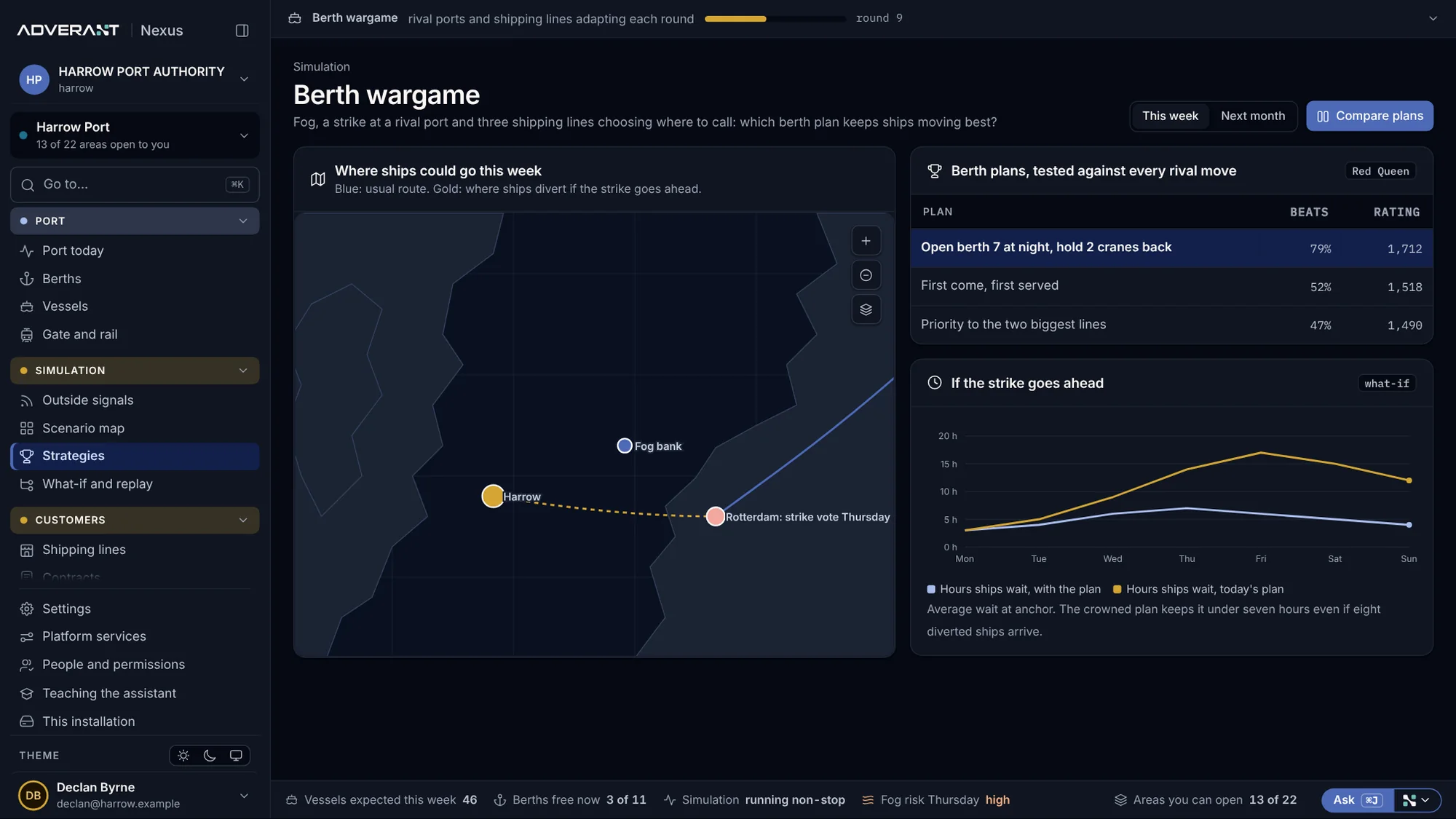
Fog, a strike and three shipping lines
Port notices, unions and the weather feed the engine. Berth plans are tested against every way shipping lines and rival ports could respond.
- Berth plans rated head to head
- Waiting time kept under seven hours
Packs, not code
Fintech, insurance, ports and shipping, energy supply, retail, business software, hospitality, manufacturing, telecoms and healthcare services.
- Players, axes, scorecard and signals
- Versioned and tested
Advice you can check. Action only from people.
Same inputs, same result
Every run can be replayed exactly, so any decision can be explained months later.
Cited, or pending
Every figure about a rival or a customer group has a source. Unknowns are marked, never invented.
No language models inside
Models help draft profiles offline. The simulation itself is plain, testable code.
People decide
Prices, budgets and assignments change only when a named person approves.
About simulation.
Are Lumière, Oriel Mutual and Harrow Port real?
No. They are made-up businesses, shown for demonstration. The screens are real Nexus screens with sample data.
What does it read from outside?
Only public sources and the systems you connect: price pages, job boards, reviews, news, official notices, weather and event calendars. You choose the sources, and each signal keeps its link.
Does it coordinate prices with competitors?
No. It models how rivals are likely to respond, from public evidence. It never contacts them or shares anything with them, and pricing playbooks carry a compliance check.
Can it run all the time?
Yes. Only the parts of the map touched by a new signal are re-scored live, and wider searches run overnight on spare capacity, inside your own cluster.
Do we need to write code?
No. Pick a pack, connect your data and set the weights. A new pack starts as a copy of the nearest one.
Where does it run?
On your own Nexus cluster, like the rest of the platform. Nothing leaves without your say.
Go deeper
Bring one market and one quarter.
We will set up the engine on your cluster with you, and play out your next move before you make it.