

Order it from your cloud. Run every client on it.
Every fintech client wants AI in its product, with proper controls, and nobody wants to wait a year for it. Nexus is in your cloud marketplace and installs the same day.
Nexus installs into your own cluster from the marketplace you already buy from. Add the banking pack, let AI agents map each client’s systems to it, and give every client its own private space, or its own cluster in the country it needs. A person approves every change, and every step is on the record.
Download the two-page fintech brief (PDF) · Watch the five-minute film

From the marketplace to a million customers, in six steps.
Each step builds on the last. Small clients can start on day one, and big ones can move to their own cluster whenever they need to.
Order from your cloud
Nexus is listed in your cloud provider’s marketplace. The licence goes on your normal cloud bill, and the computing power stays with your provider.
Install in your cluster
It installs into your own Kubernetes cluster, on any cloud, and is up the same day.
Add the banking pack
The pack brings customers, accounts, payments, checks and limits, how they connect, and the rules between them, with screens, workflows and agents.
Map each client
Agents read a client’s own systems and match them to the pack. Anything new comes back as a suggestion for a person to accept.
Add clients
Small clients get a private space on your cluster in minutes. Big ones get their own cluster, in the region and cloud they need.
Go live and grow
Going live takes one click. Capacity grows with demand, upgrades go out without downtime, and any cluster can move.
From the marketplace to running, the same day.
Order Nexus in one checkout, in the same marketplace where you buy everything else. It installs into your own cluster, and every part reports its own health. Adverant counts usage for the licence and never sees the content.
Installs into your cluster
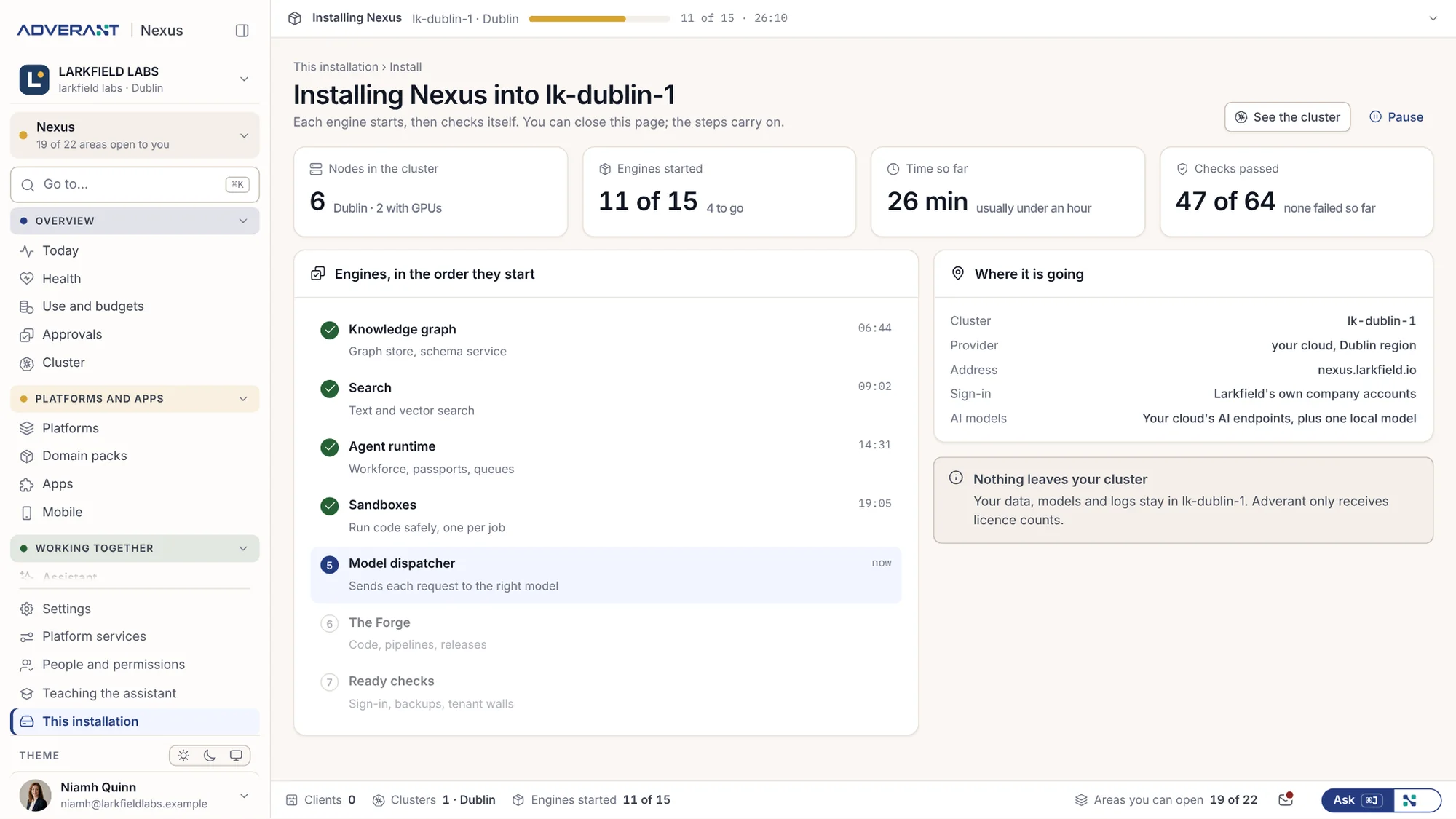
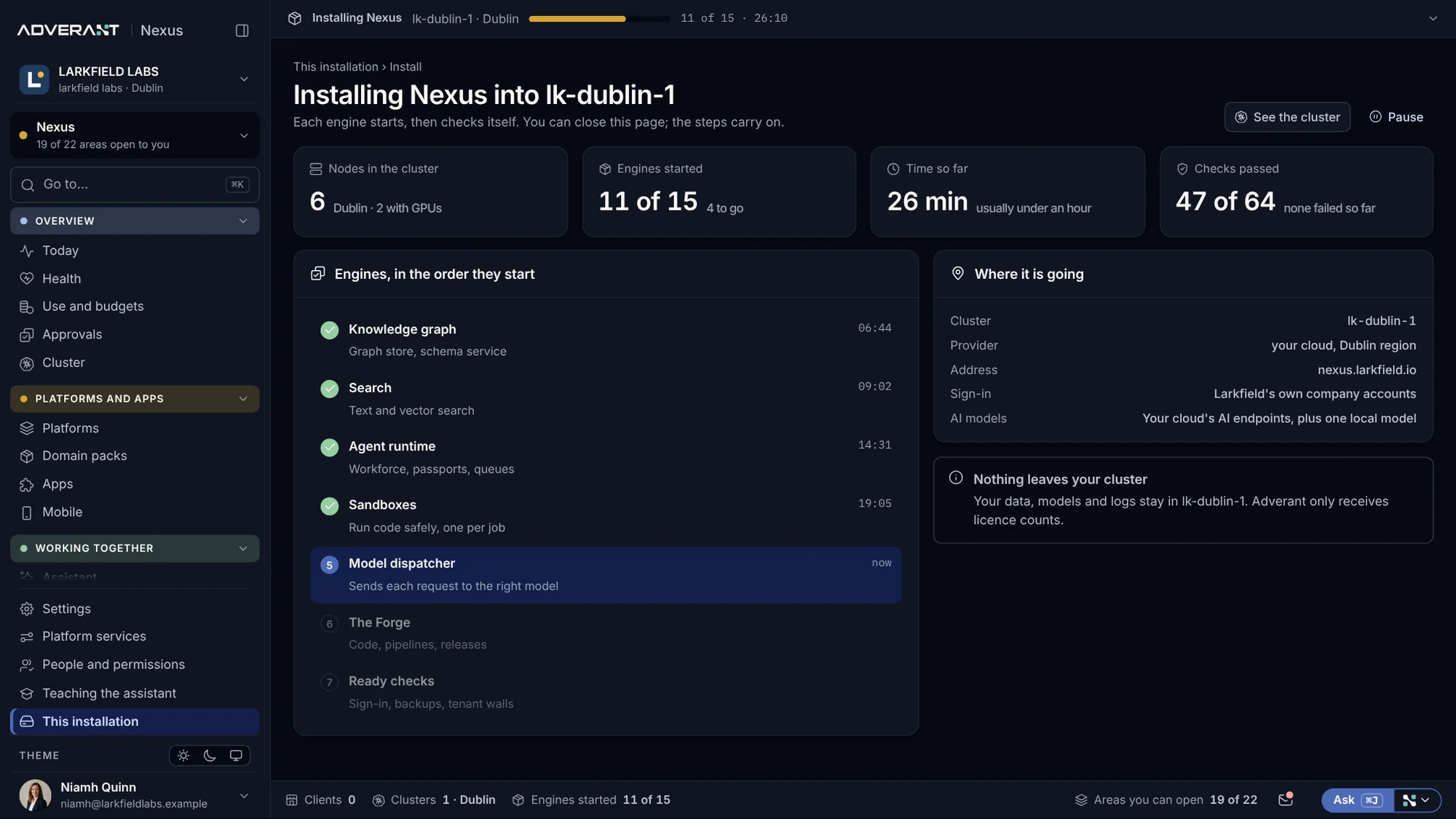
Watch each part of Nexus come up in your own cluster.
- Any cloud with Kubernetes
- Up the same day
- Health for every part
What gets installed
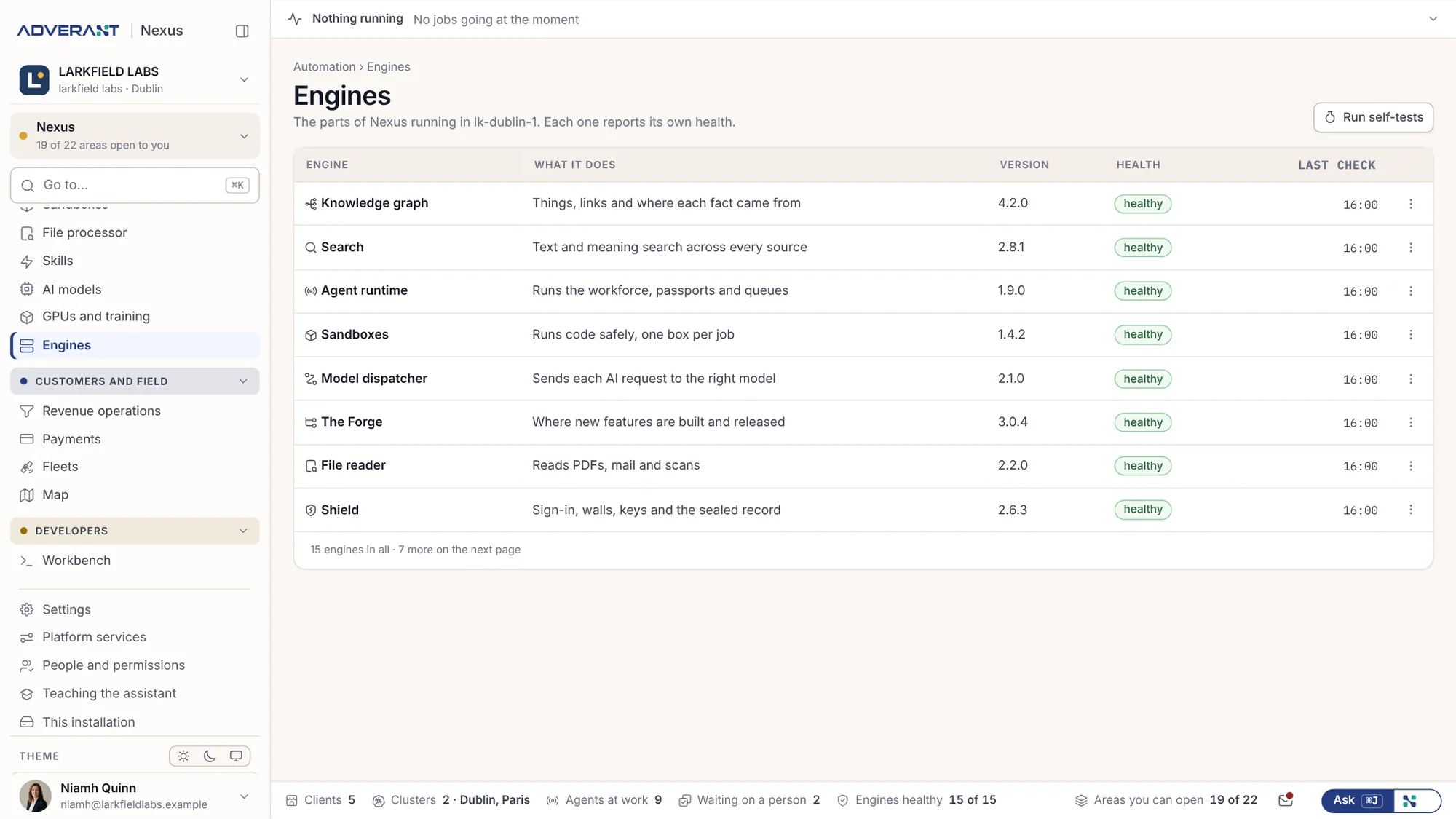
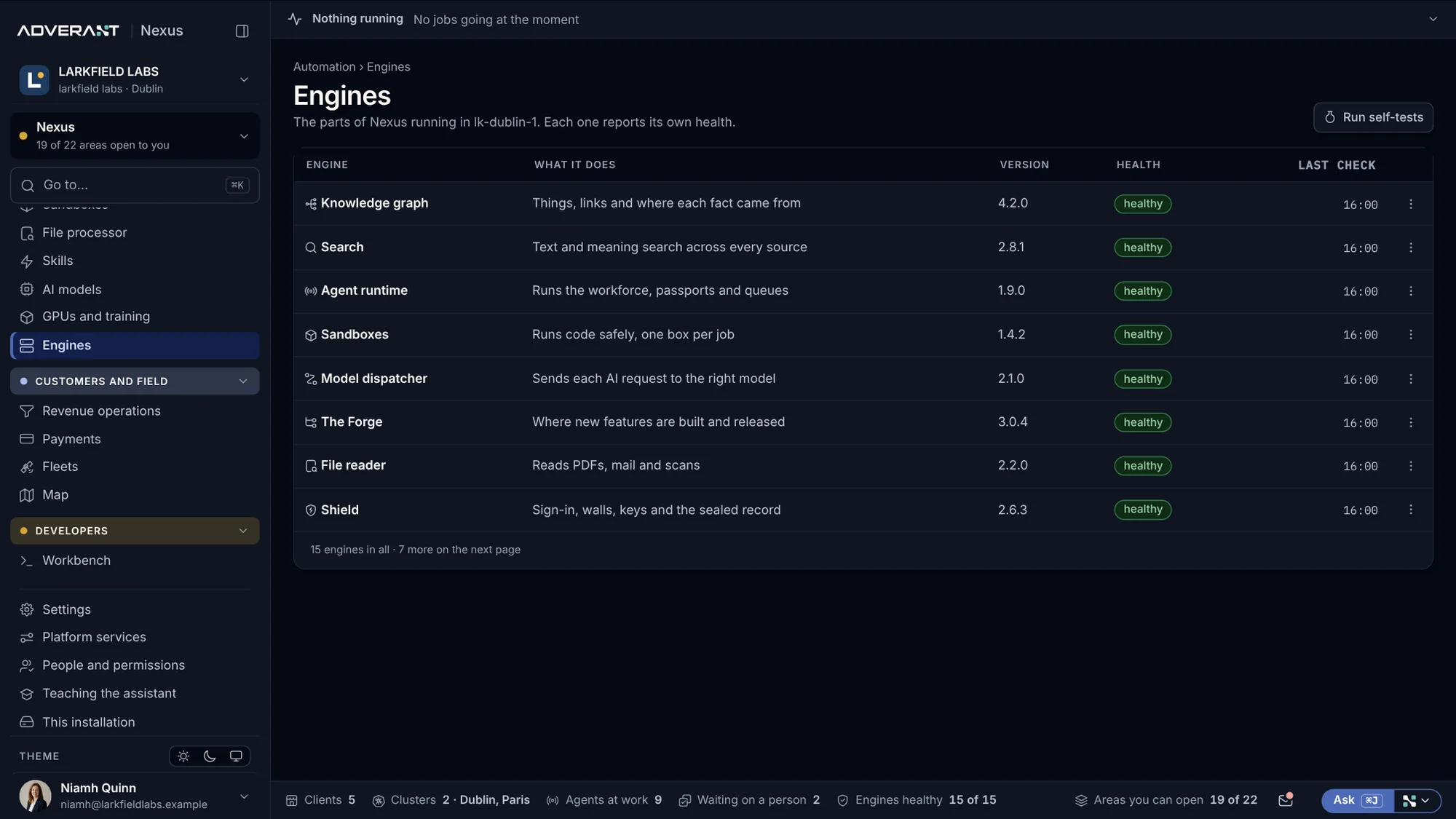
The knowledge graph, search, the agent runtime, sandboxes, the dispatcher that sends each AI request to the right model, and the Forge.
- Every engine included
- Each one checked
- Nothing to wire up
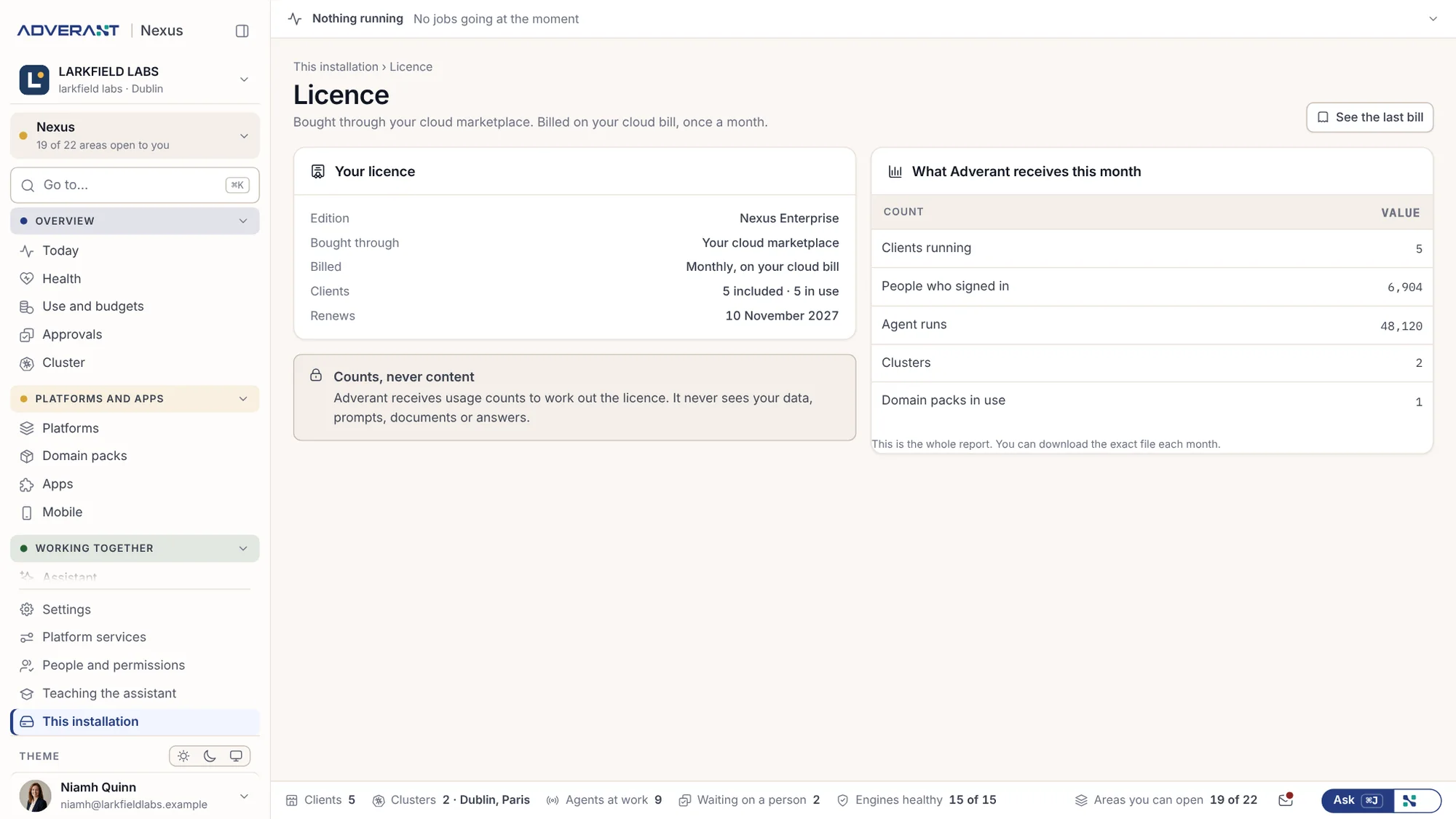
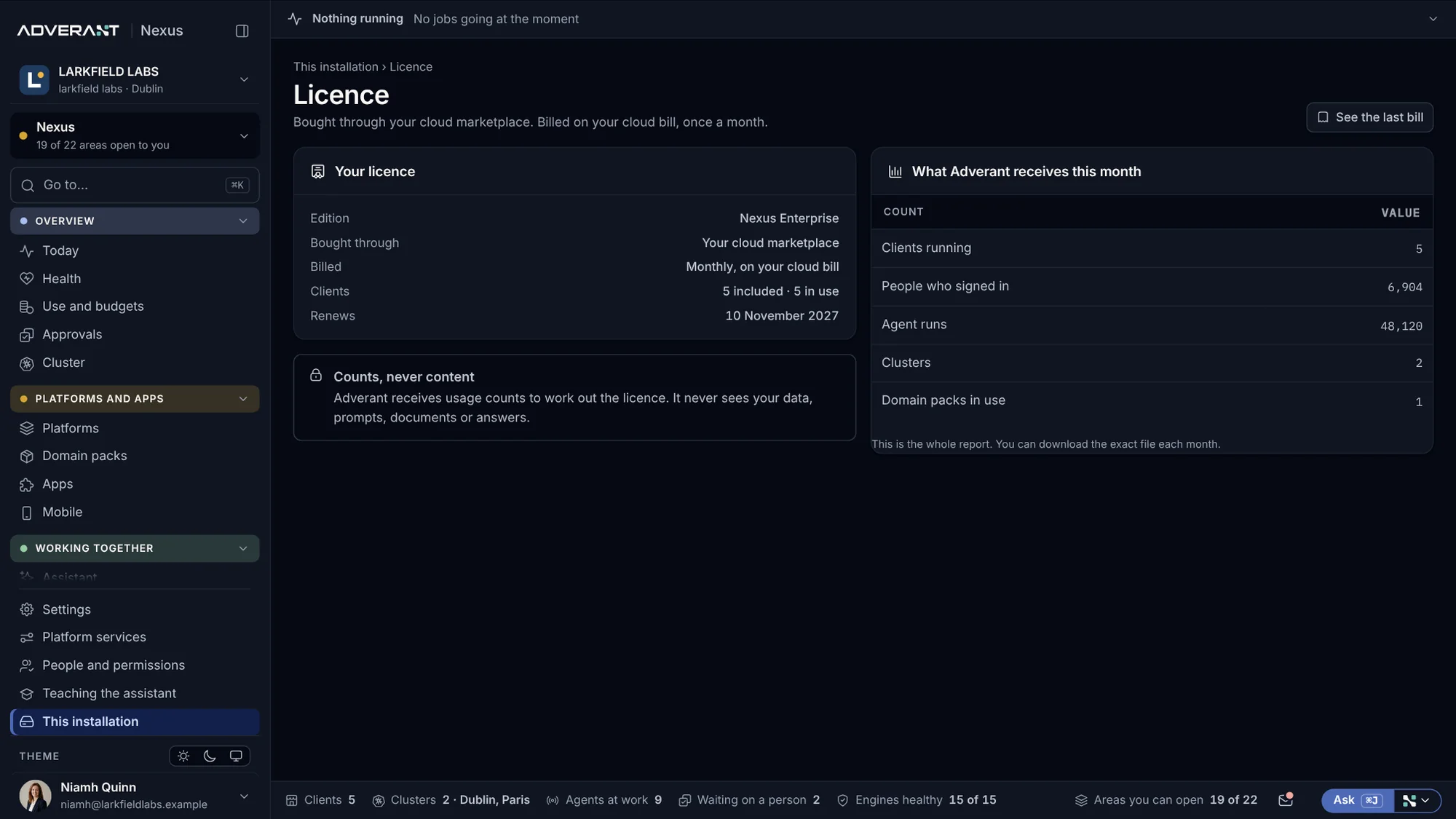
Licence and billing
- On your cloud bill
- Usage counted, content never read
- Community and Enterprise plans
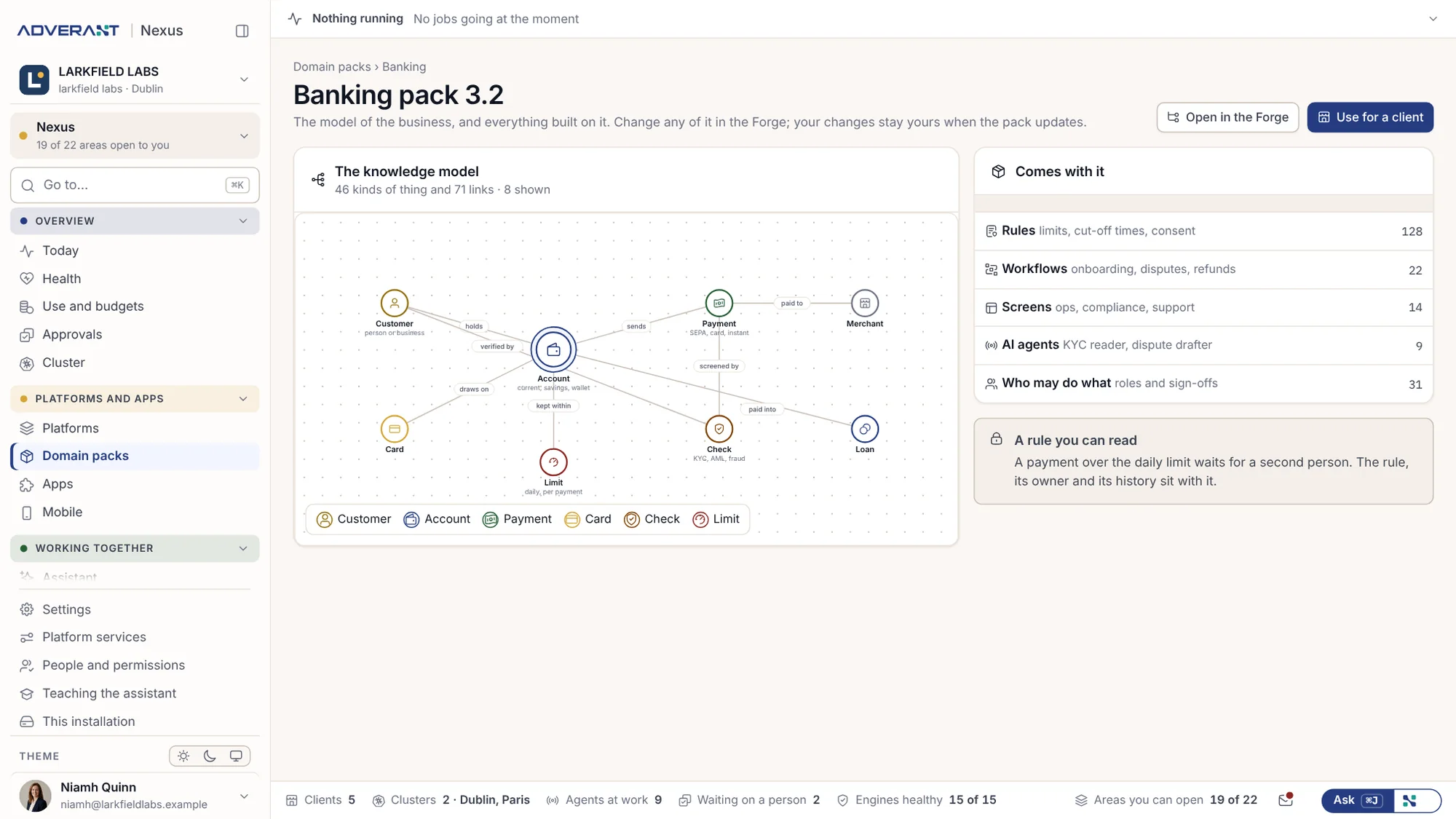
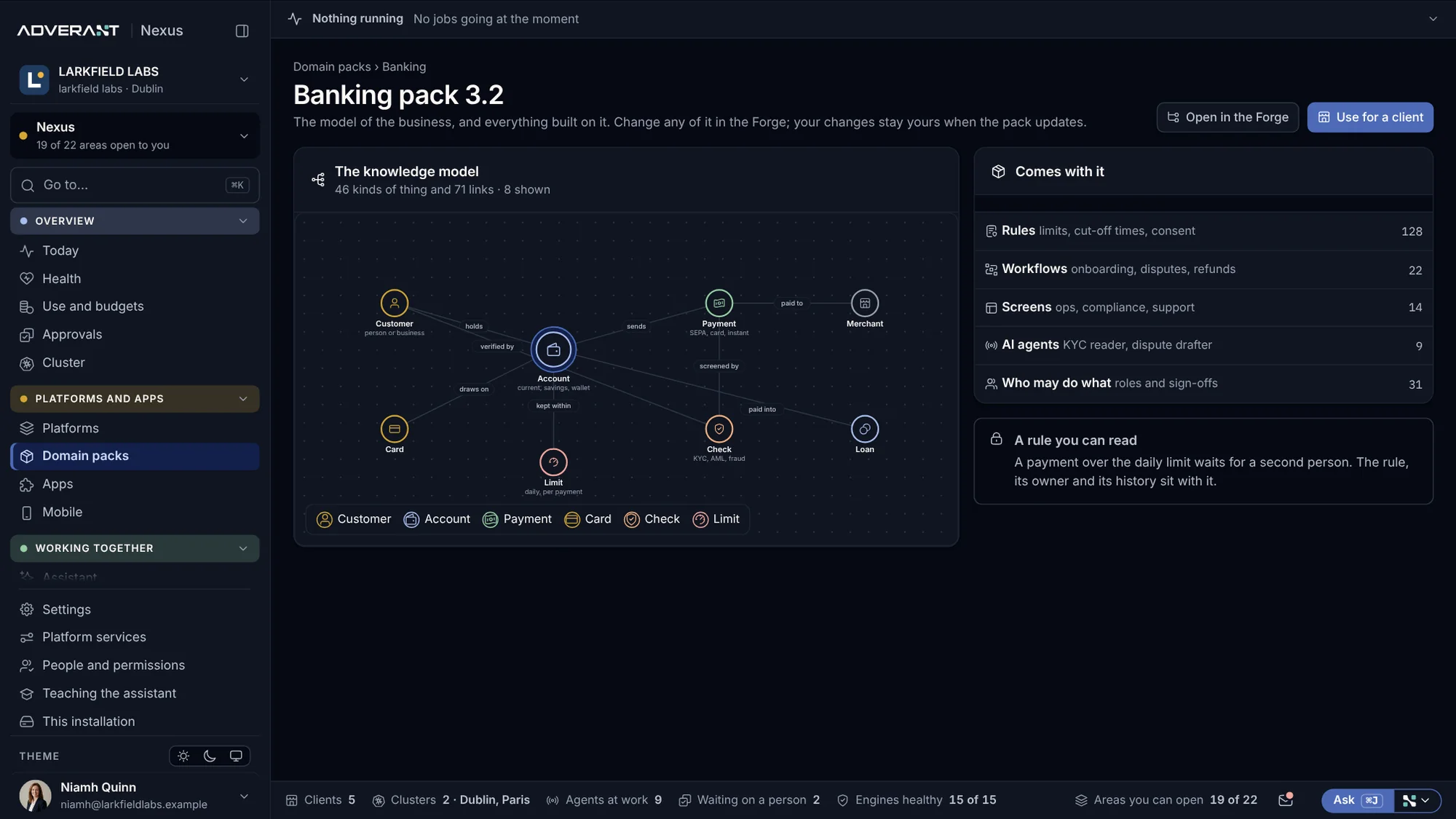
A model of the business, ready on day one.
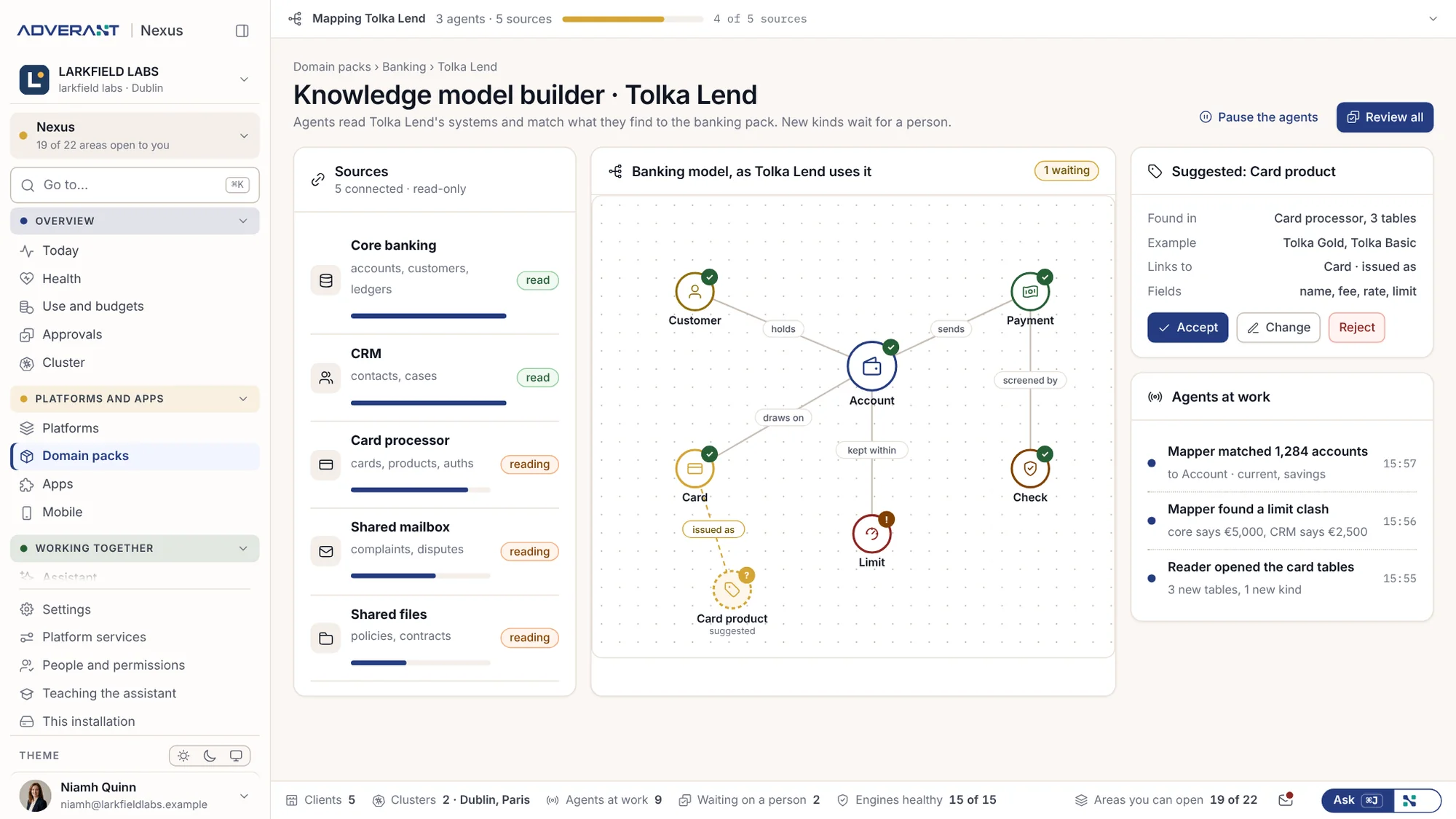
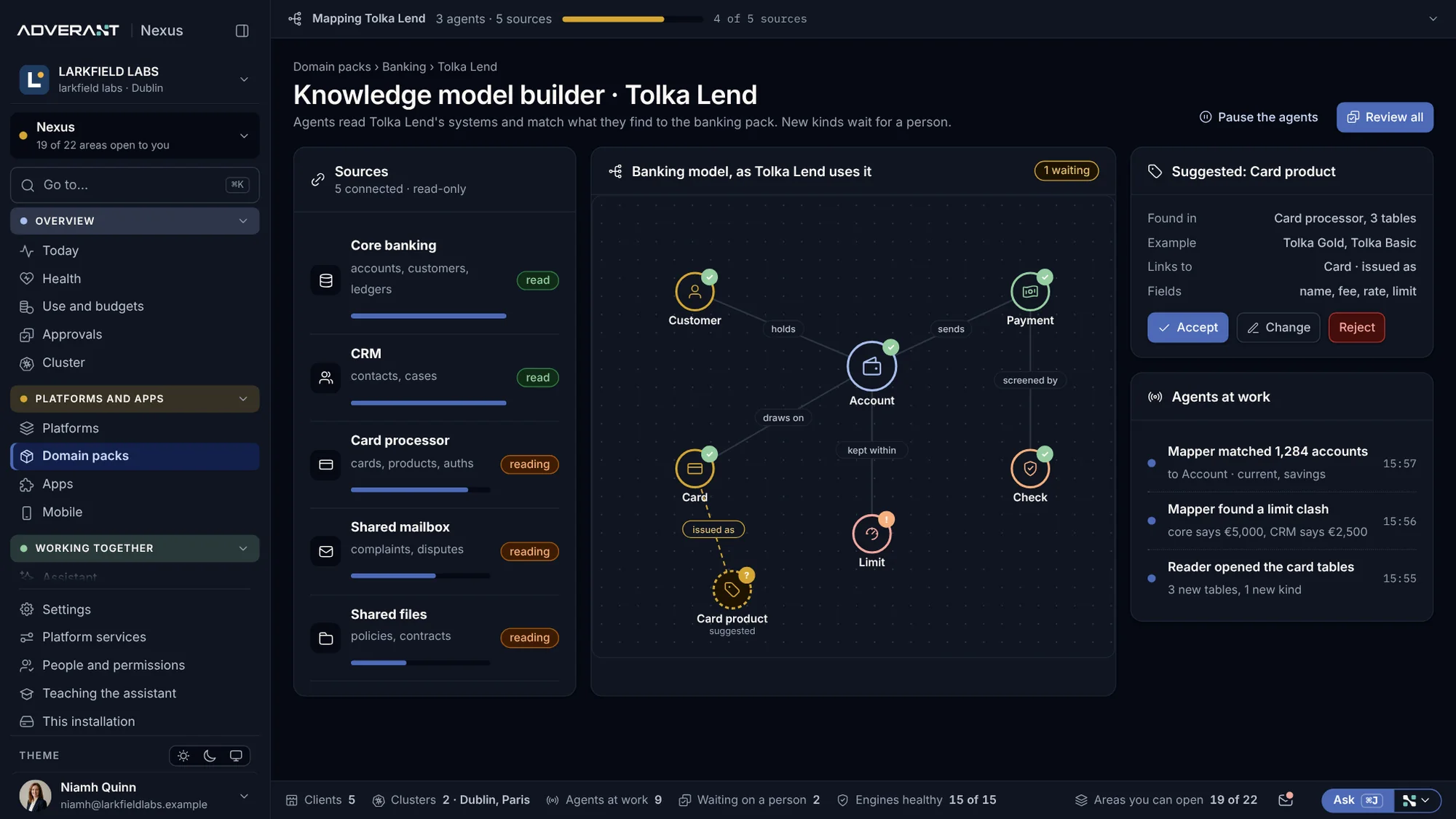
The banking pack holds what a fintech is made of: customers, accounts, payments, cards, checks and limits, and the rules between them. Agents then map each client’s own systems to it, show how sure they are about each match, and queue anything new for a person.
What the pack brings
The model, rules, workflows, screens, agents and policies, in one package.
- Entities and how they link
- Rules and workflows
- Screens for every role
Agents map each client
Agents read the core banking system, the CRM, the card processor, email and shared files.
- Matches shown with confidence
- New kinds suggested
- A person accepts or rejects
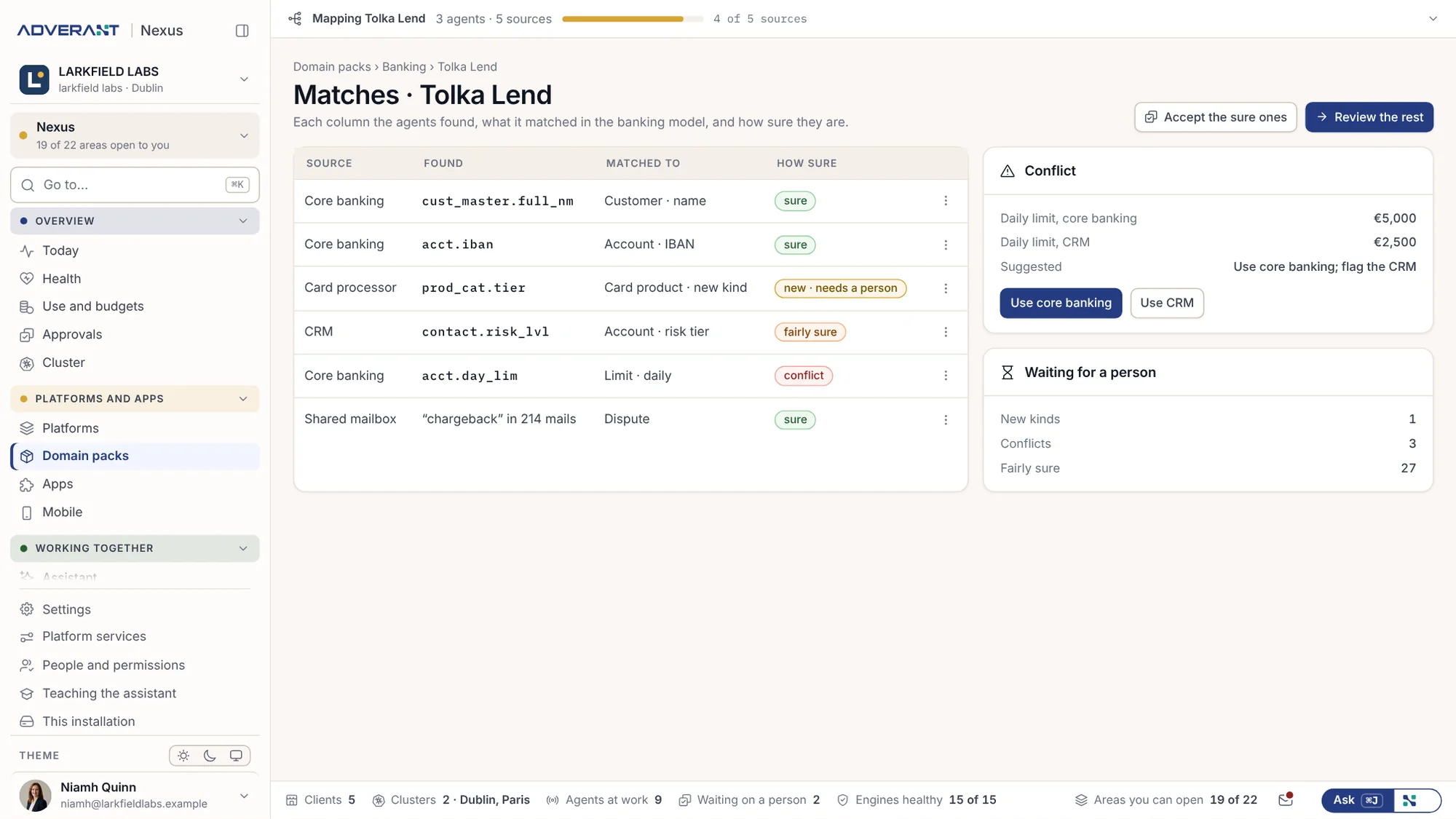
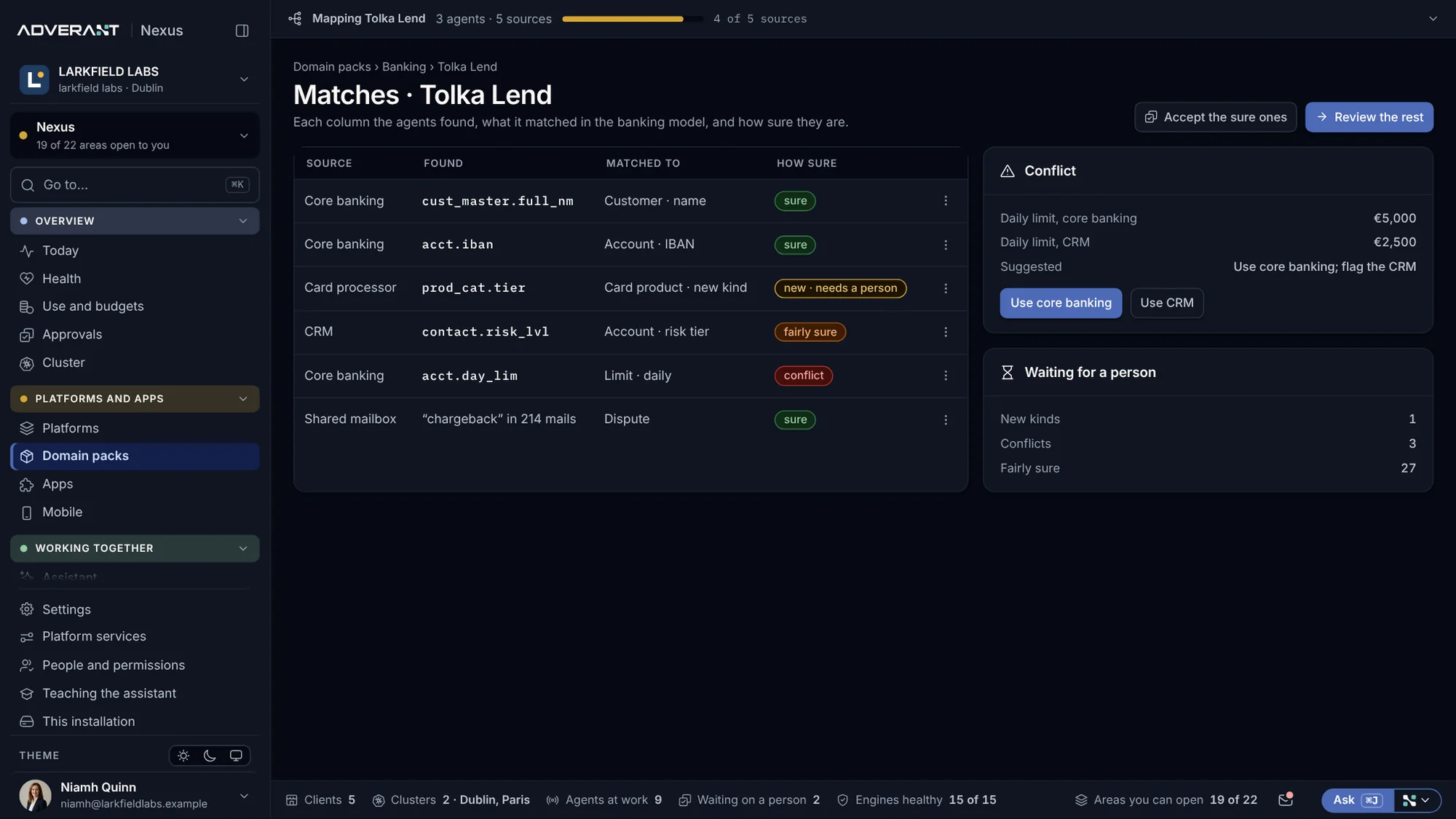
Matches and conflicts
- Confidence on every match
- Conflicts flagged
- Nothing changes unapproved
Change anything, tested before it goes live.
A developer adds a field or a rule, or asks an agent to build a new screen. Every change is versioned and tested in the Forge, and a release that fails its tests is stopped. Versions can also be kept in GitHub or GitLab.
- With or without code
- Every version kept
- Failed releases stopped
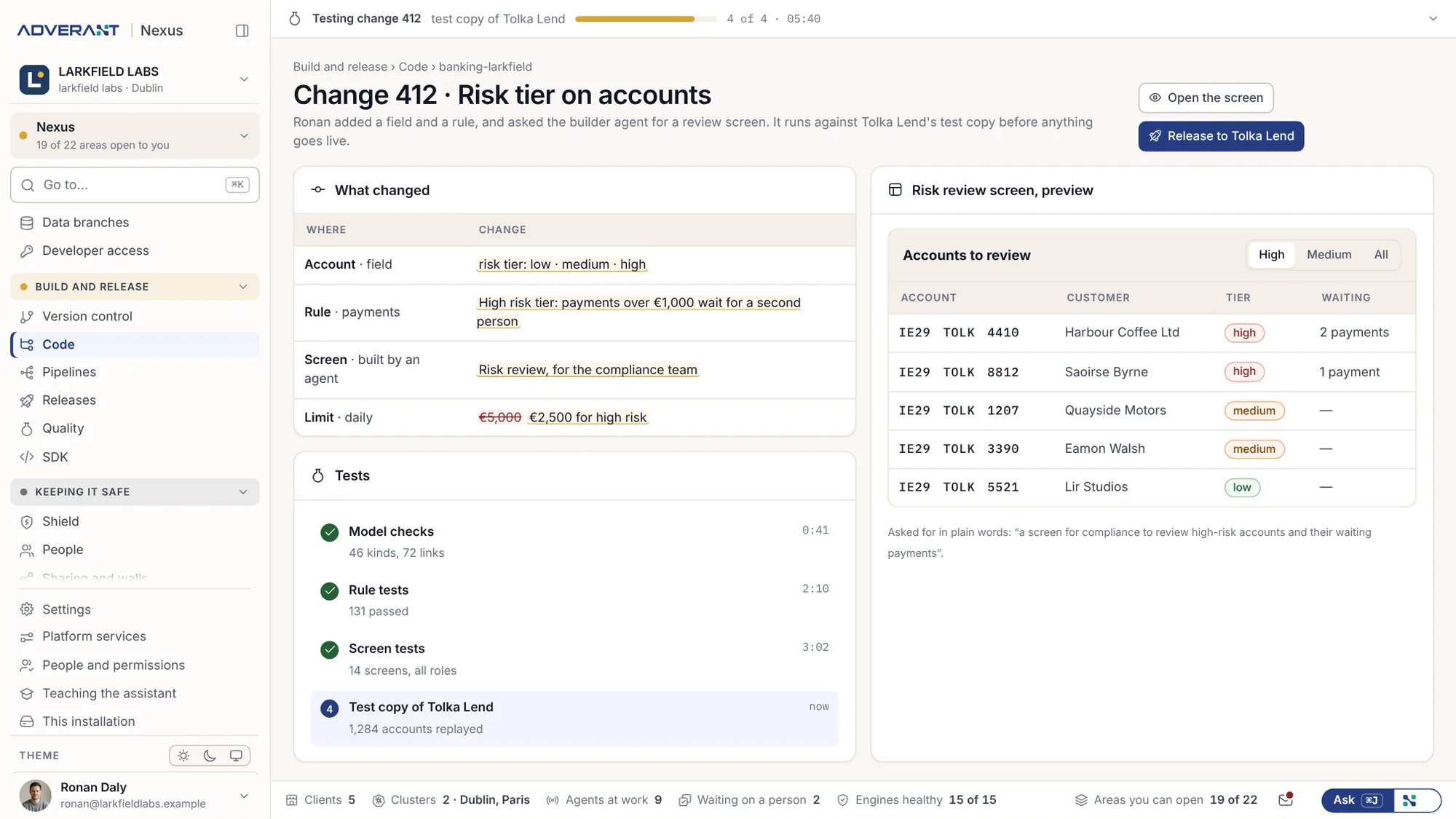
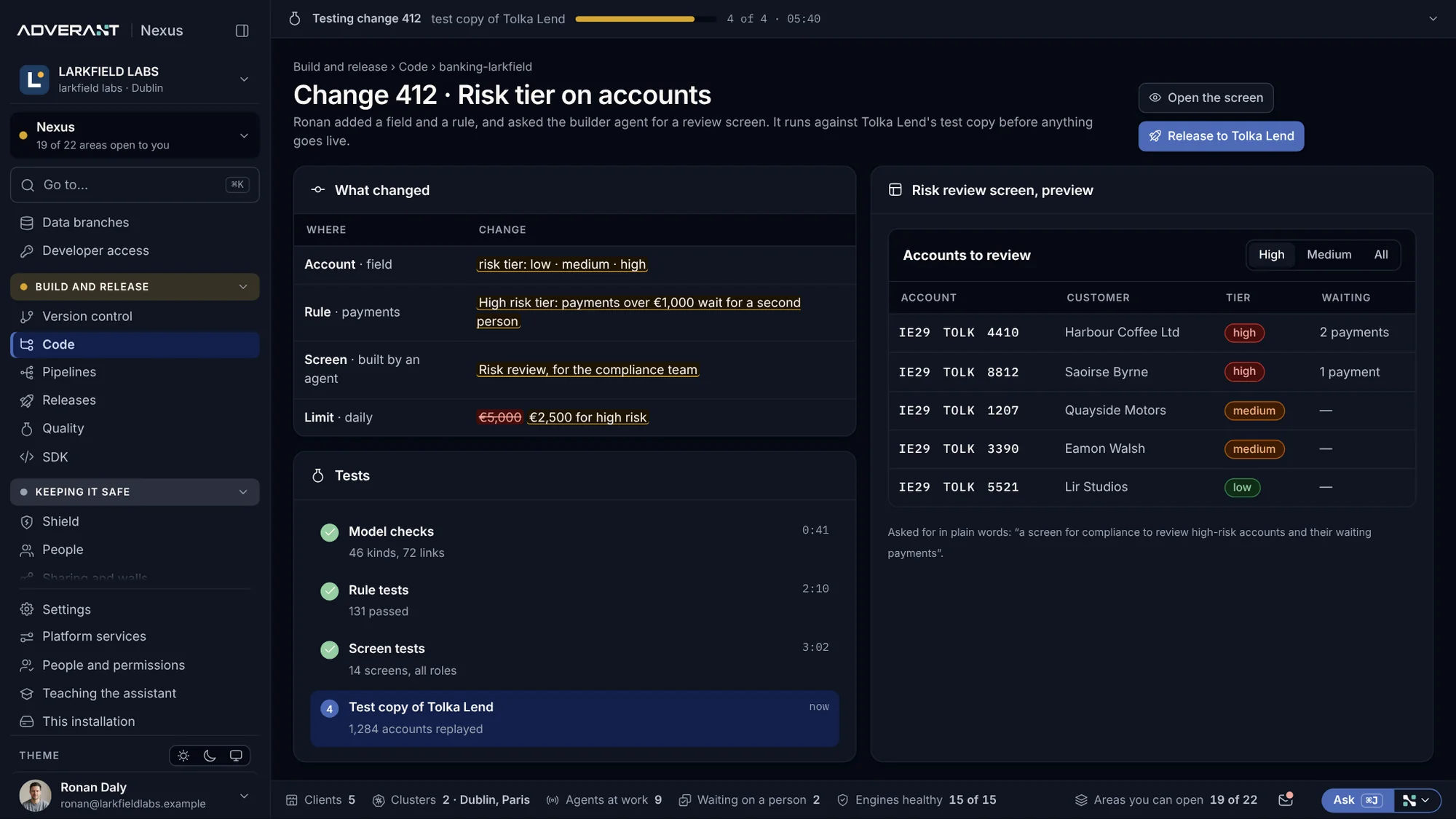
Every client in its own space, or on its own cluster.
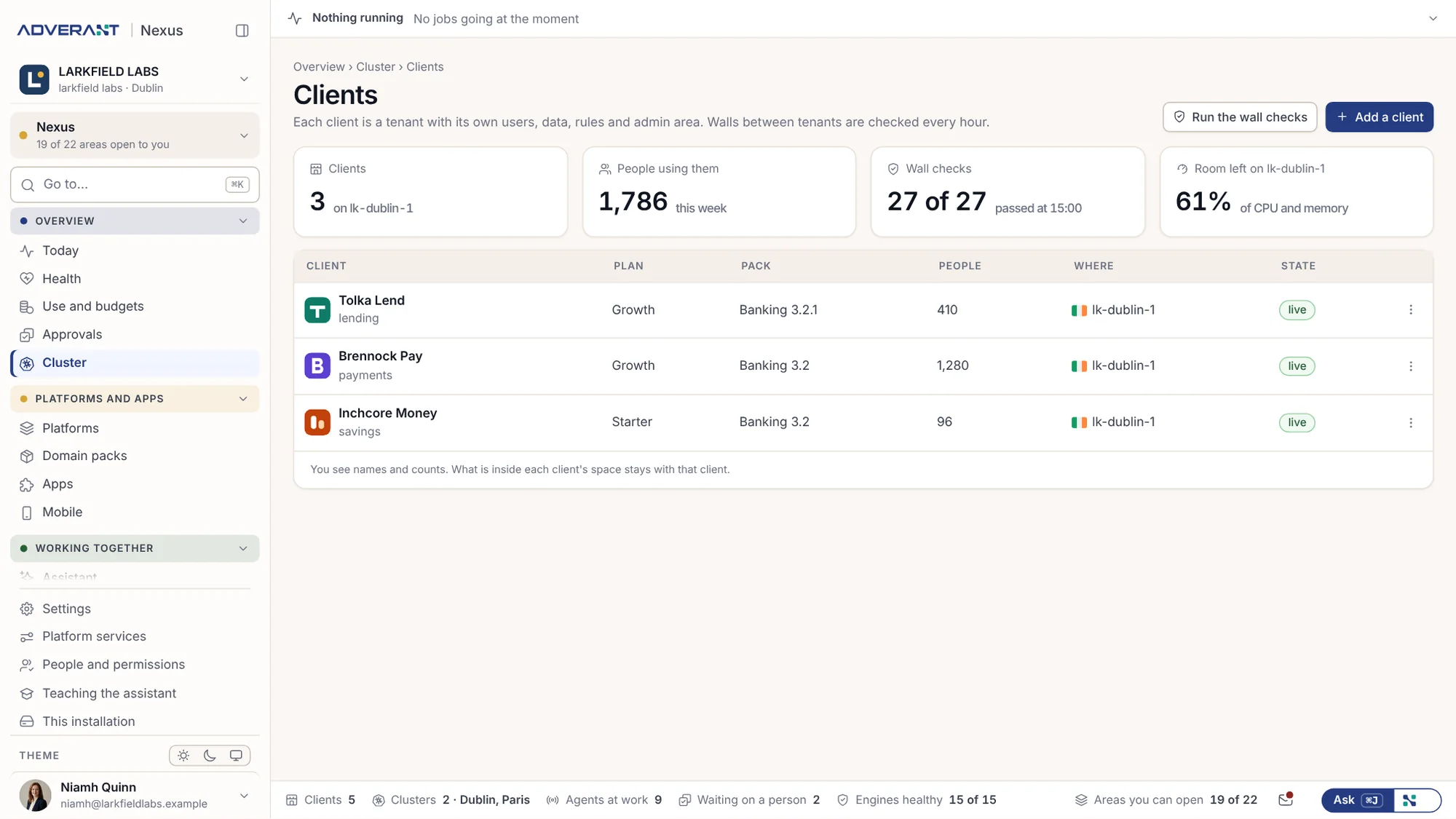
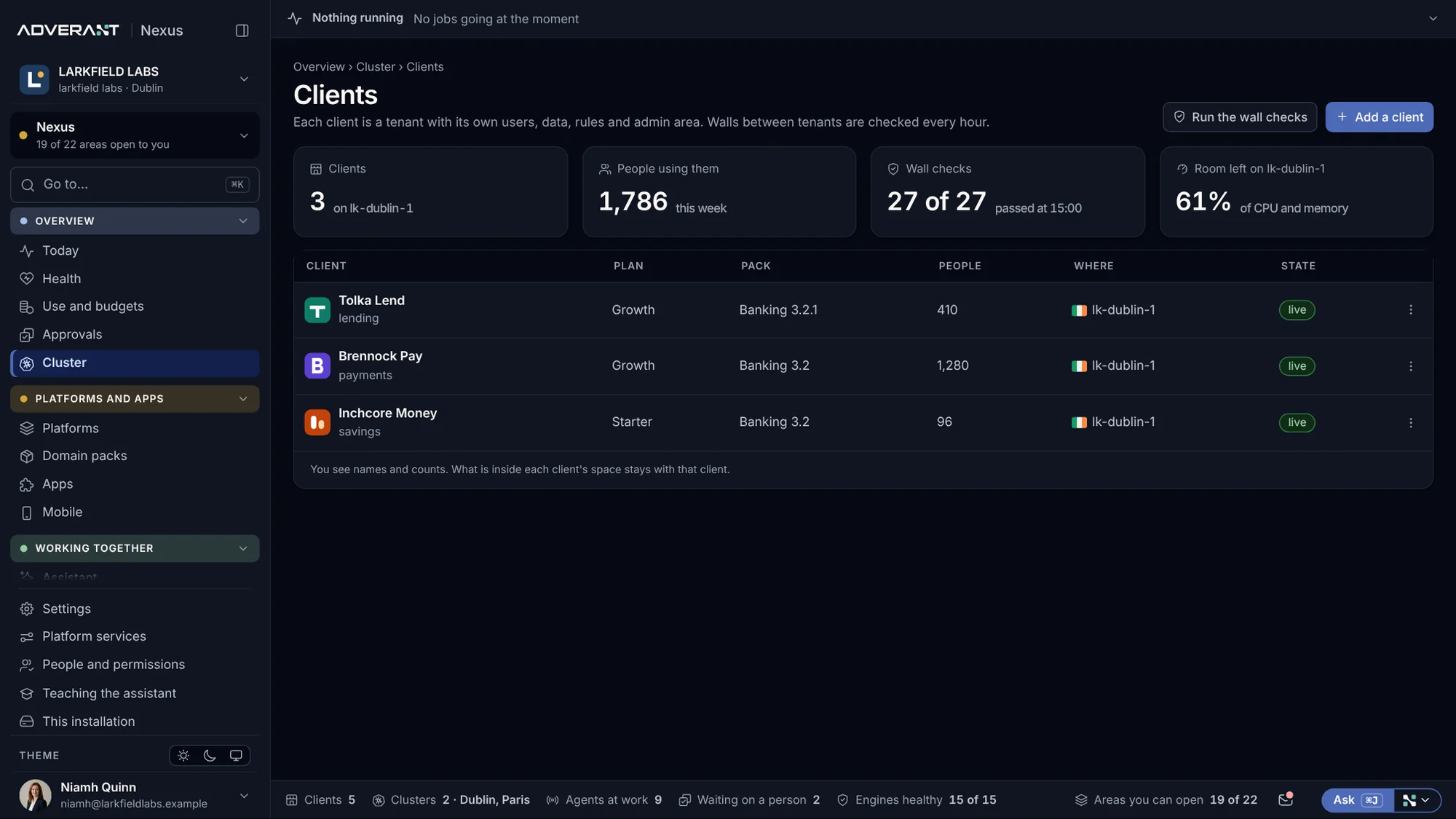
A new client gets its own users, data and rules on your cluster in a few minutes. A bigger client can have its own cluster in another country, with another cloud provider, set up from the same configuration and run from the same place.
Clients as tenants
- Ready in minutes
- Own users, data and rules
- Walls checked hourly
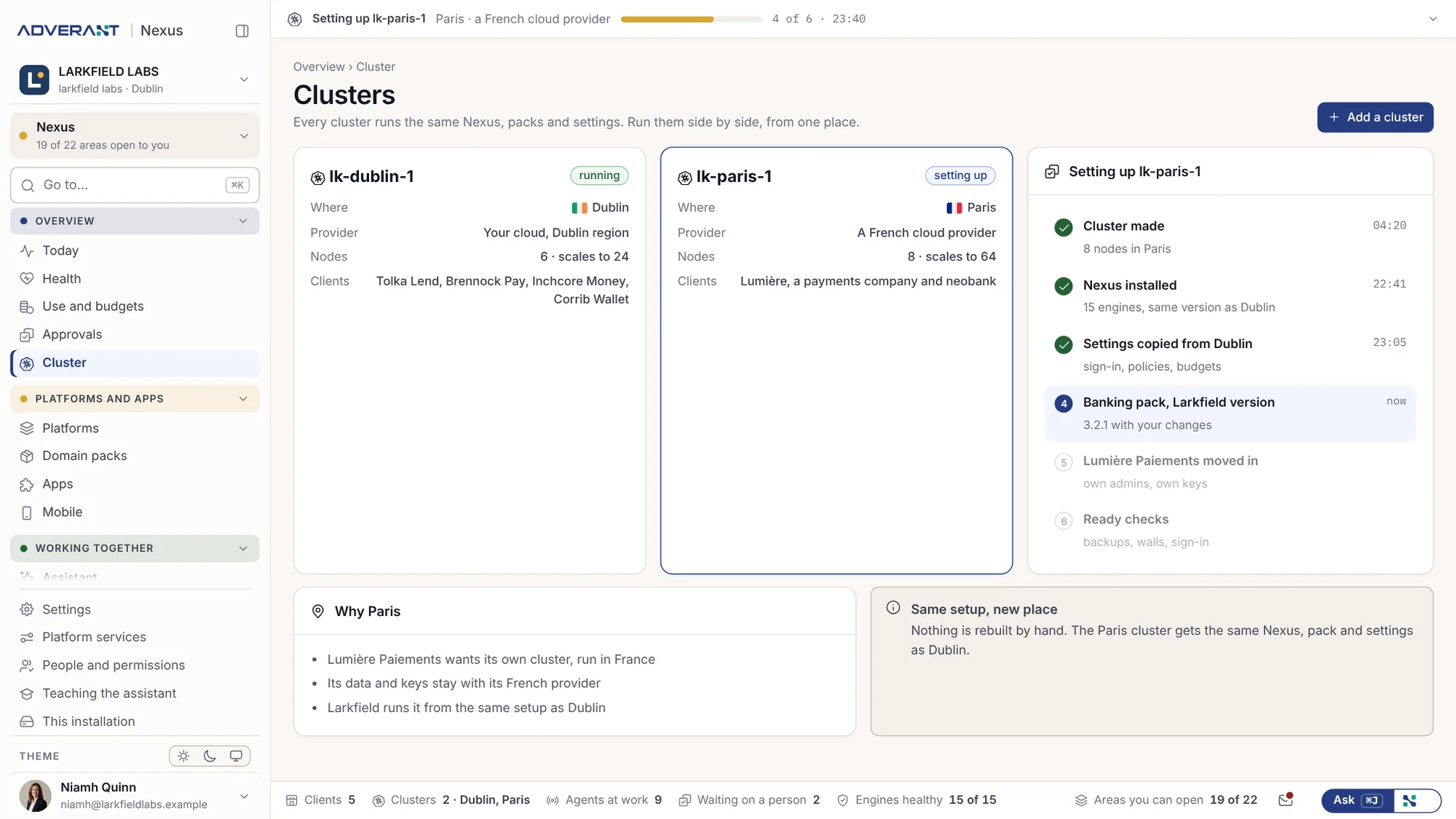
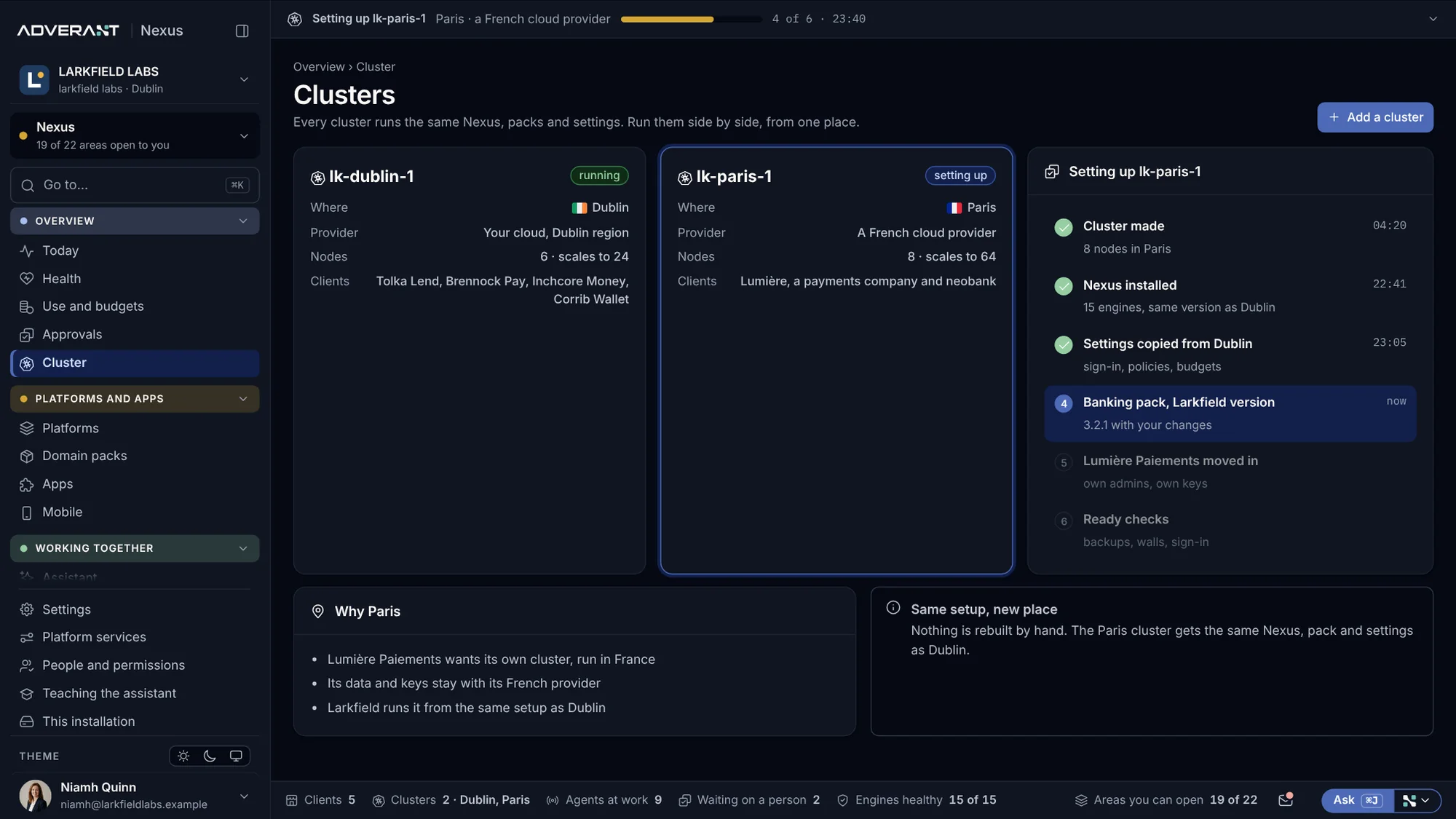
A cluster in Paris
A payments client wants its own cluster in France. It is set up from the same configuration.
- Any region, any cloud
- Same pack and settings
- Run side by side
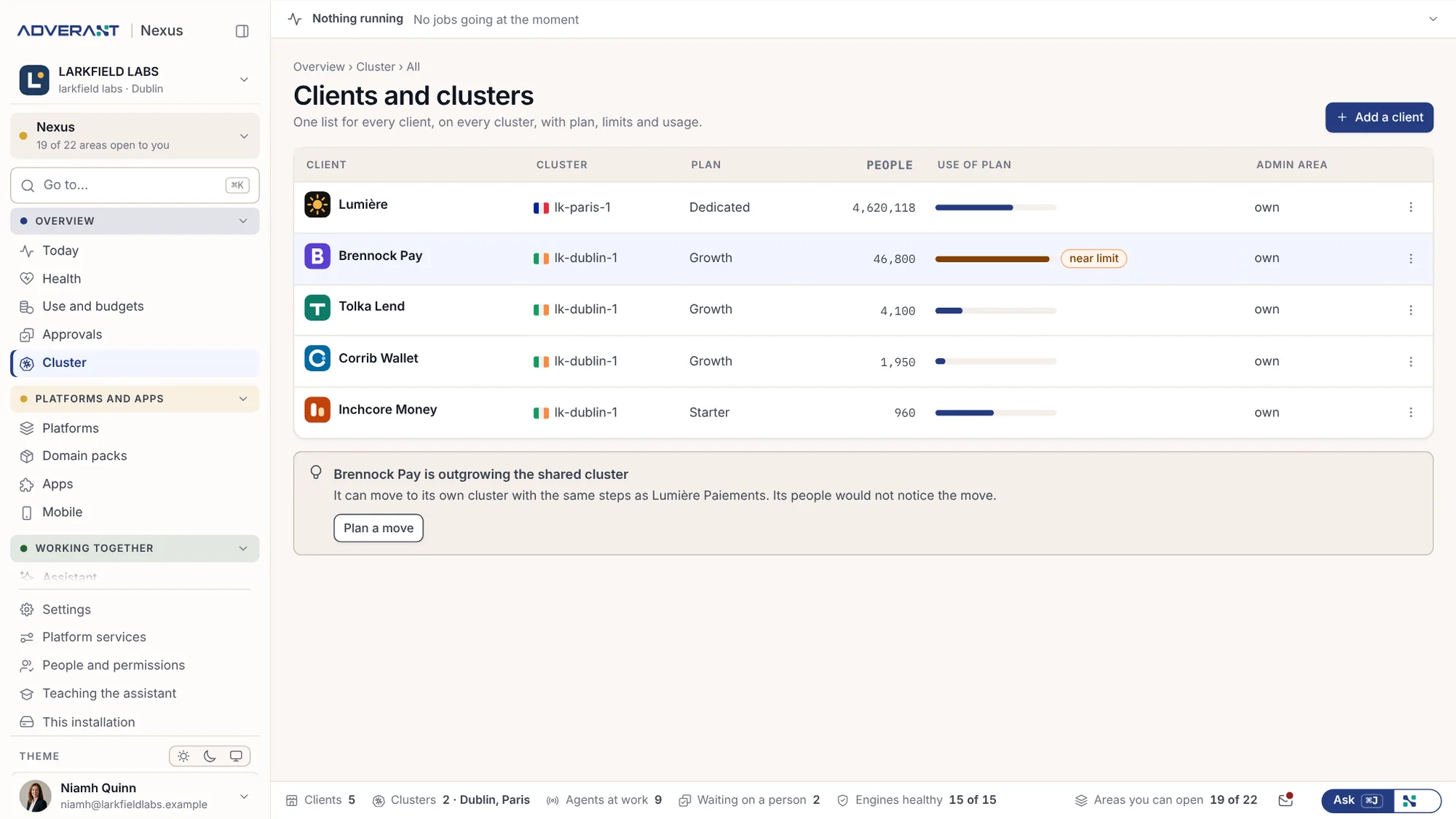
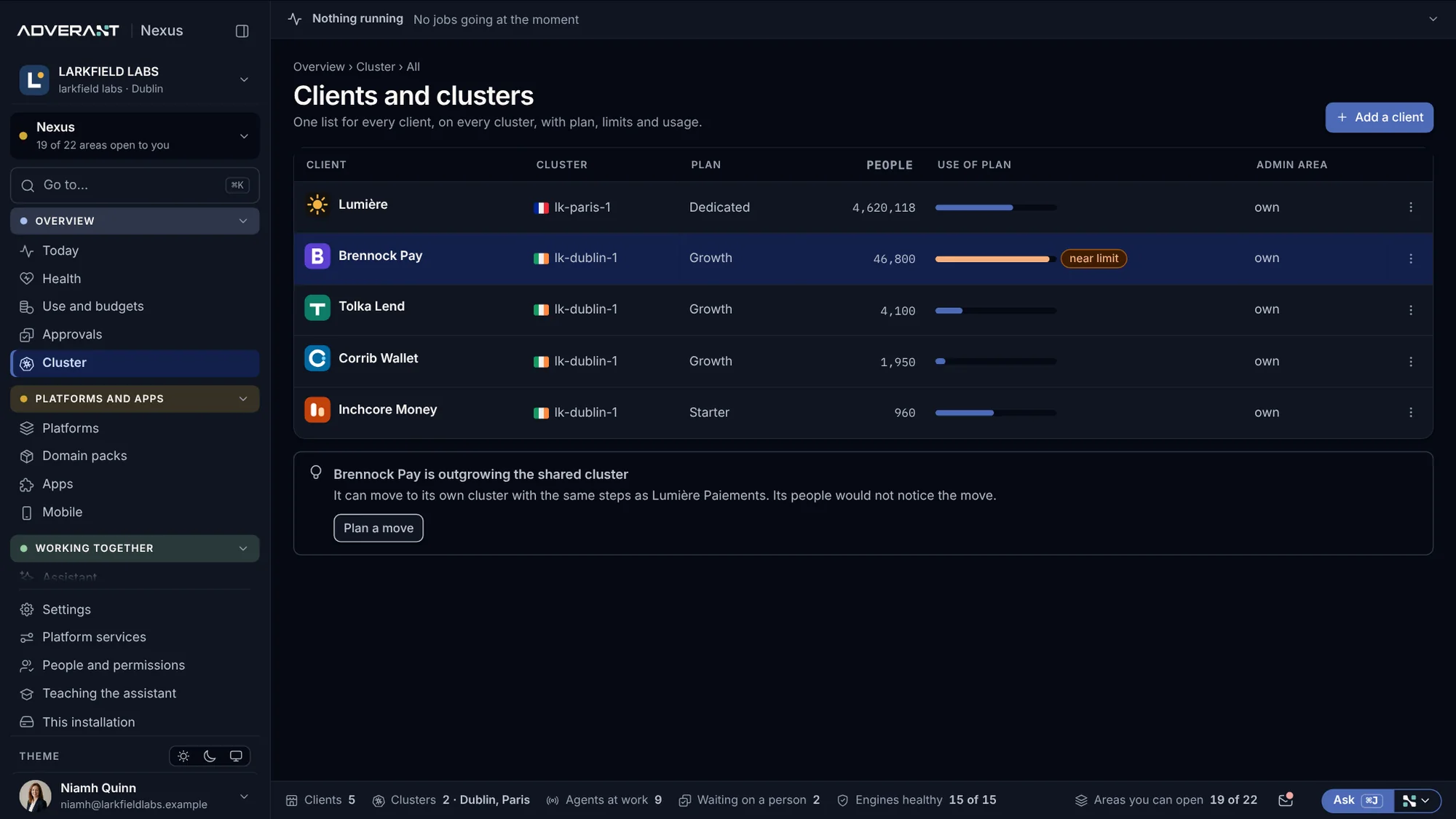
Every client and cluster
- Plans and limits
- Usage per client
- Move up to a cluster any time
A whole bank, run from the same platform.
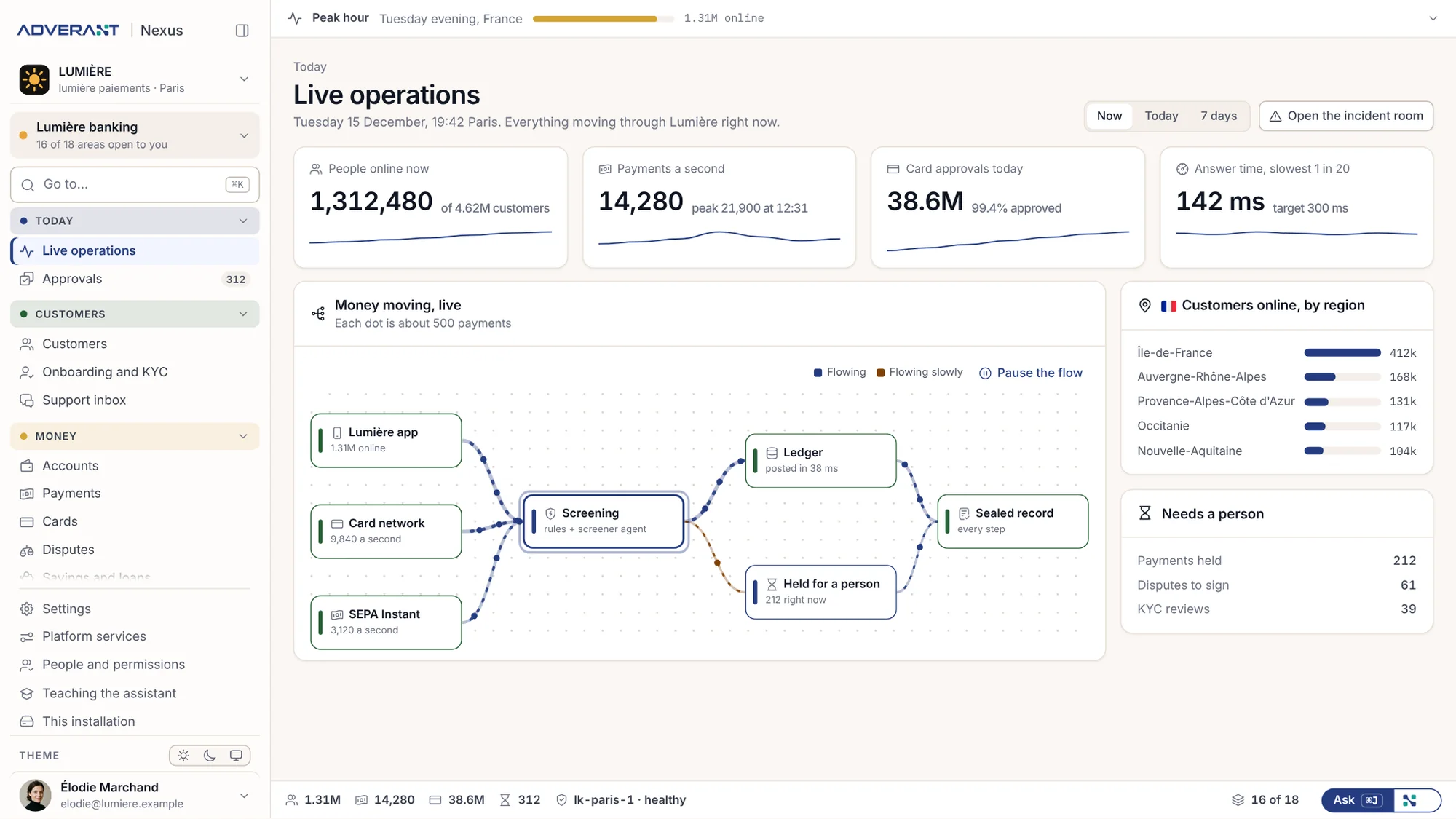
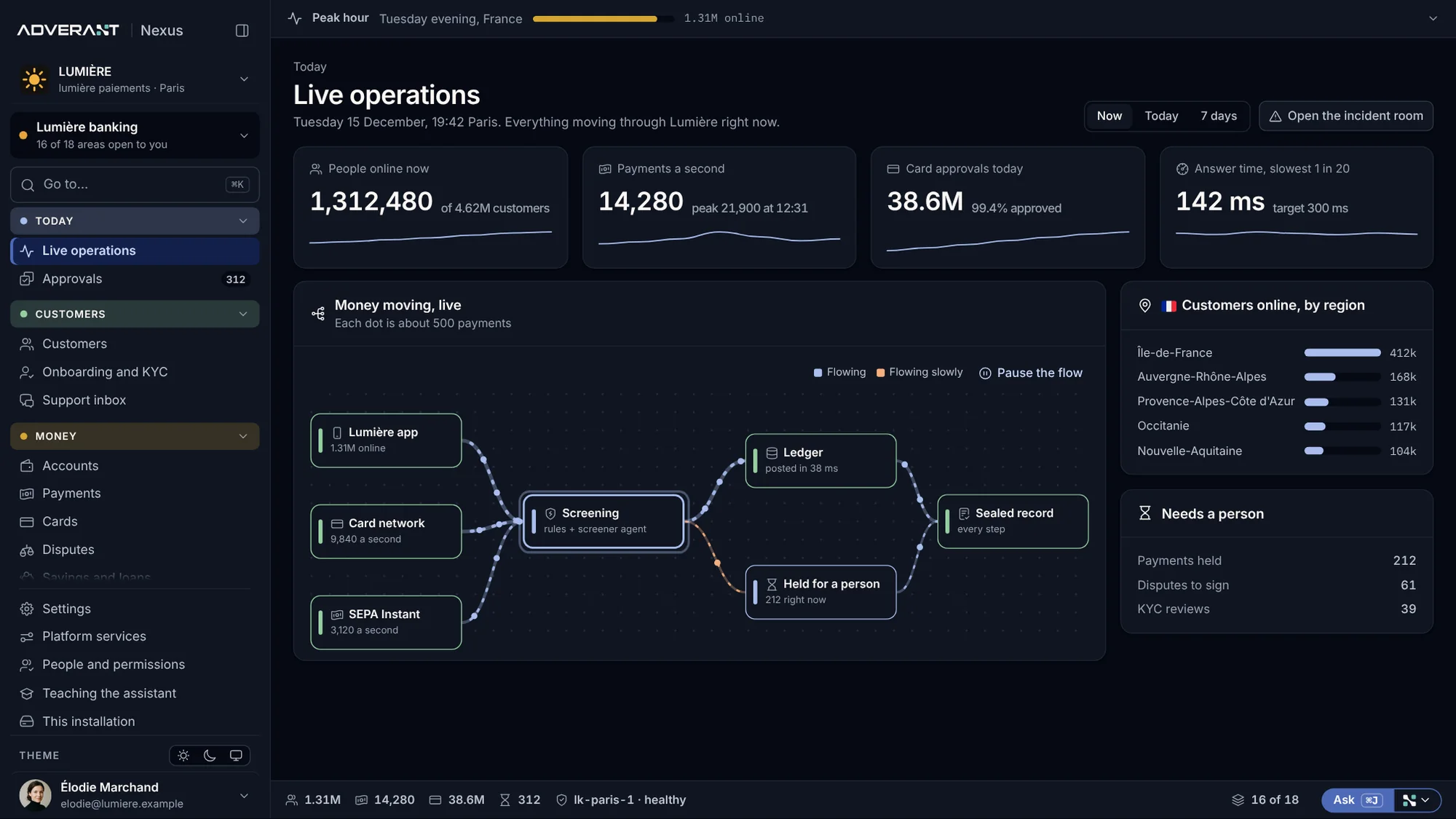
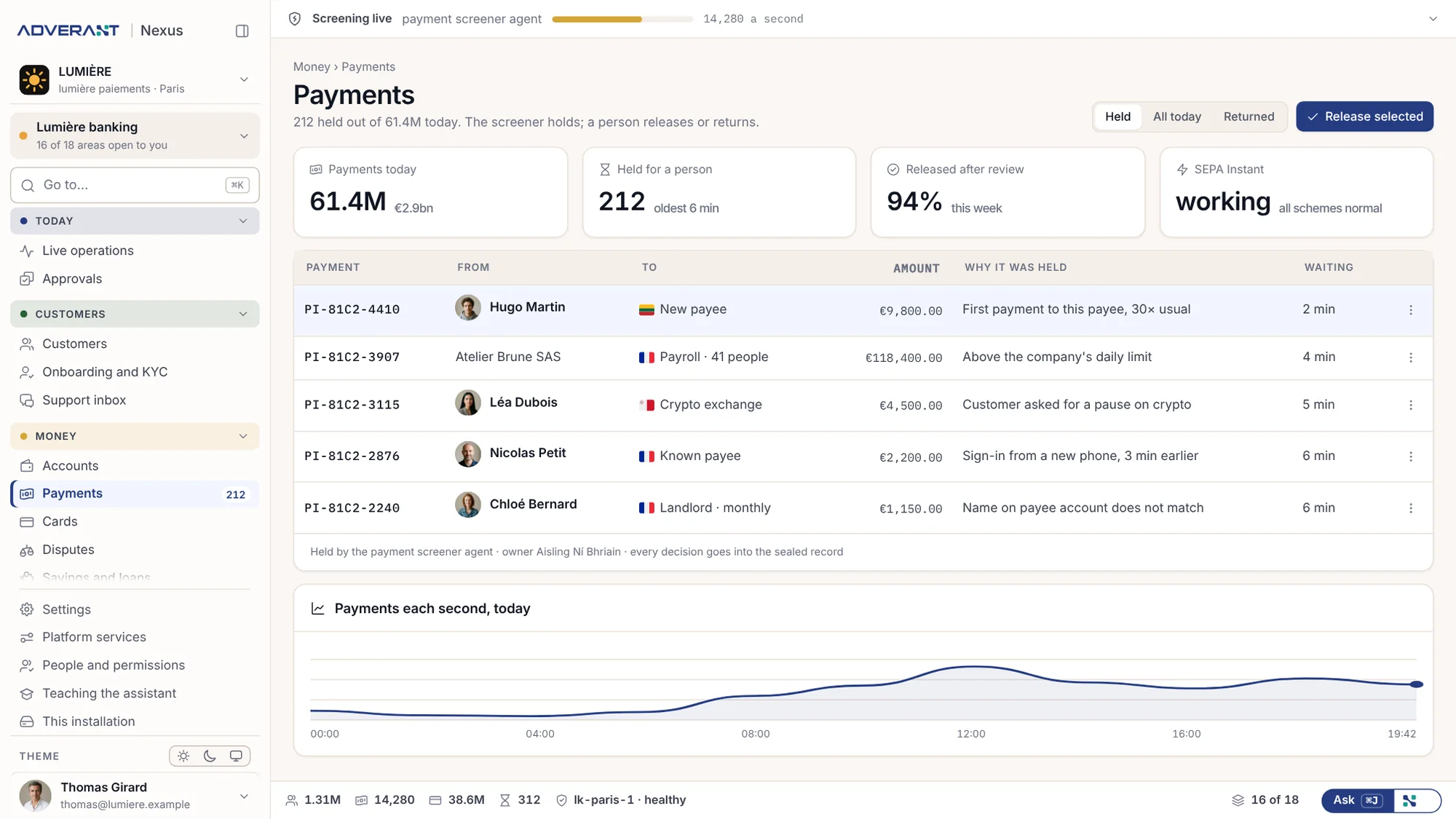
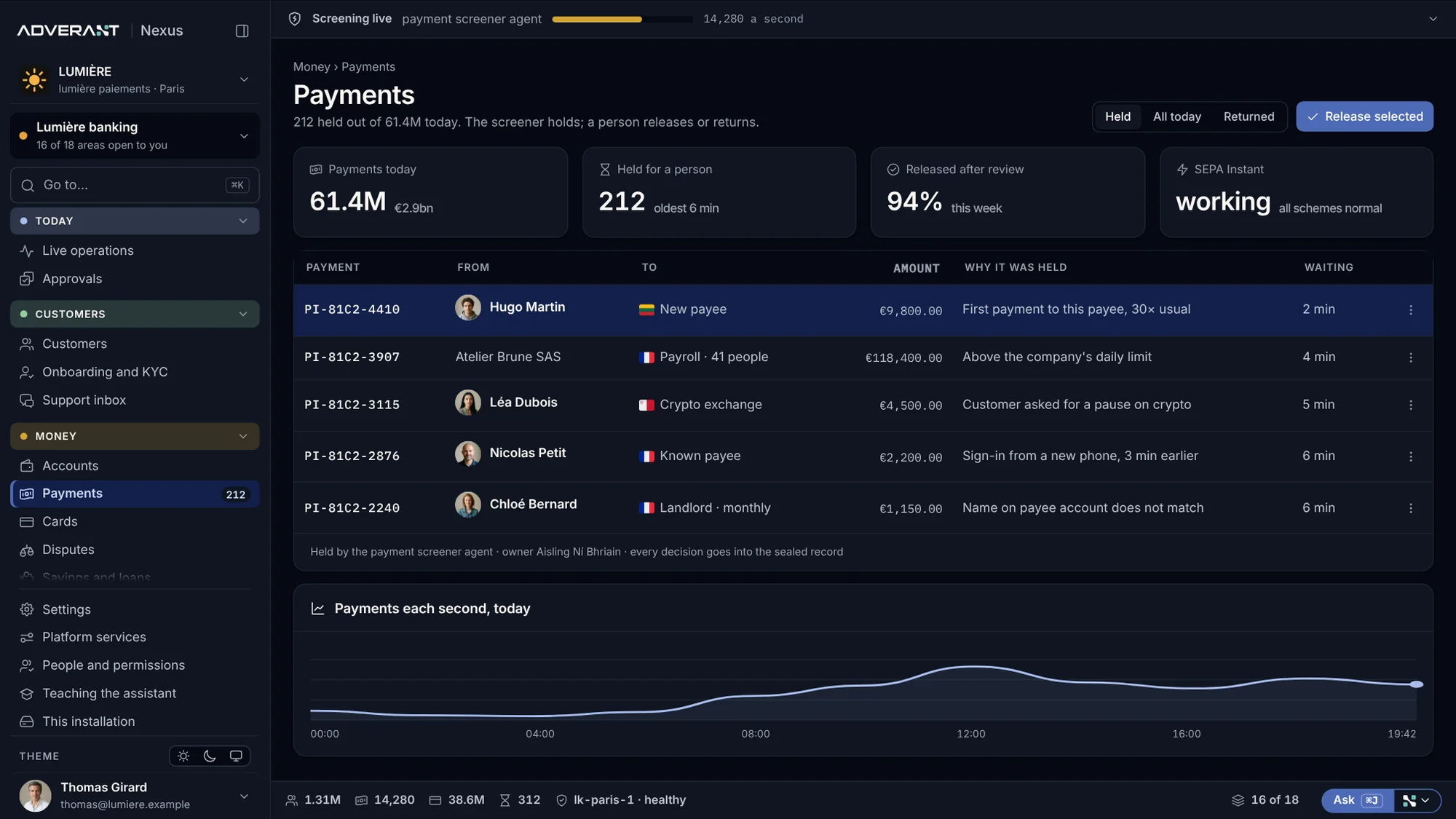
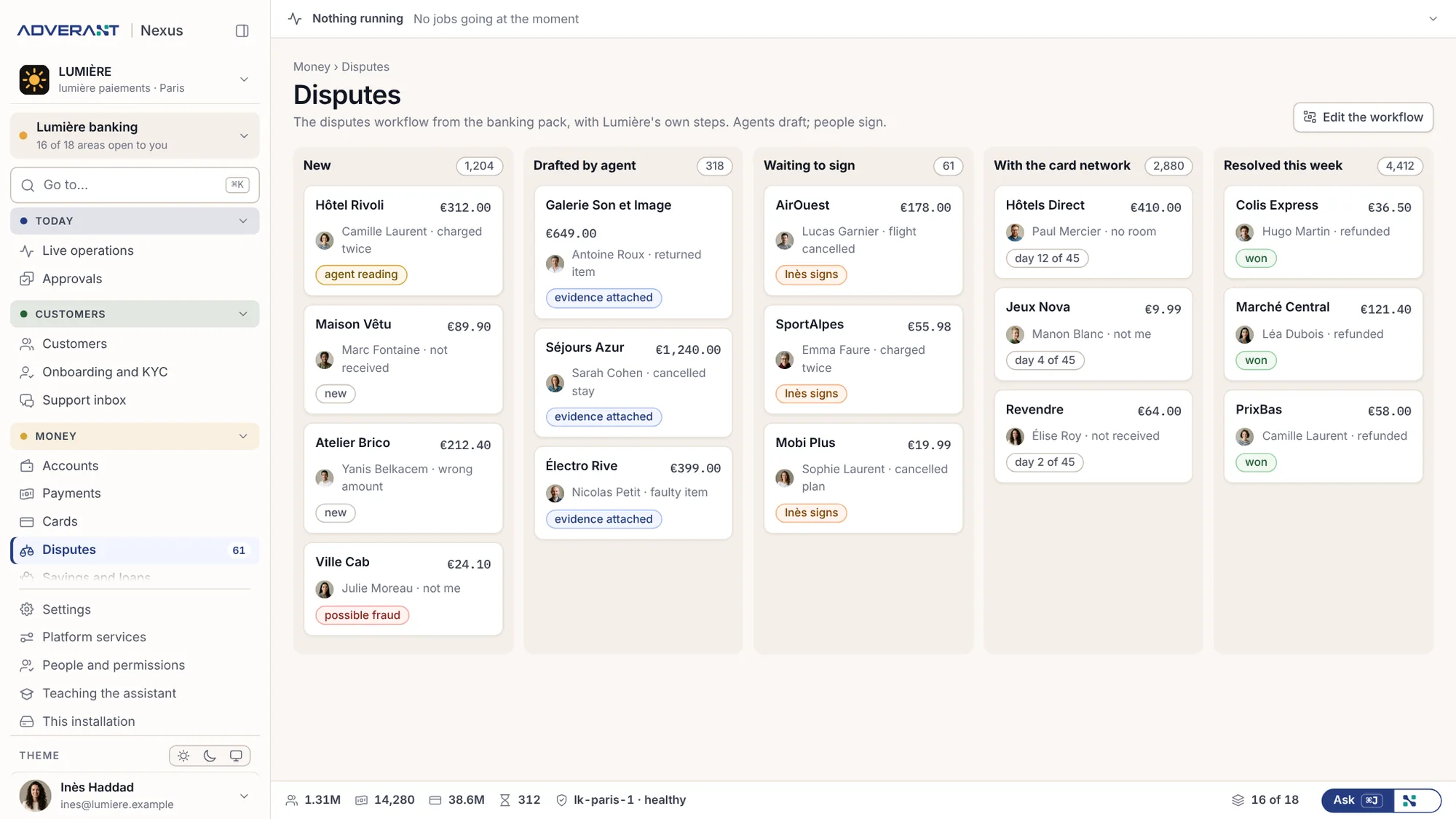
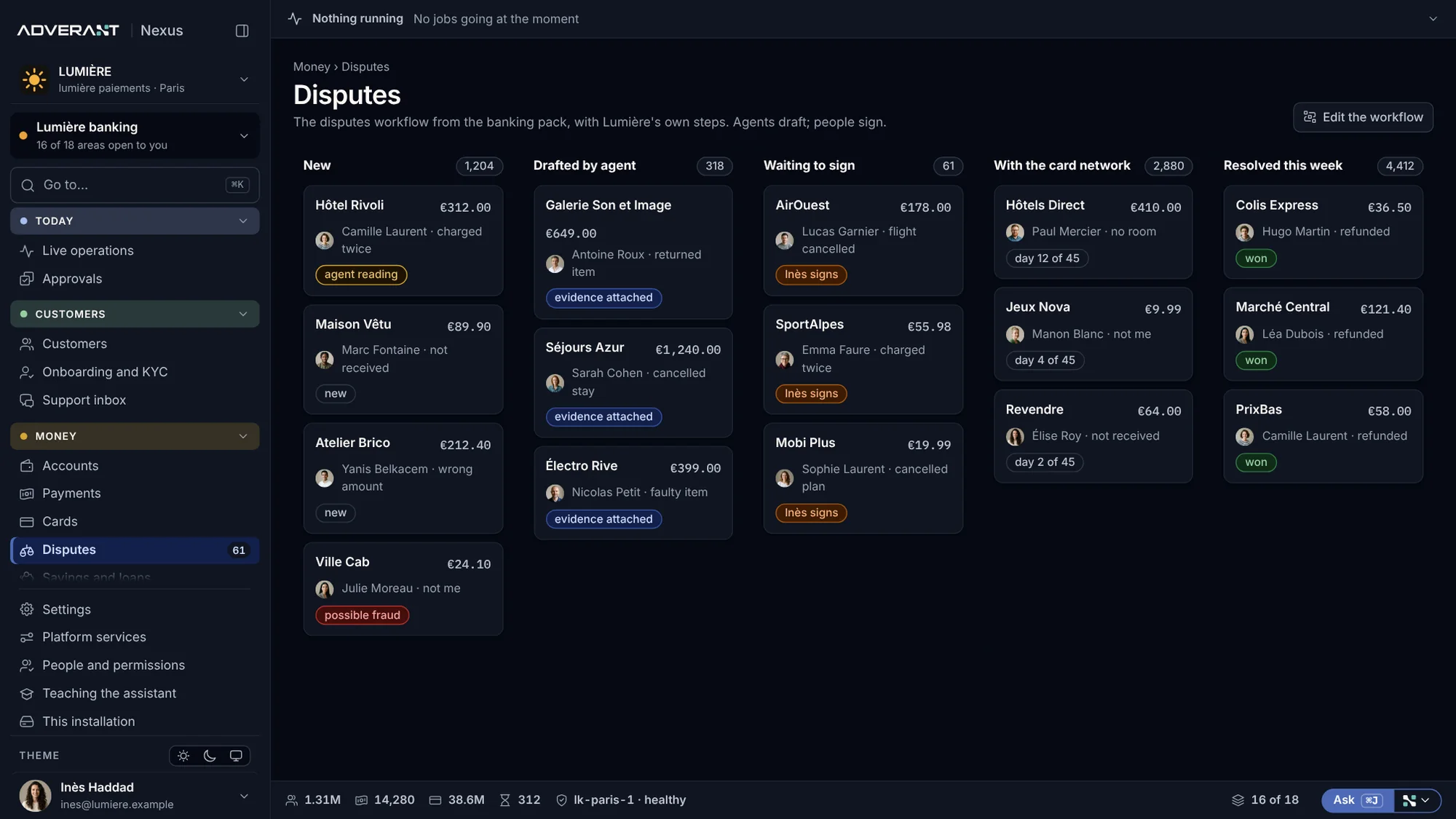
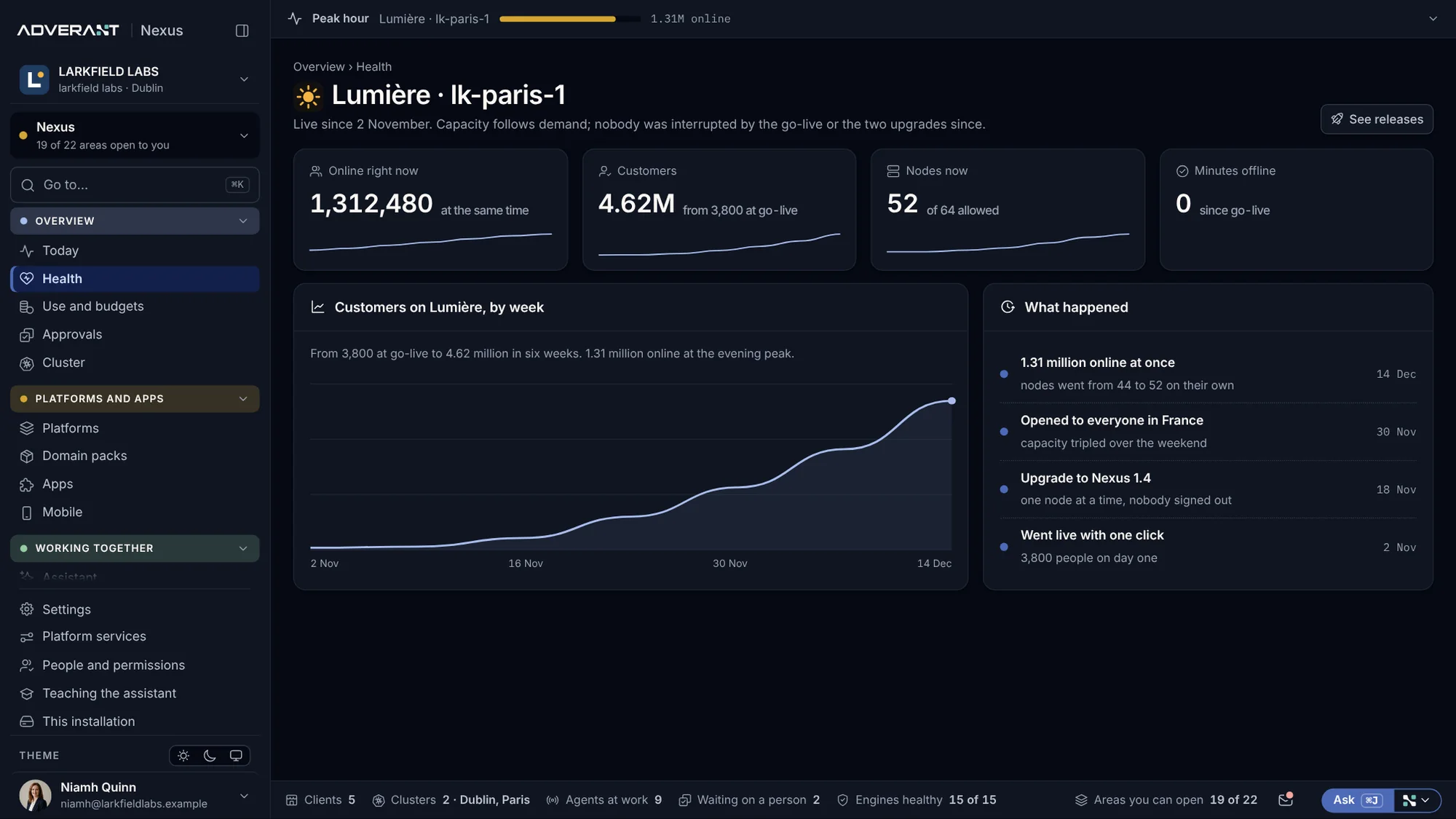
Lumière is a neobank with millions of customers, on its own cluster in Paris. Its team runs live operations, customer support, held payments, disputes, onboarding and fraud checks from screens that came with the banking pack.
Live operations
- Over a million online
- Money moving, live
- Queues for people
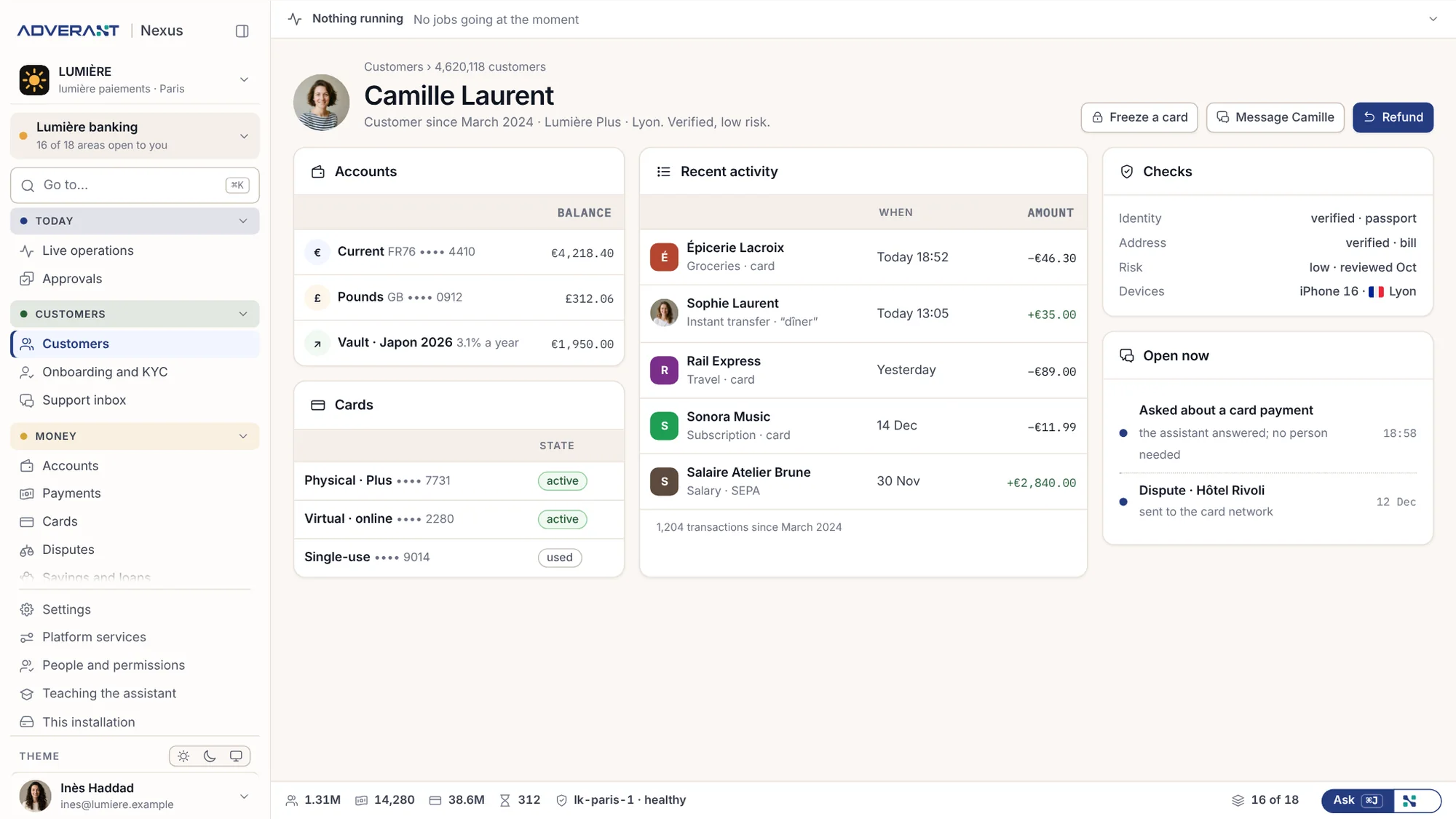
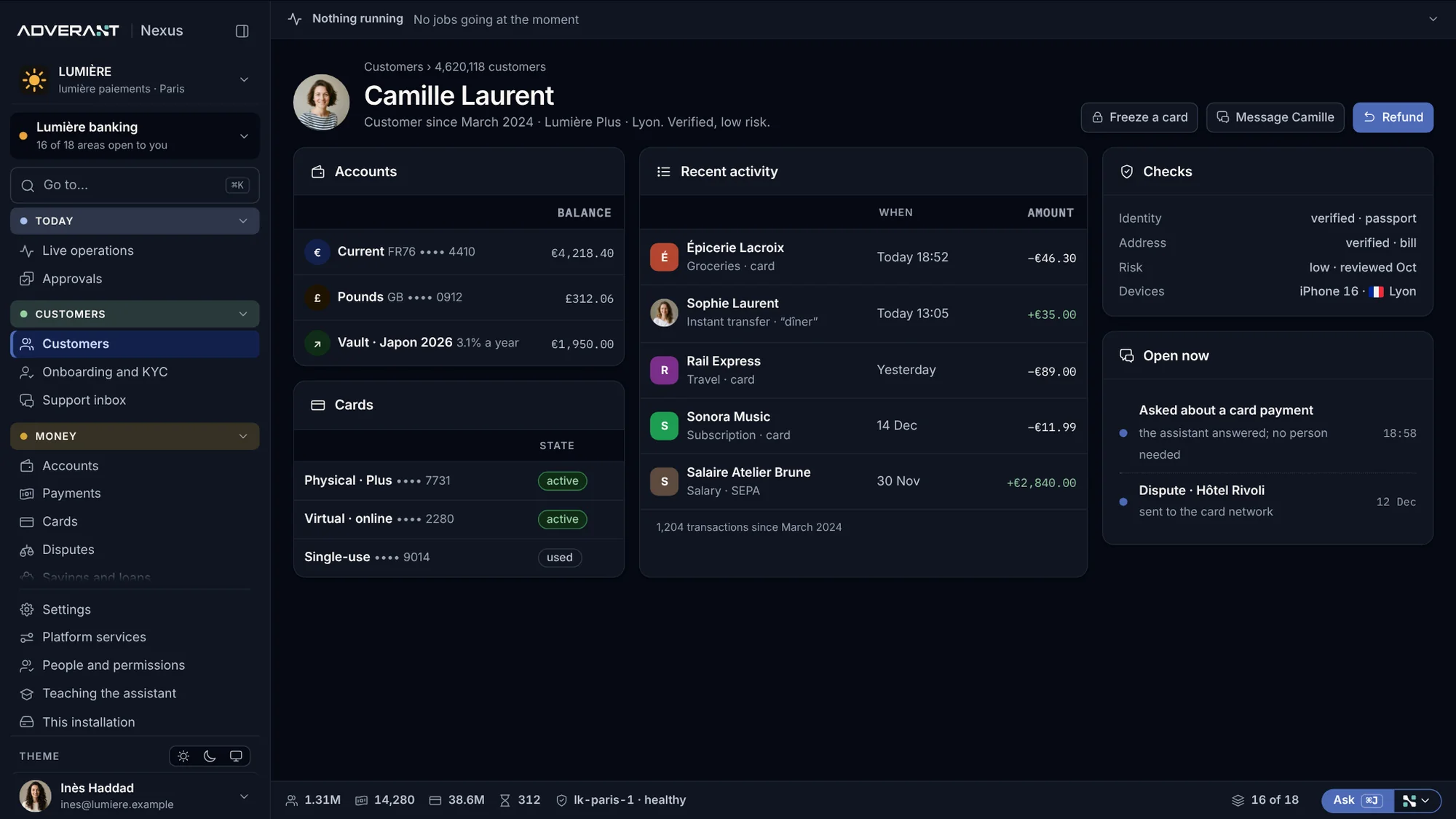
One customer, one page
- Everything in one place
- Actions logged
- Checks shown first
Payments held for a person
- Reasons shown
- Cleared by a person
- Every decision recorded
Card disputes
- Agents draft
- People decide
- Customers kept informed
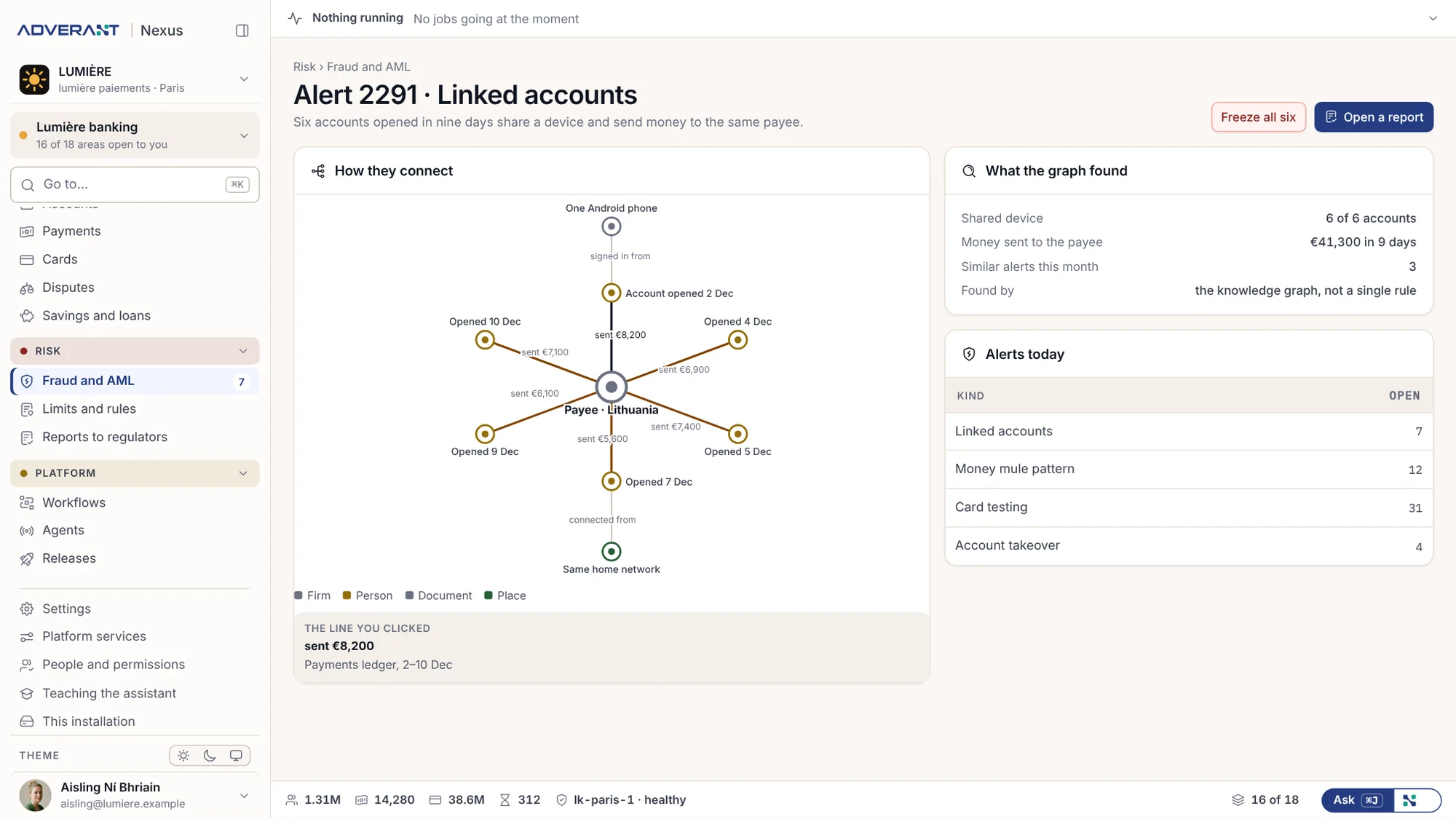
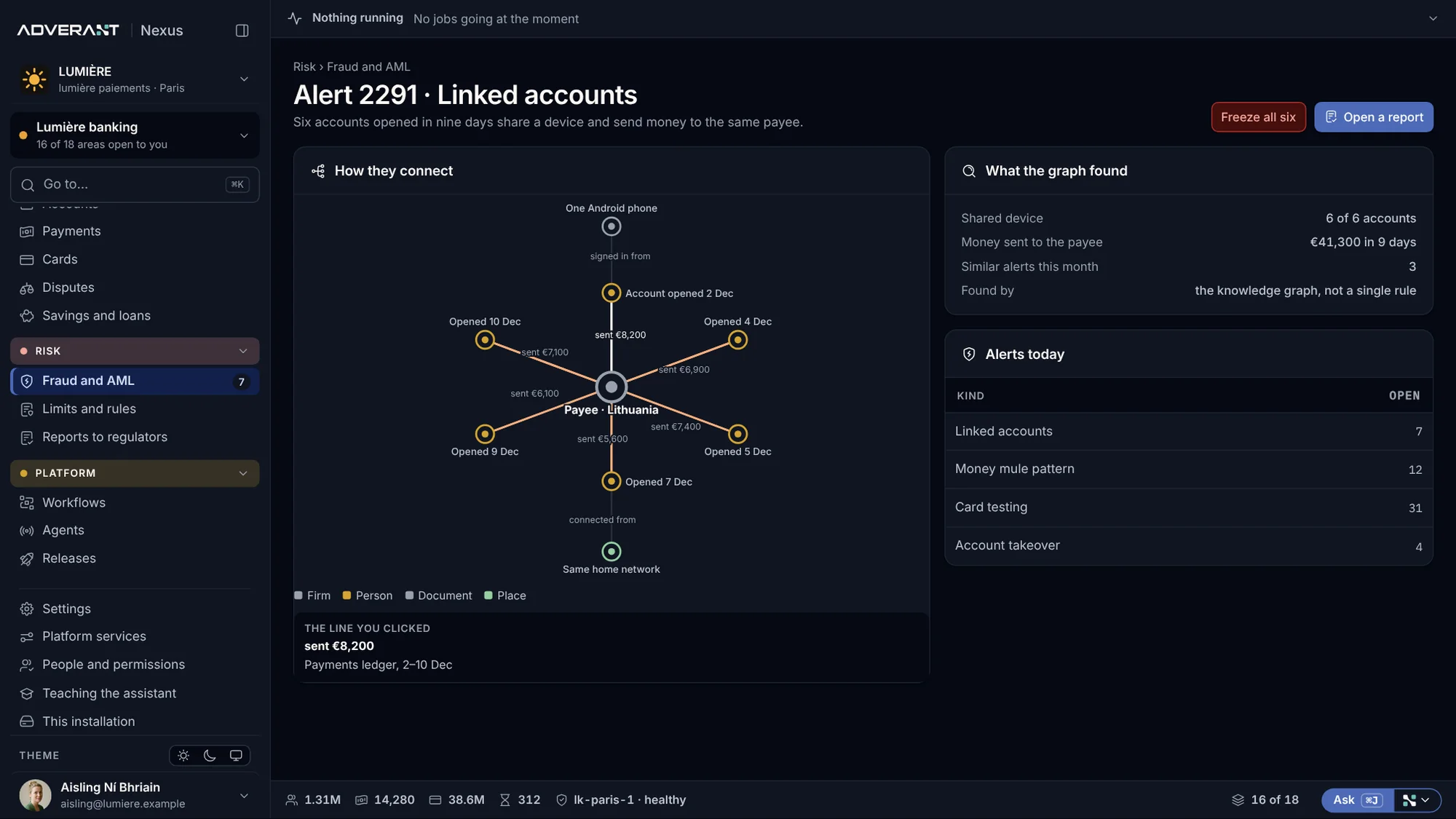
Fraud and money laundering
- Links found across accounts
- A person investigates
- Reports filed from the record
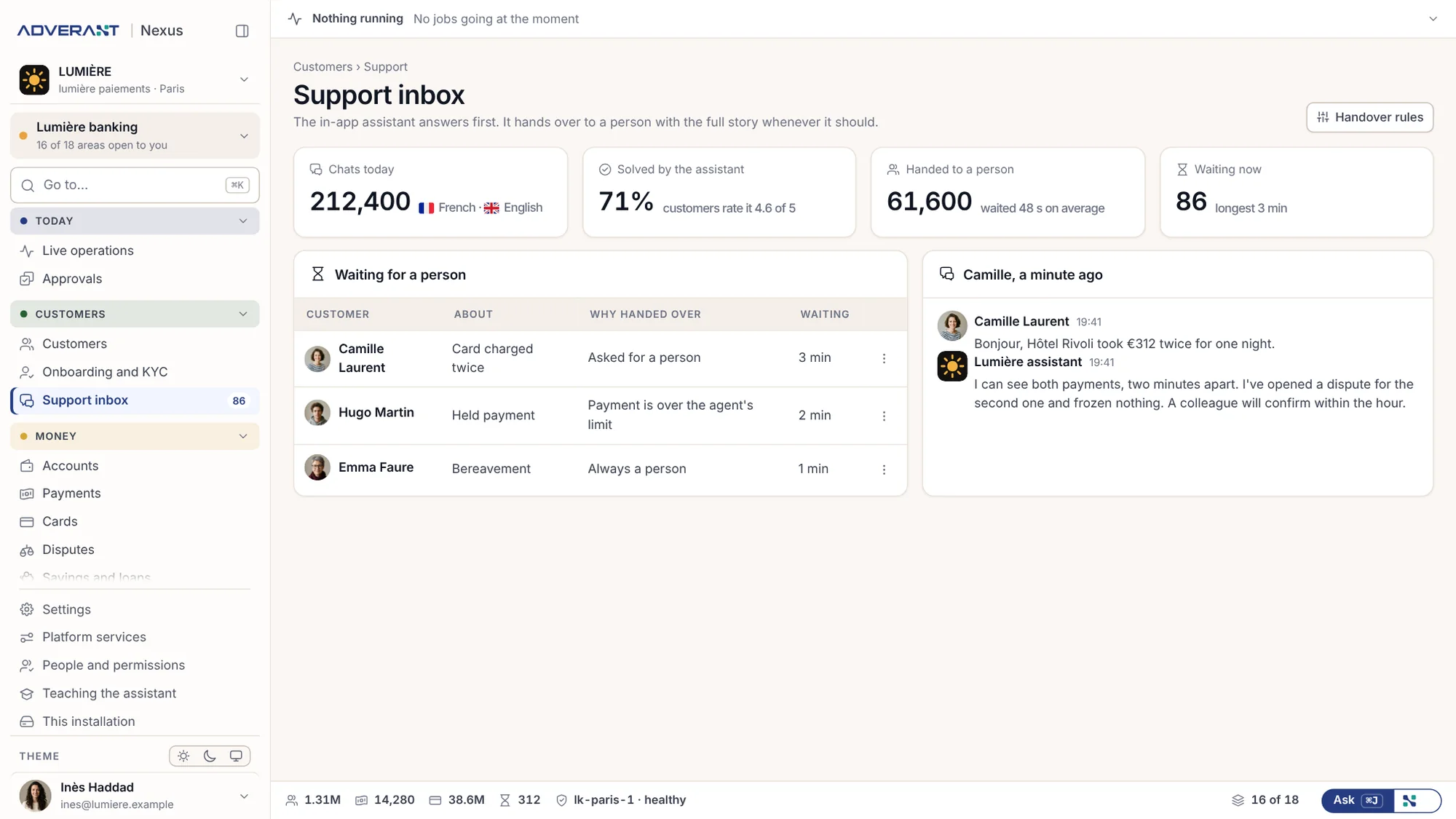
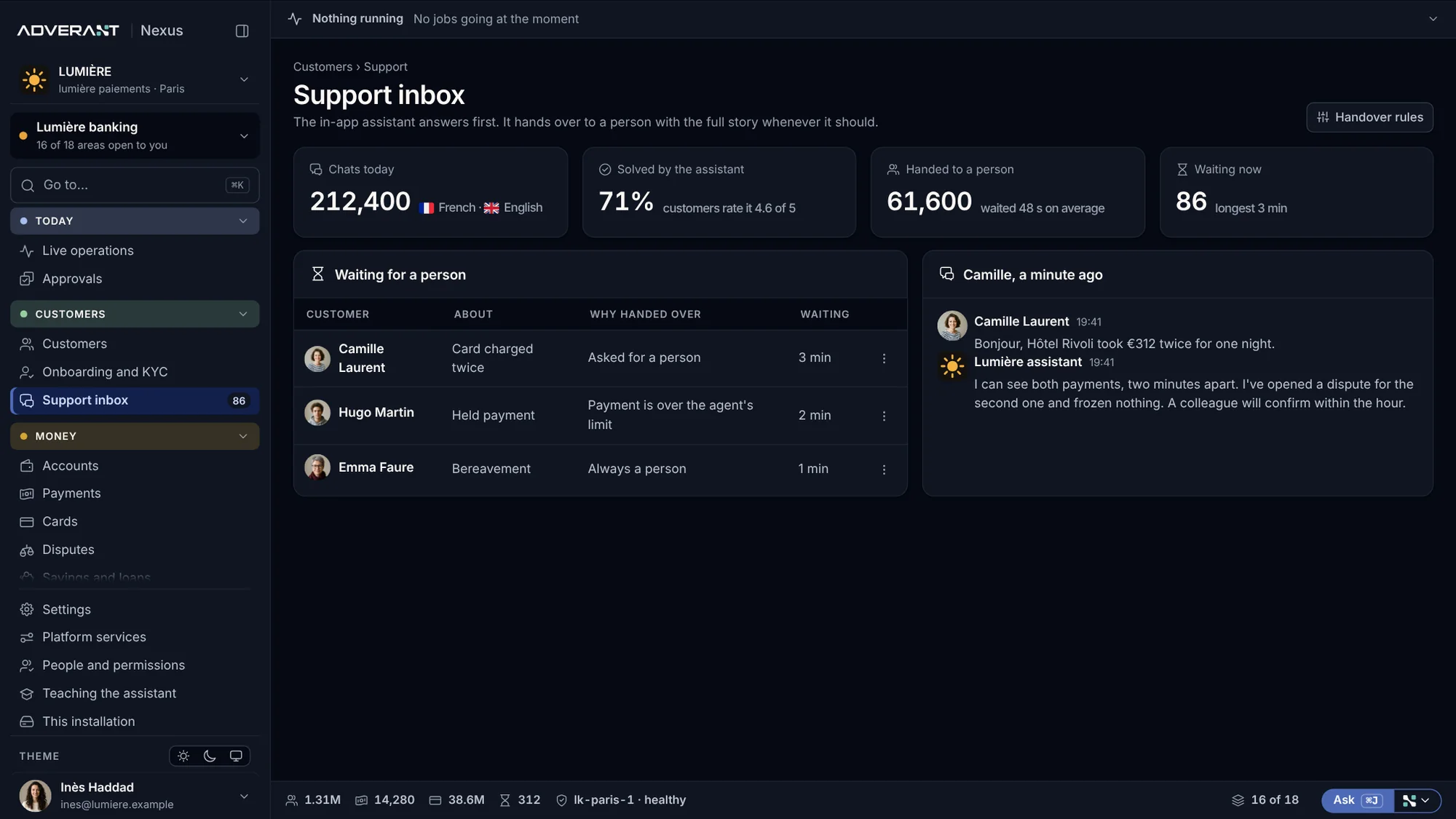
Support inbox
The assistant answers customers and hands over to a person when it should.
- Answers in seconds
- Hands over to people
- Every answer sourced
Their own banking app, on the same platform.
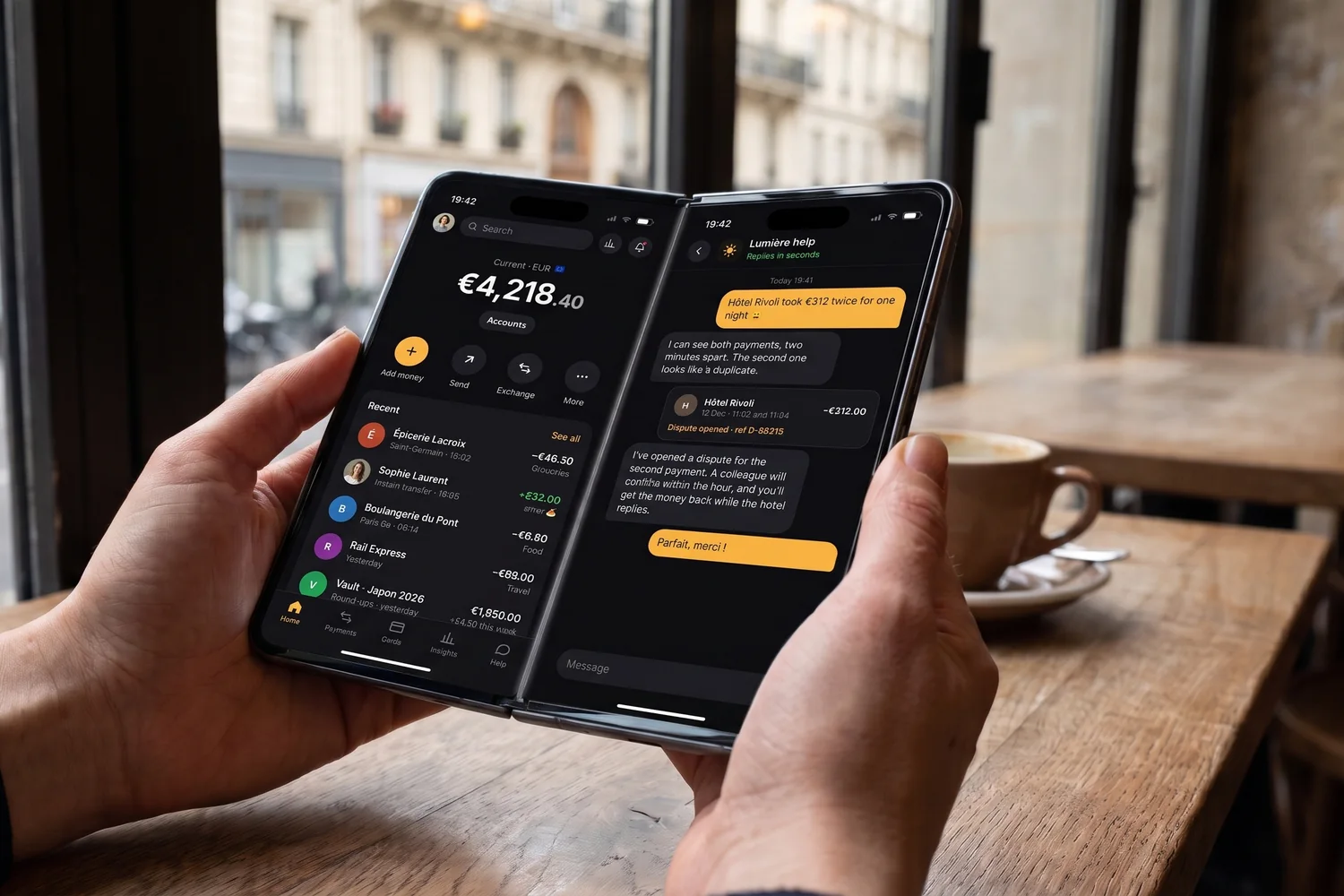
Lumière’s customers use its own app. Payments, cards, savings and help all run on the same Nexus cluster as the back office, with over a million people using it at once.
- The client’s own brand
- Back office and app on one platform
- Built to carry millions
The same controls for every client.
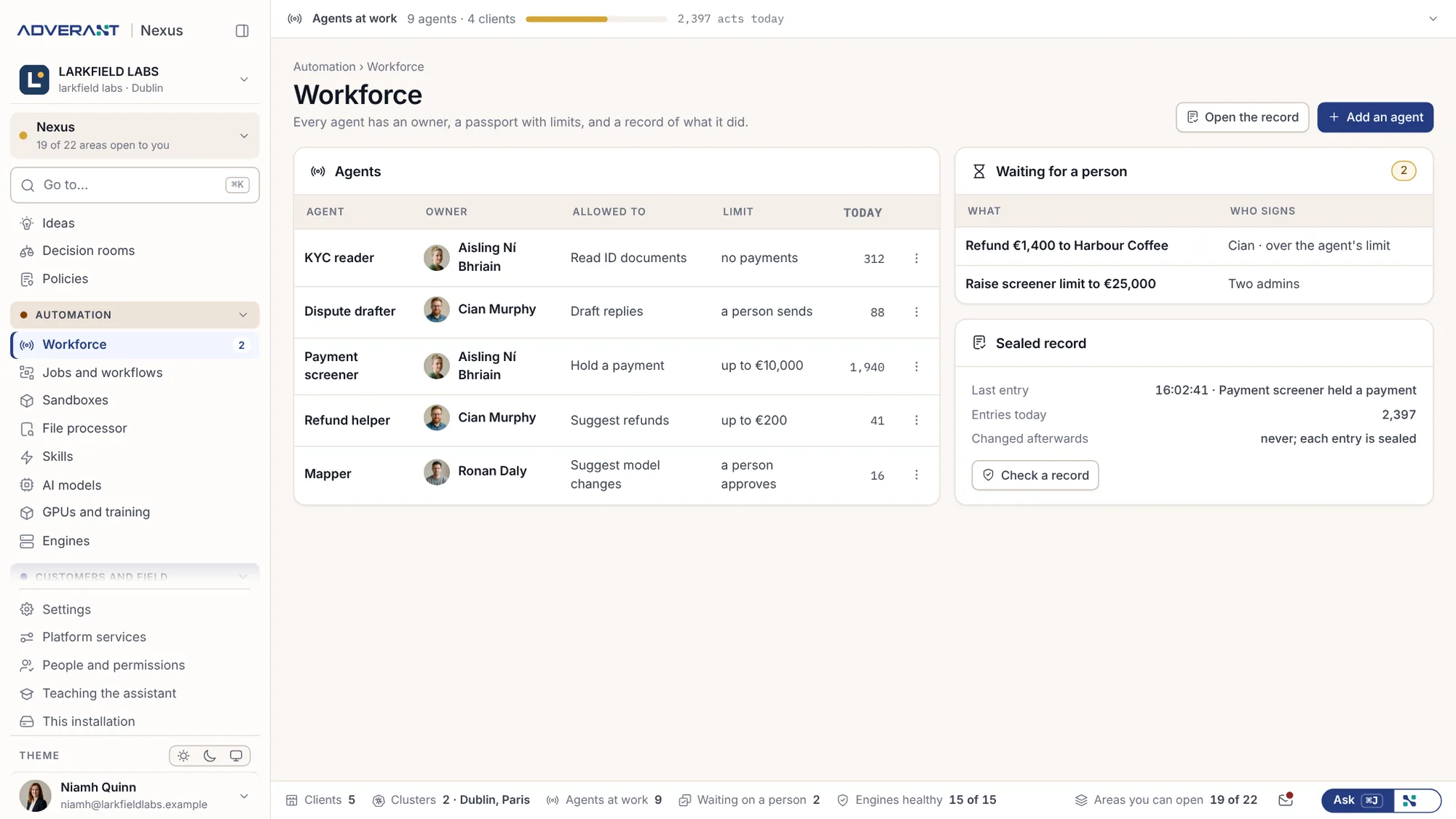
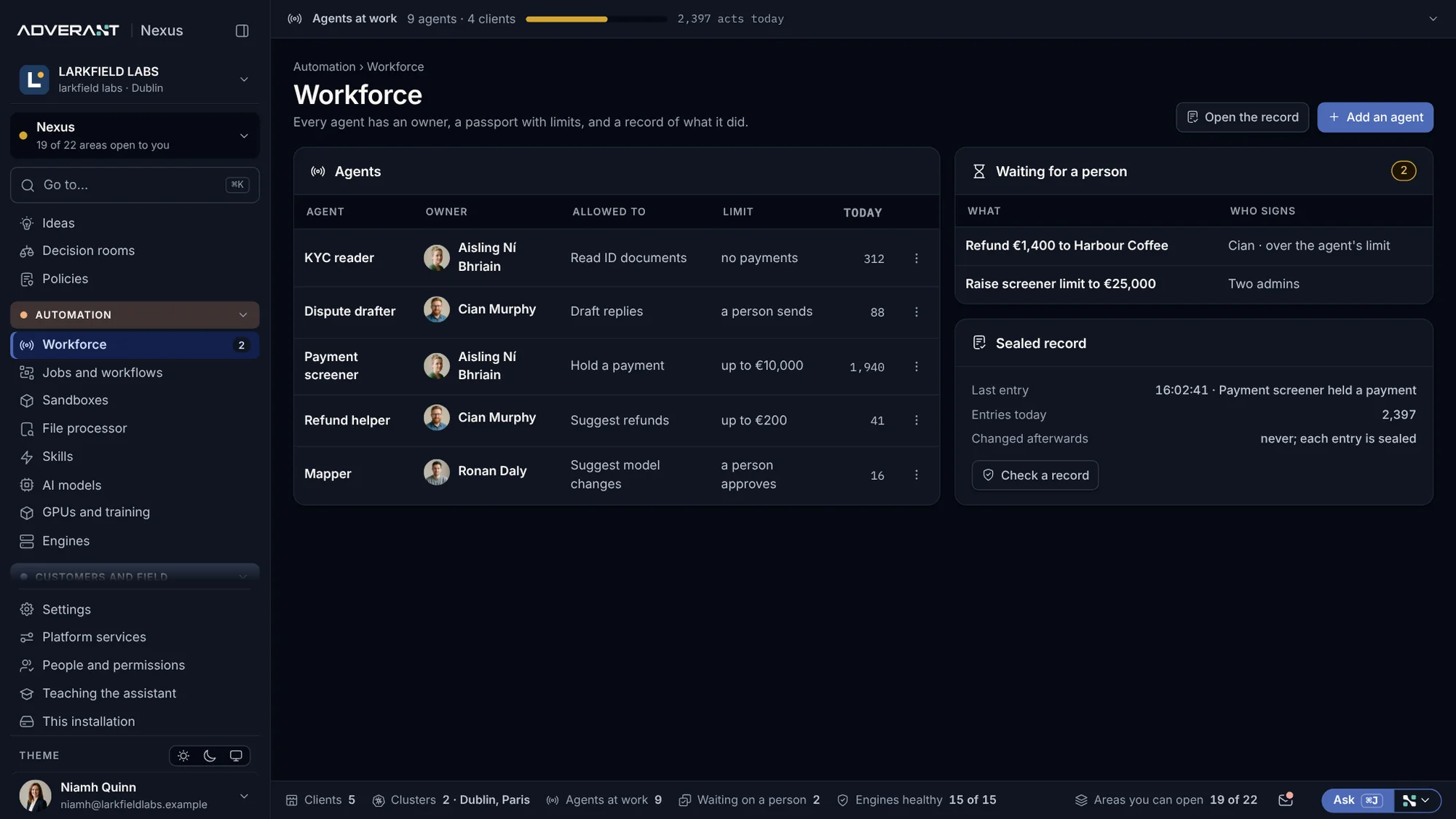
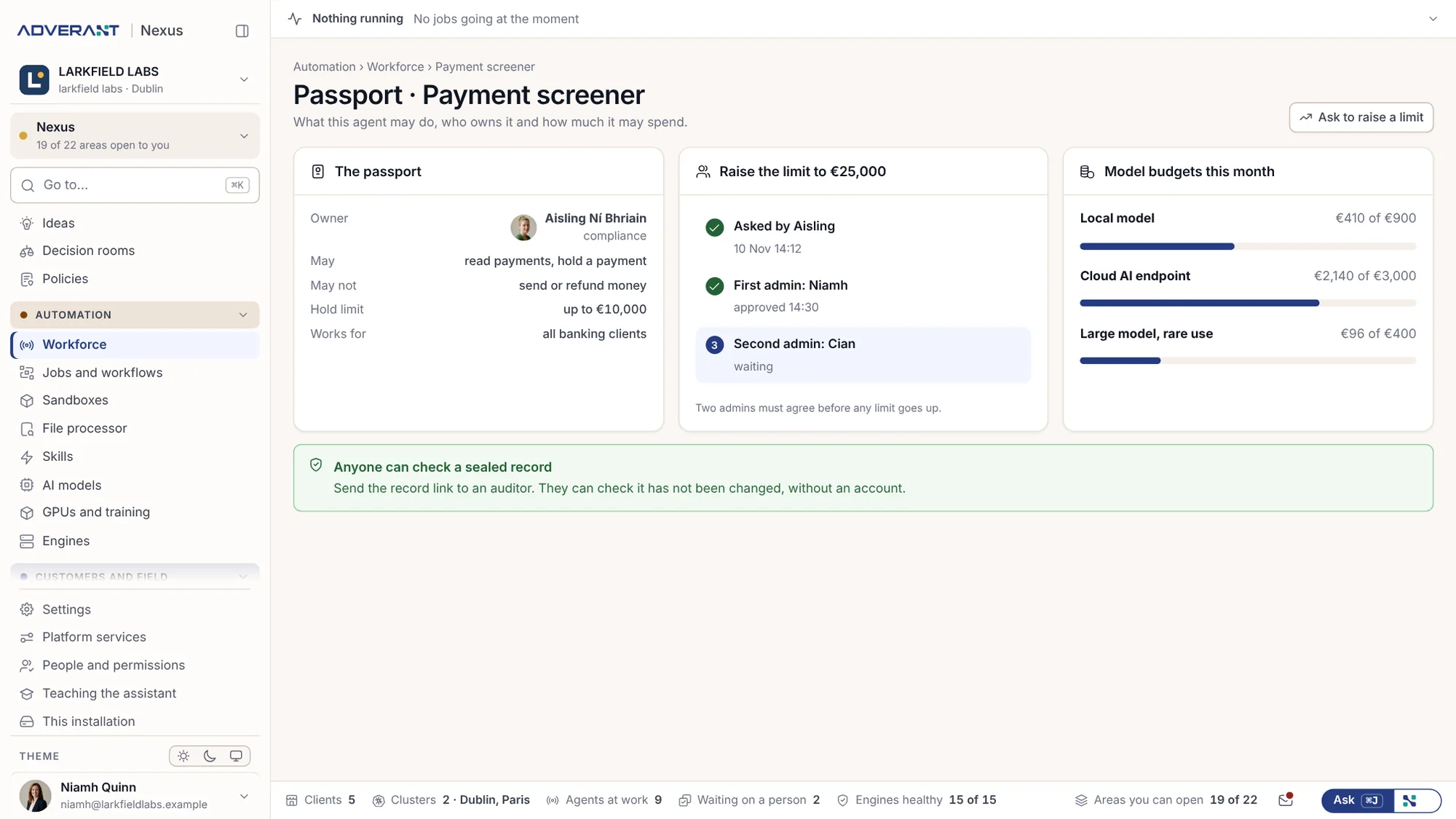
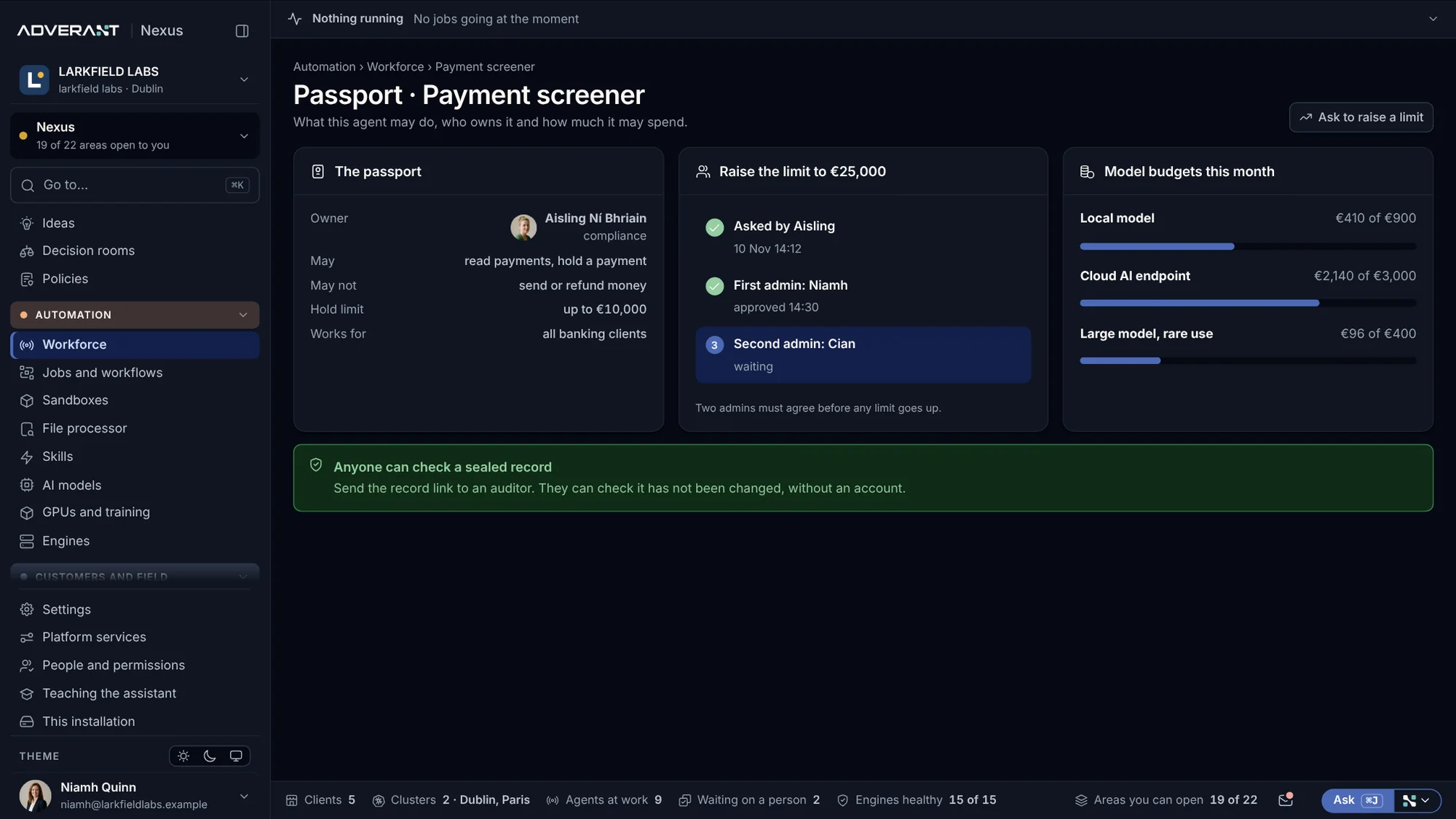
Each AI agent has an owner, a passport that says what it may do, and limits. Raising a limit takes two admins. People sign off the decisions that matter, and every step goes into a record that cannot be changed afterwards. That helps clients with DORA, the EU AI Act and GDPR.
Owners, limits and records
- An owner for every agent
- Sign-offs where they matter
- Sealed records
A passport and its limits
- Two admins to raise a limit
- A budget for every model
- Checked without an account
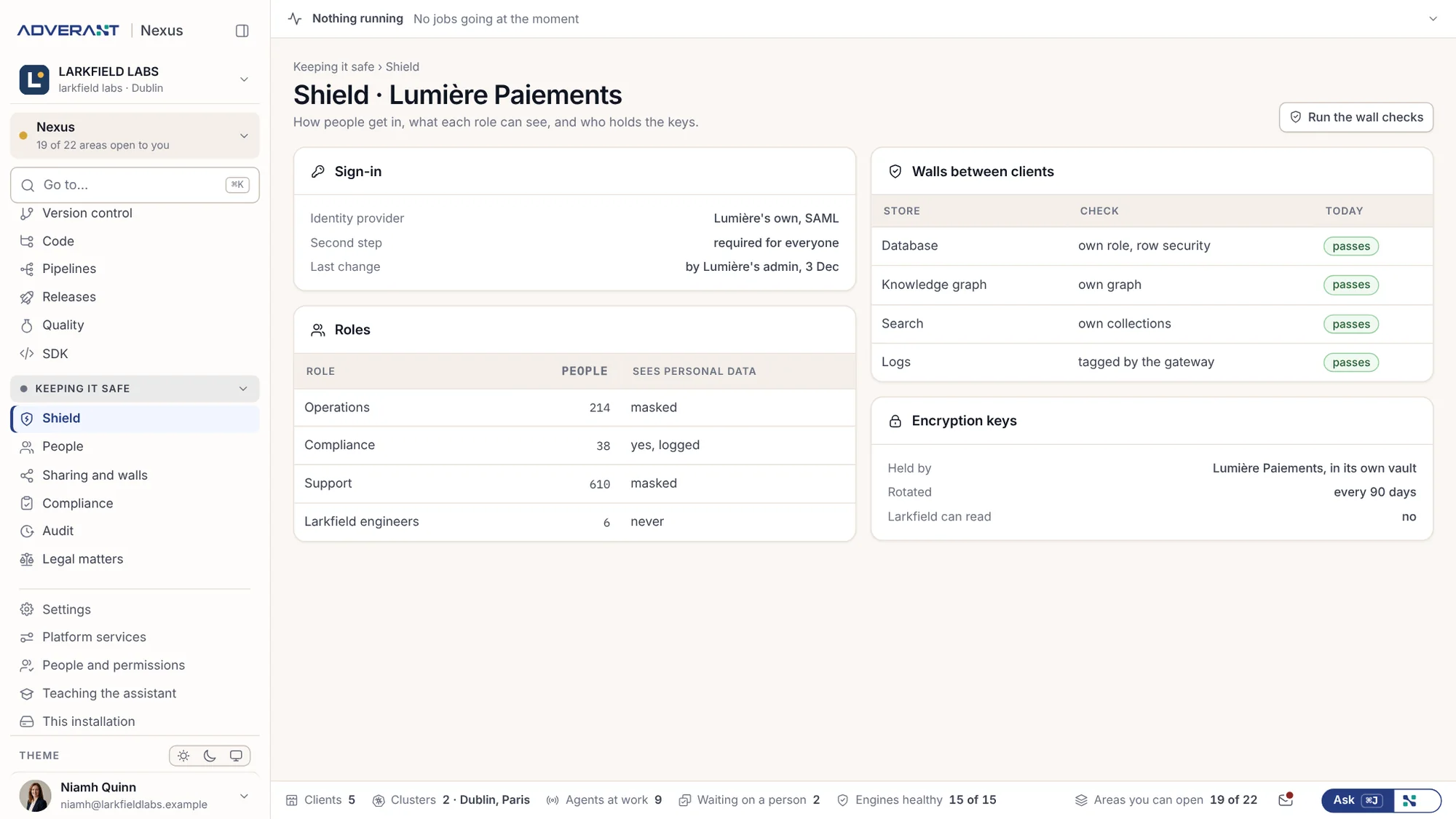
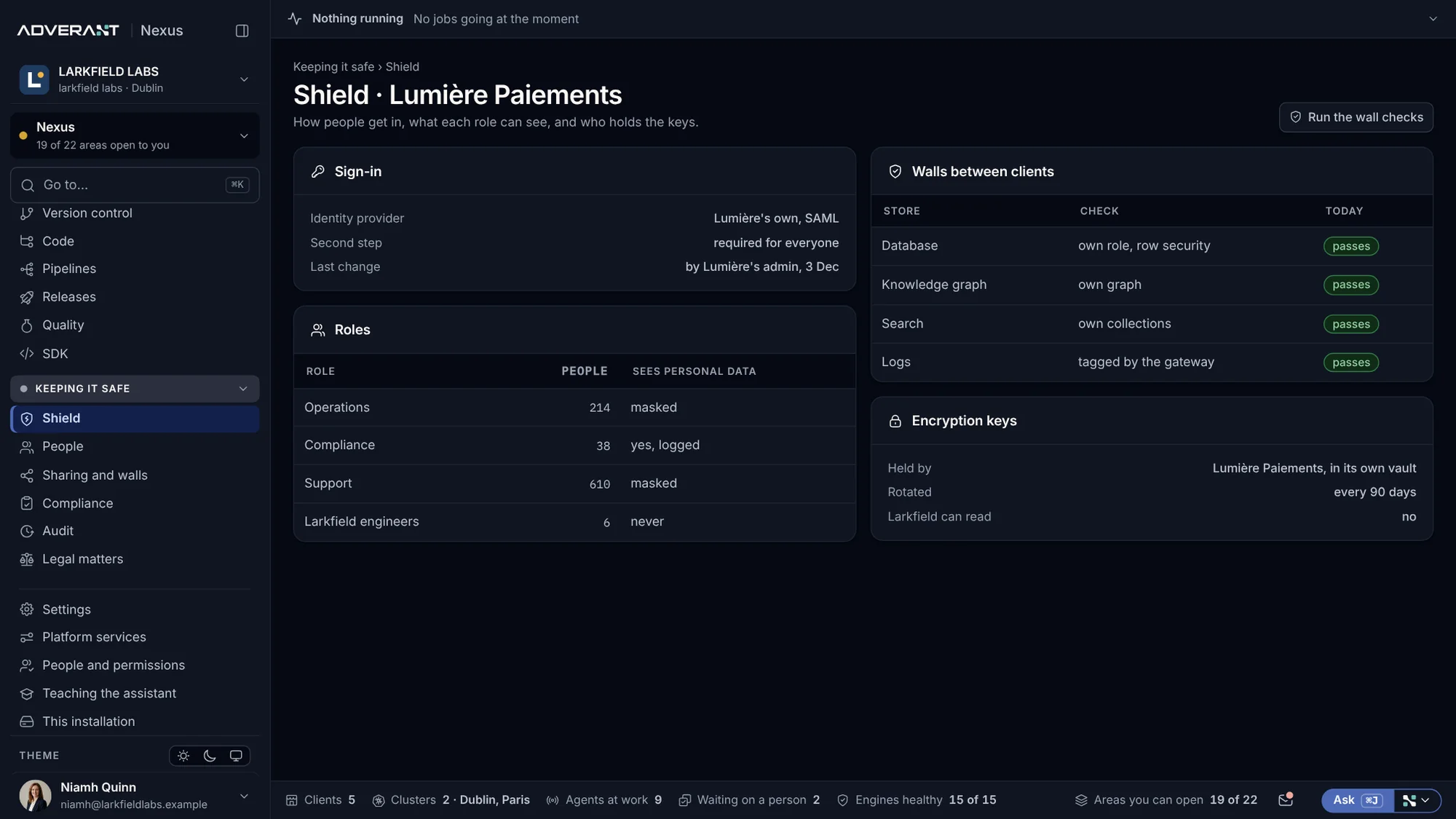
Sign-in, roles and keys
- Single sign-on
- Roles and walls
- Client-held keys
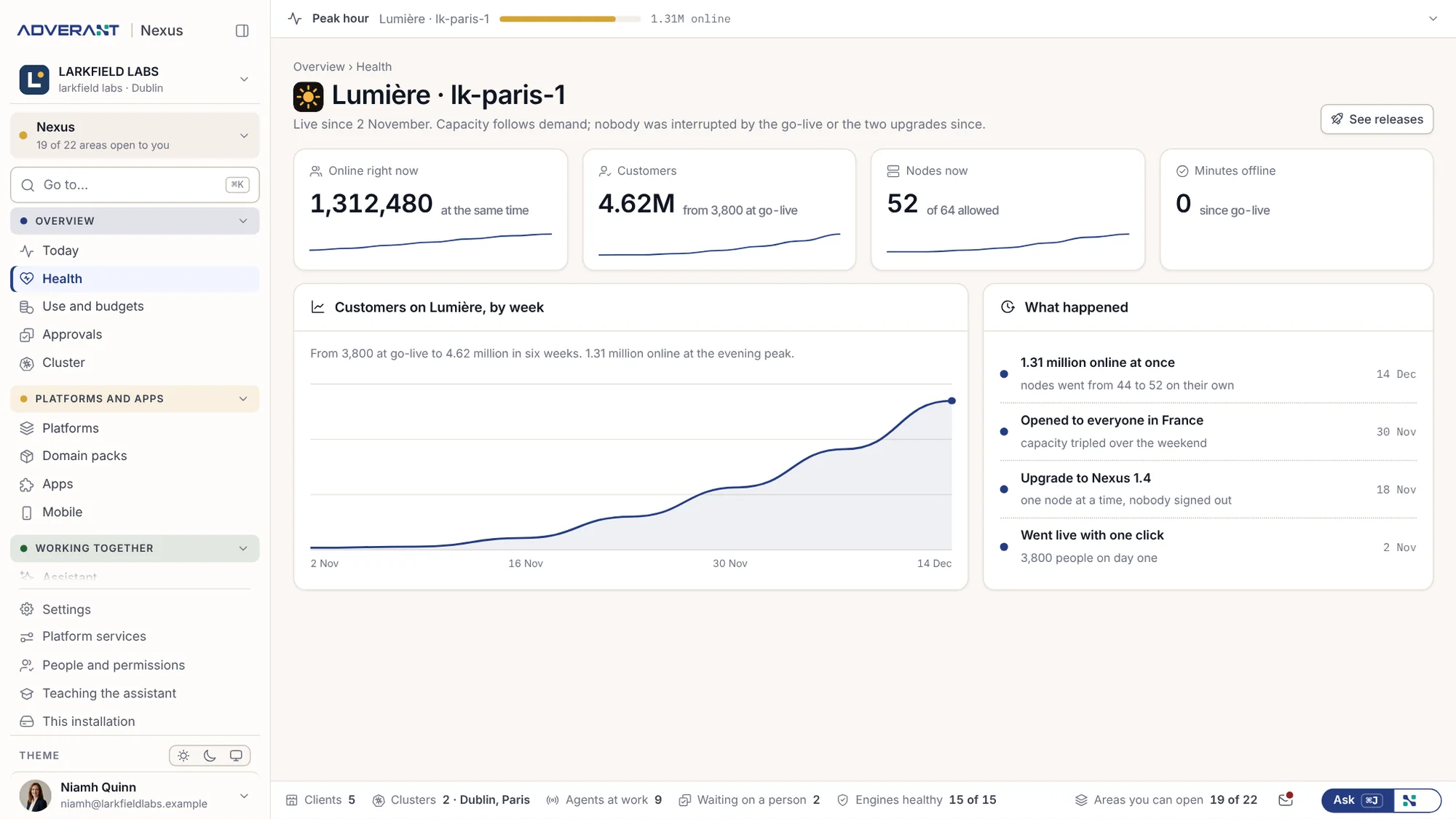
From a few thousand users to over a million.
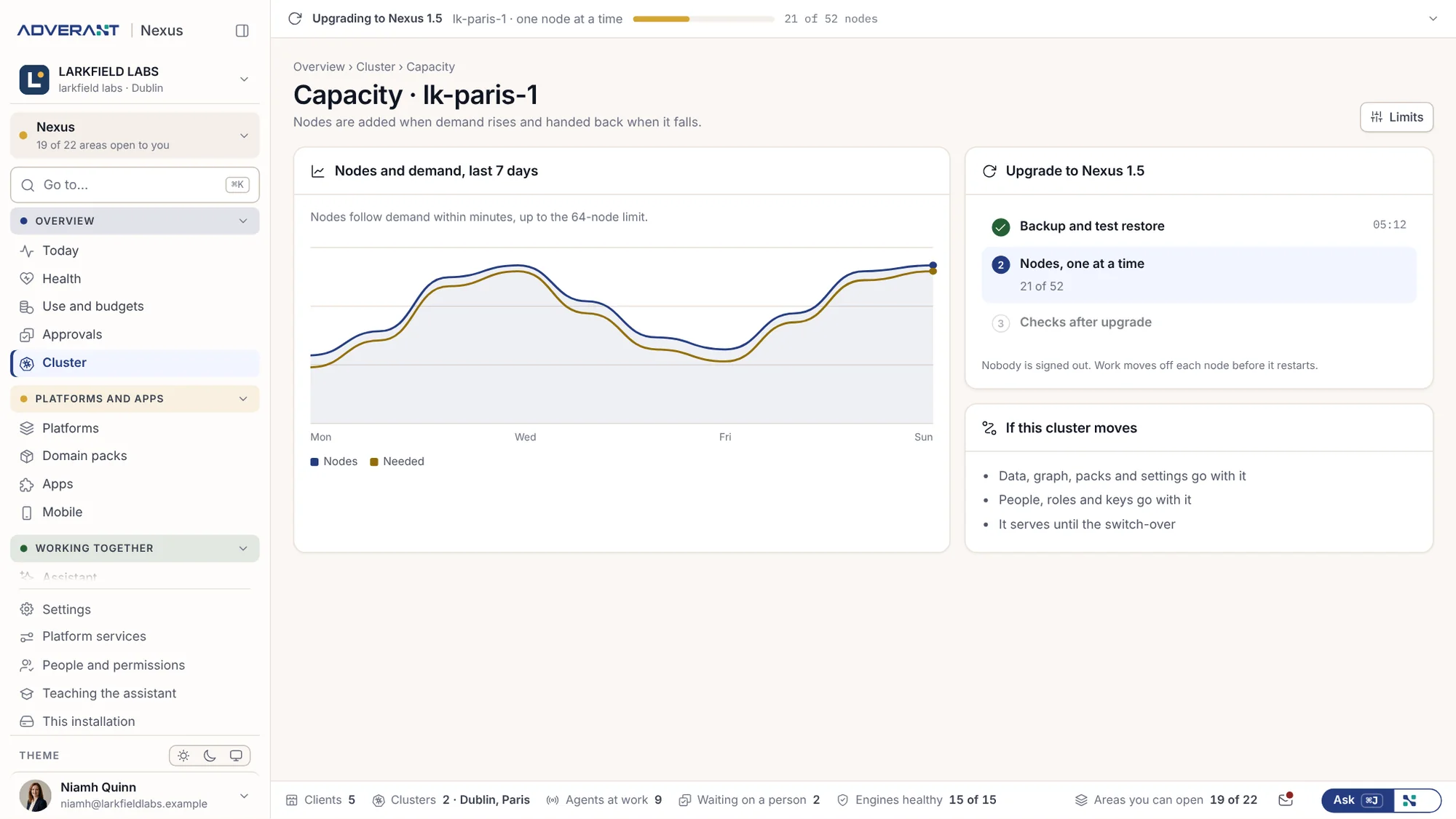
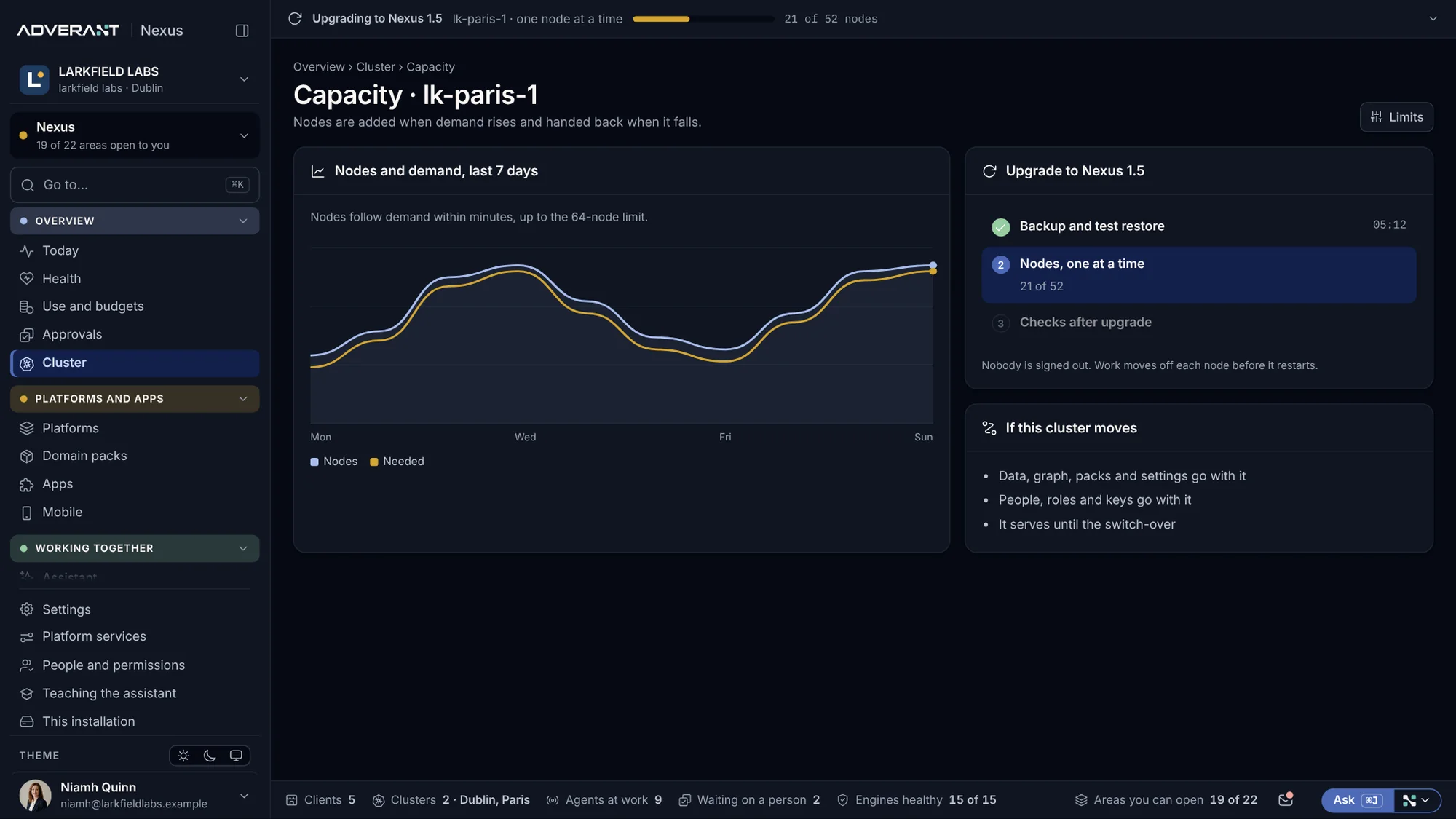
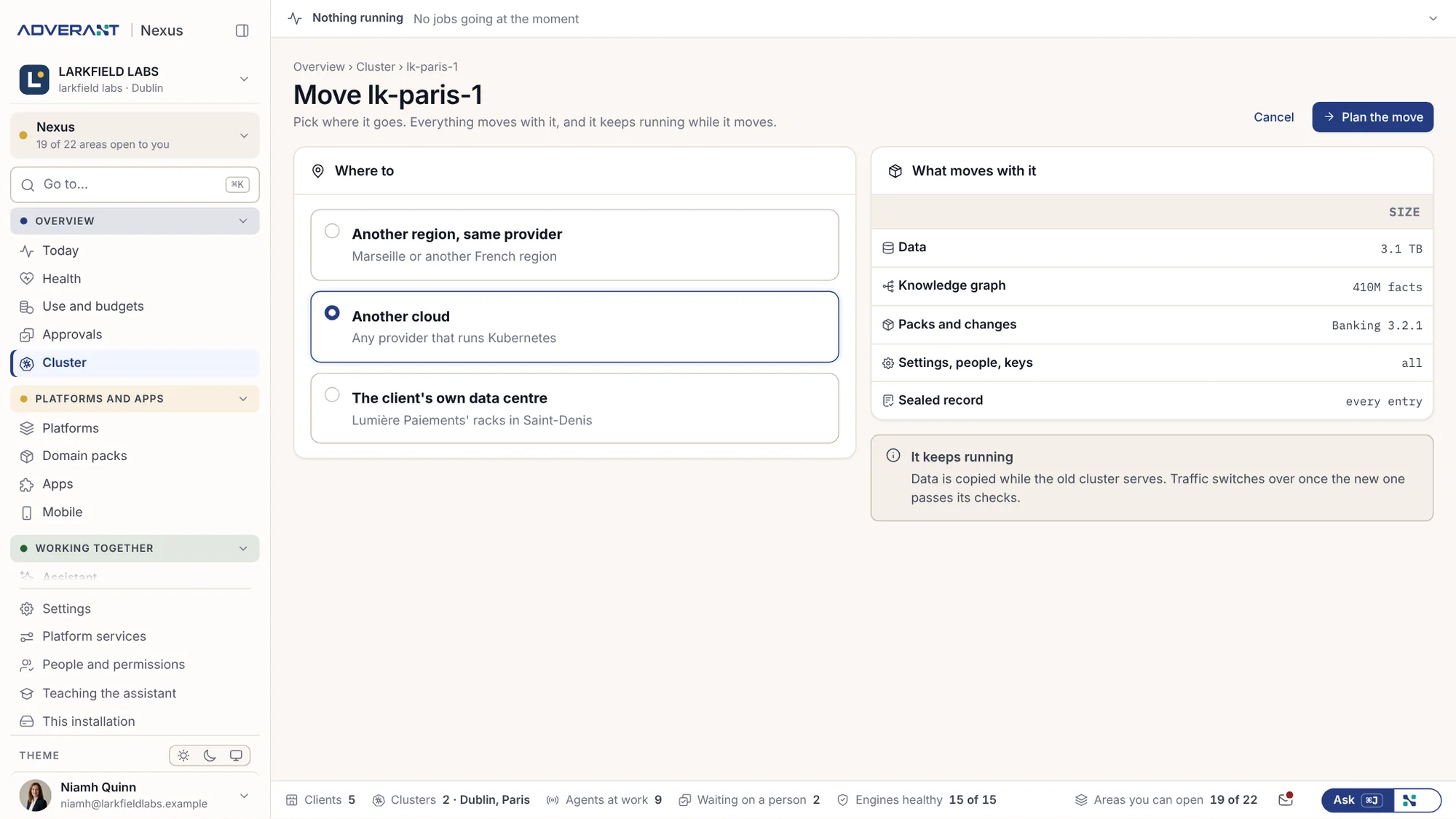
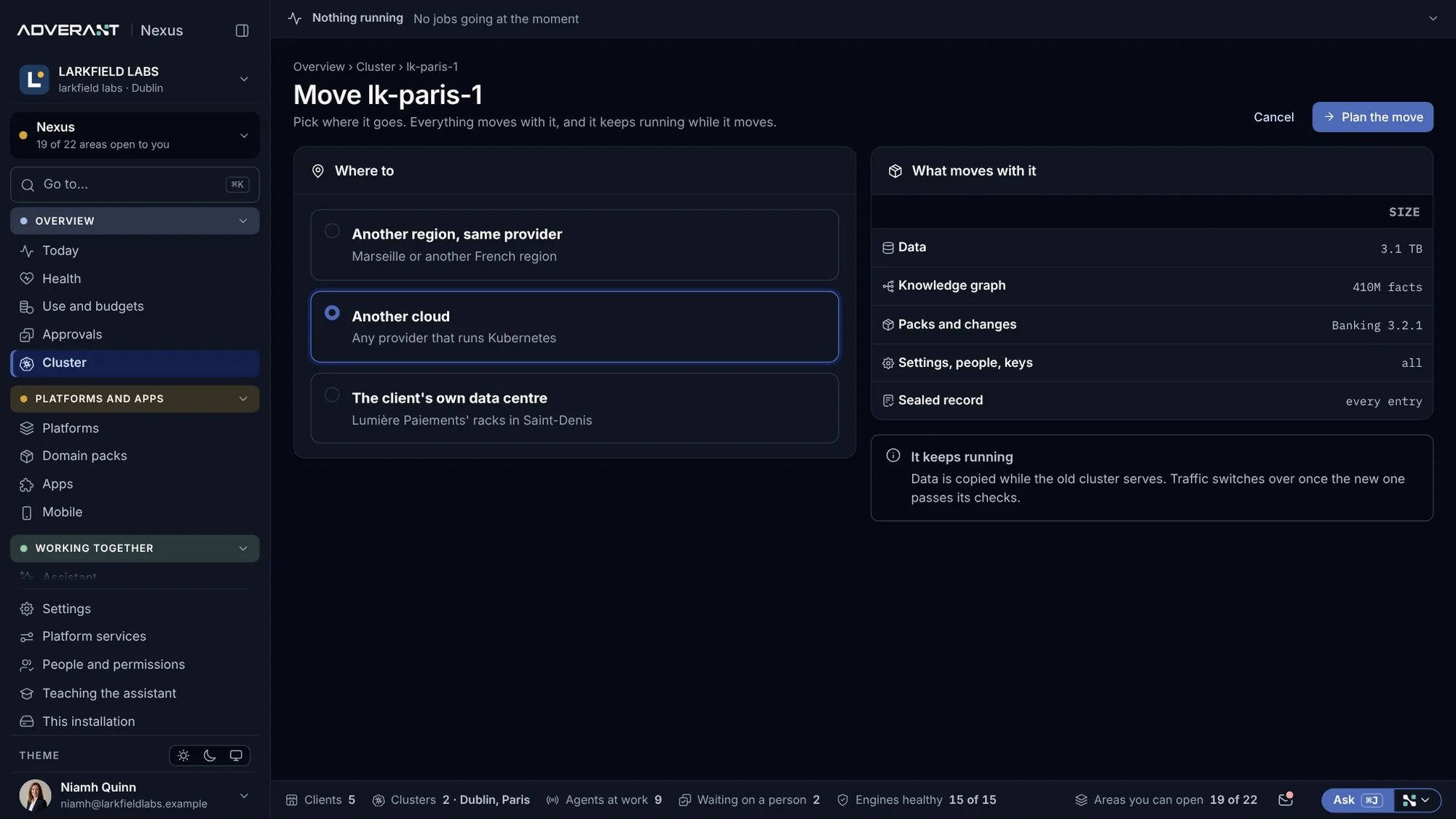
Capacity grows and shrinks with demand, and upgrades go out one node at a time, so nobody is interrupted. Nobody is locked in either: any cluster can move to another region, another cloud or the client’s own data centre, with its data, knowledge graph, packs and settings.
Going live and growing
- One click to go live
- Capacity follows demand
- Watched around the clock
Capacity and upgrades
- No downtime
- One node at a time
- Rolled back if needed
Move a cluster
Plan a move to another region, another cloud or the client’s own data centre.
- Data and settings move too
- Keeps running
- No lock-in
For fintech companies and studios.
Who is this for?
Fintech companies, neobanks and payment firms, and the software studios and consultancies that build platforms for them.
Where do we buy it?
In your cloud provider’s marketplace. The licence goes on your normal cloud bill, and the computing power stays with your provider. Adverant never resells it.
Which clouds does it run on?
Any cloud with Kubernetes, and your clients’ own data centres. Each cluster can move later without starting again.
Can our clients see each other?
No. Each client has its own space, with its own users, data and rules, and the walls between them are checked every hour. A client that needs more can have its own cluster.
Does the AI change things on its own?
No. Agents suggest, and a person accepts. Every change is versioned and tested, and every step goes into a record that cannot be altered.
Are Larkfield Labs and Lumière real?
No. They show how a studio and its clients would use Nexus. The screens are real Nexus screens with sample data.
Go deeper
Run your fintech platform on Nexus.
Tell us about your products or your clients, and the cloud you use. We will show you what running them on Nexus looks like.