

Everything your company knows, connected and ready to ask.
At the heart of Nexus is a knowledge graph built from your documents, mail, systems and records. Think of it as your own search engine for the business. The ontology says what your customers, contracts, ships or claims are and how they connect. GraphRAG then gives every AI the facts that matter to a question, drawn from across the whole business and each with its source. That is far more context than any prompt can hold, and it is why the answers can be trusted.
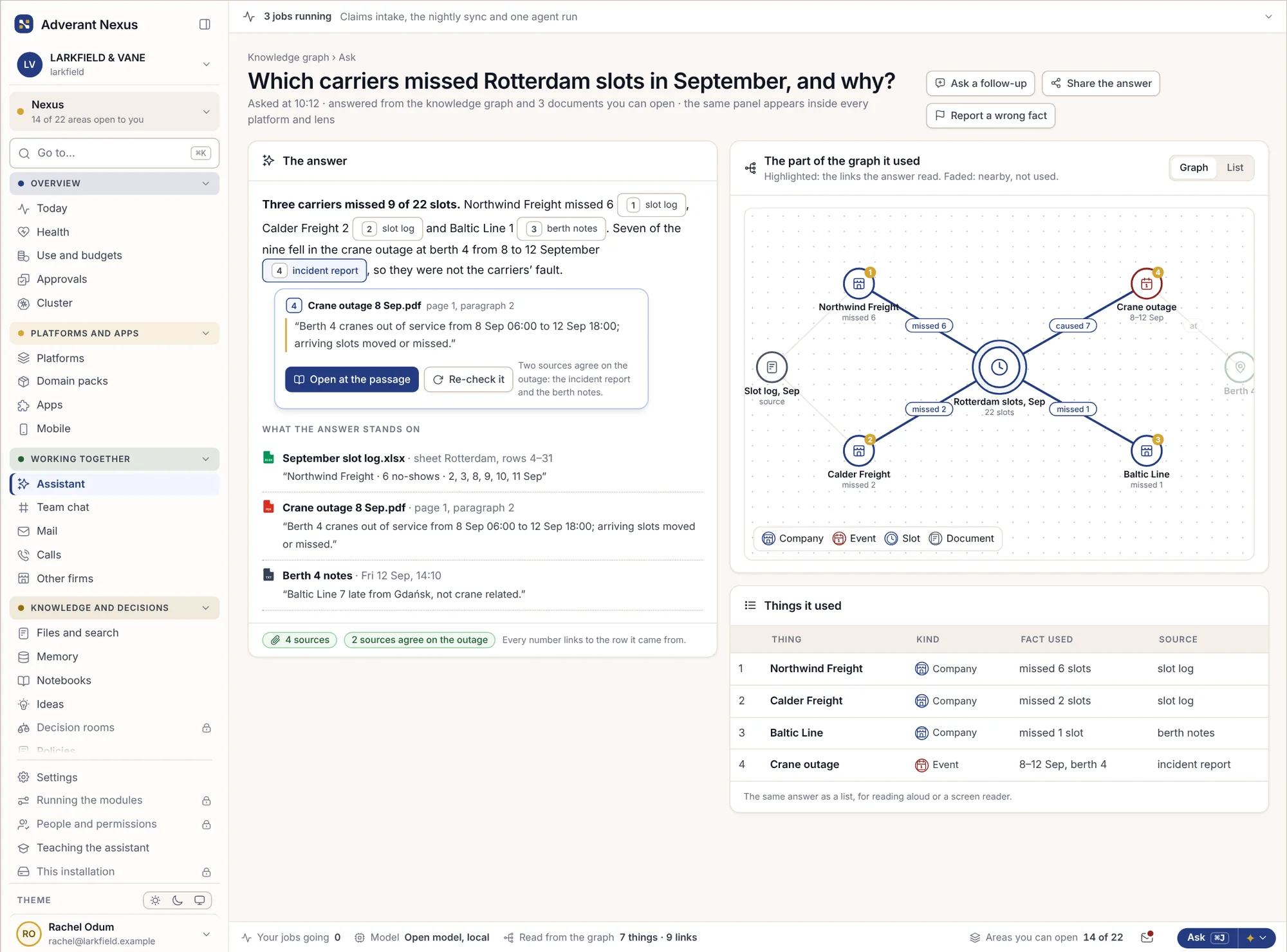
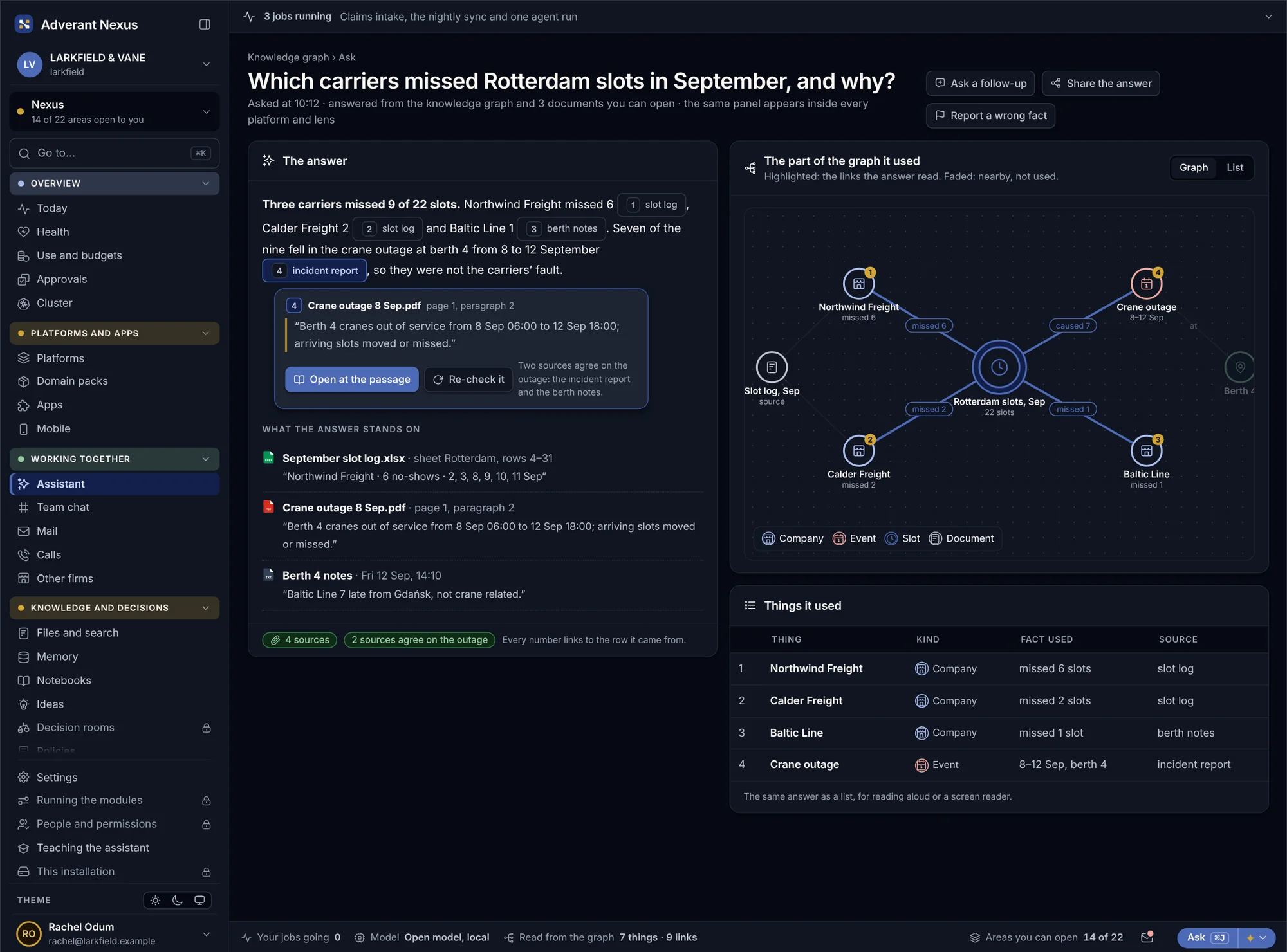
The full context, not just the nearest paragraph.
Ordinary search finds documents that use the same words. GraphRAG follows the connections: a question about a carrier reaches its contracts, its claims, the ships it runs and the mail about them, even when none of them use the same words. The AI answers from that whole picture, and shows each fact it used.
- Answers drawn from across the business
- Connections followed, not just keywords
- Summaries of whole topics for broad questions
- Only facts the person asking may see
Shape the model. See what it touches first.
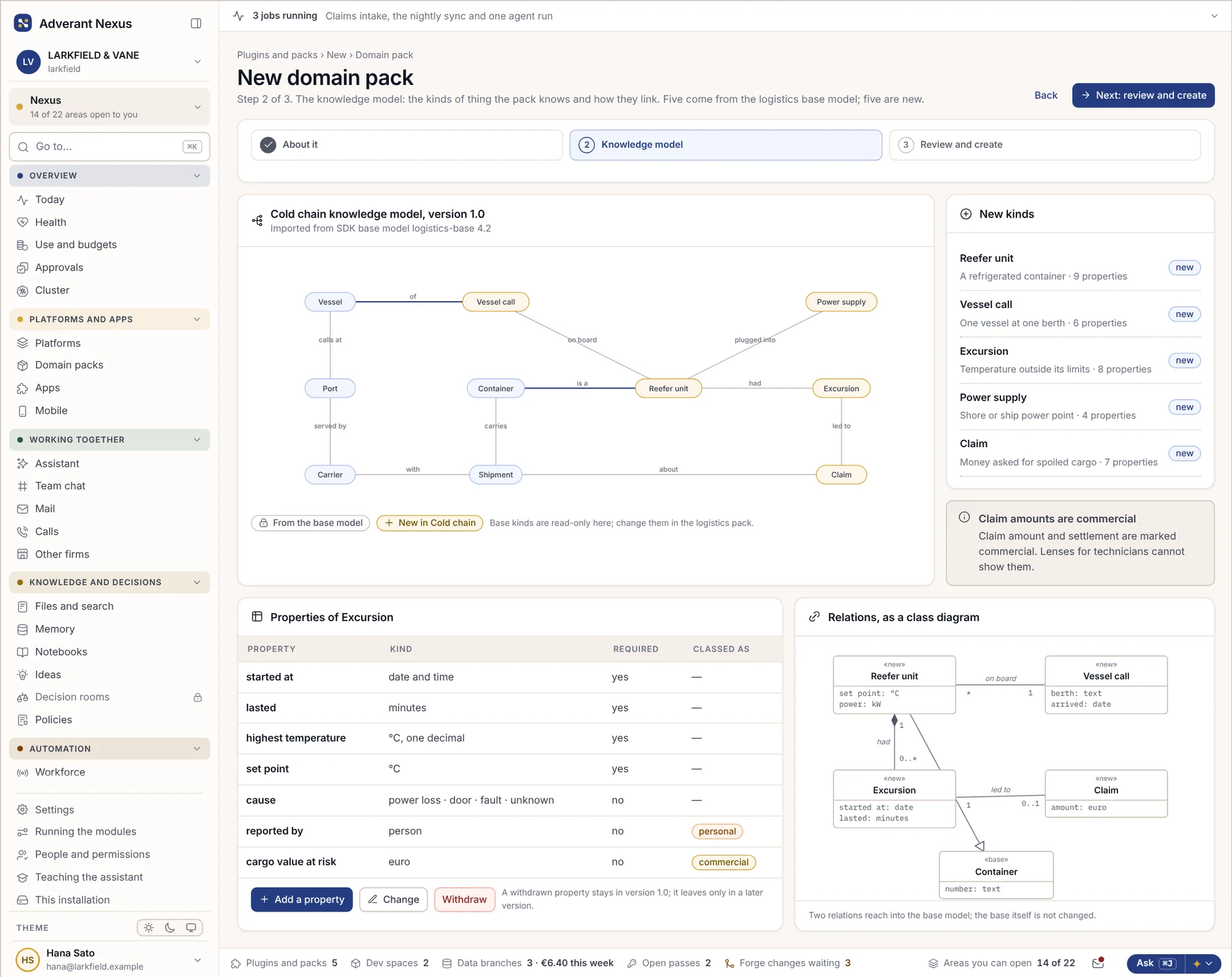
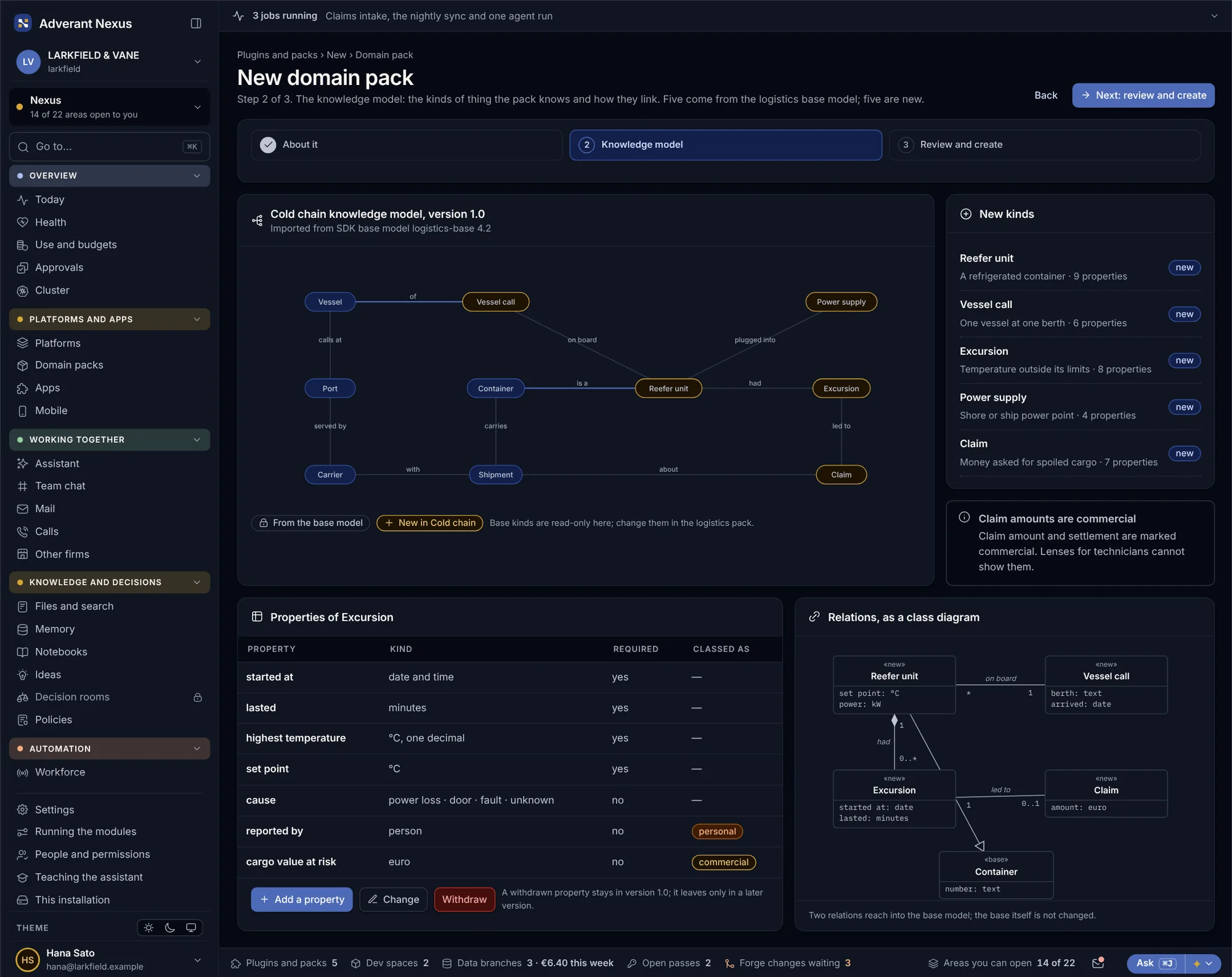
Add a kind of thing, a property or a link, and see how many existing facts it would change before you save. Domain packs bring a starting model for their industry, and you extend it for your own business.
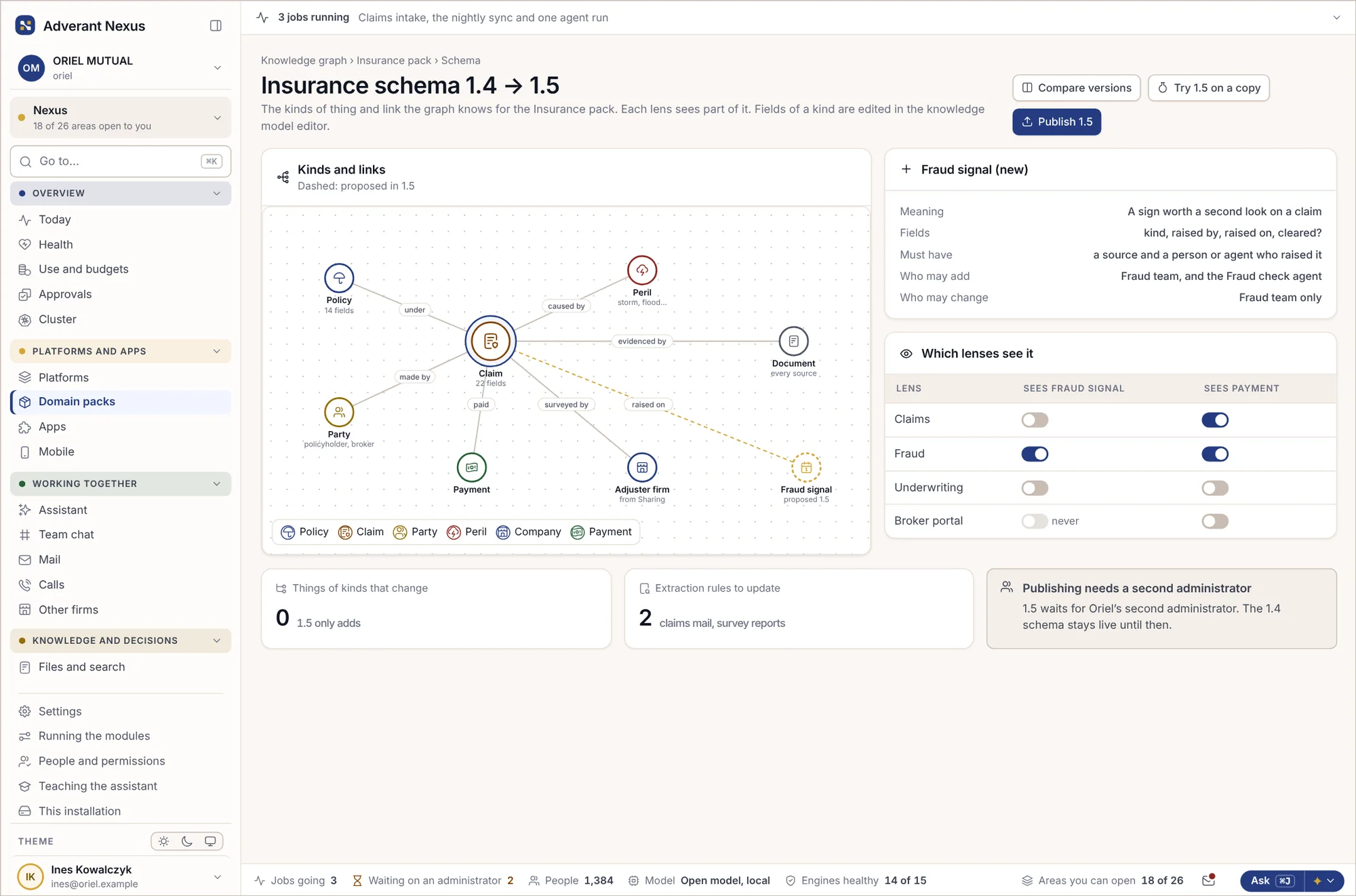
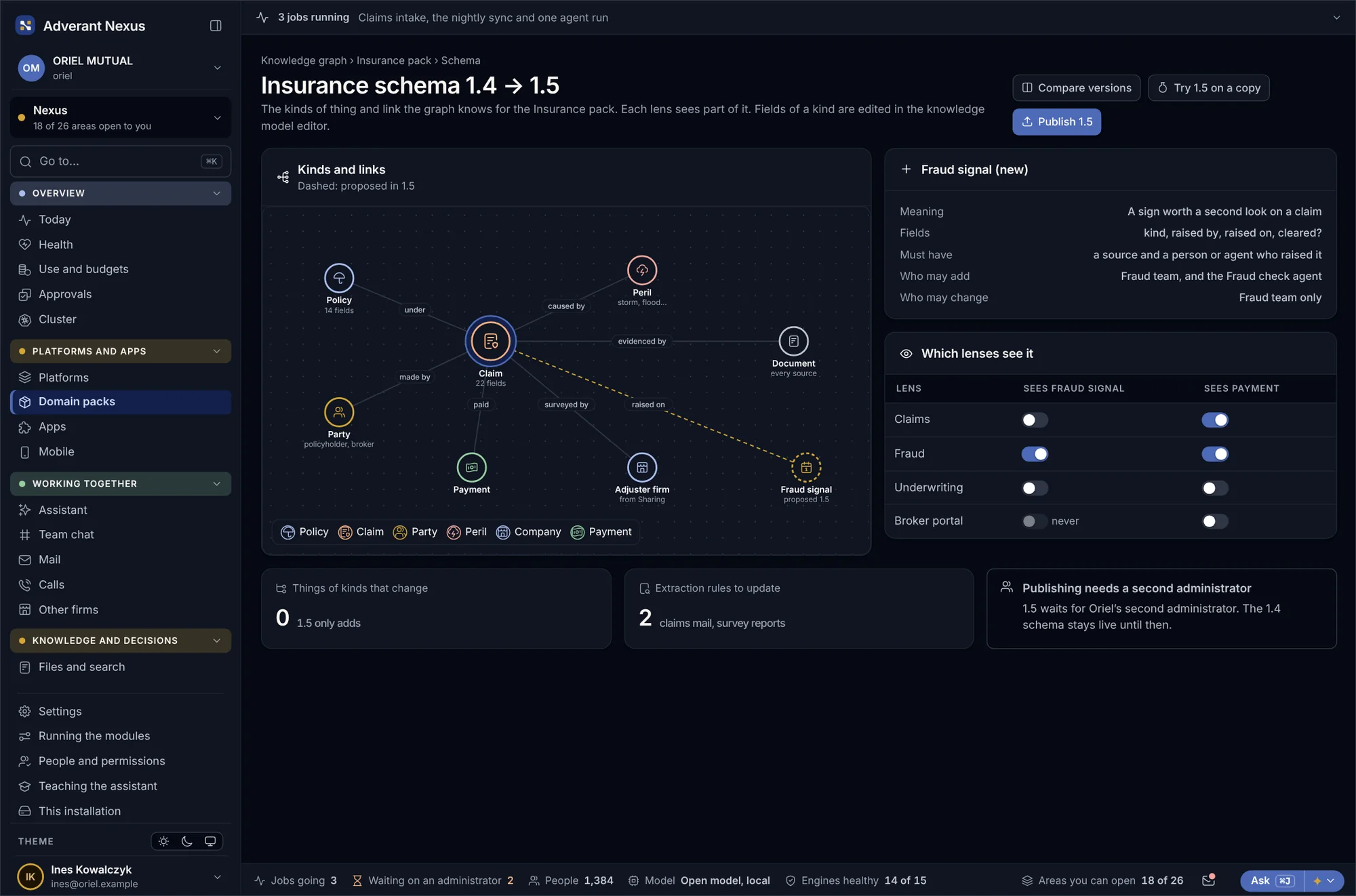
The schema for a domain
Add a new kind of thing to a domain’s schema and choose which lenses see it.
- Kinds, properties and links on screen
- Lenses decide what each role sees
- Every change versioned
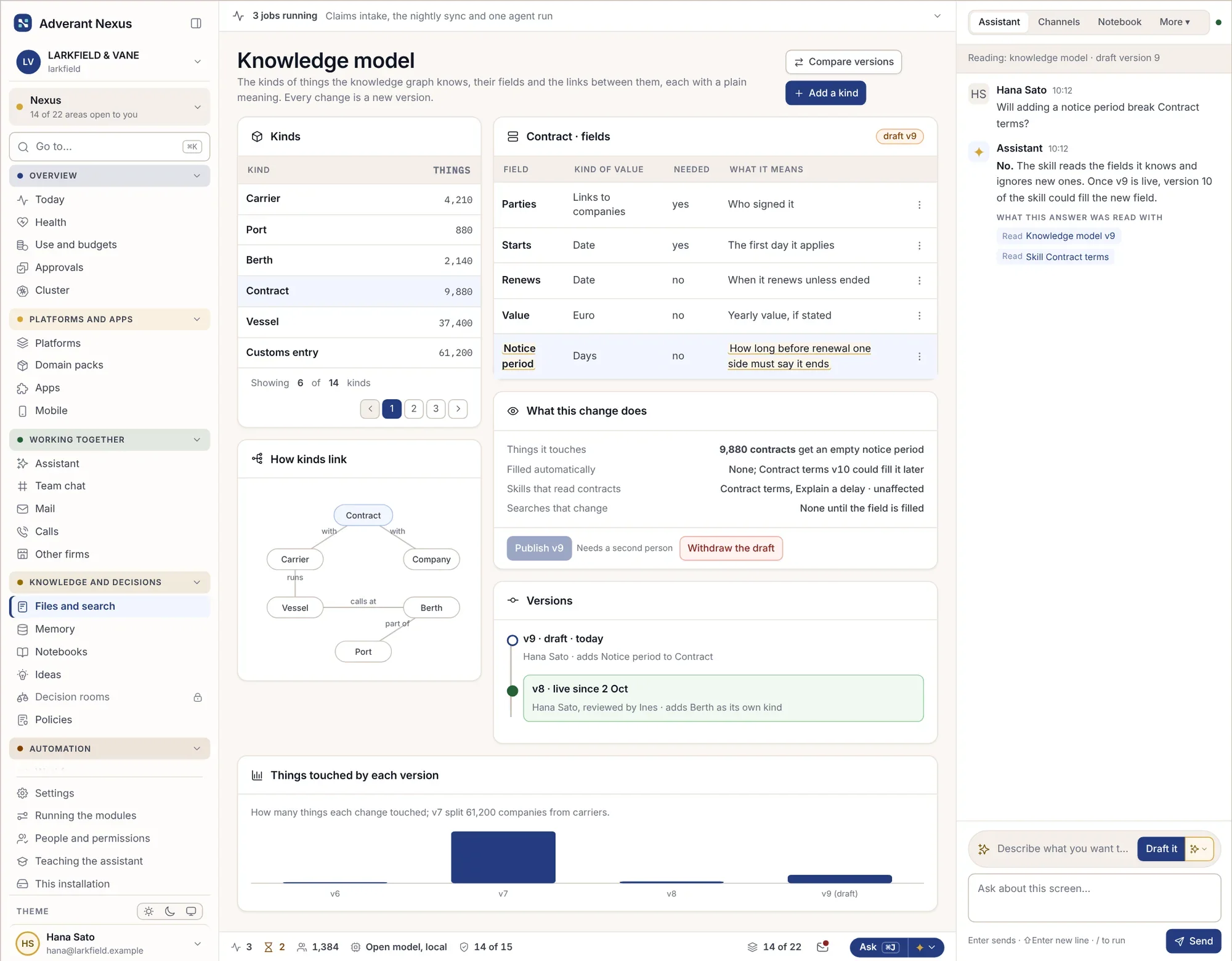
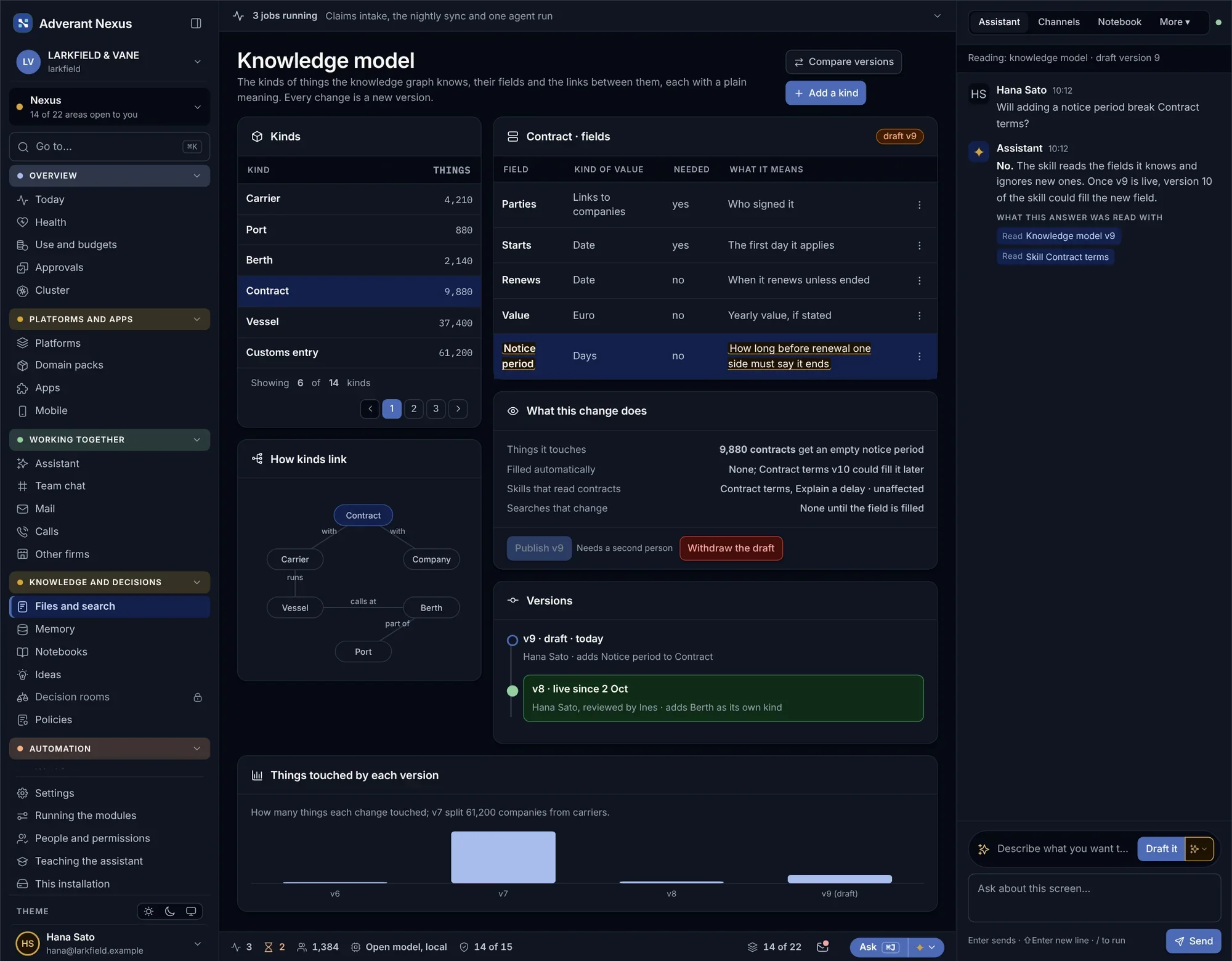
The knowledge model editor
Add a notice period to contracts and see every record it affects before the change is made.
- Impact shown before saving
- Reversible
- Reviewed like code
Start from an industry model
Domain packs bring a base model. Add the kinds of thing only your business has on top of it.
- Base models for each industry
- Your own kinds layered on top
- Upgrades keep your additions
Change the model safely
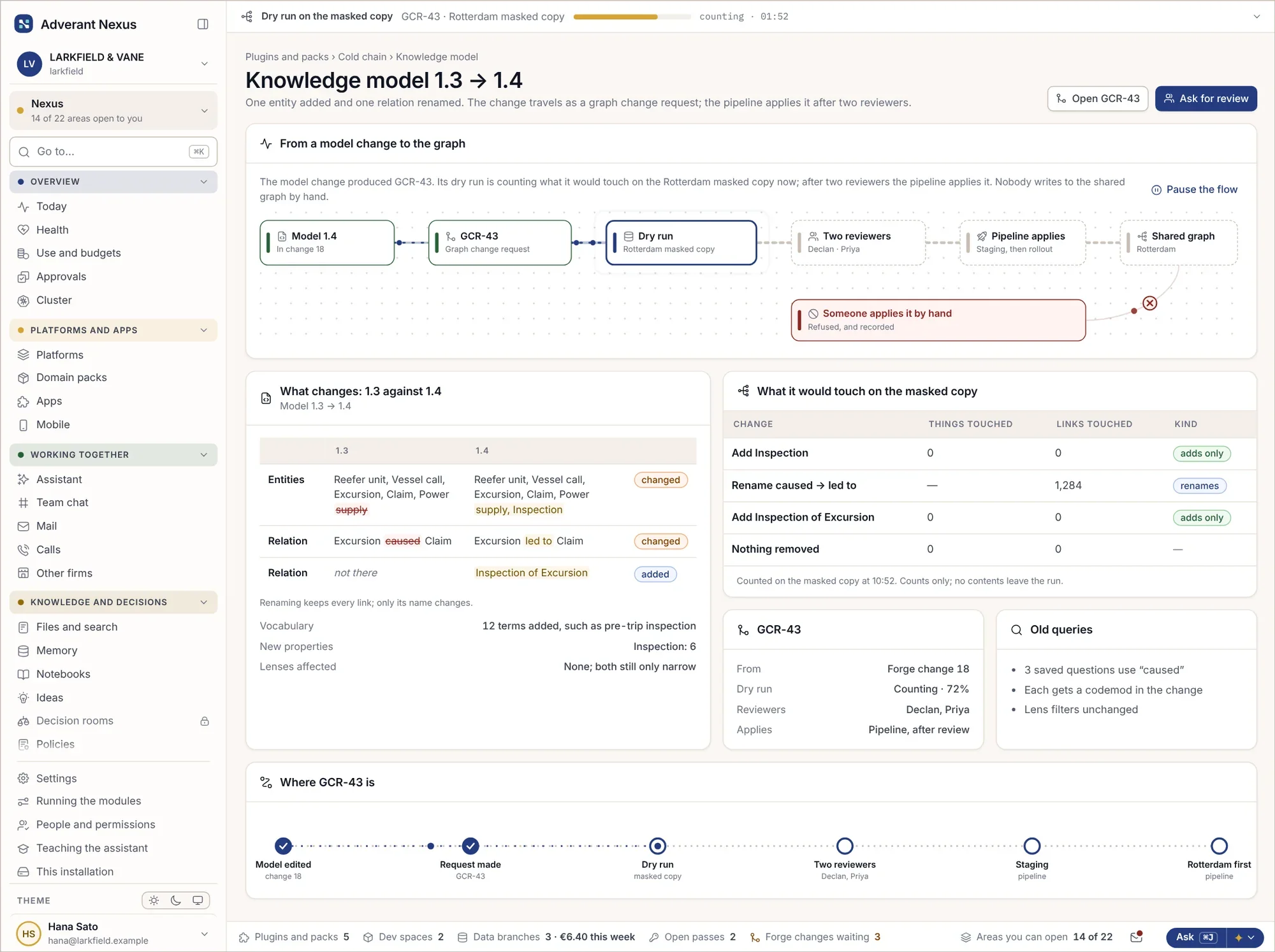
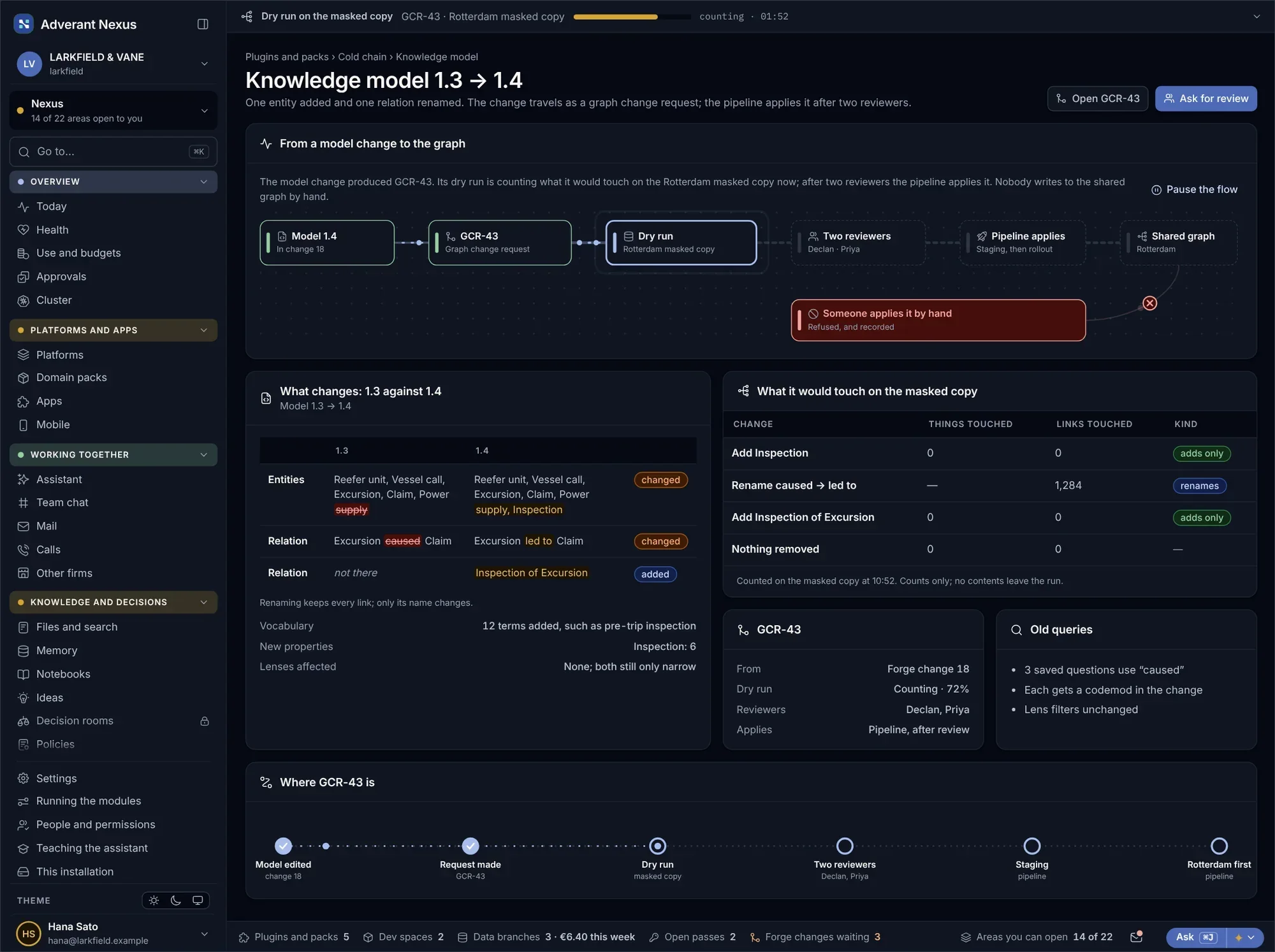
- Versions compared side by side
- Dry run on a masked copy
- A way back for every change
Filled from your documents and systems, checked as it goes.
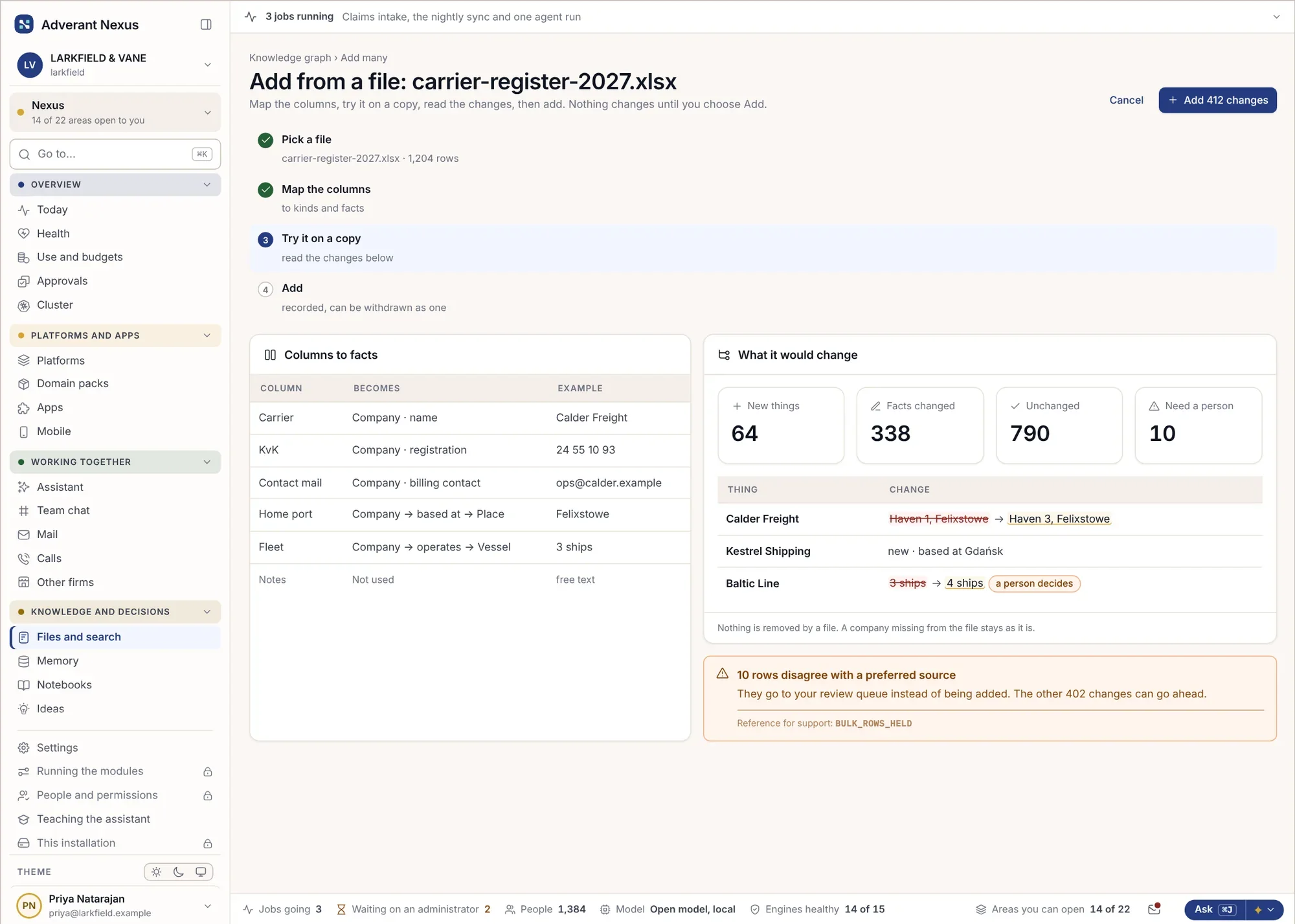
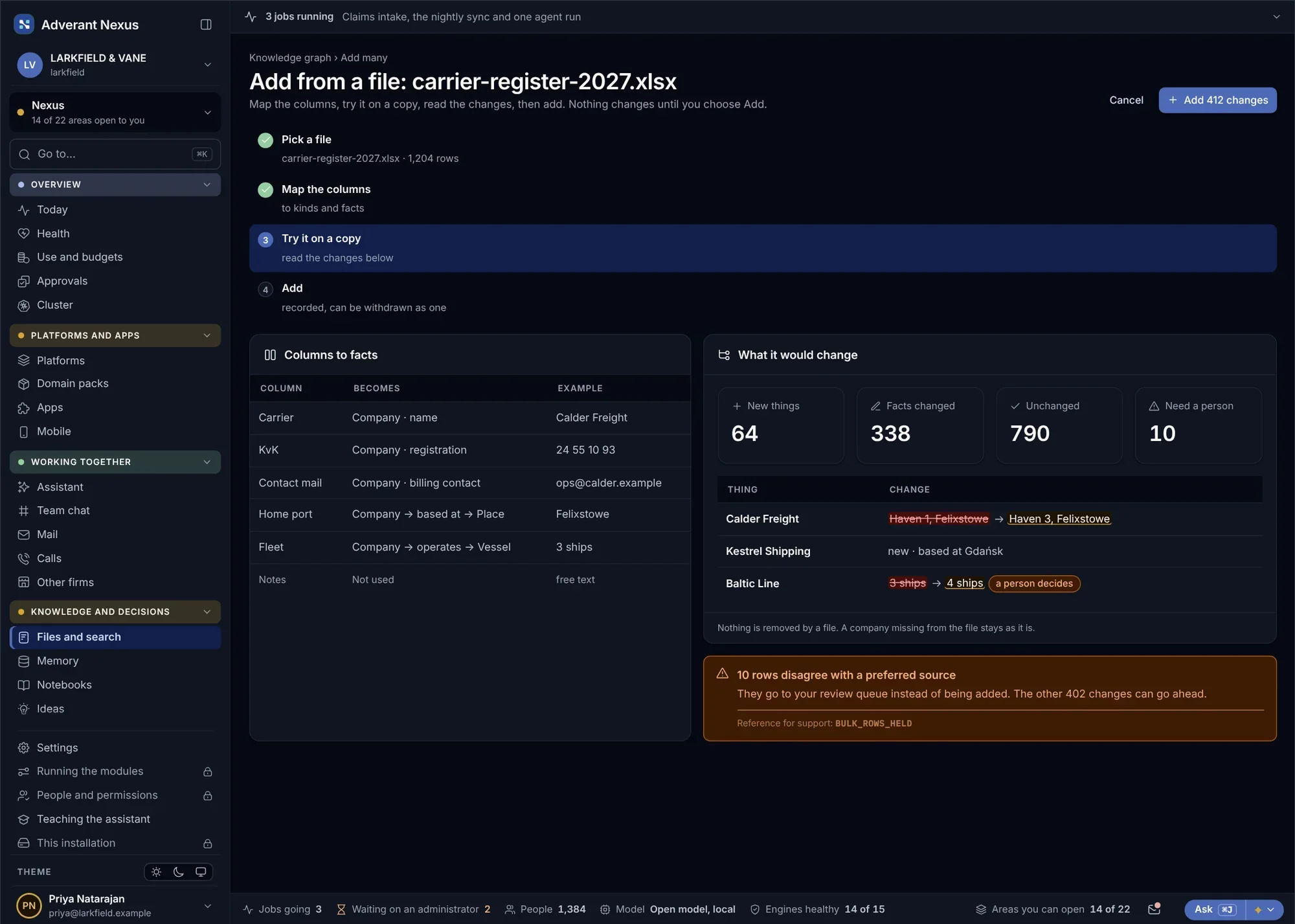
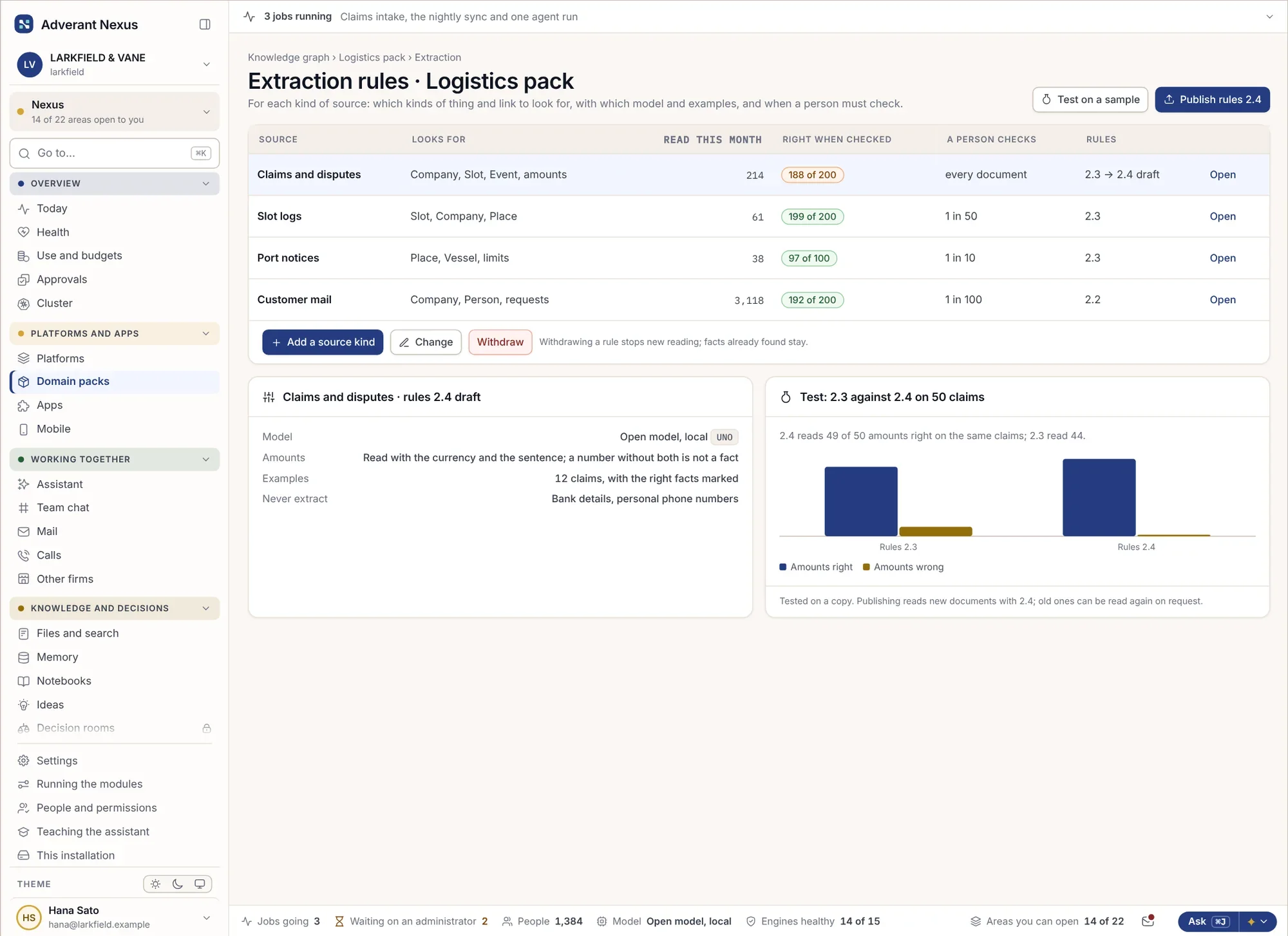
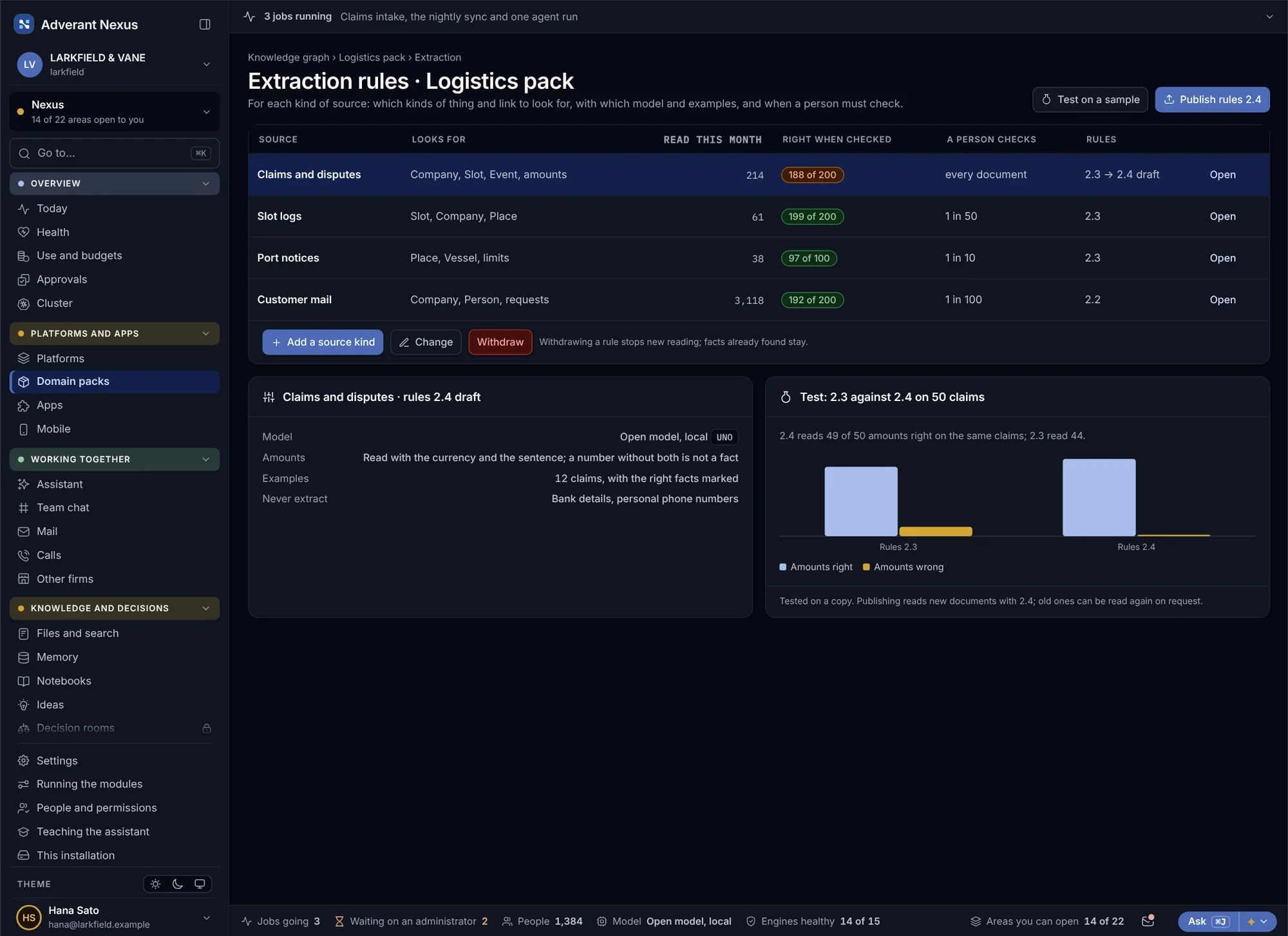
Facts are extracted from documents and loaded from registers and databases. Extraction rules are tested before they change anything, large loads show their effect before they run, and duplicates wait for a person to decide.
Add many at once
- Checked before loading
- Duplicates caught
- Undone if wrong
Extraction rules
- Rules per kind of document
- Tested on samples
- Then applied
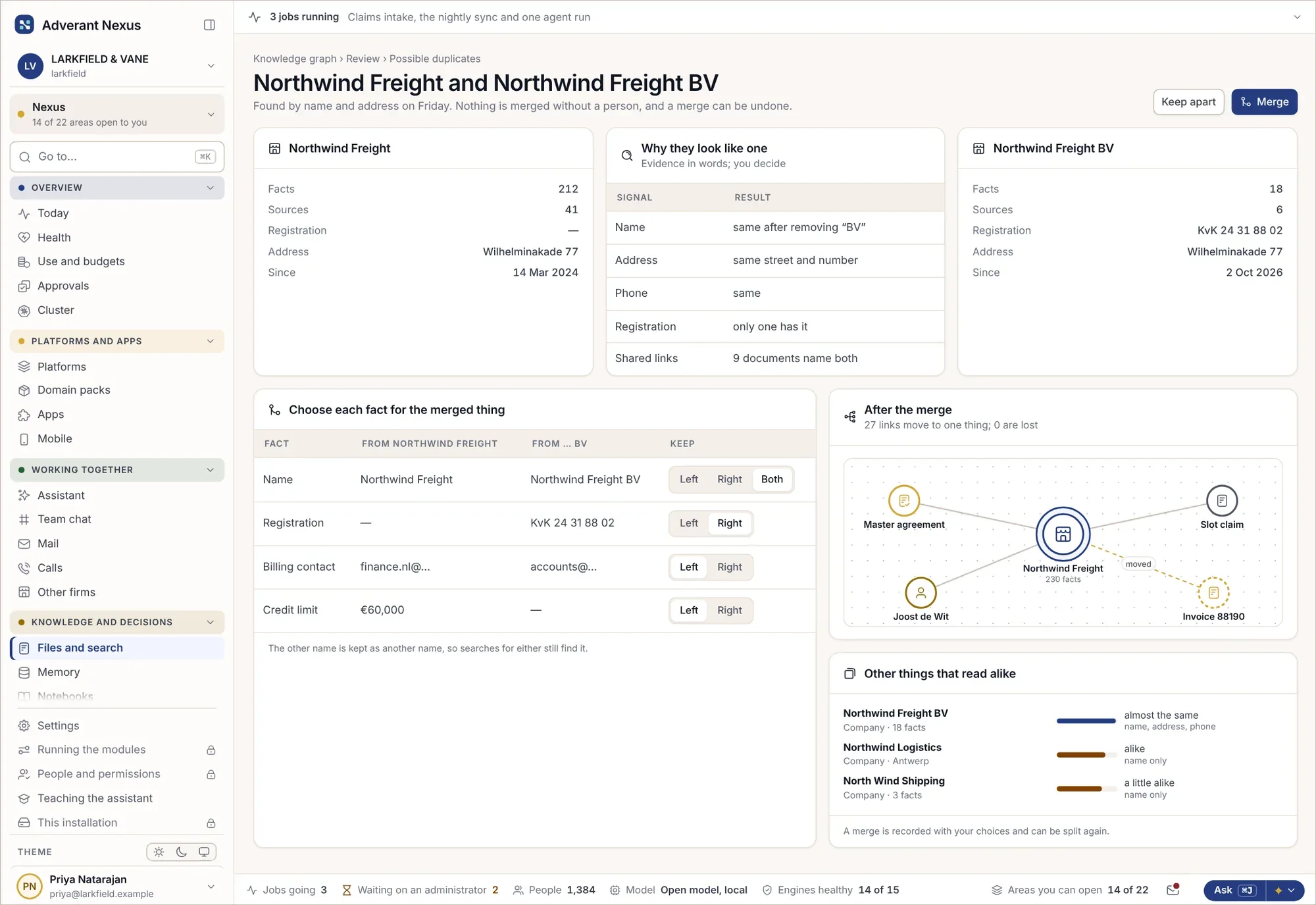
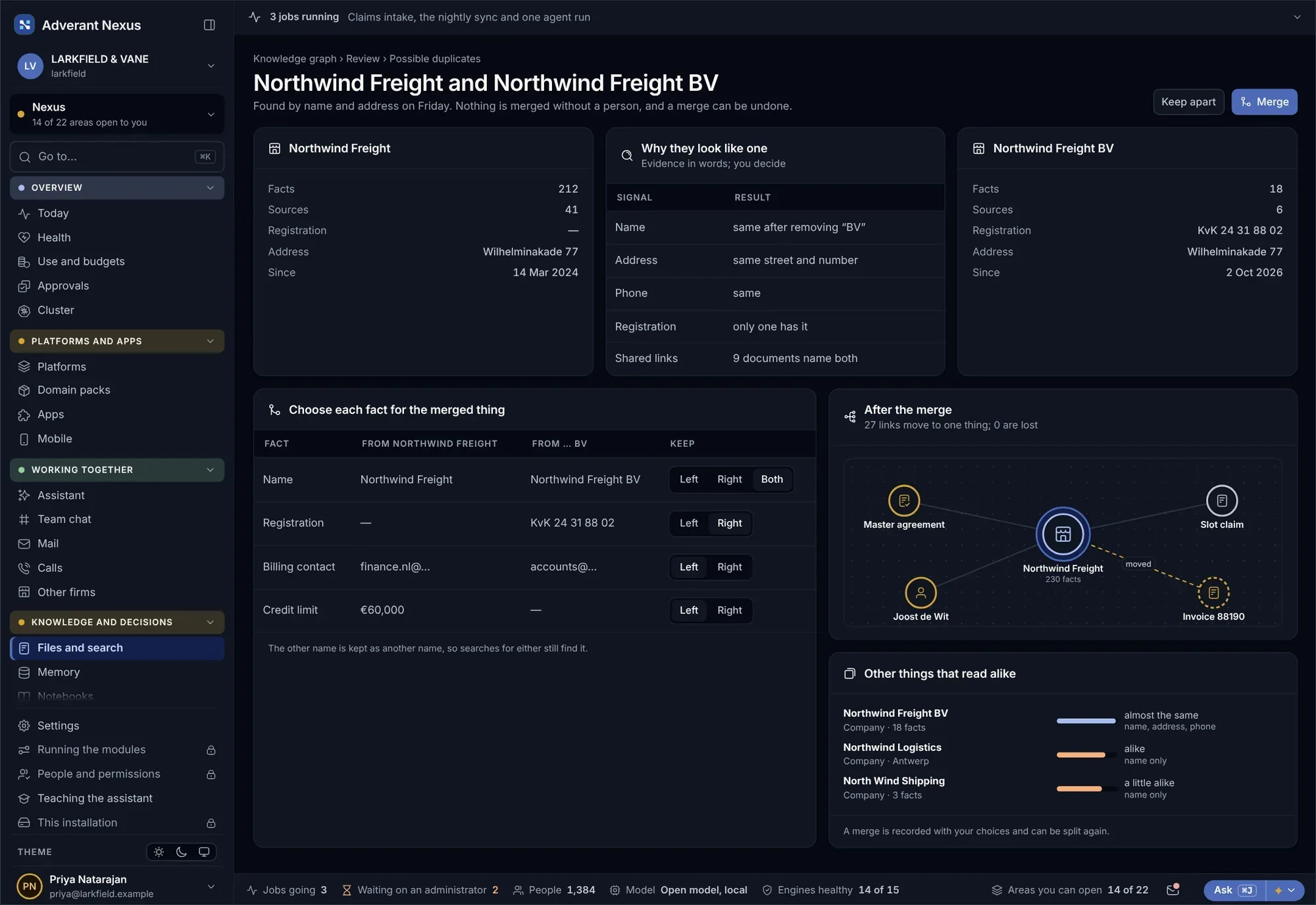
Same thing twice
- Evidence side by side
- Merged or kept apart by a person
- Split again if wrong
Look anything up, and see where it came from.
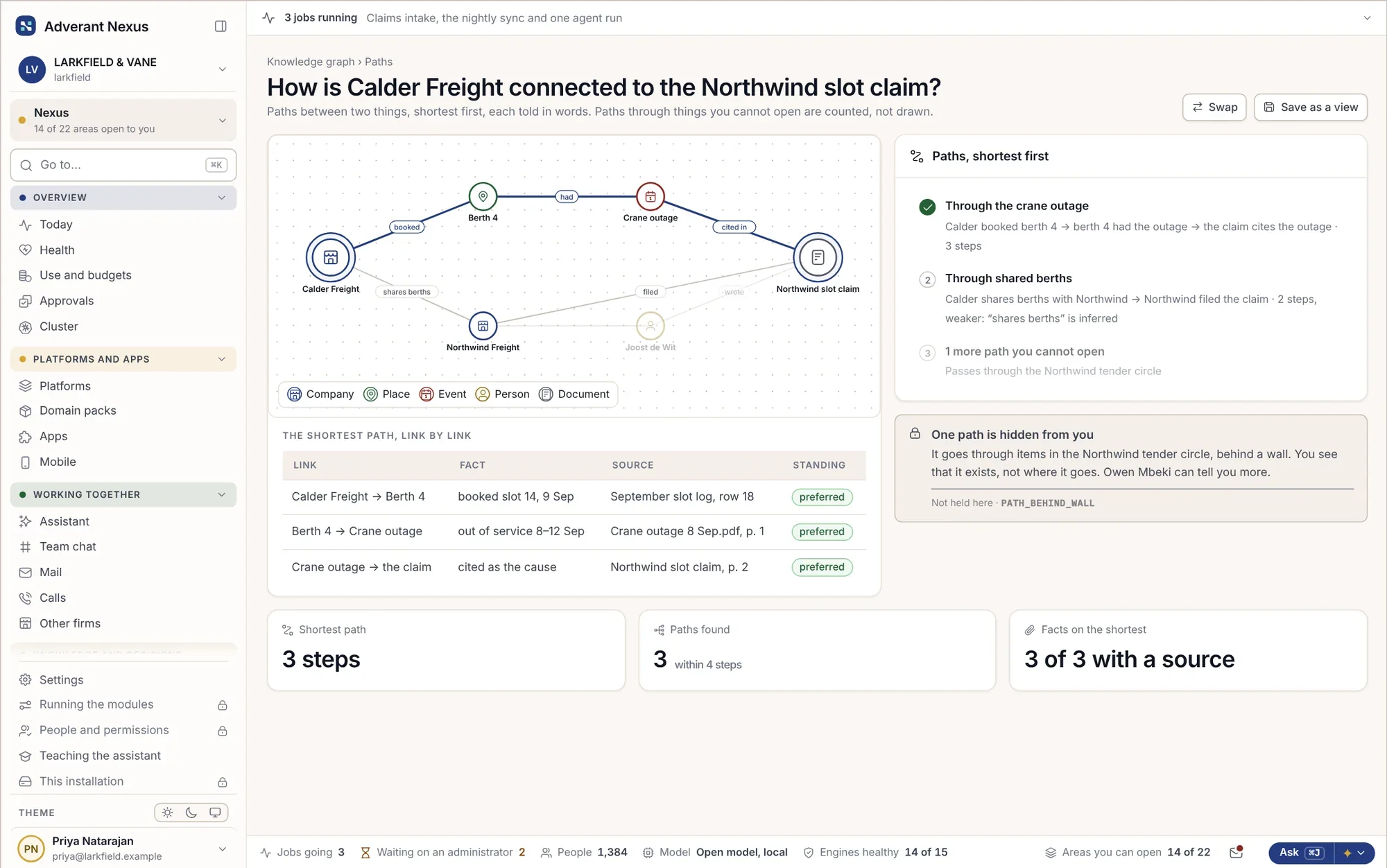
Open one thing on one page before a call. Explore what surrounds it and keep the view for your team. Settle disagreements with the history of each fact.
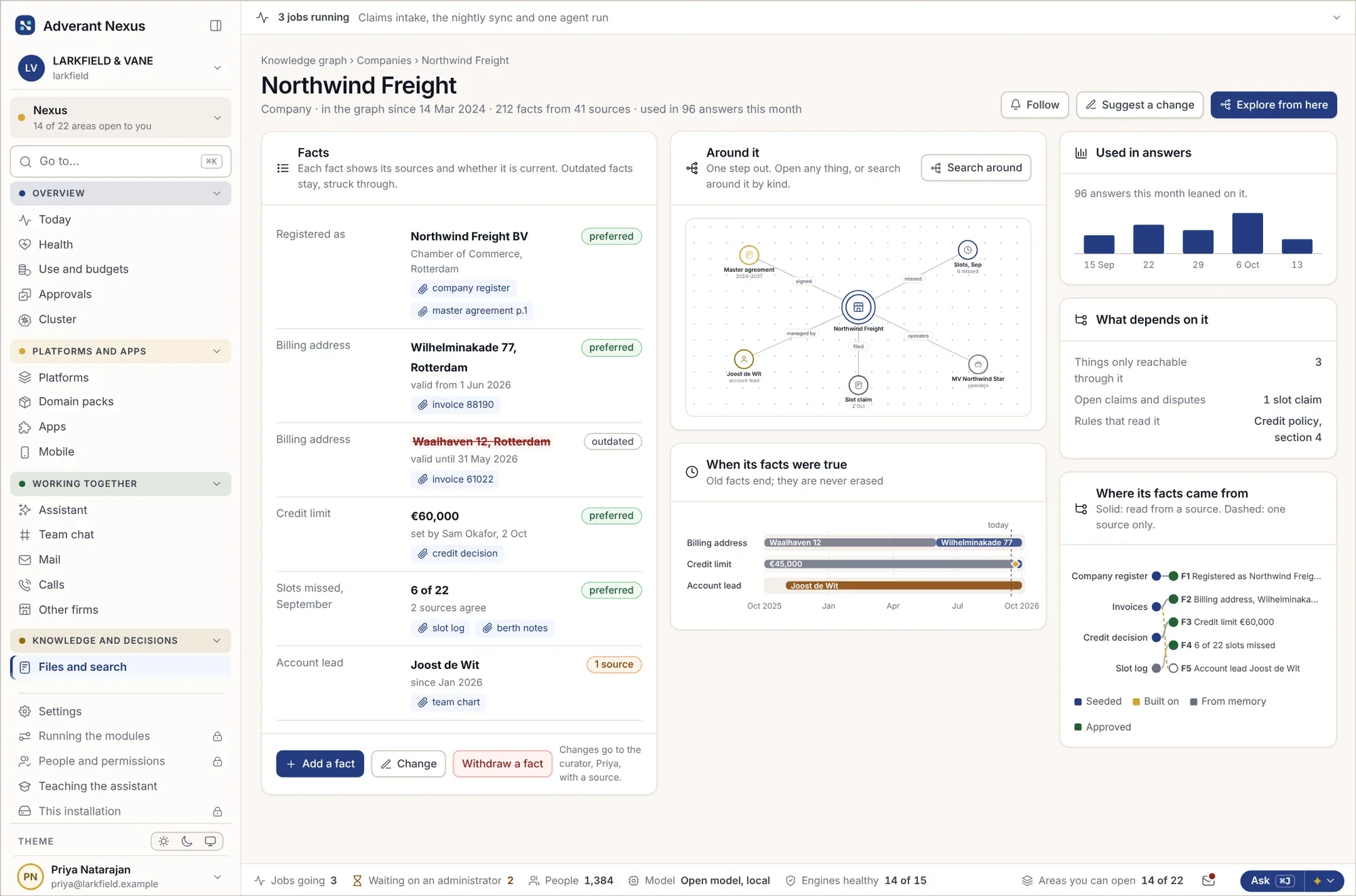
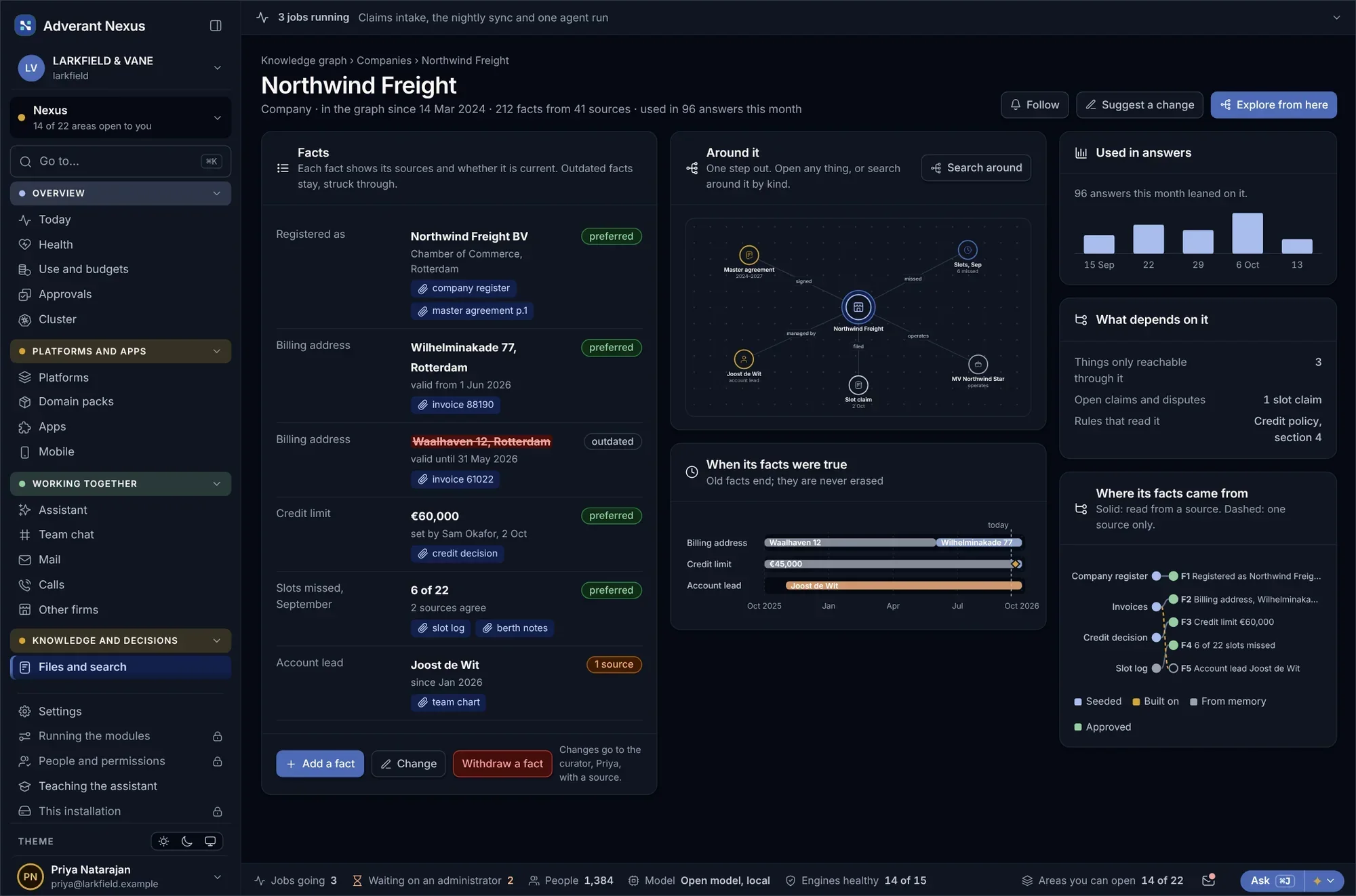
One thing, on one page
What we know about a company before a call: from where, and since when.
- Everything about one thing
- Sources on every line
- Correct a fact where you find it
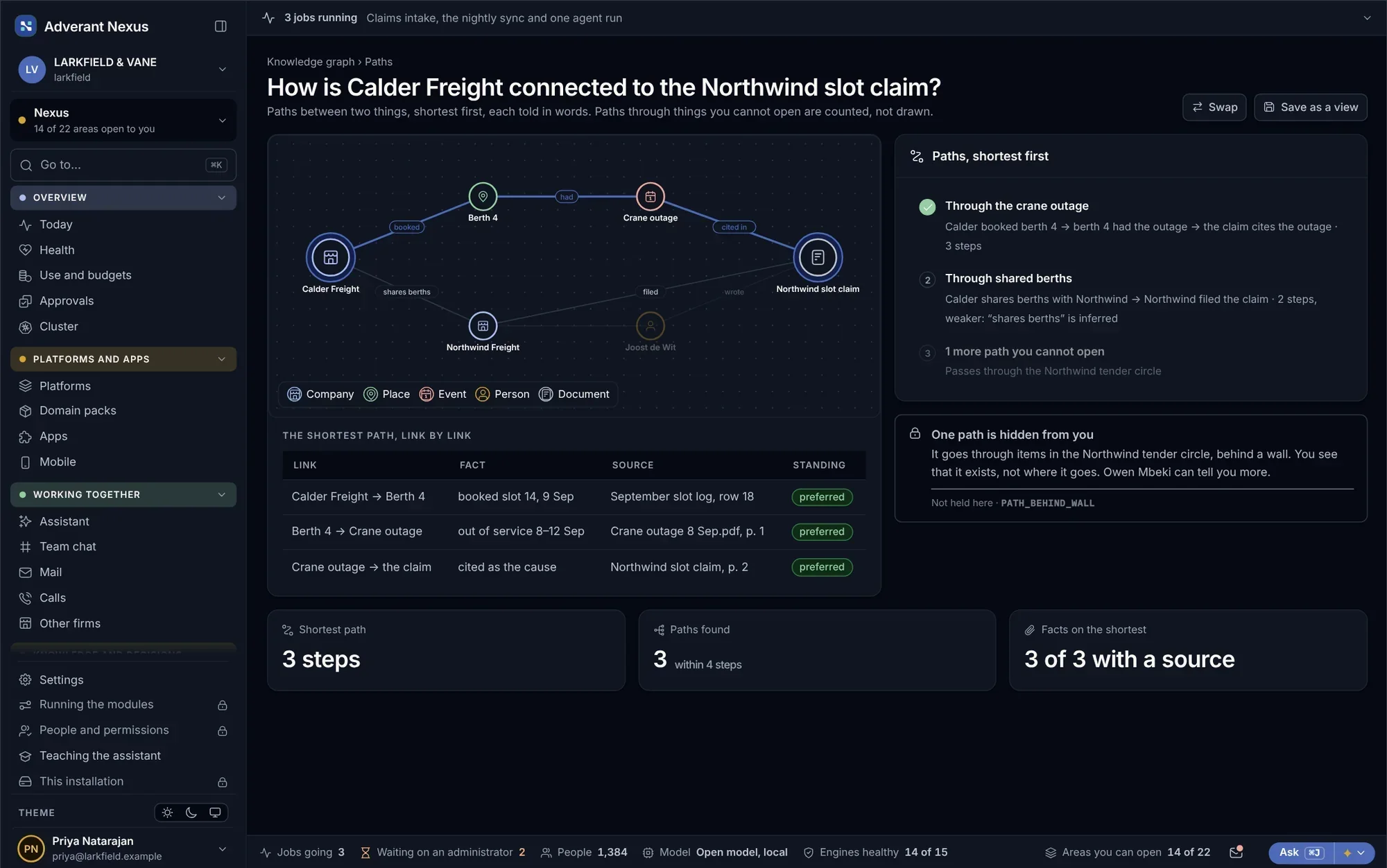
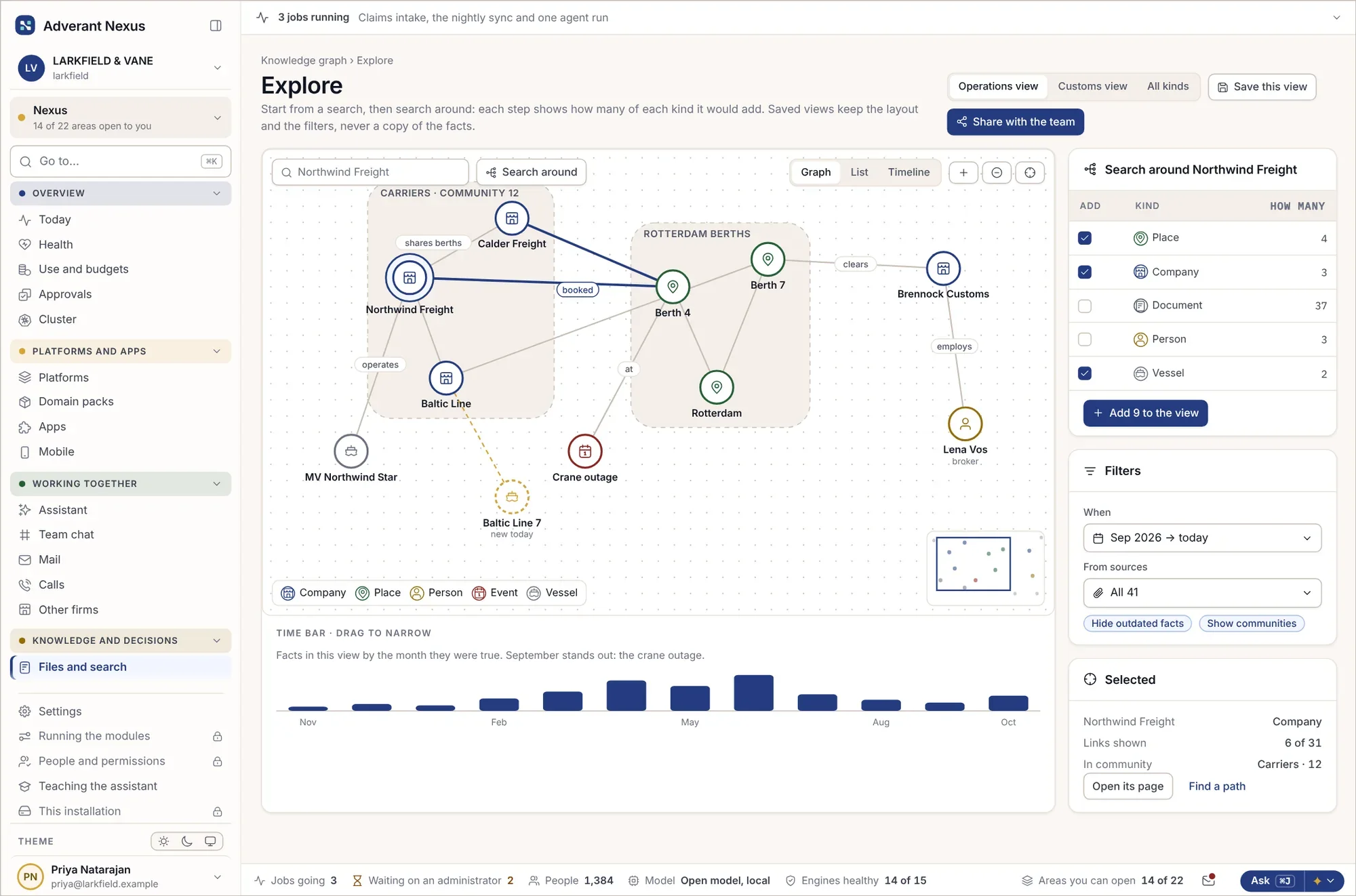
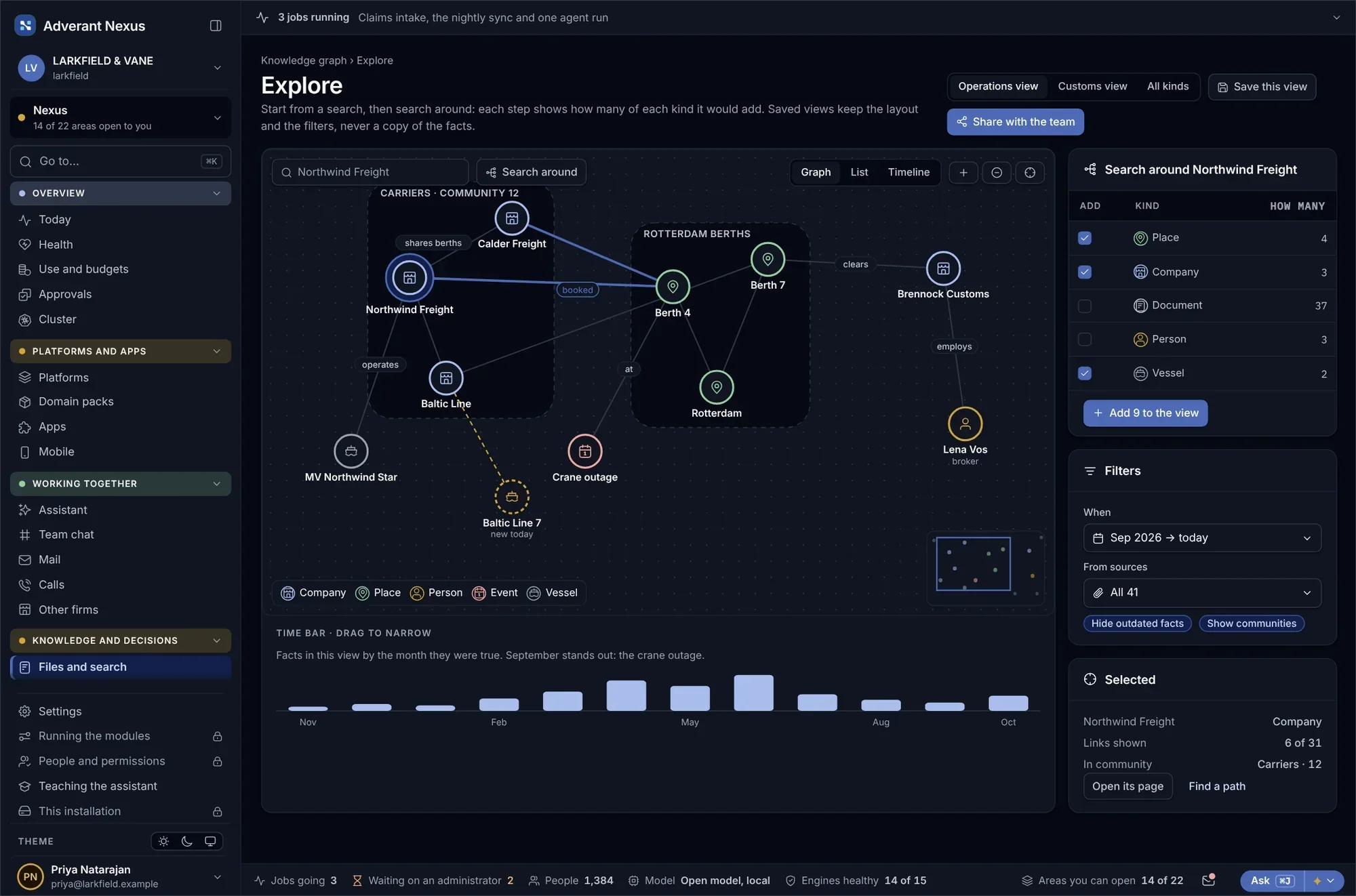
Explore around a thing
Start from a ship, a customer or a berth and see what surrounds it.
- Visual exploration
- Views saved and shared
- Lenses decide what each role sees
Facts over time
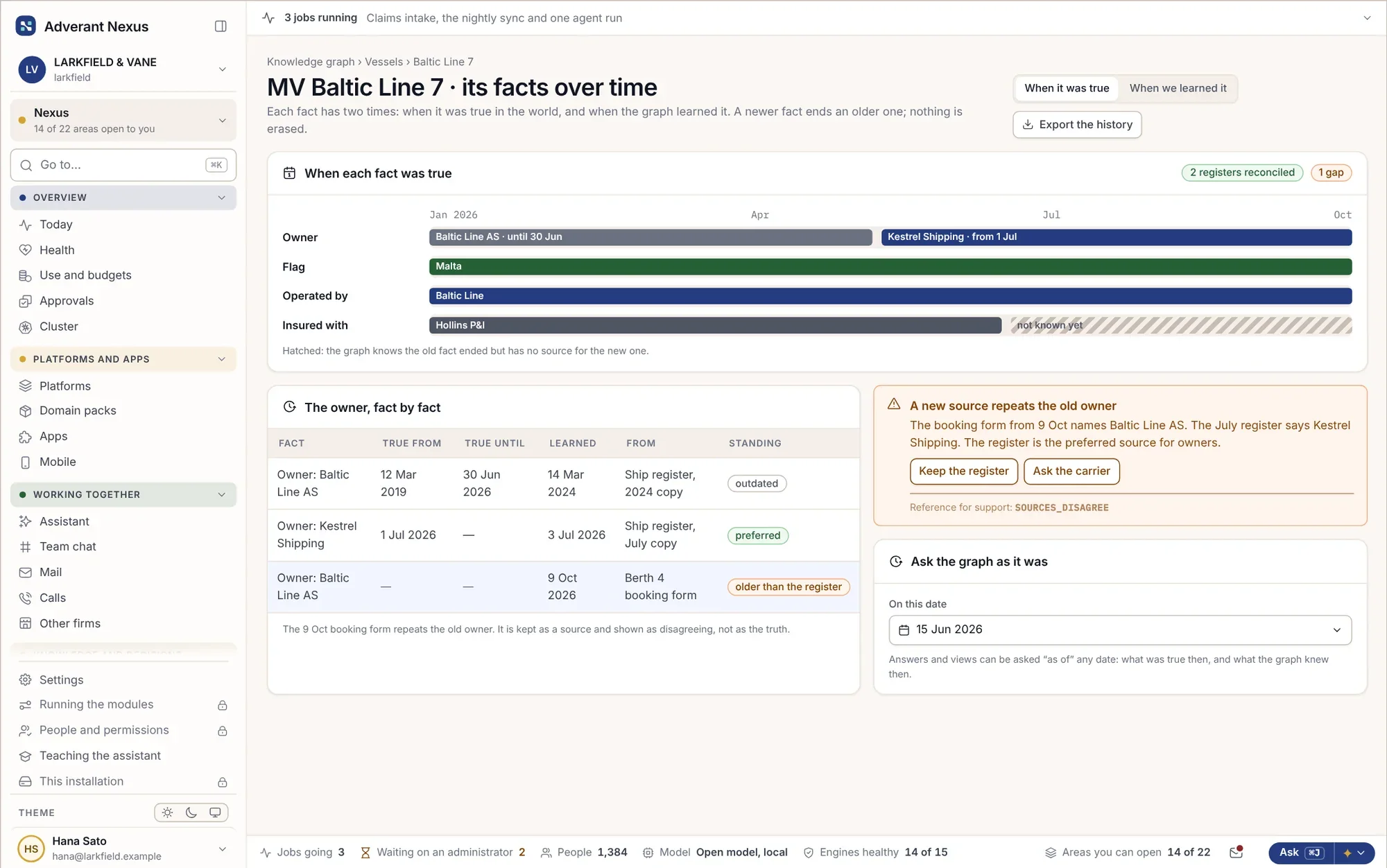
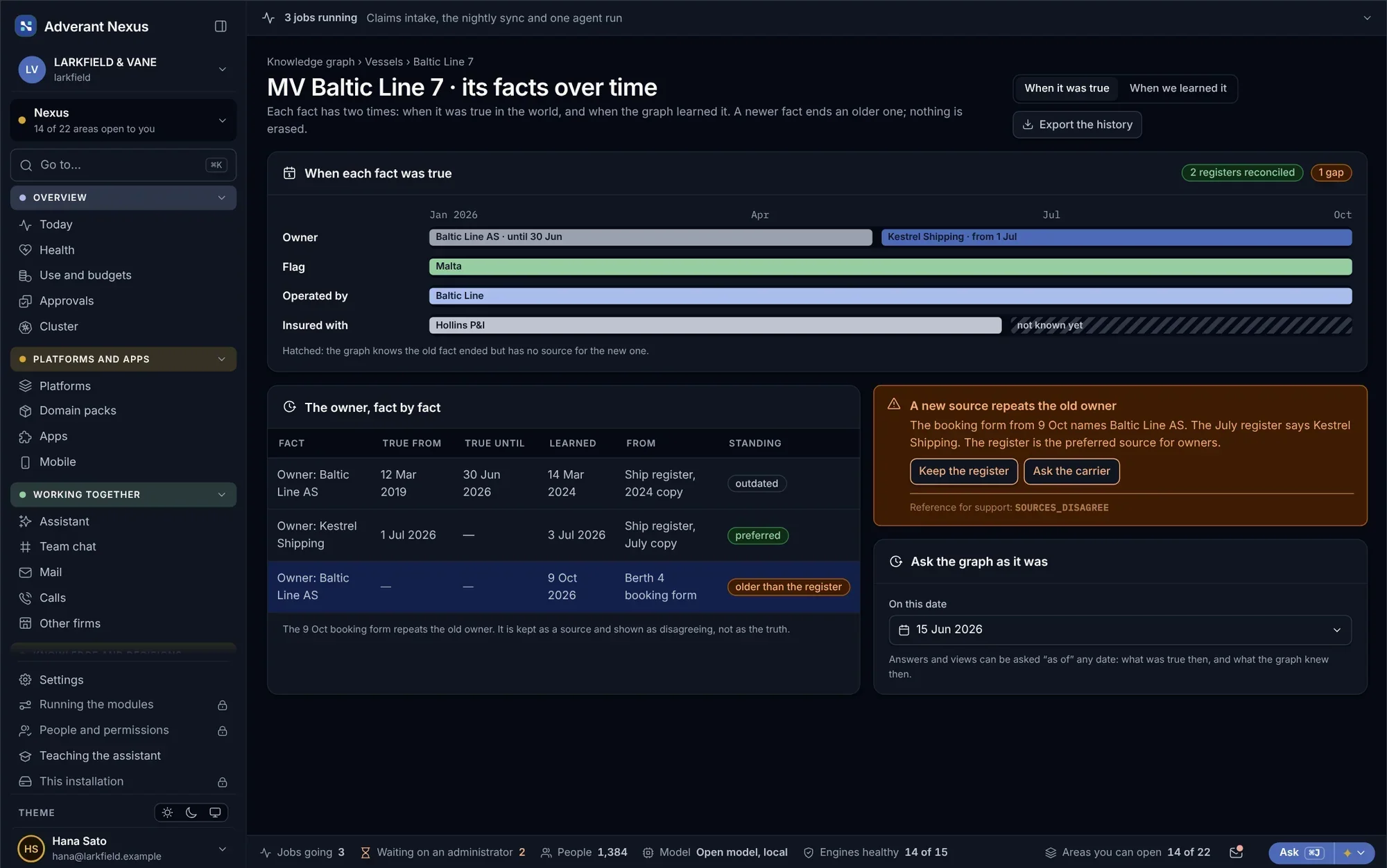
Two registers disagree about a ship’s owner. Settle it with evidence.
- History on every fact
- Sources side by side
- Settled by a person, with a reason
Protected fact by fact.
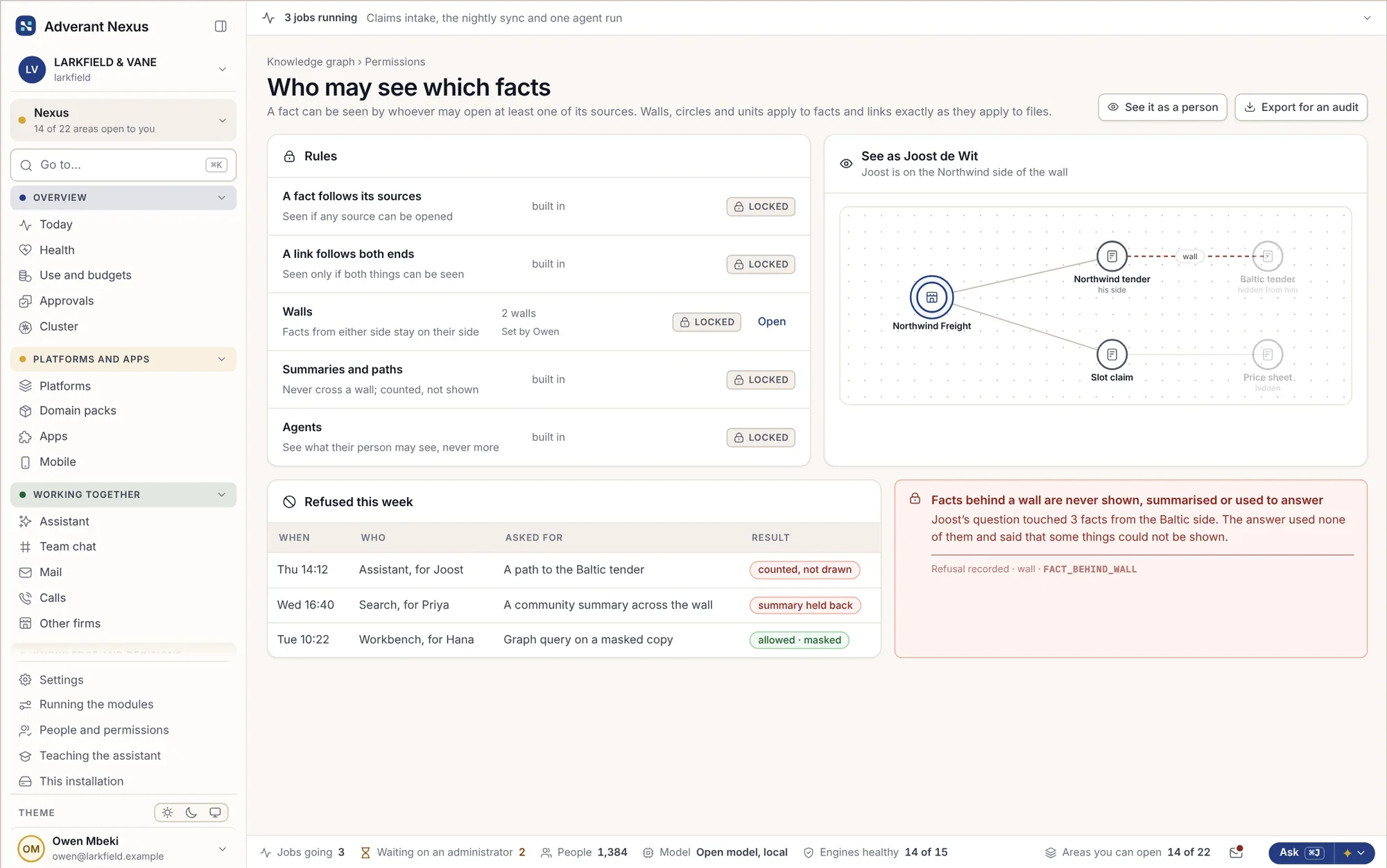
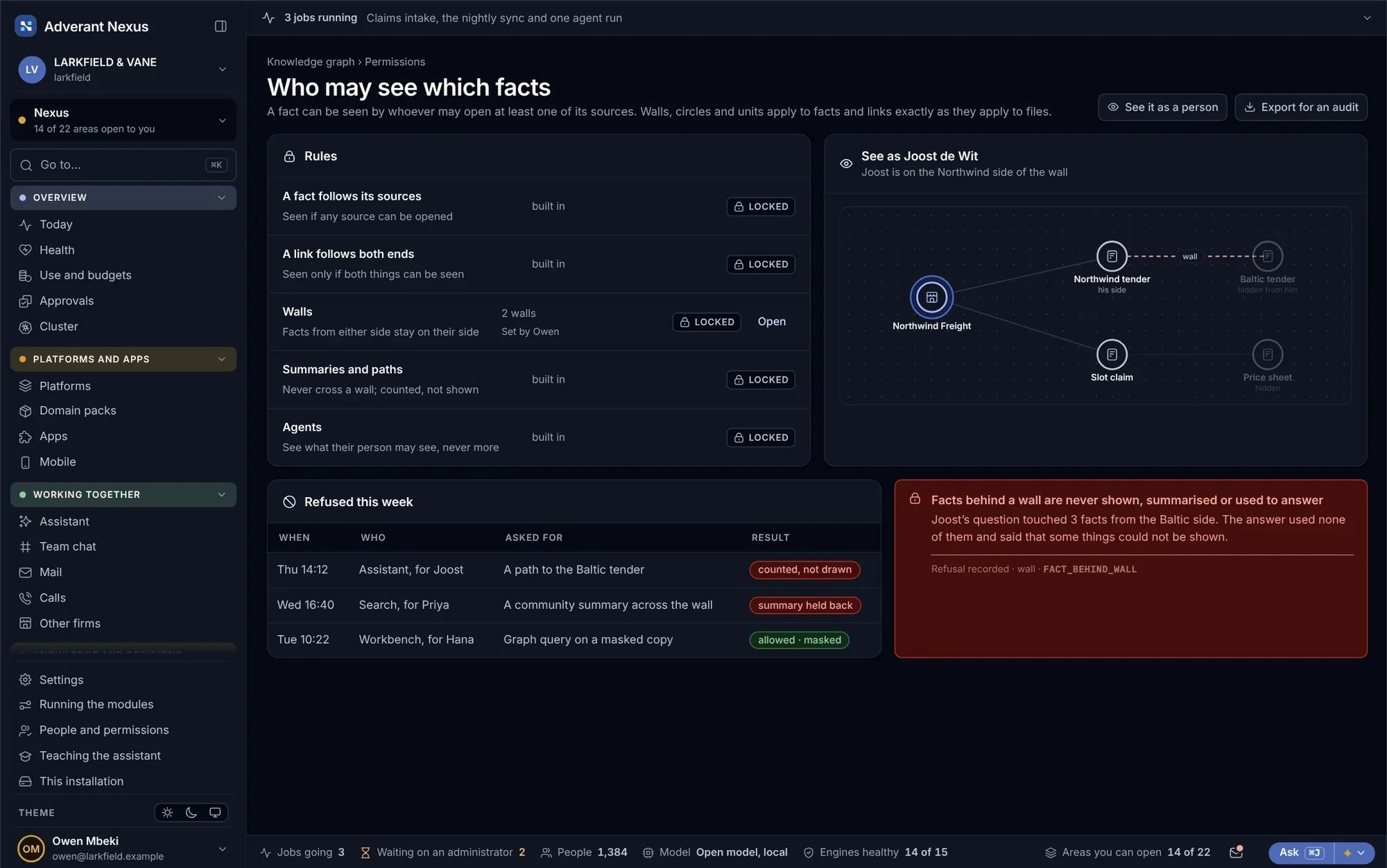
Permissions and walls apply to individual facts, not just documents. Two tender teams can work from the same graph without either seeing the other’s facts, and the AI only ever answers from what the person asking may see.
- Fact-level permissions
- Walls hold inside the graph
- Answers built only from visible facts
About the knowledge graph.
What is GraphRAG?
Retrieval for AI that works over a knowledge graph instead of loose text. It finds the facts connected to a question across the whole business and gives them to the model with their sources, so answers rest on far more context than a prompt can hold.
Do we need an ontology before we start?
No. Start from the model a domain pack brings, or from what Nexus finds in your documents, and refine it as you go.
Does building the graph touch our systems?
No. Nexus reads from your systems; it does not write to them. The graph is built beside them.
Can we export the knowledge base?
Yes, as a signed bundle, for example to move it to a test cluster.
Go deeper
See your business as a graph.
Bring a register and a handful of documents. We will build the first version of your model with you and ask it questions.