

From an idea to production, without going backwards.
Nexus includes its own software factory. Ideas are ranked, a decision room picks one, and AI agents and engineers build it on branches. The Forge tests every change against the main line as it will be, not as it was, signs what it builds, and releases it in waves with a way back. Fast enough for AI-speed work, careful enough for regulated work.
From a question to a release, in six steps.
Every step leaves a record, and every step has a person who can stop it. The line from an idea to running code is one you can follow back at any time.
Ideate
Ask a real question. Idea runs generate options, test them against each other and rank them, inside a budget.
Decide
The shortlist goes to a decision room. A named person rules, and the ruling becomes the plan.
Build
AI agents and engineers write the change on a branch, with its tests, each in its own sandbox.
Check
A security gate that blocks, an AI review that explains, and a person who approves where the rules ask.
Merge
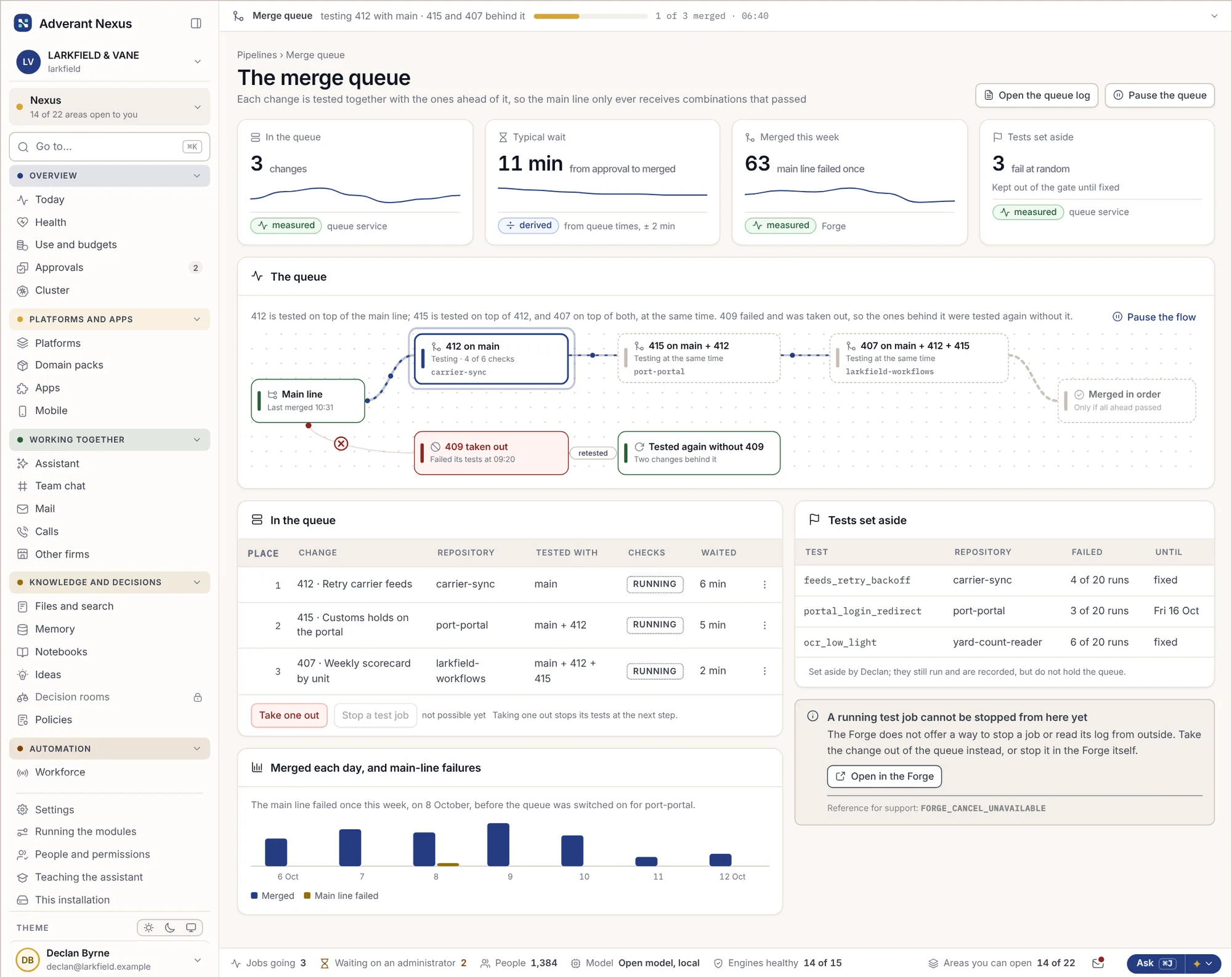
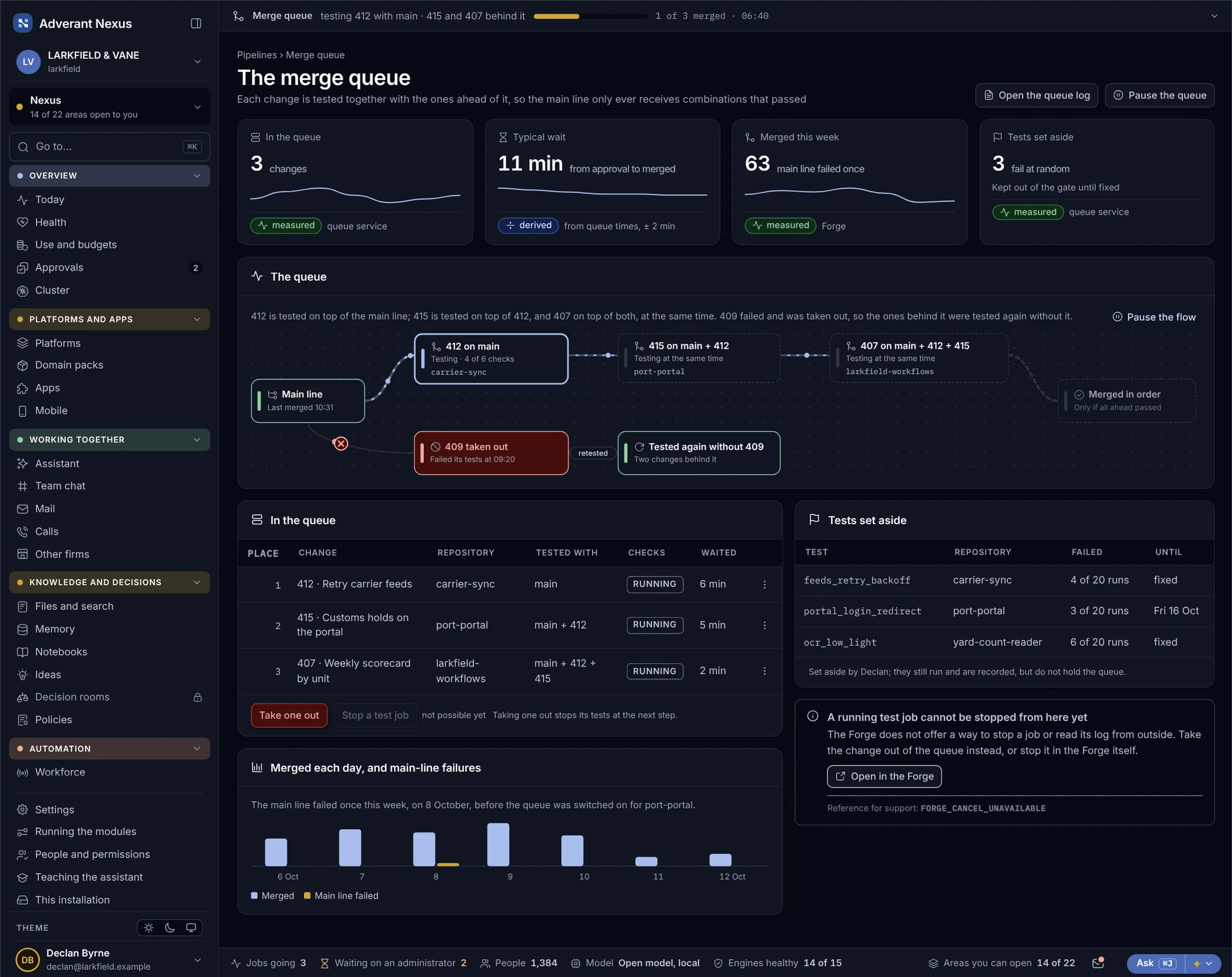
The merge queue tests each change together with the ones ahead of it. The main line never breaks.
Ship
Signed images go out in waves with health checks. Any release can be rolled back in one reviewed step.
Ideas in at one end, working software out of the other.
The factory joins the parts of Nexus that think with the parts that build. Ideas, decisions, agents and the Forge share one record, so you can follow any line of code back to the question that started it.
Ideas, ranked
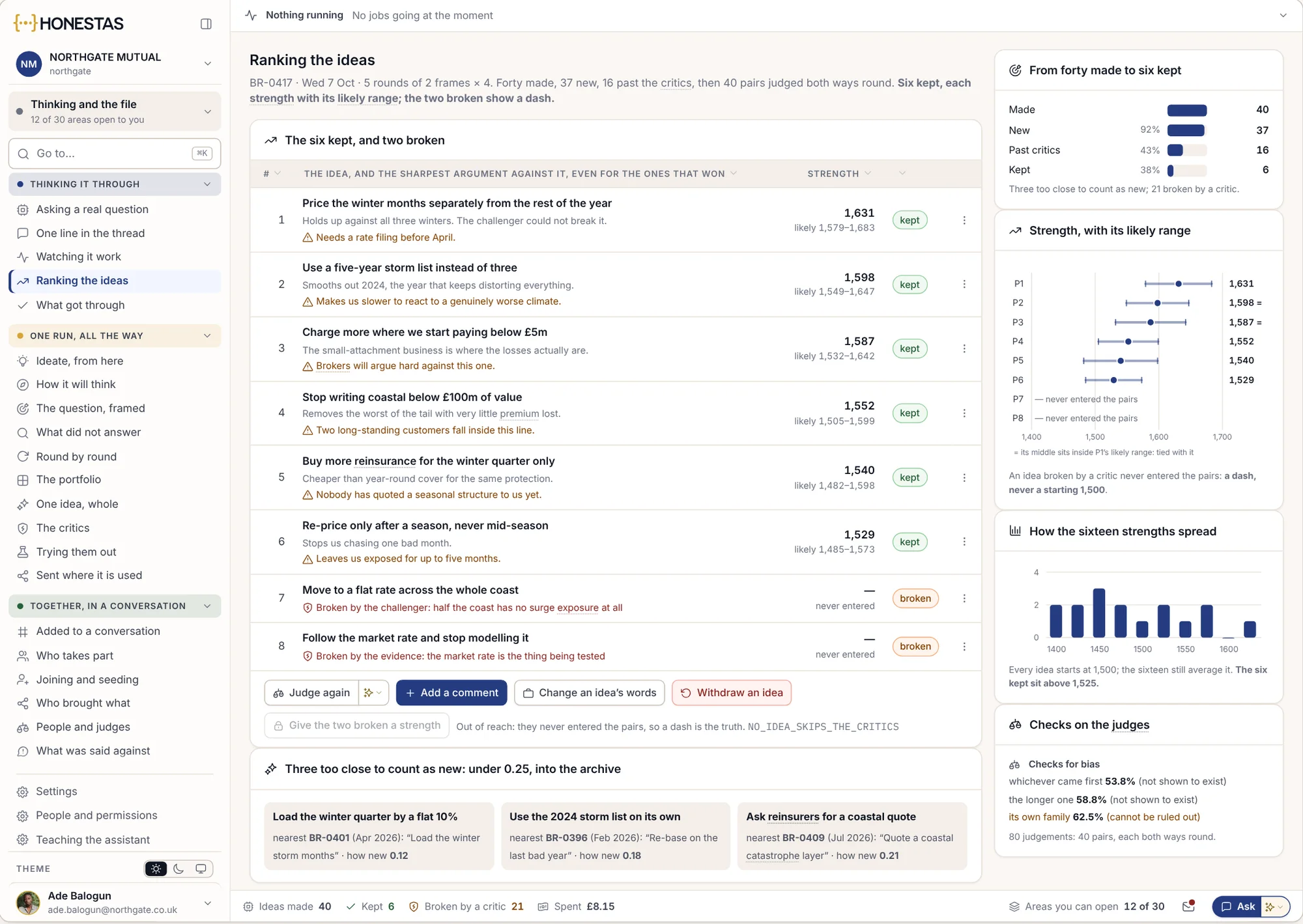
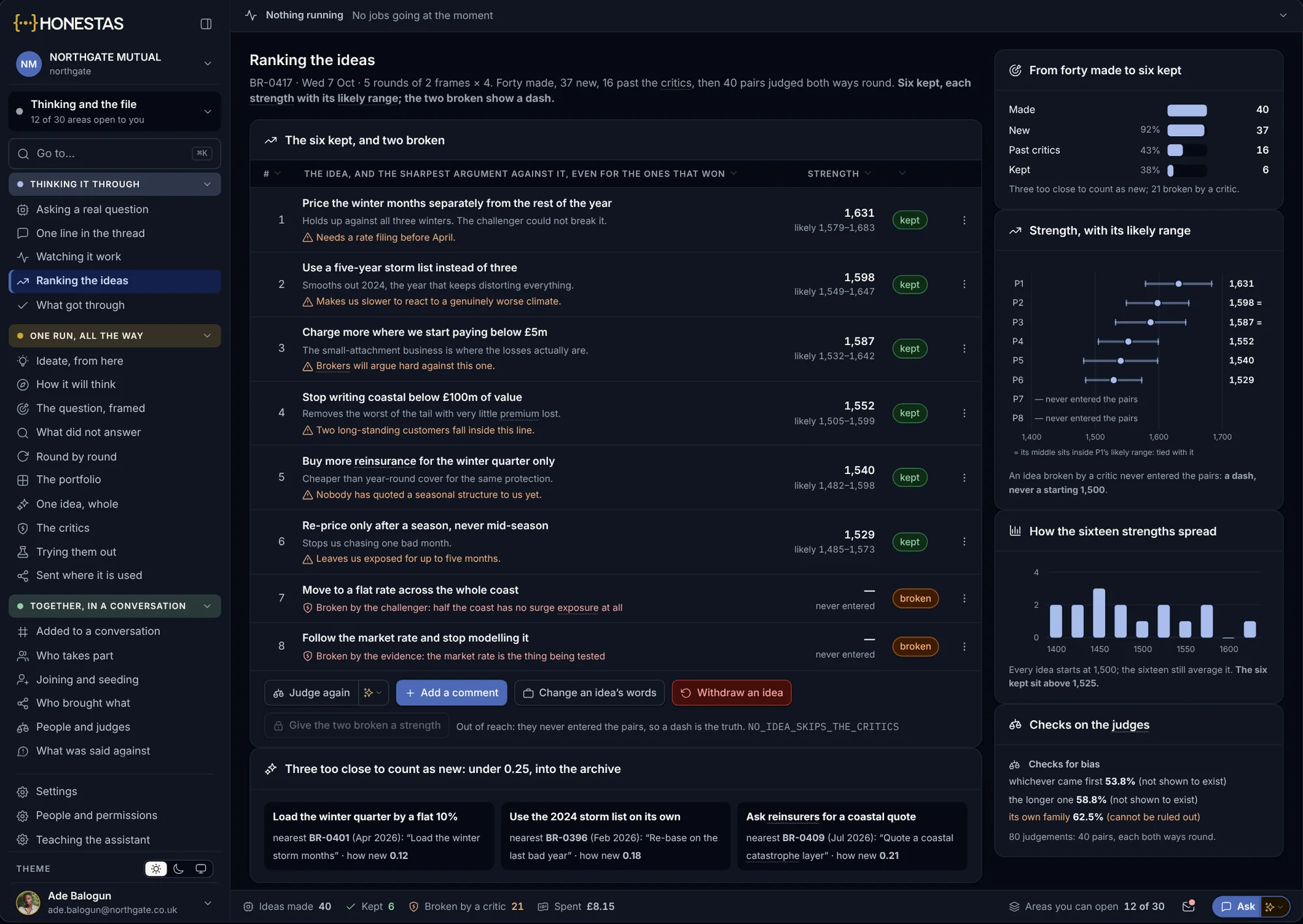
Idea runs test options against each other and keep the strongest argument against each one.
- Ranked, head to head
- The case against, kept
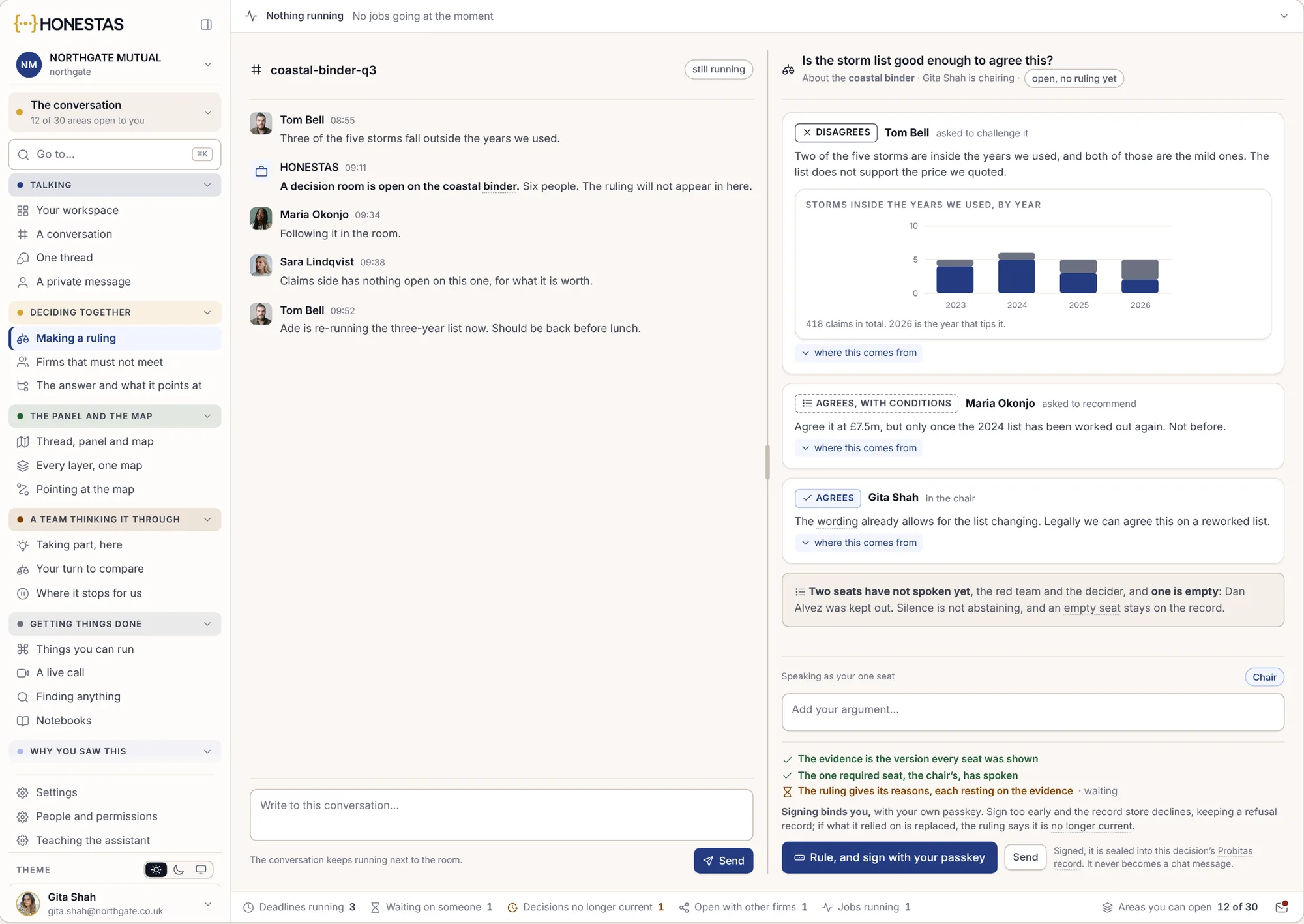
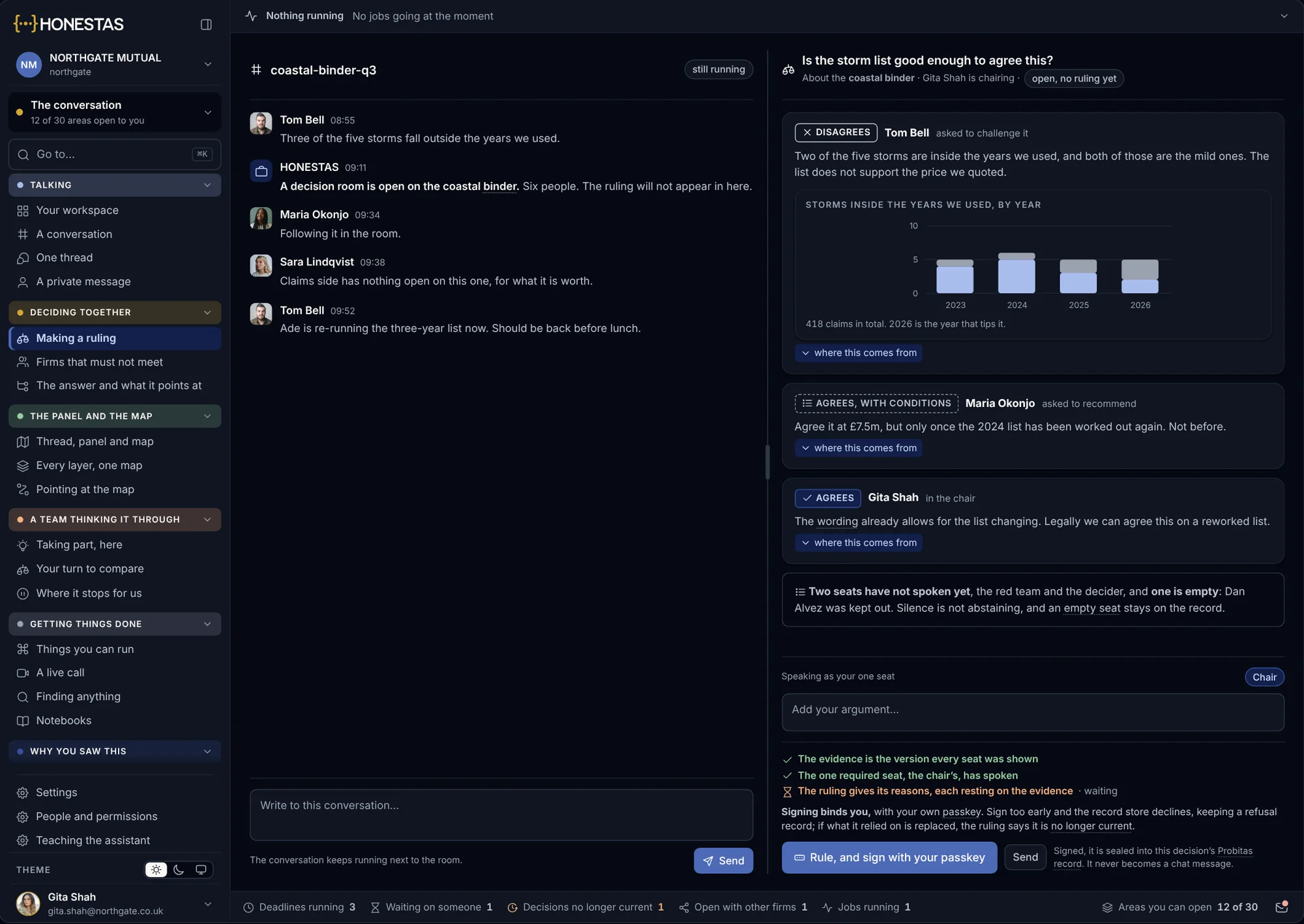
A ruling becomes the plan
- A named person rules
- The ruling is the brief
Changes from agents and people
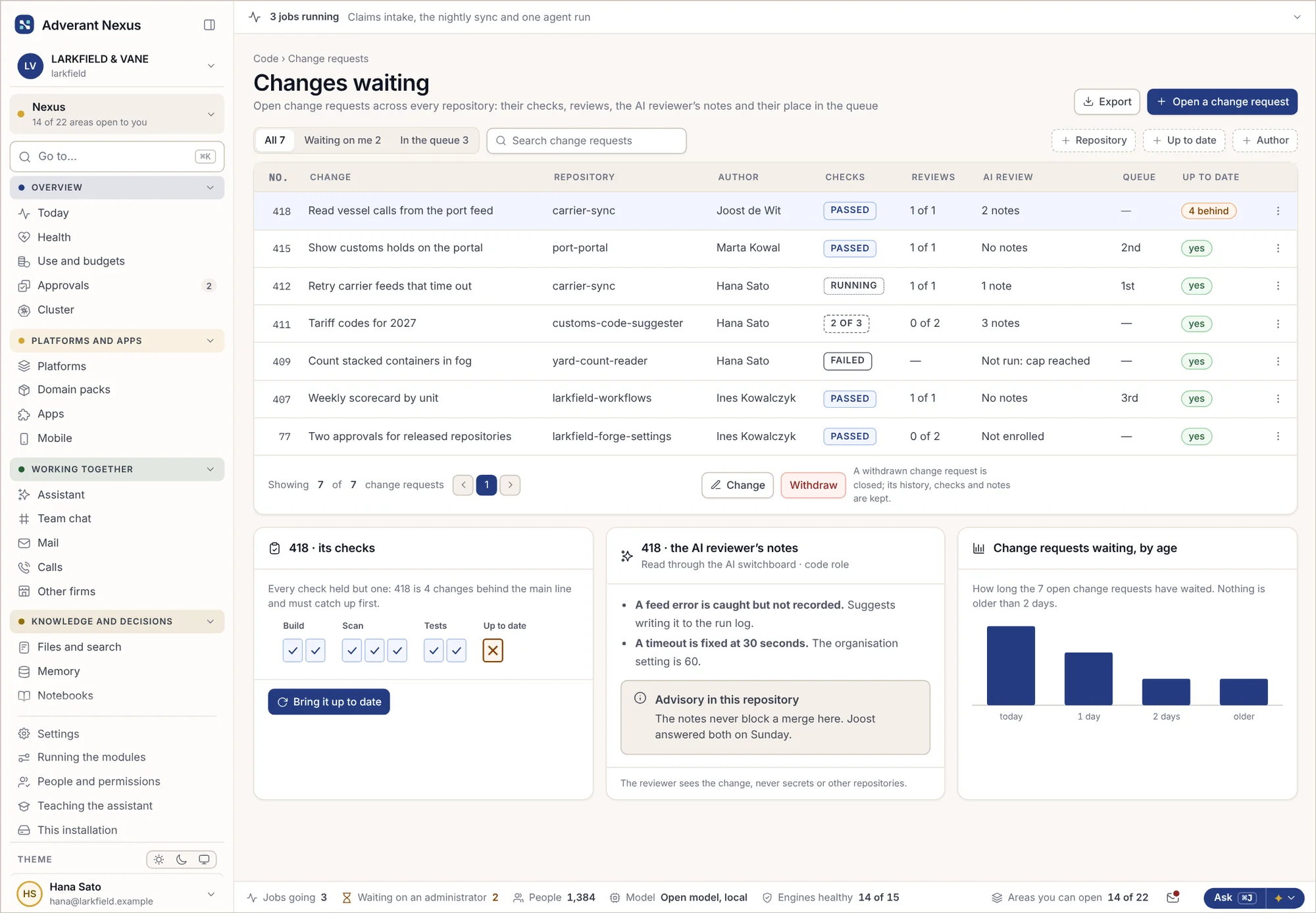
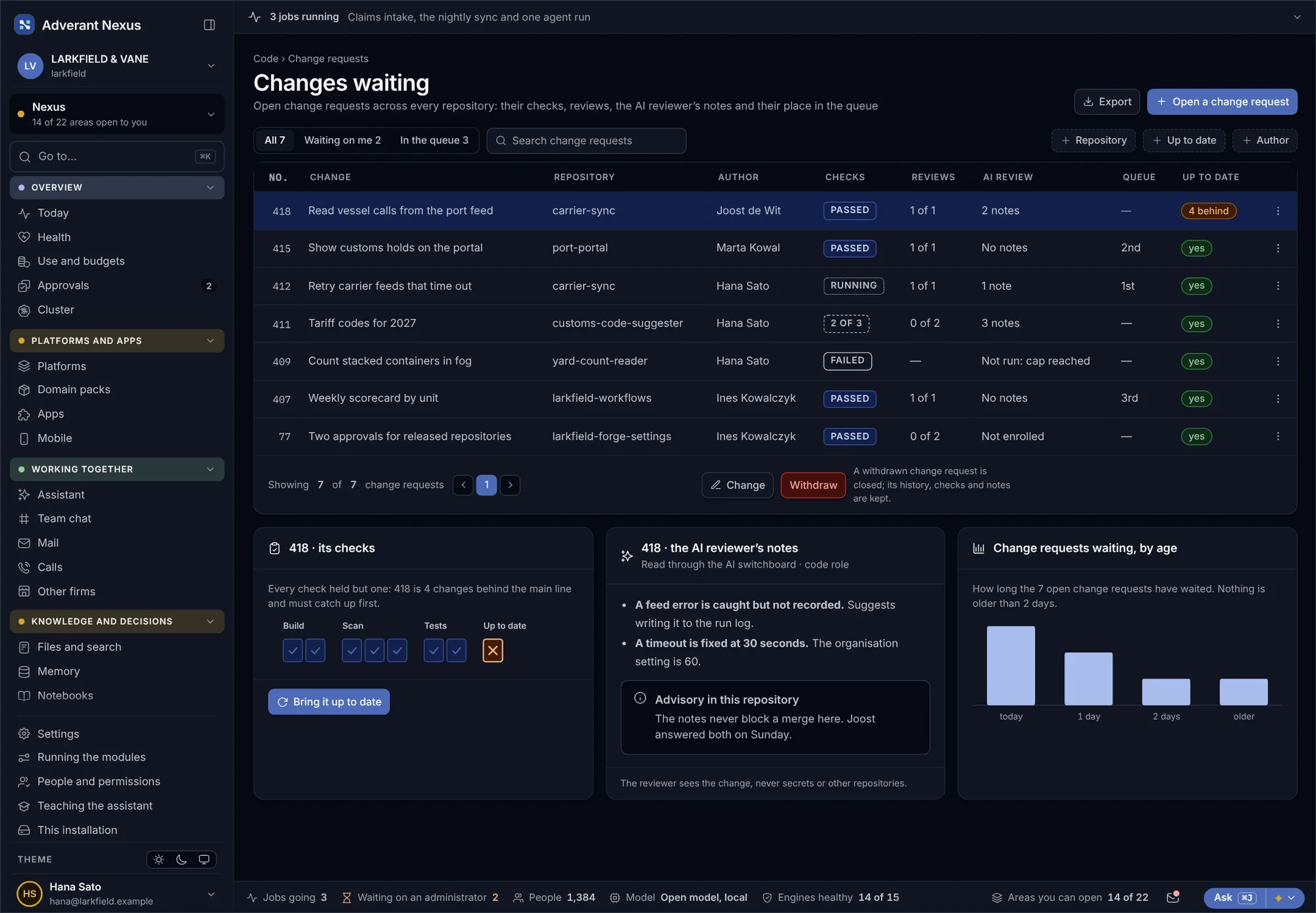
AI agents open change requests like any engineer. Each shows its checks, its reviews and its place in the queue.
- Agents and people, same rules
- Nothing merges by itself
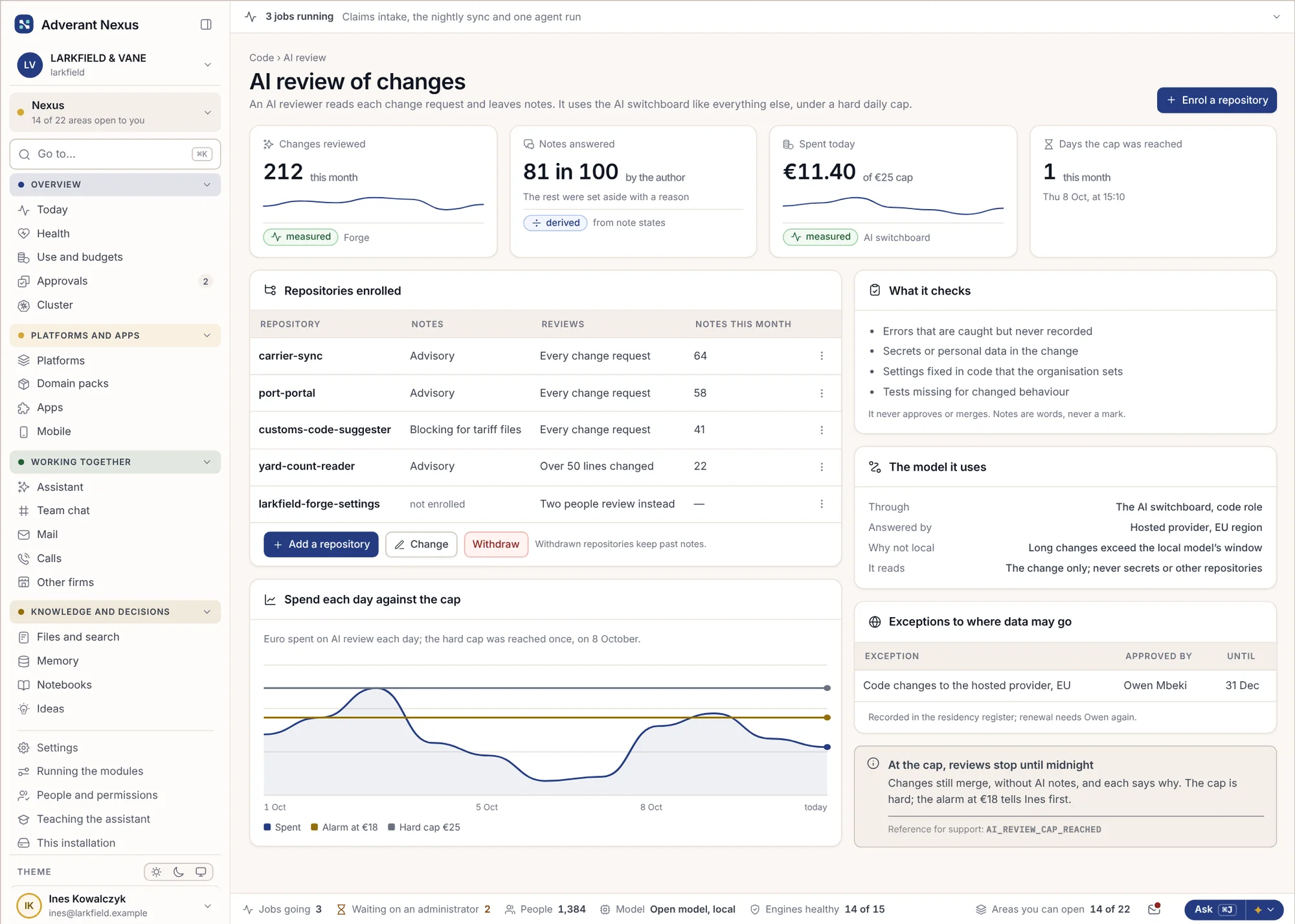
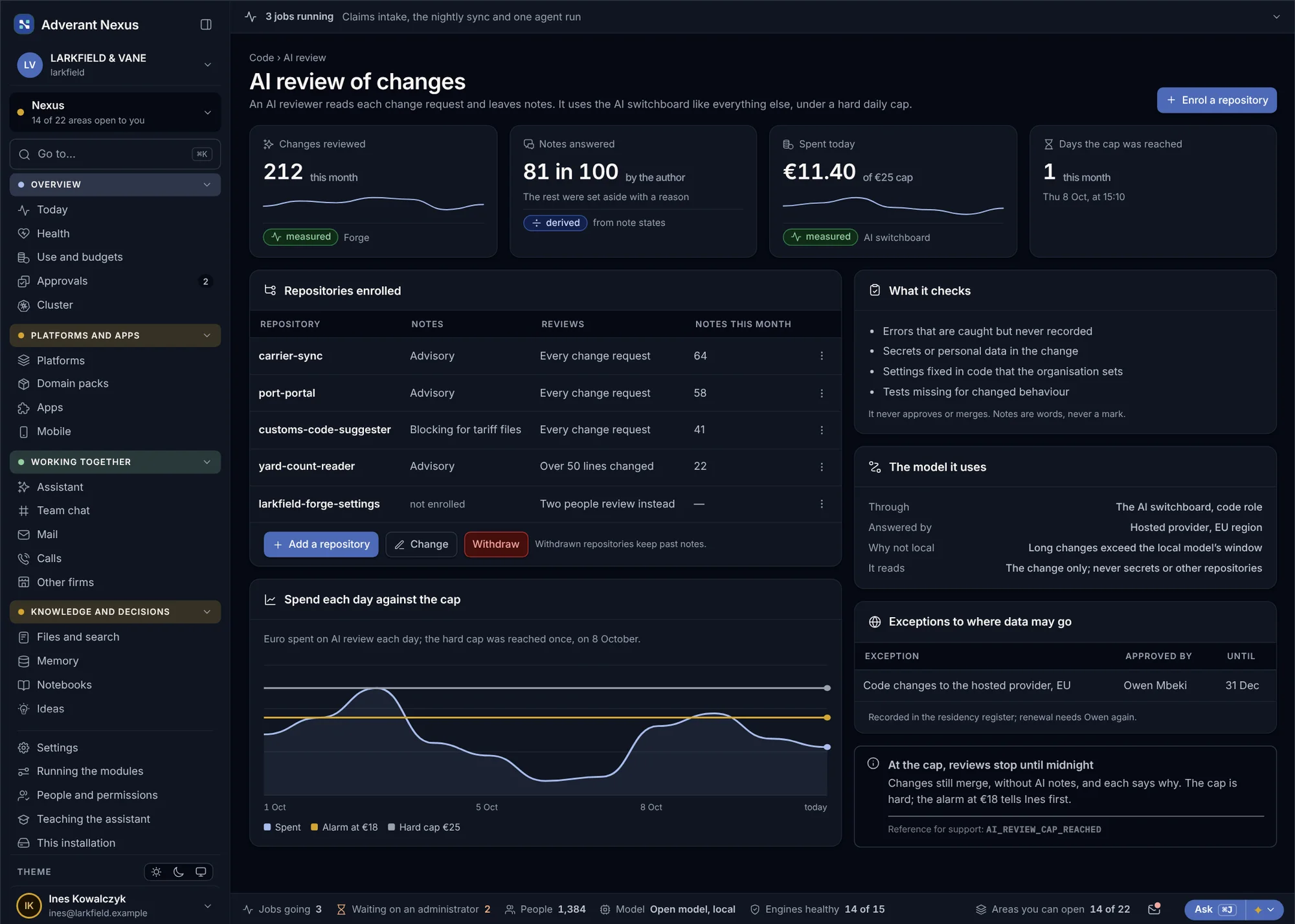
An AI reviewer on every change
Every change is read by an AI reviewer that explains what it found, inside a daily spend cap. It advises; people decide.
- Notes in plain words
- A hard daily cap
The main line never breaks.
Most pipelines test a change against the main line as it was when the branch started. The Forge tests it against the main line as it will be, with every change ahead of it in the queue. A build that fails a security scan is never signed, so it can never be released.
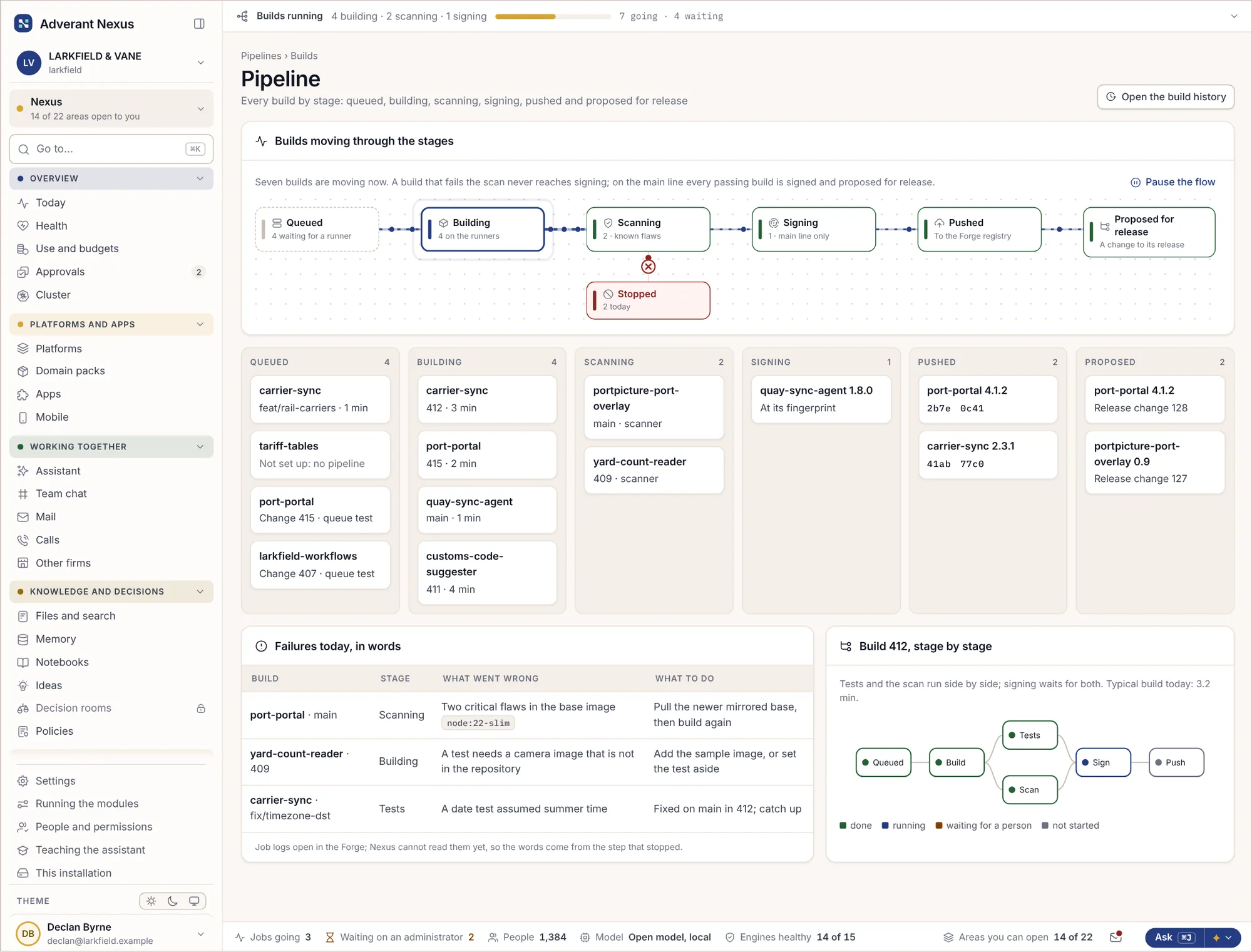
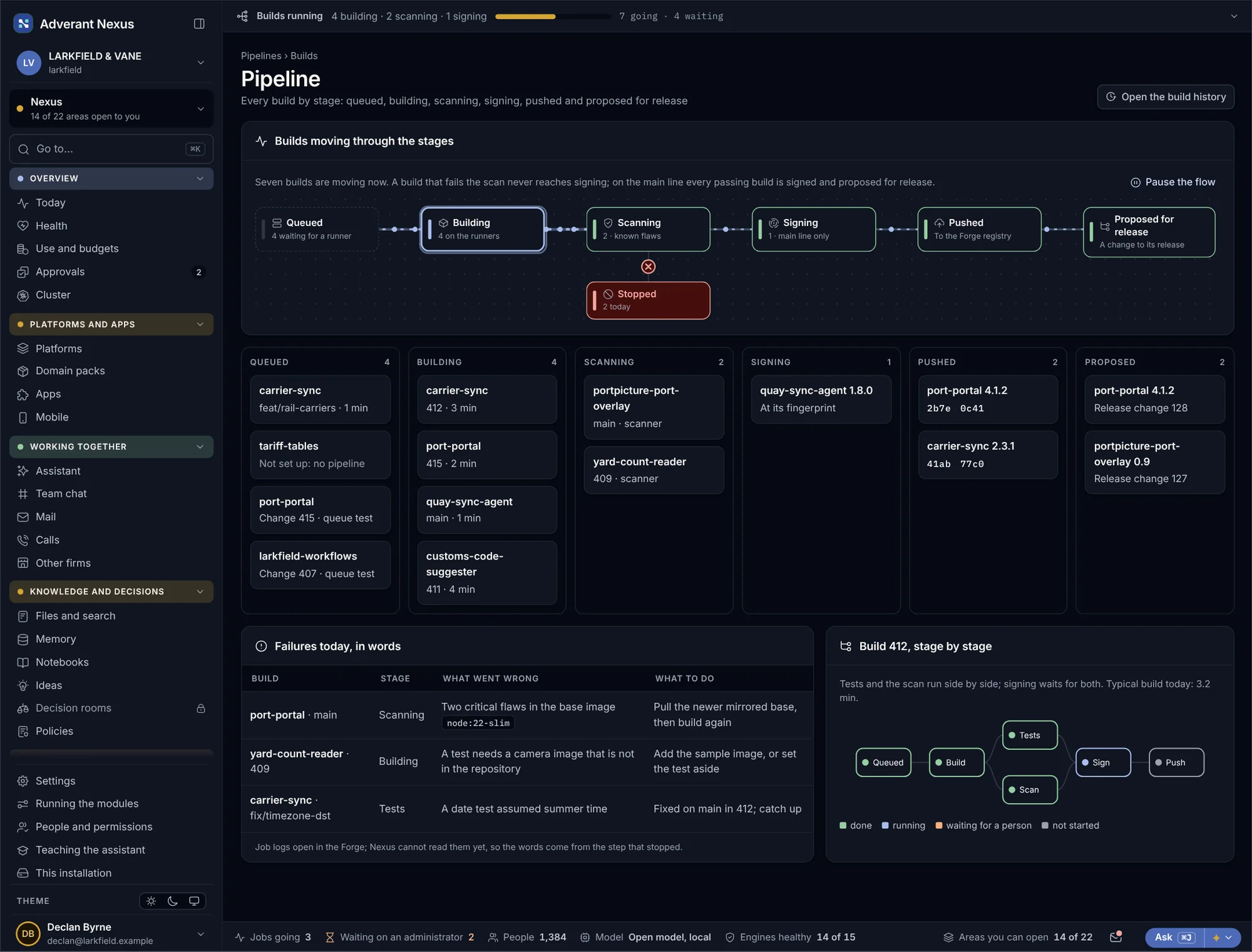
Build, scan, sign, propose
Every build moves through the same stages. Tests and the security scan run side by side; signing waits for both.
- Scans block, they do not just warn
- Failures explained in words
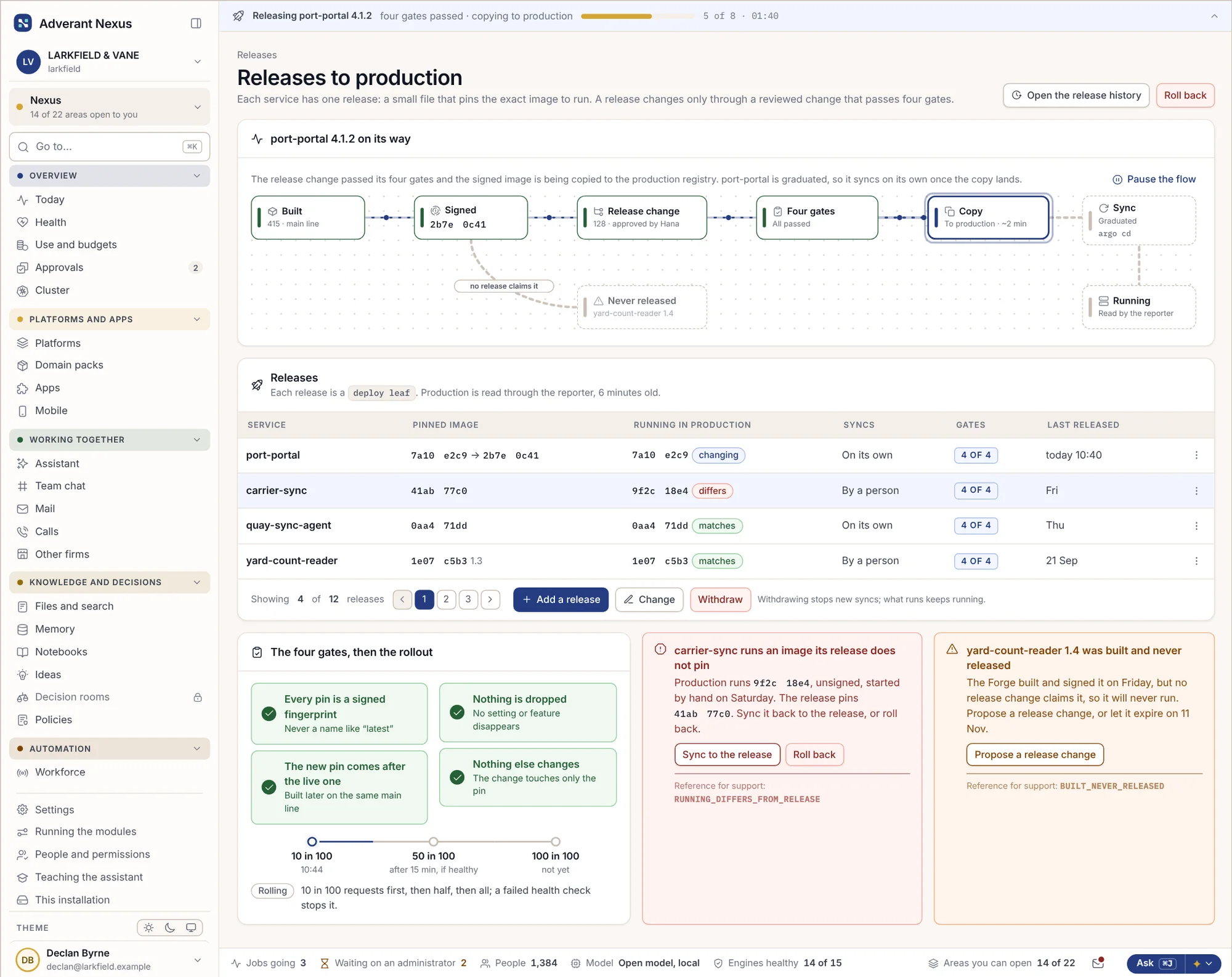
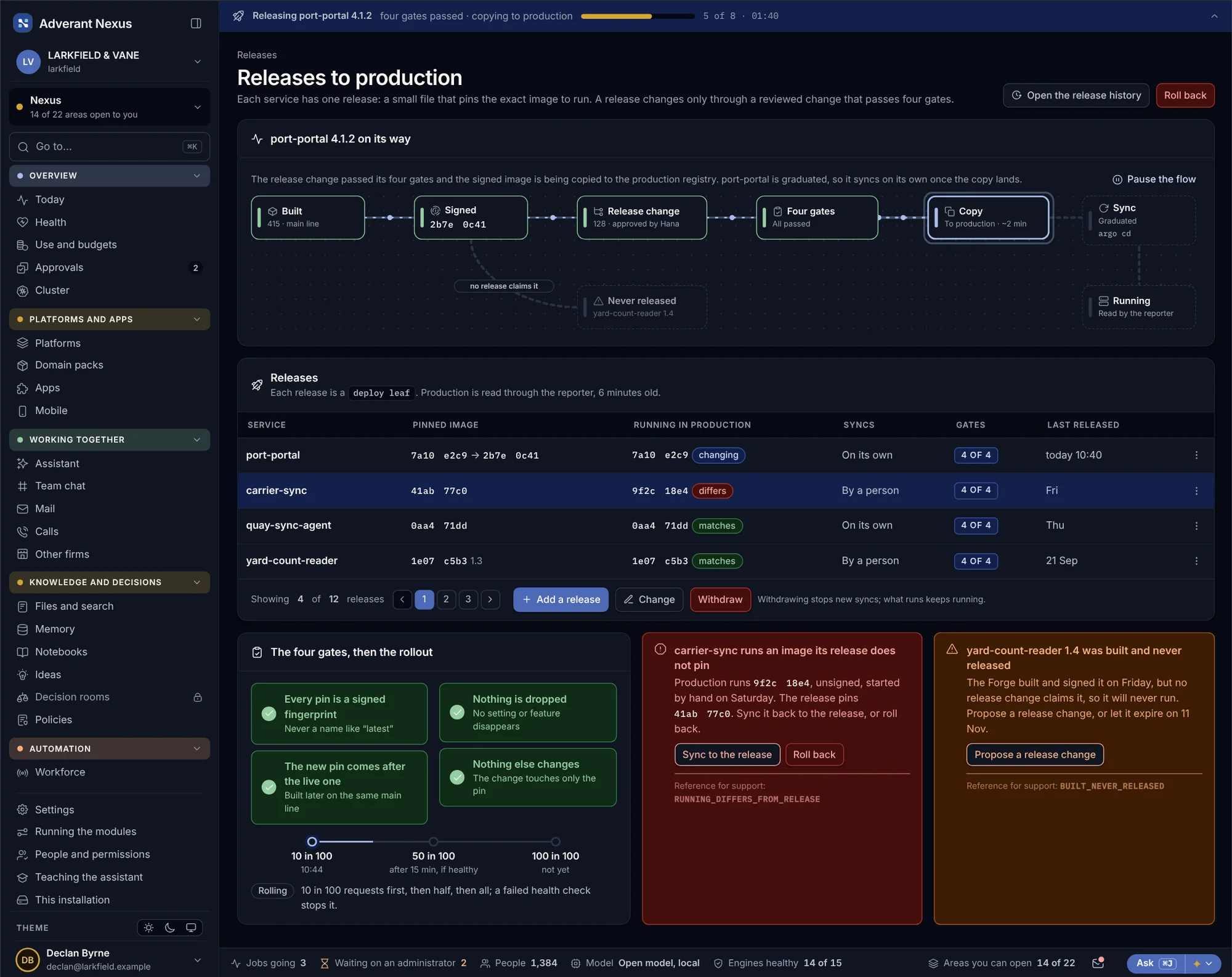
Four gates, then waves
Each release passes four gates, then rolls out to 10 in 100 requests, then half, then all.
- Pinned to an exact image
- Waves with health checks
As fast as the agents can write.
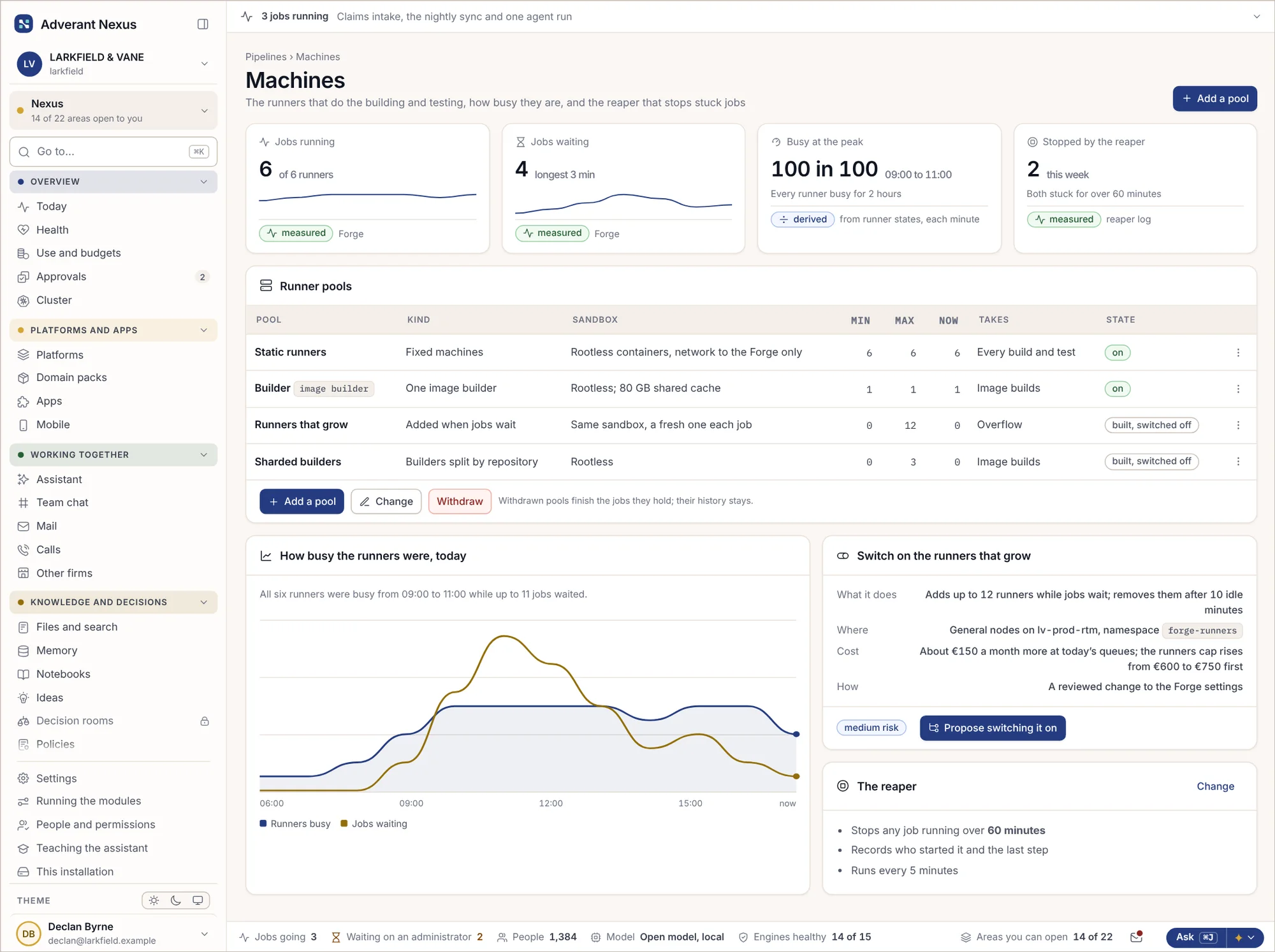
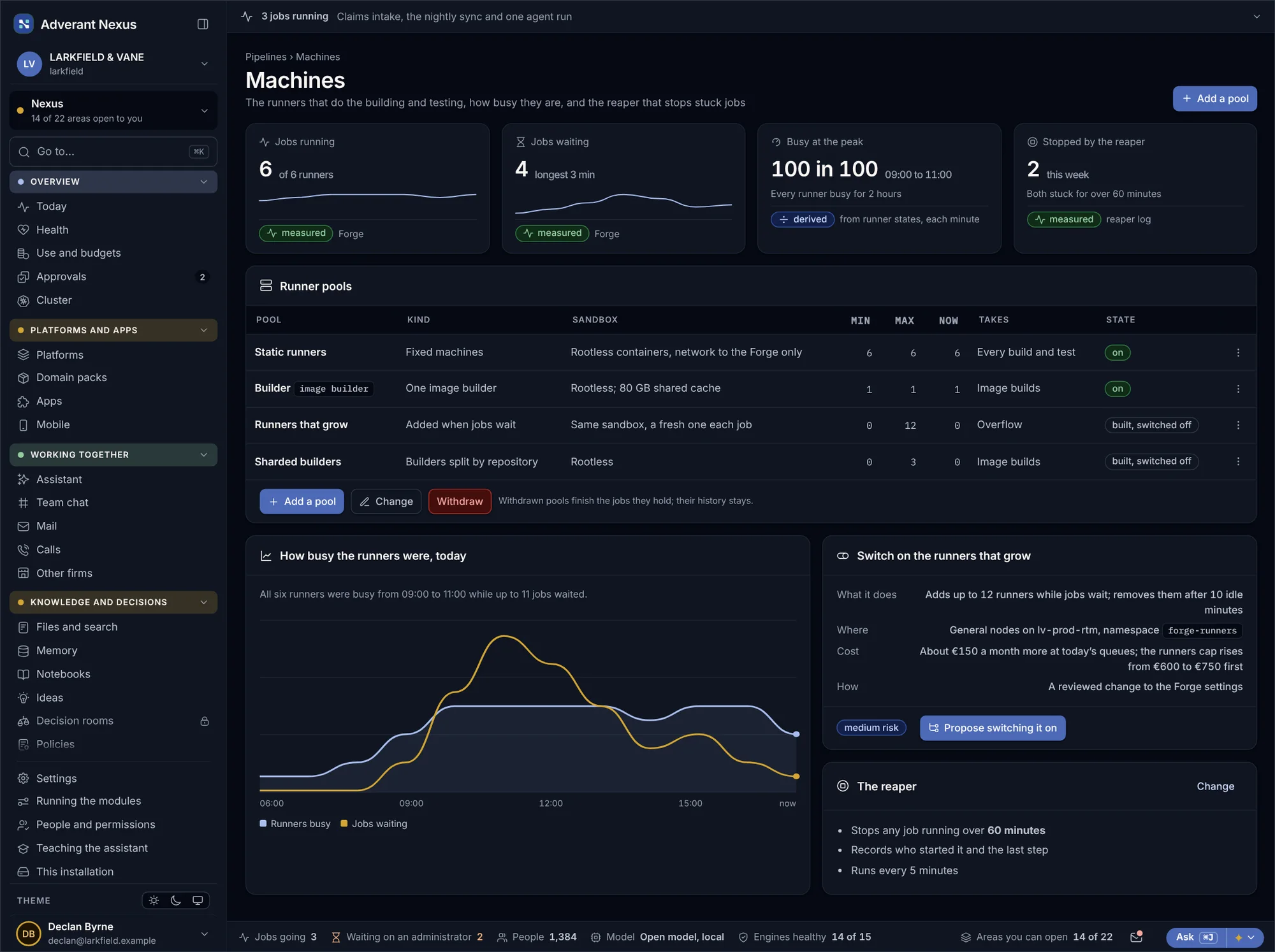
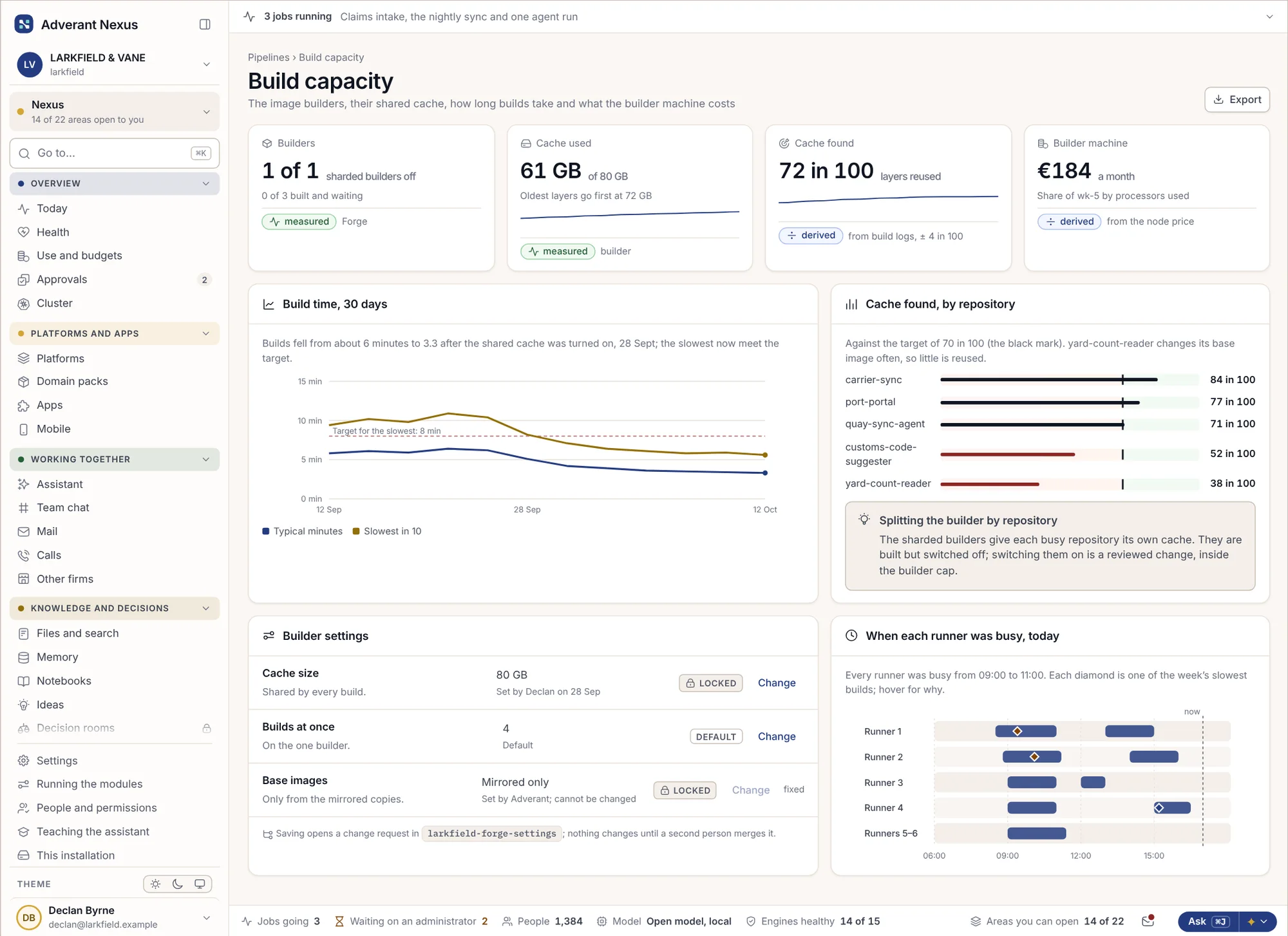
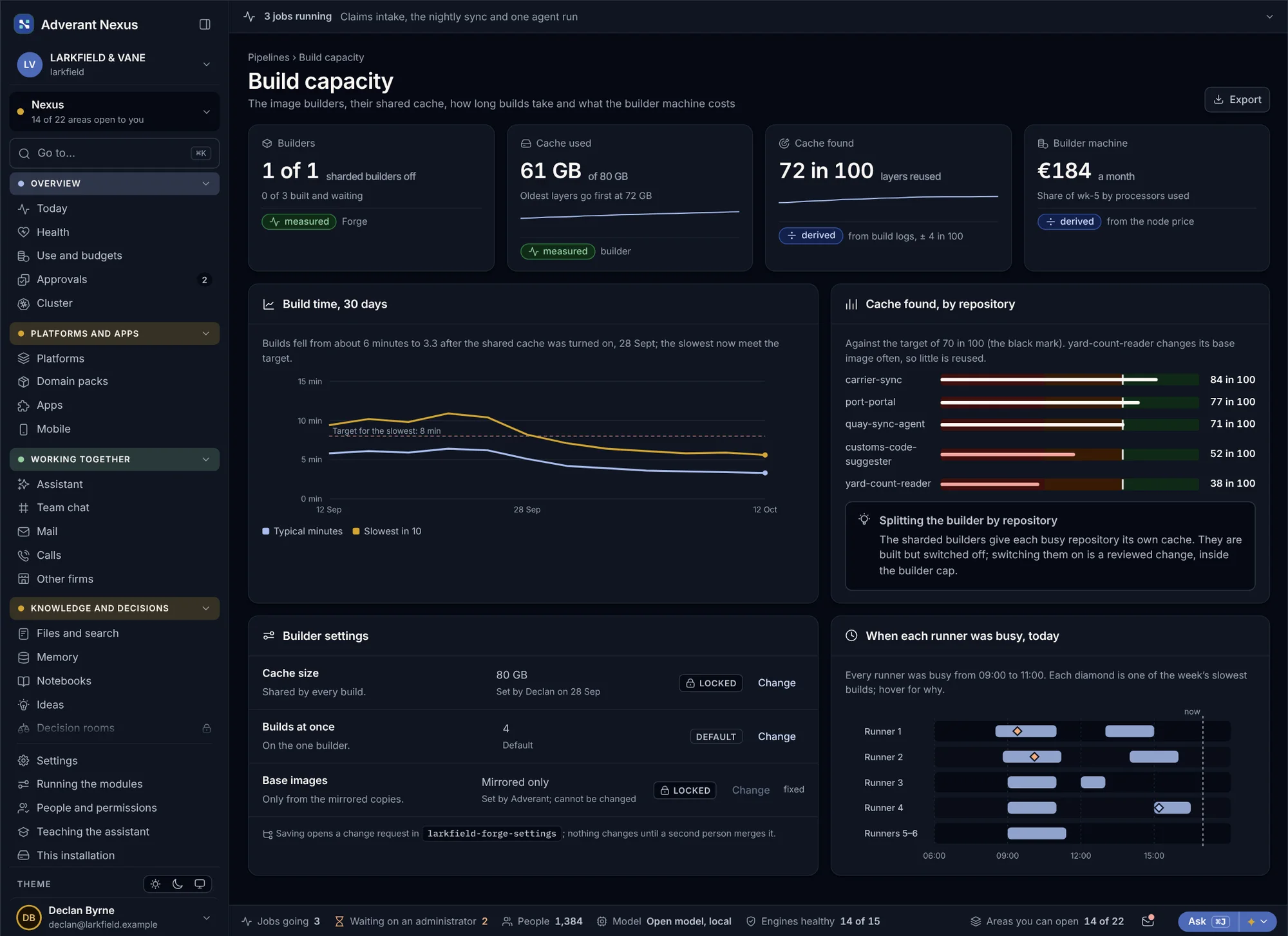
When AI agents write code, builds arrive in bursts. Runners are added while jobs wait and removed when they are done, and a shared build cache means most of each image is reused rather than rebuilt.
Runners that grow with the queue
Each build runs in its own sealed sandbox. More runners start while jobs wait, within a cap you set.
- A fresh sandbox for every job
- Grows and shrinks within a cap
Most of each build, reused
A shared cache keeps the layers that did not change, so a typical build takes a few minutes.
- Build time tracked over 30 days
- Cache hits by repository
Only signed builds reach production.
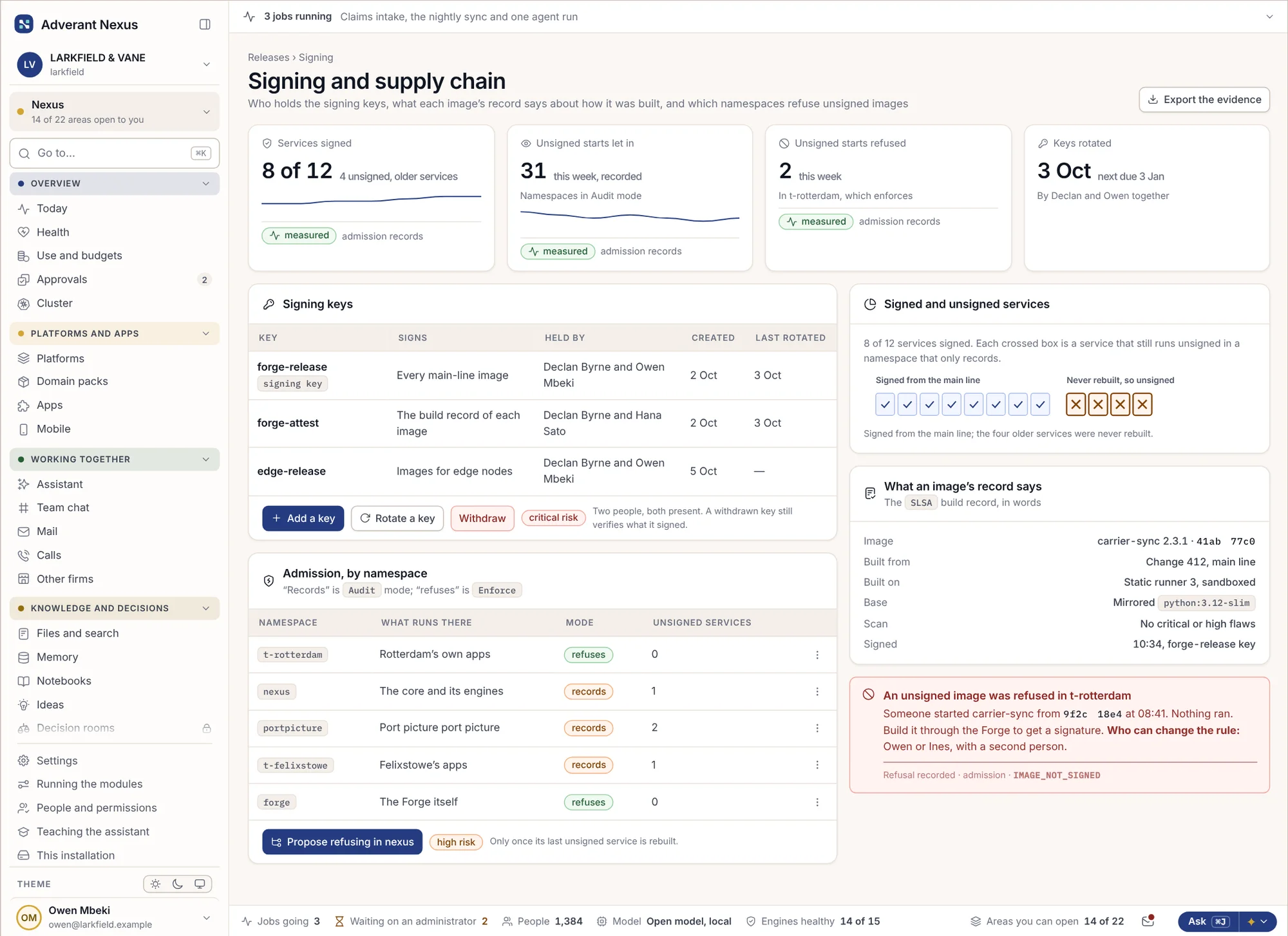
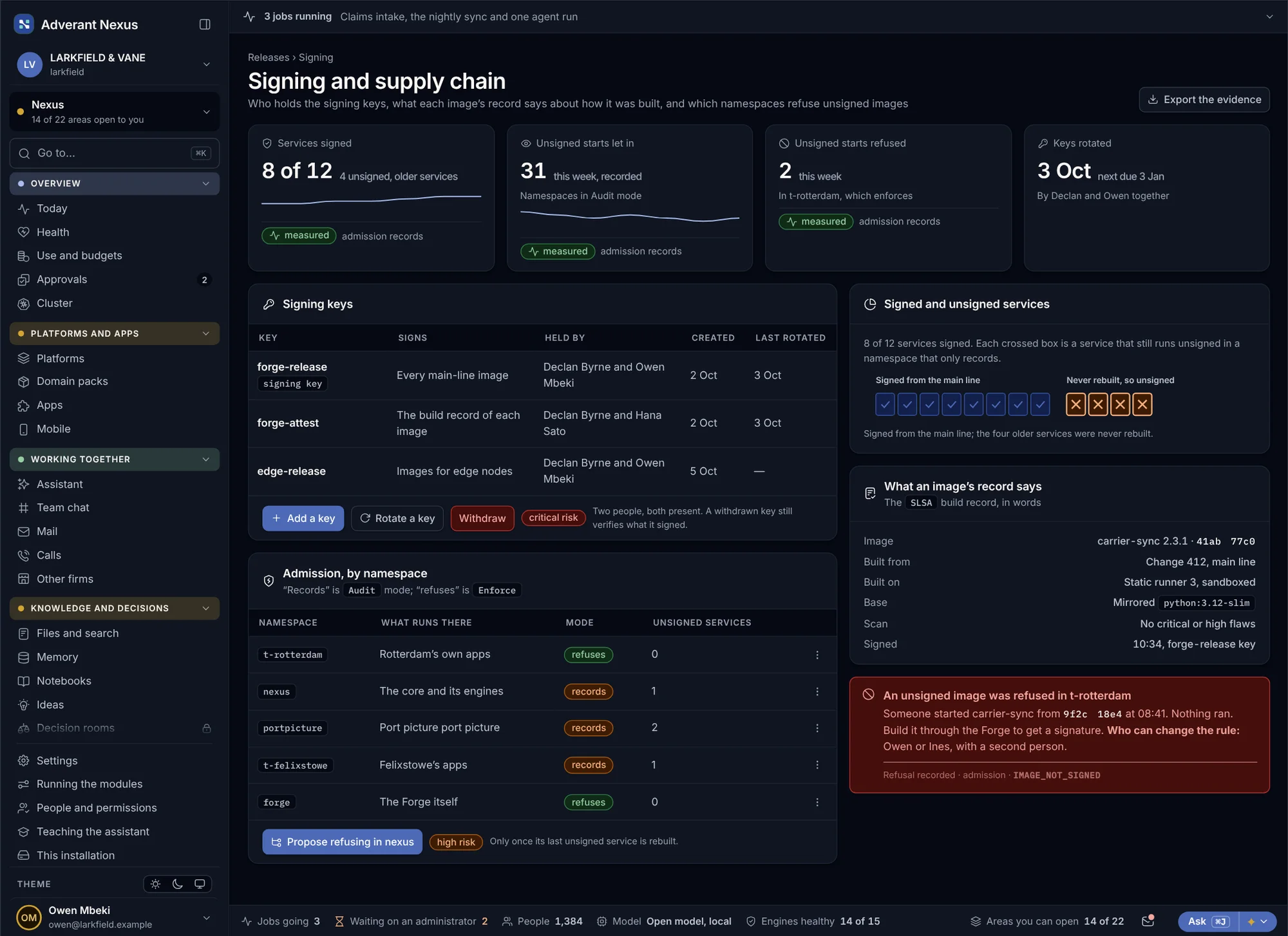
Every image is signed at its fingerprint, with a record of how and where it was built. Production refuses anything unsigned, and secrets are written once and never shown again.
Signed at its fingerprint
Two people hold each signing key. Each image carries a build record, and unsigned images are refused where you choose.
- Keys held by two people
- Unsigned images refused
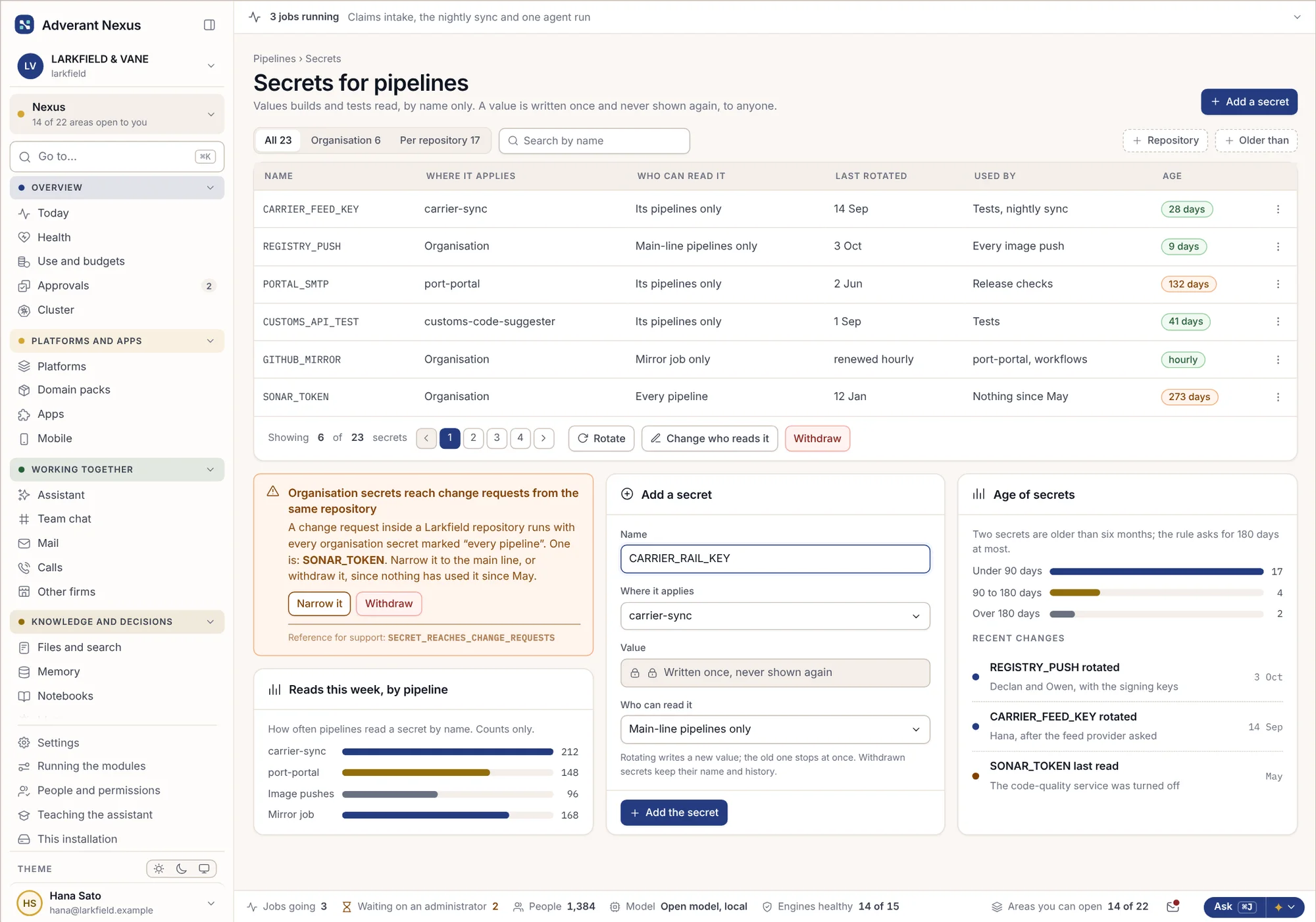
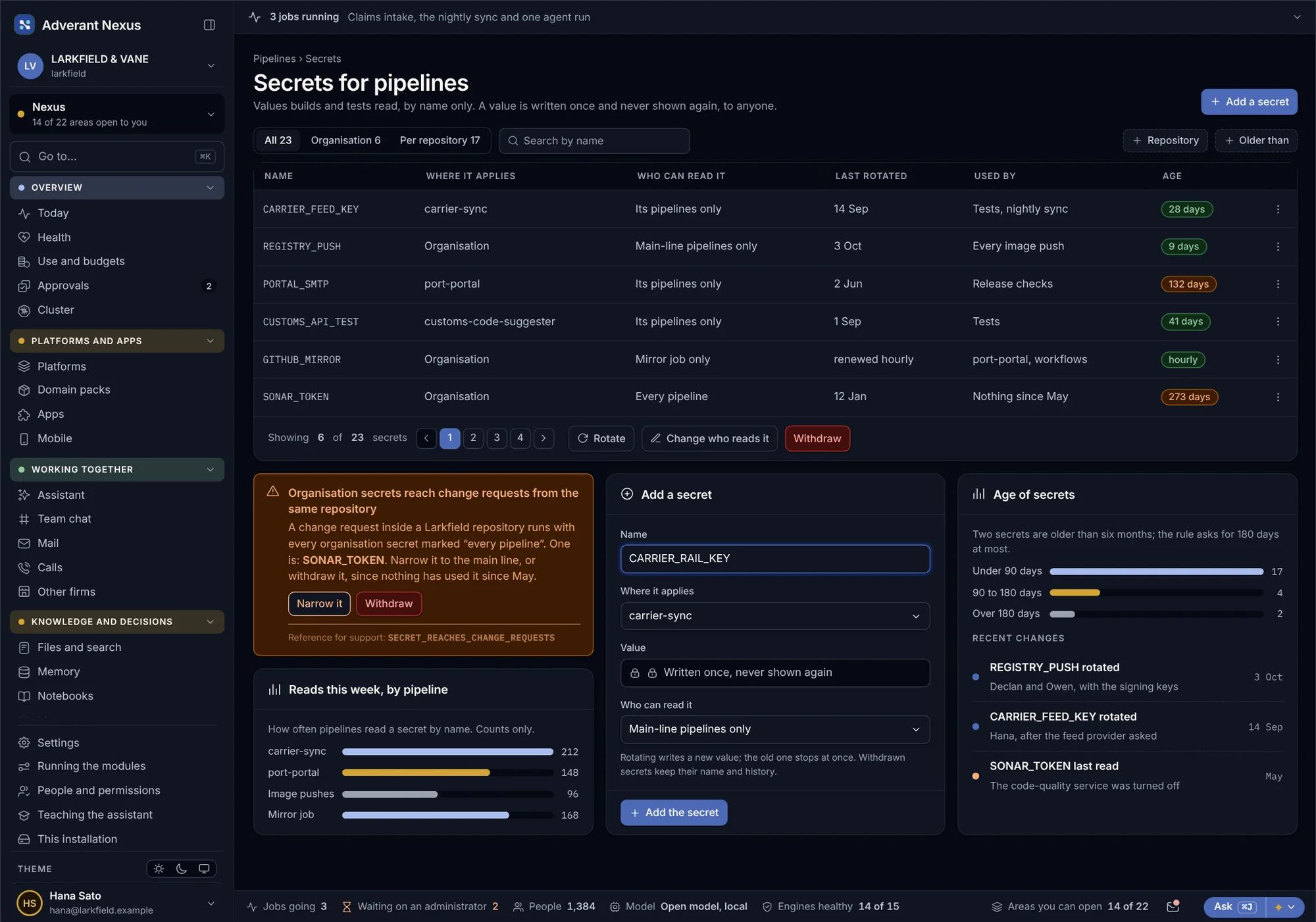
Secrets, by name only
Builds and tests read secrets by name. A value is written once and never shown again, and every read is counted.
- Written once, never shown
- Who can read each one
Ship in waves, with a way back.
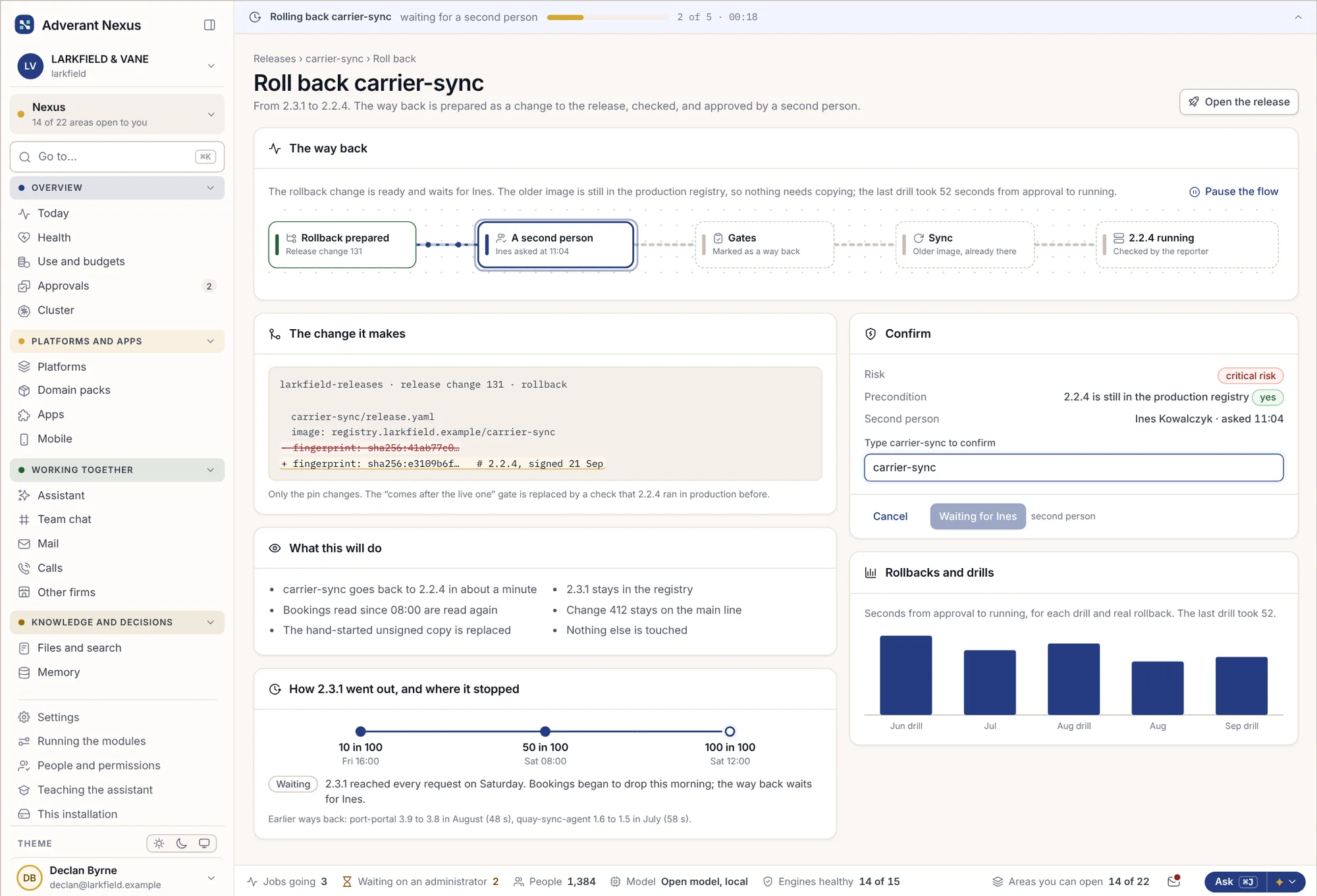
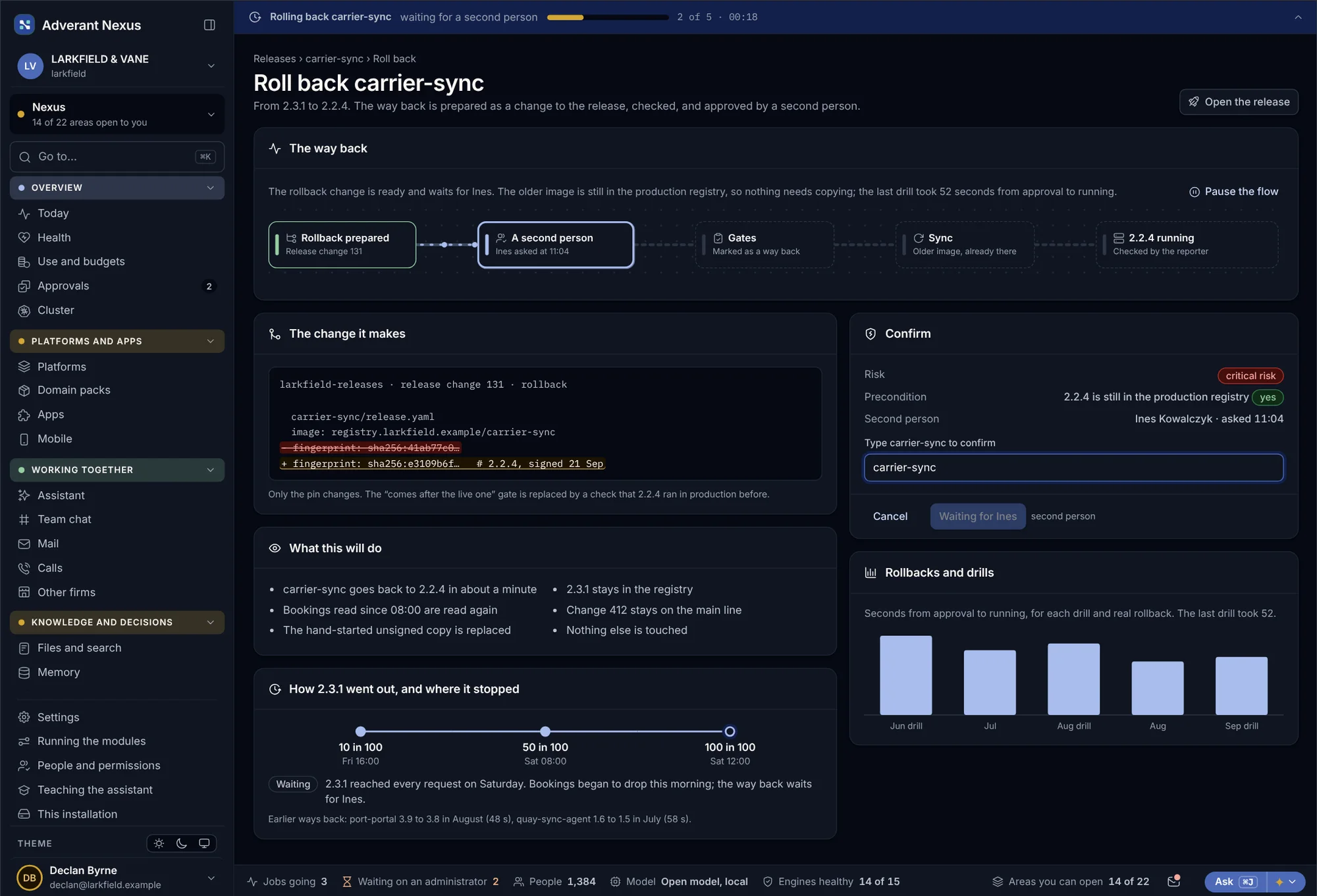
A release is a small reviewed change that pins the exact image to run. It goes out to a few requests first, then half, then all, with health checks between. Rolling back is the same kind of change, approved by a second person.
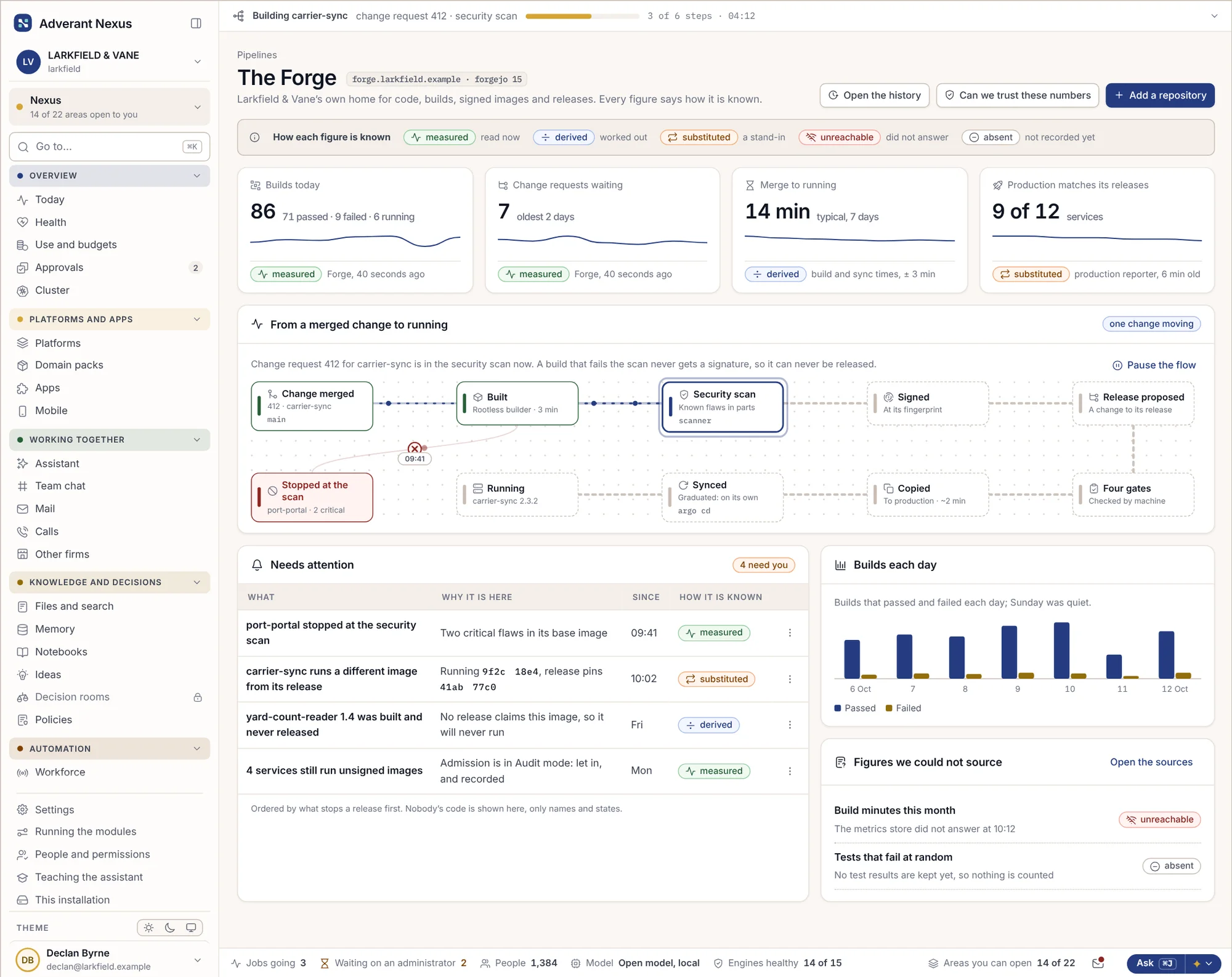
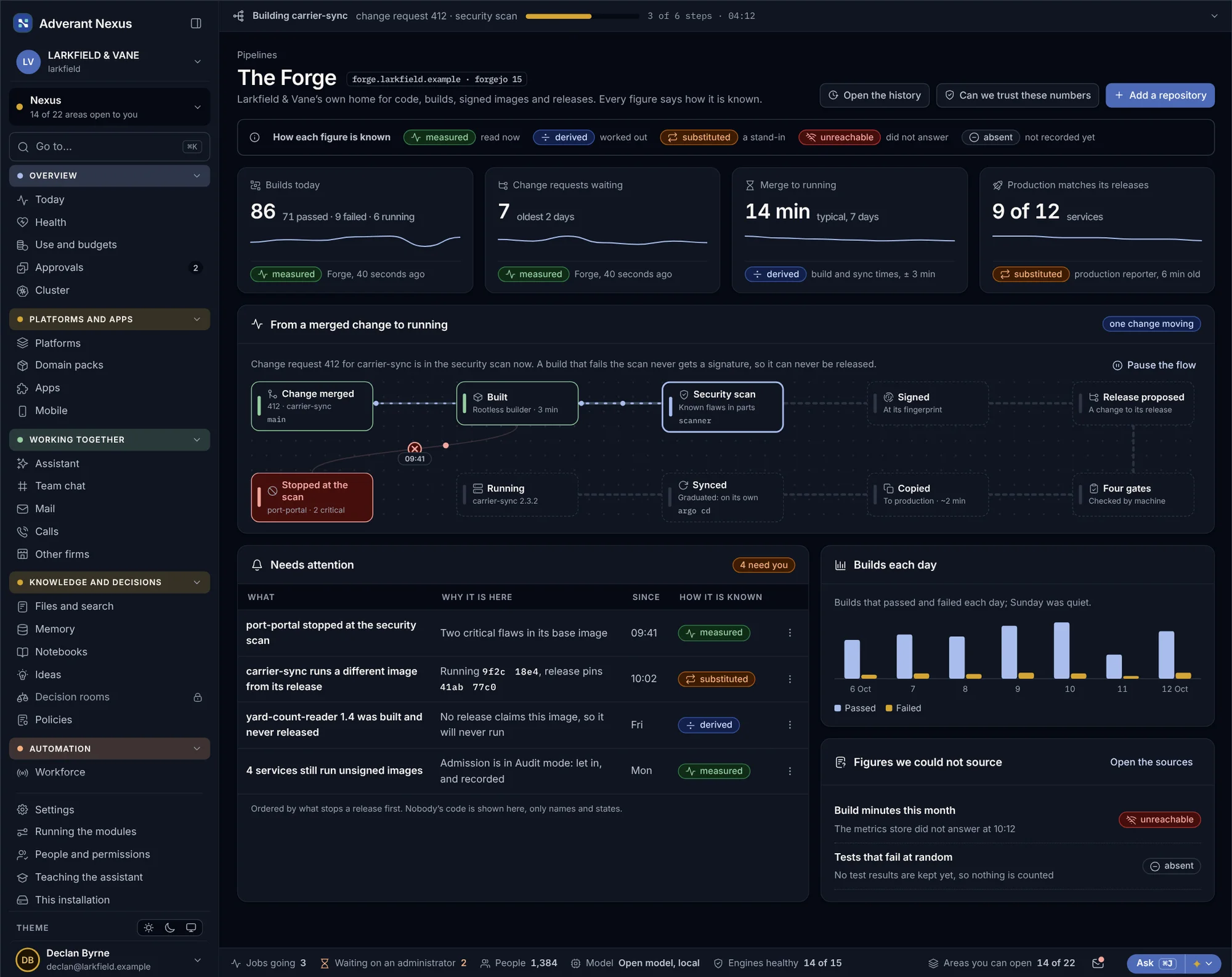
From a merged change to running
- Every step from merge to running
- What needs a person, first
Back in about a minute
The way back is prepared as a change, checked and approved by a second person. Drills keep it fast.
- A reviewed change, not a scramble
- Drilled every month
Your code, your hardware, your rules.
The Forge runs inside your installation, on your own hardware or our EU cloud, with no outside service in the build path. It keeps building even when production is down, which is exactly when you need to ship a fix. Every setting is kept as files too, so changes are reviewed like code.
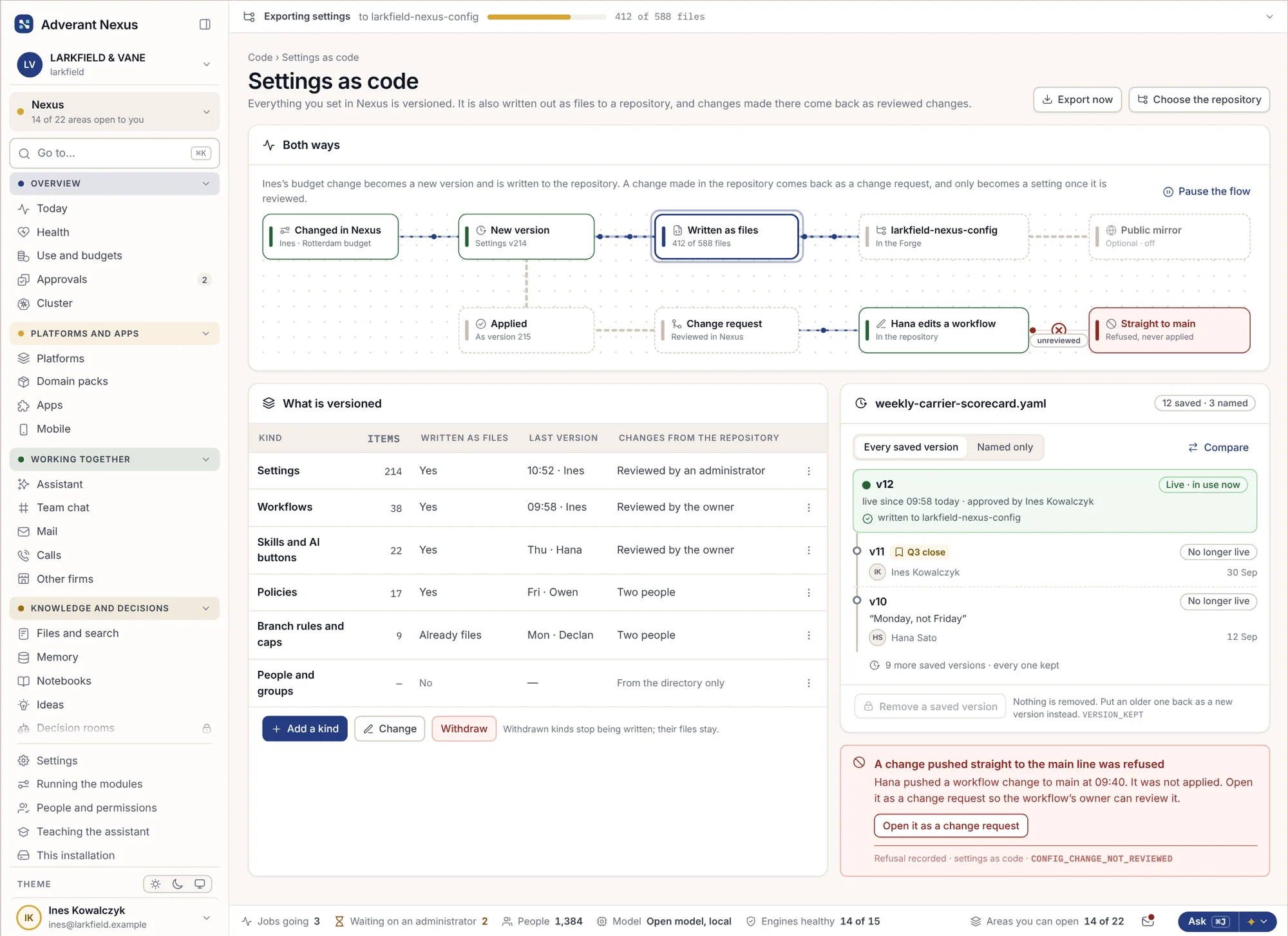
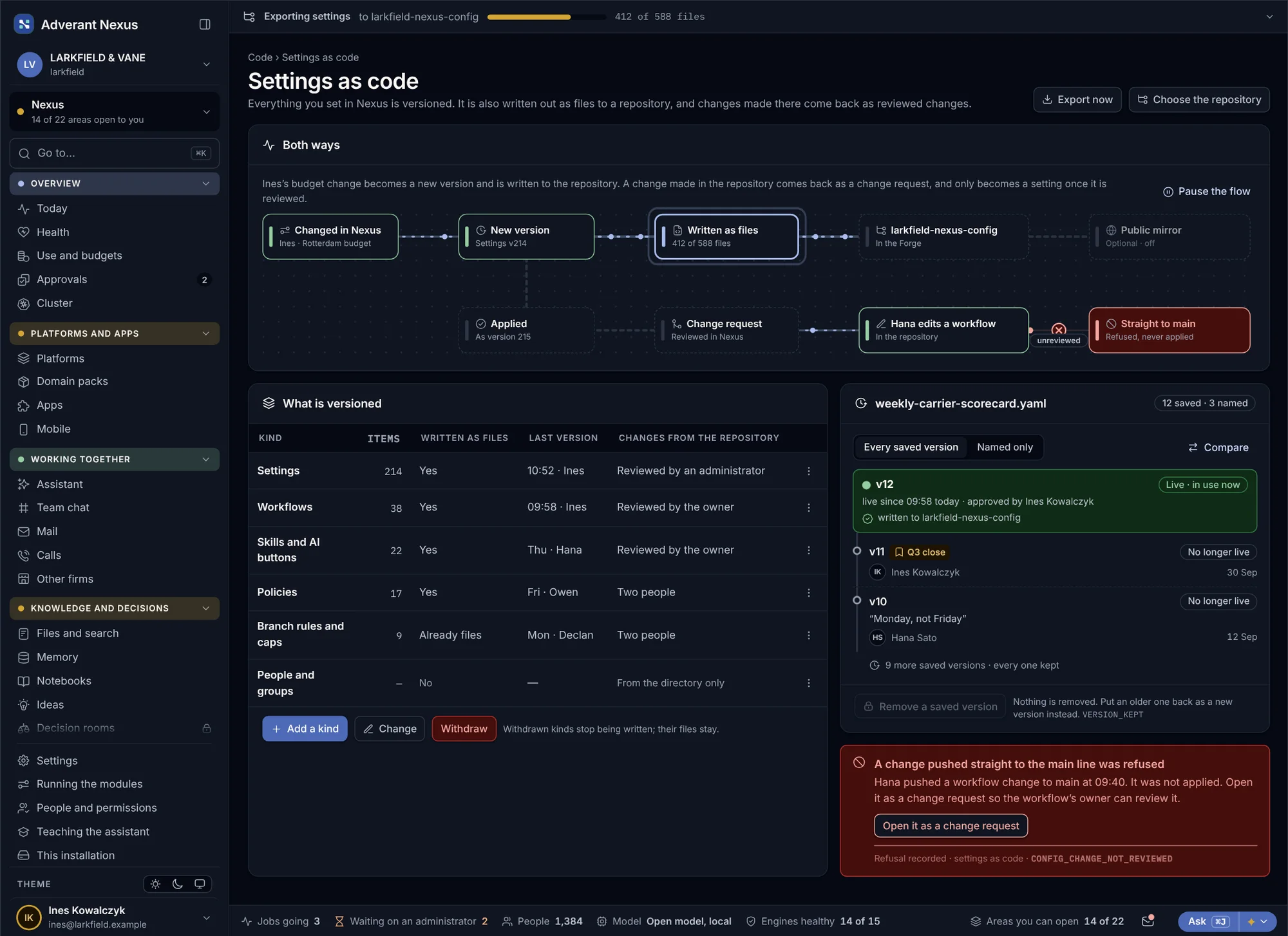
Every setting, versioned
Settings, workflows, skills and policies are written out as files. A change made there comes back as a reviewed change.
- Both ways, always reviewed
- Straight-to-main changes refused
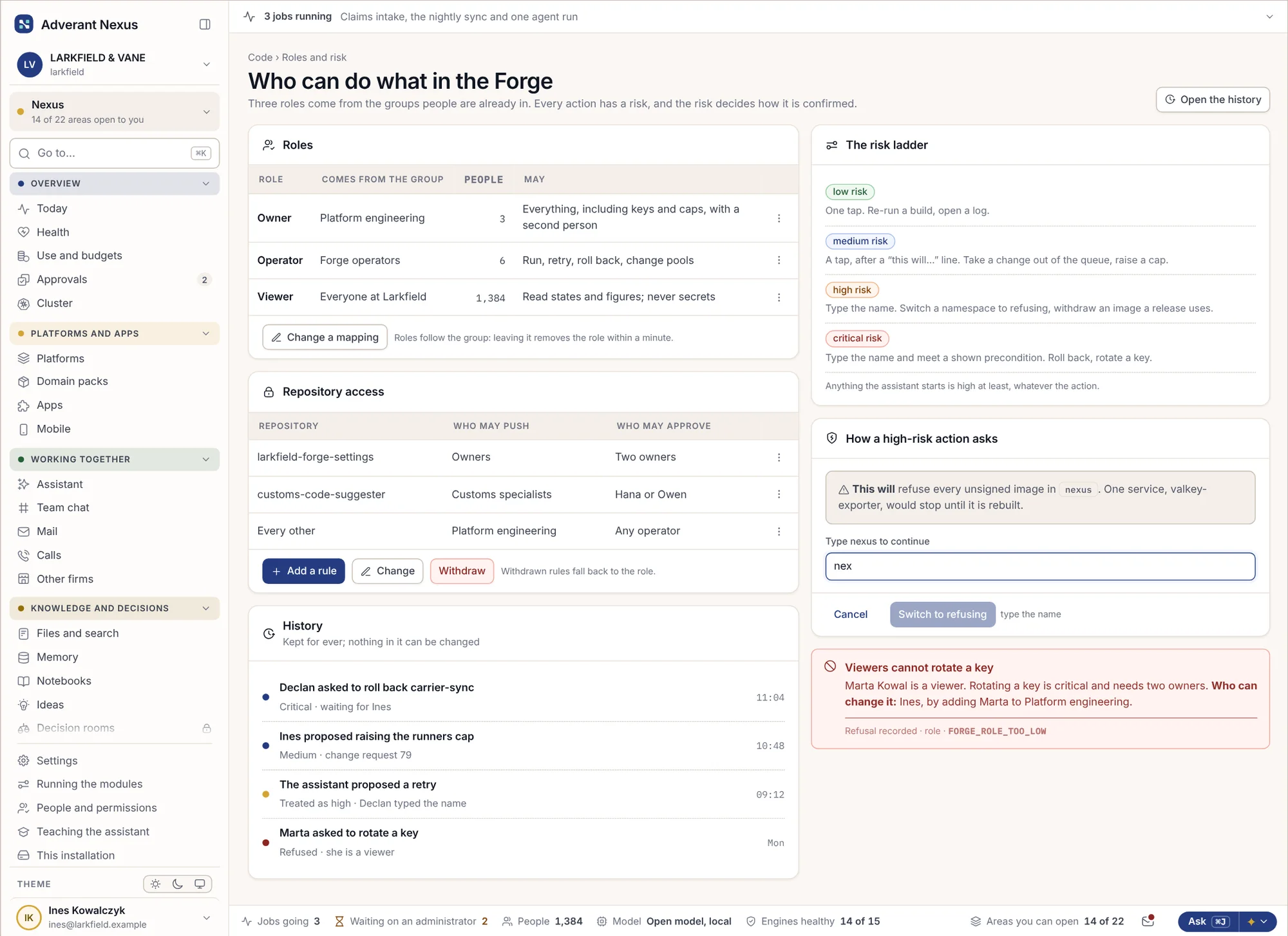
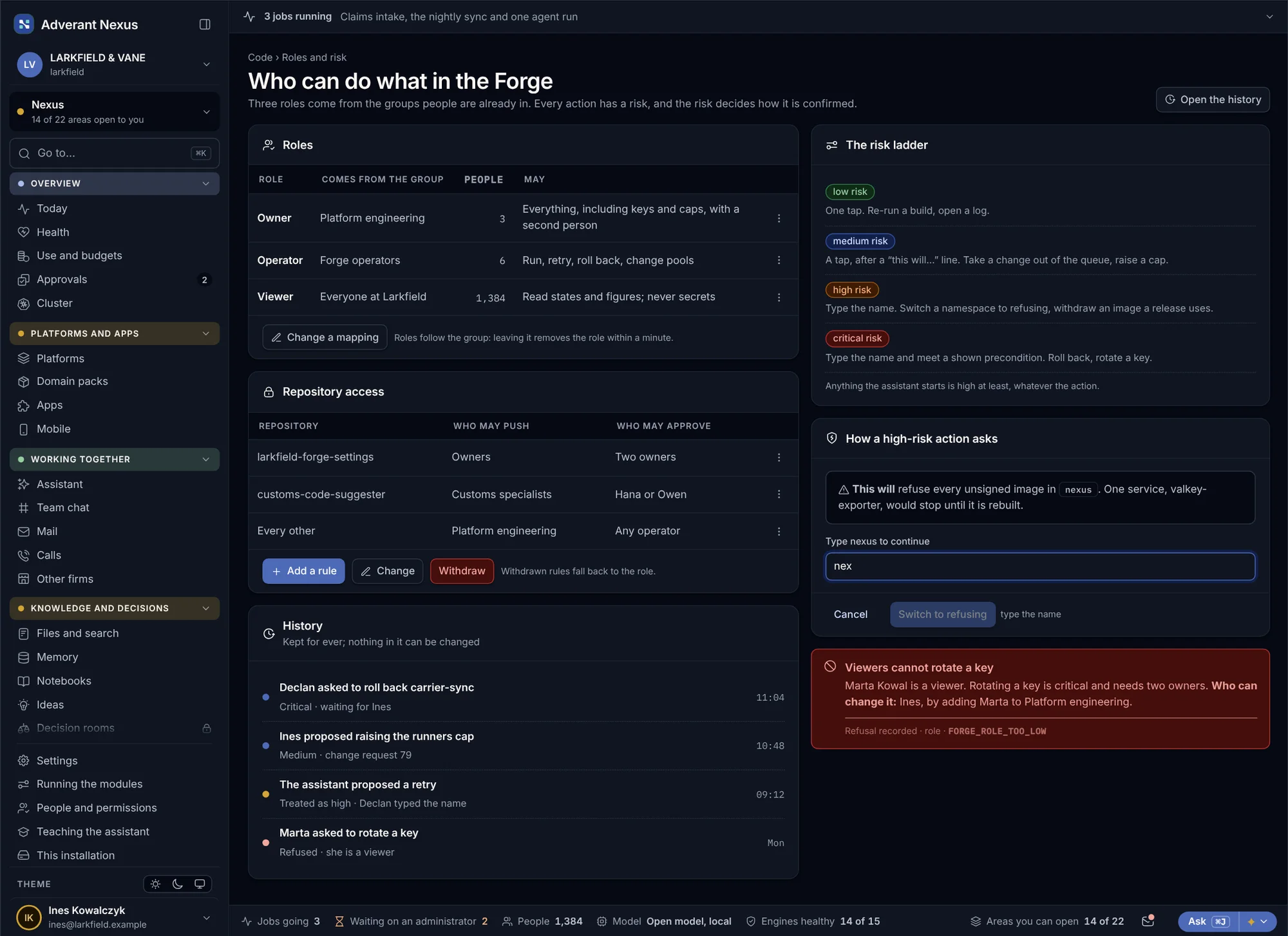
Risky actions ask properly
Every action has a risk. The higher the risk, the more it asks: a name typed, a second person, a precondition met.
- Roles from your groups
- Critical actions need two people
About the Forge and the AI factory.
Do we have to keep our code in the Forge?
No. The Forge is there by default, and Nexus also works with the code host you already use, at organisation or domain level.
Do AI agents write code on their own?
They write changes on branches, like any engineer. Nothing reaches the main line without passing the same checks, and a person approves wherever your rules ask.
How do you stop regressions?
Each change is tested together with every change ahead of it, so the main line only receives combinations that passed. Releases go out in waves with health checks, and every release can be rolled back in one reviewed step.
Does the build path depend on outside services?
No. Building, scanning, signing and releasing all run inside your installation, so you can still ship a fix when something else is down.
Can we see what the factory costs?
Yes. Build minutes, runners and AI review each have a budget and a cap, counted like every other AI call in Nexus.
Go deeper
See the factory build something real.
Bring one idea. We will show you the path from a ranked shortlist to a signed release, on your own hardware.