

Your business, mapped for you. Signed off by your people.
Modelling a business by hand takes months of workshops. Nexus agents write the first draft from the work itself.
Point Nexus at your mail, files, calls and systems. Its agents read them, start from the domain pack for your industry, and propose the kinds of thing your business really runs on, how they connect, and the evidence for each. A person signs off every change before it touches anything, and the map keeps up as the business changes.
A first draft in weeks. And no blank page.
An ontology says what your customers, contracts, ships or claims are and how they connect. Nexus builds it the way a good analyst would, only faster: read everything, start from what the industry already knows, and ask before changing anything.
Connect, read-only
Point Nexus at your file shares, mail, call recordings and business systems. It reads them and never writes back.
Start from a pack
The domain pack for your industry brings the kinds of thing every firm like yours has, already linked.
Agents read the work
A team of agents reads your data and finds the people, things, events and links it keeps mentioning.
Proposals, with evidence
Each new kind arrives as a proposal: what it is, how it links to the rest, and exactly where it was found.
A person signs off
The person who owns that area tries the change on a masked copy, sees what it touches, and signs it off or turns it down.
The graph fills
Facts flow into the knowledge graph, each with its source, and every AI in Nexus answers from them.
The work as it really happens, not just the tables.
Most of what a business knows never reaches a database column. It sits in mail threads, contracts, call notes and spreadsheets. The ontology builder reads all of it, from only the mailboxes, folders and systems you choose, so the map matches how your people actually work.
“Credit hire” comes up in 312 emails a quarter.
Hire companies are named in 6 supplier contracts.
Claimants ask about a hire car on 1 call in 9.
1,840 claims carry a hire cost, filed under “other”.
Sample data
Every firm in your industry shares most of the model.
Domain packs bring that shared part for each industry we serve, from insurance and banking to energy, defence and logistics. The agents spend their time on what is different about your business, and pack upgrades keep your additions and flag any clash for you to decide.
- A base model for each industry
- Your own kinds layered on top
- Upgrades keep what you added
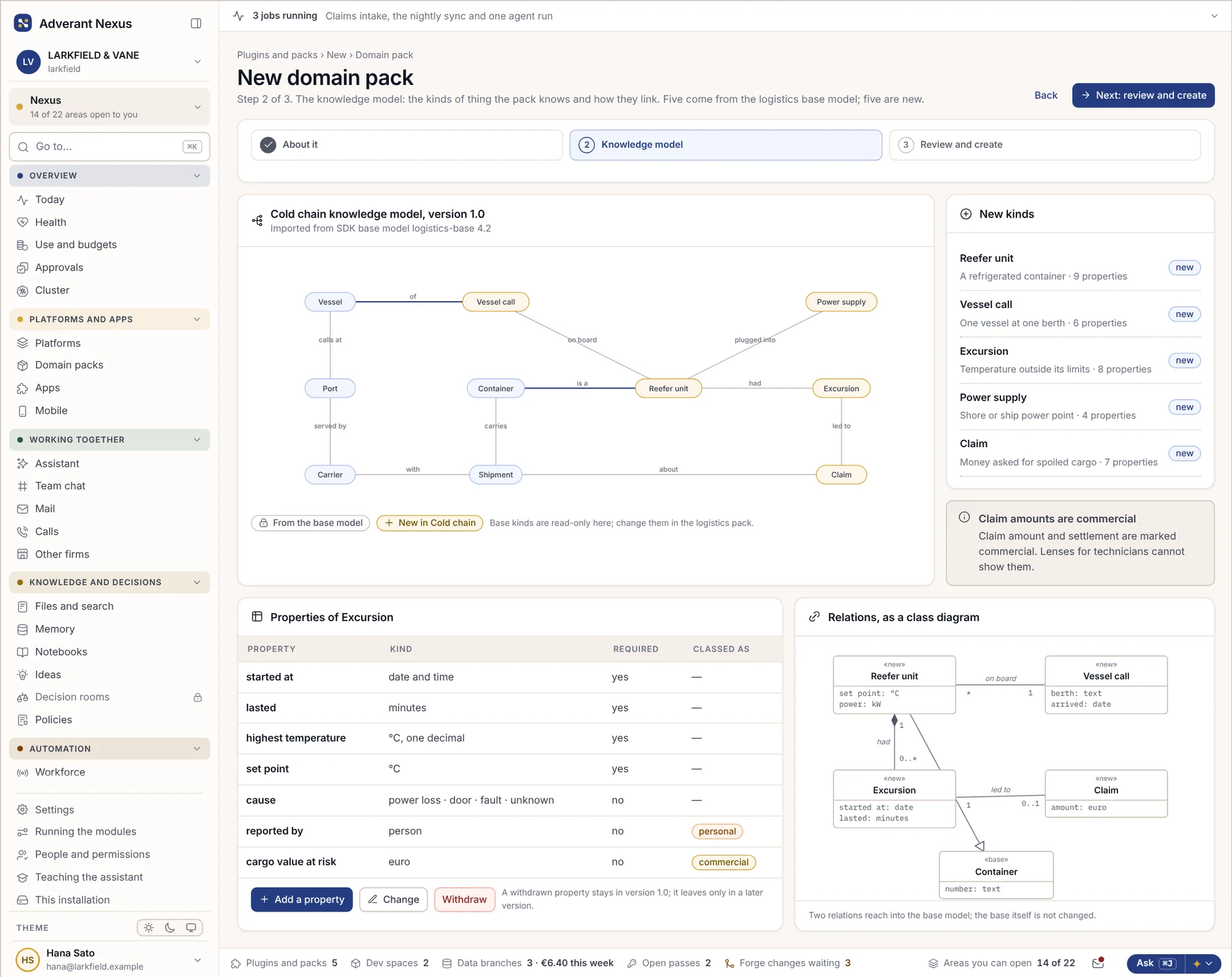
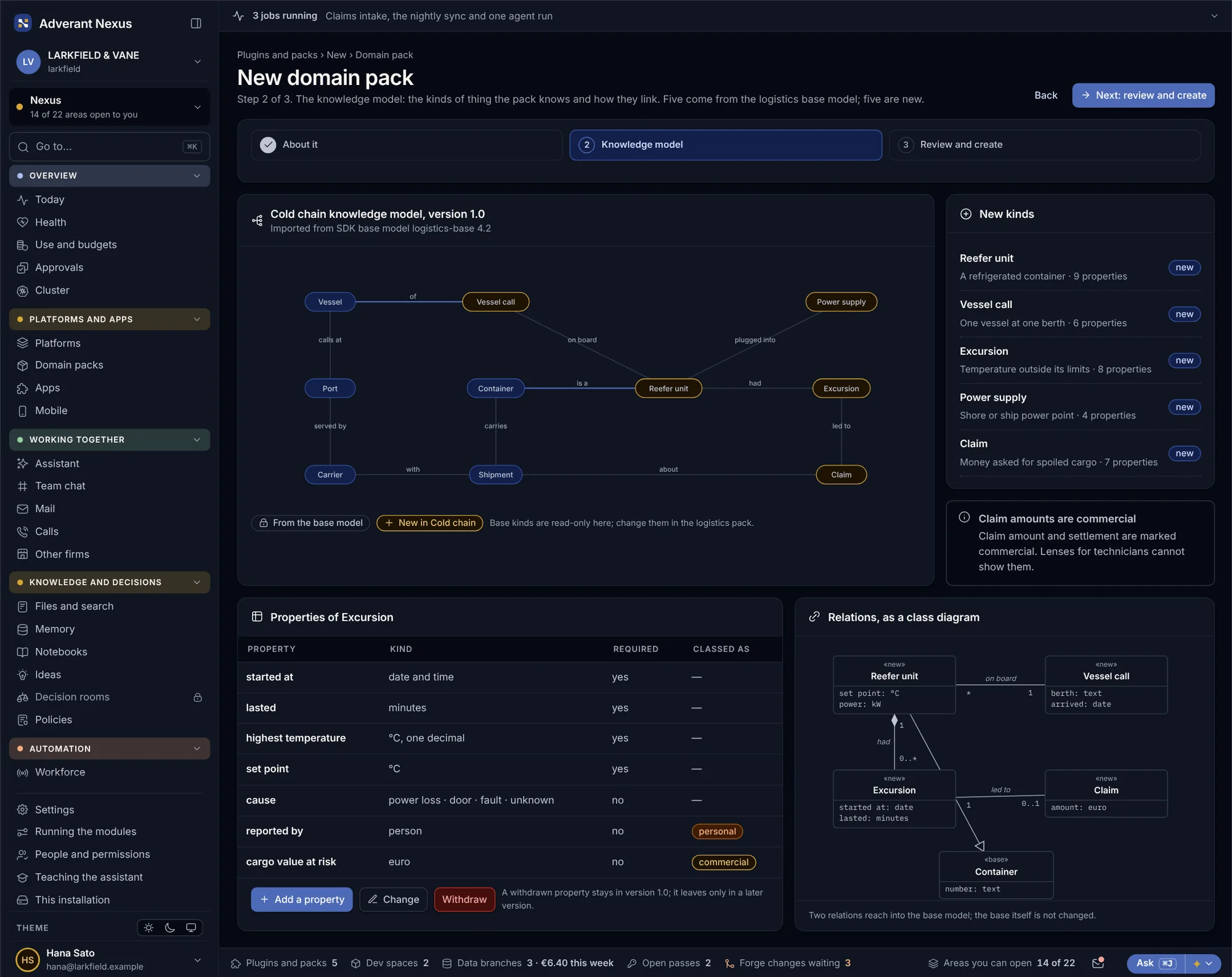
The parts of your business nobody wrote down.
Agents notice what keeps coming up: a kind of case your claims team handles every week, a supplier type that appears in hundreds of contracts, a link between two systems that people make by hand. Each one arrives as a proposal you can check, not a change already made.
- New kinds of thing, and the links between them
- Where each one was found, with the sources
- Names in your own words, in your own languages
- Duplicates and clashes flagged, not merged blindly
Credit hire case
A hire-car bill claimed through a credit hire company after an accident. It comes up every week, and the insurance pack has no kind for it.
- Found in
- 312 emails, 41 claim files, 6 contracts
- Links
- Claim → Credit hire case → Hire company
- Would touch
- 1,206 facts now filed under Claim
Tried on a masked copy: no clashes
Nothing goes live until a person says so.
Every proposal is tried first on a copy of your graph with personal details masked, so the person who owns that part of the business sees what it would change before it changes anything. Sign-offs are recorded with who, when and why, and every change has a way back.
- Tried on a masked copy first
- Impact shown before sign-off
- Who, when and why, on record
- A way back for every change
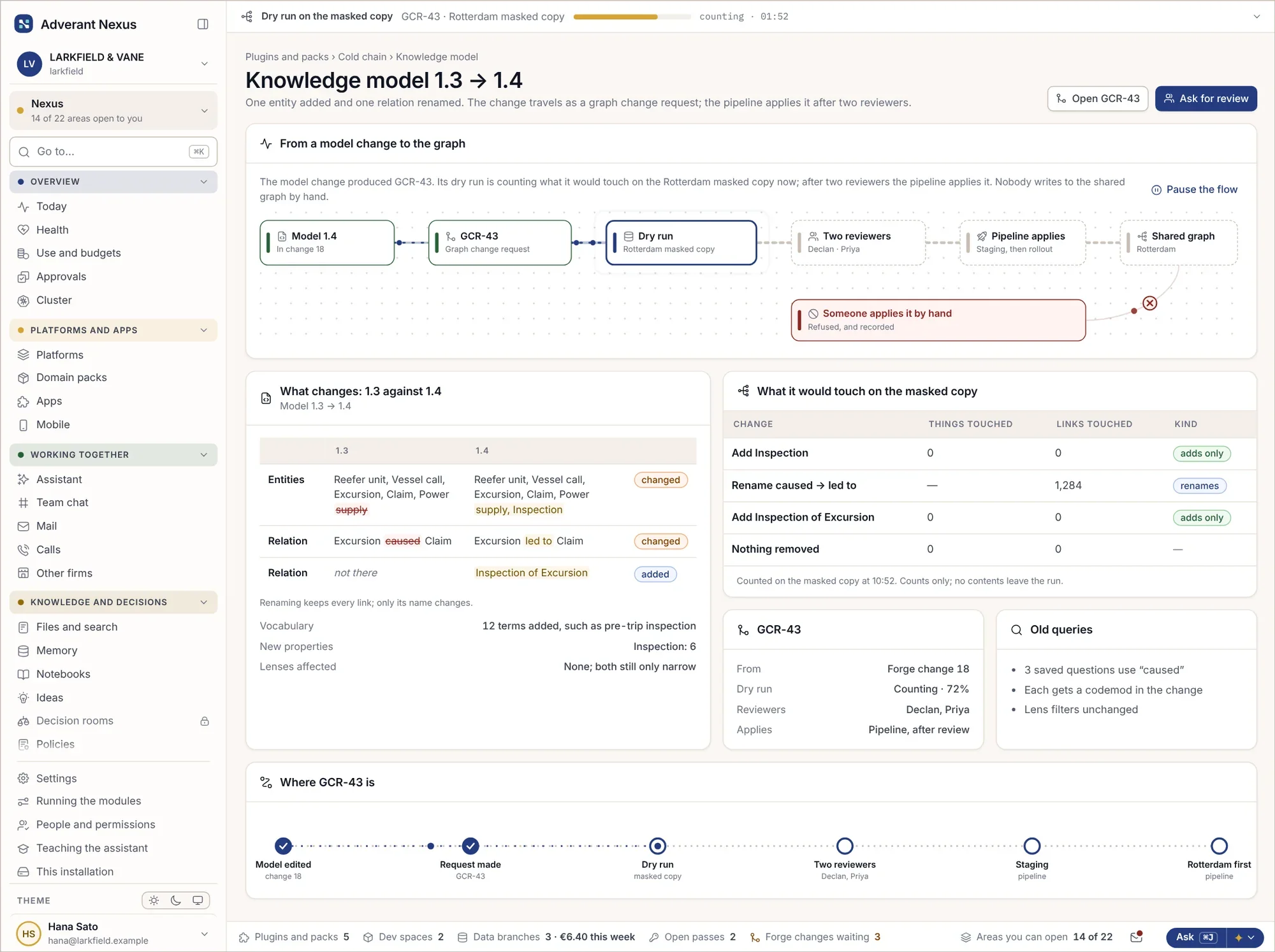
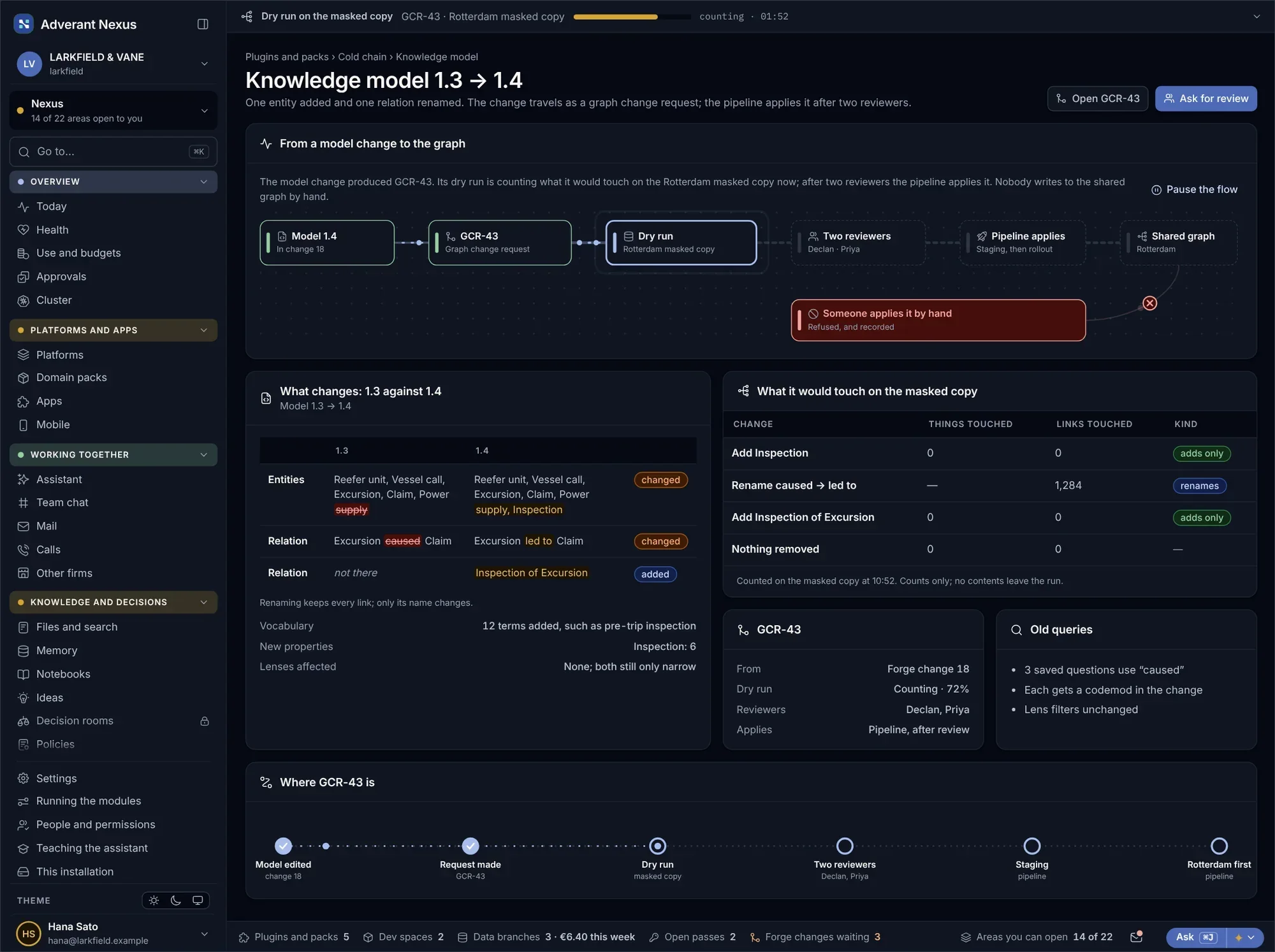
Your business changes. The map keeps up.
The agents read on as new work arrives. When a new product, partner or kind of case starts to appear, it comes back as a new proposal, so the map does not quietly fall behind the business.
New kinds, as they appear
A new product line or a new type of supplier turns up as a proposal, with its evidence.
Links that changed
When work starts flowing a different way, the links in the model are flagged for review.
Kinds nobody uses
Parts of the model that no longer match anything real are flagged, never deleted on their own.
About the ontology builder.
What is an ontology, in plain words?
A map of the kinds of thing your business deals with, such as customers, policies, ships or claims, and how they connect. It lets every AI in Nexus understand your data the way your people do.
Do we need data scientists or modelling workshops?
Not data scientists. The agents write the first draft from your own data and the pack for your industry. You do need someone who knows each part of the business to read the proposals, which are in plain words, and decide. That is hours of review, not months of workshops.
Can it change our systems?
No. Nexus reads from your systems and never writes to them. The ontology and the knowledge graph are built beside them.
What if the agents get something wrong?
Nothing they propose is live until a person signs it off, after trying it on a masked copy. A wrong proposal is turned down, and every signed-off change can be undone.
Which AI models does it use?
Any you choose. If nothing may leave your building, use models that run on your own servers. All AI work goes through the AI switchboard, so you decide which model sees which data, and every call is counted.
Is our data used to train anyone else’s model?
No. Nexus does not train on your data, and your ontology and knowledge graph stay in your own deployment. If you choose a hosted model, its provider’s terms apply to what you send it, and the switchboard lets you keep sensitive sources on your own models.
Who sees our mail and calls?
Only the sources you choose are read, and they are read inside your own deployment. A reviewer sees the evidence for a proposal only if they are already allowed to see that source, and personal details are masked on the trial copy.
Is this a real ontology, or a list of tags?
A real one: kinds of thing, their properties, the links between them and the rules they follow, all versioned. The same customer found in three systems is matched into one, with the evidence kept.
Go deeper
See the first draft of your business.
Pick a mailbox, a folder and a register. We run the ontology builder on them with you, in your environment, and walk through what it proposes.