

Credit, onboarding and DORA. Answered from the same records.
The banking pack reads applications, accounts and customer files, prepares the credit file and the checks, and shows where every figure came from. Credit decisions stay with people, and each one is sealed with its evidence.
- Amount
- EUR 250,000
- Term
- 5 years
- Purpose
- New CNC line
- Security
- Equipment charge
- Revenue
- EUR 3.1m, up 12%
- EBITDA
- EUR 410k
- Debt service cover
- 1.62x
- Arrears
- None in 36 months
Cash flow covers the new repayments with room to spare1. The largest customer is 31% of sales2, above the policy limit of 25%3.
The model scores. A person decides. The applicant can ask for a human review.
Better files. Decisions that hold up.
Analysts spend days gathering figures that already exist. The pack gathers them, cites them and checks them against your policy, so people can spend their time on judgement.

Credit files that cite their figures
Every number in the file links to the page of the accounts or the ledger it came from, and to the policy it is tested against.

Customer checks with reasons
Onboarding and AML alerts say why they fired and what would clear them, so reviewers can close the easy ones fast.


One record for every regulator
The sealed decision answers the credit policy, DORA, the AI Act and GDPR at once. Nothing is rebuilt for each audit.
One pack. A lens for each role.
Relationship managers, analysts, committees and the second line each get a lens on the same customer and the same file.
- Relationship manager
The customer, the application and what is still missing. Drafted requests to the customer.
- Credit analyst
The credit file: figures with sources, policy tests, ratios and the drafted recommendation.
- Credit committee
Files waiting on a decision, the case for and against, and a room to rule in.
- AML and onboarding
Alerts with reasons, ownership chains, screening hits and the evidence to close or escalate.
- Risk and compliance
The AI register, incidents with their DORA clocks, and sealed decisions mapped to the rules.
From application to a sealed decision.
Every application runs the same path, so every decision leaves the same kind of record.
Take the application
Online, in branch or through a broker. The pack opens a file and asks only for what is missing.
Know the customer
Identity, ownership and screening are checked. Alerts carry reasons and a suggested next step.
Build the credit file
Accounts, ledgers and bank data are read. Figures are tested against your credit policy, with sources.
Decide and seal
A person or committee decides. The decision, the evidence and the rules it answers are sealed together.
Screens for each desk in the bank.
Sample screens with a fictional bank. Product screens show the Nexus core the pack runs on.
Every figure has a source
Ratios, covenants and policy tests sit beside the page they came from. Where the accounts and the ledger disagree, both are shown.
| Test | Result | Policy |
|---|---|---|
| Debt service cover | 1.62x · pass | Min 1.25x · s. 5.1 |
| Loan to value | 58% · pass | Max 70% · s. 5.4 |
| Customer concentration | 31% · exception | Max 25% · s. 7.2 |
| Sector limit | Within | Manufacturing · s. 9 |
The top customer has a three-year contract to 2029 with a public body. Suggest a covenant to report concentration each quarter.
Exceptions need a named approver.
Alerts that explain themselves
Ownership chains, screening hits and unusual payments come with the reason they fired and what would clear them. A person closes or escalates.
| Check | Finding | State |
|---|---|---|
| Identity | Directors verified with eID | Clear |
| Ownership | 2 owners over 25%, chain resolved | Clear |
| Screening | Name match on a sanctions list, different date of birth | Review |
| Payments | Three transfers to a new supplier in 9 days | Review |
A false match is closed by a person, with a reason that is kept.
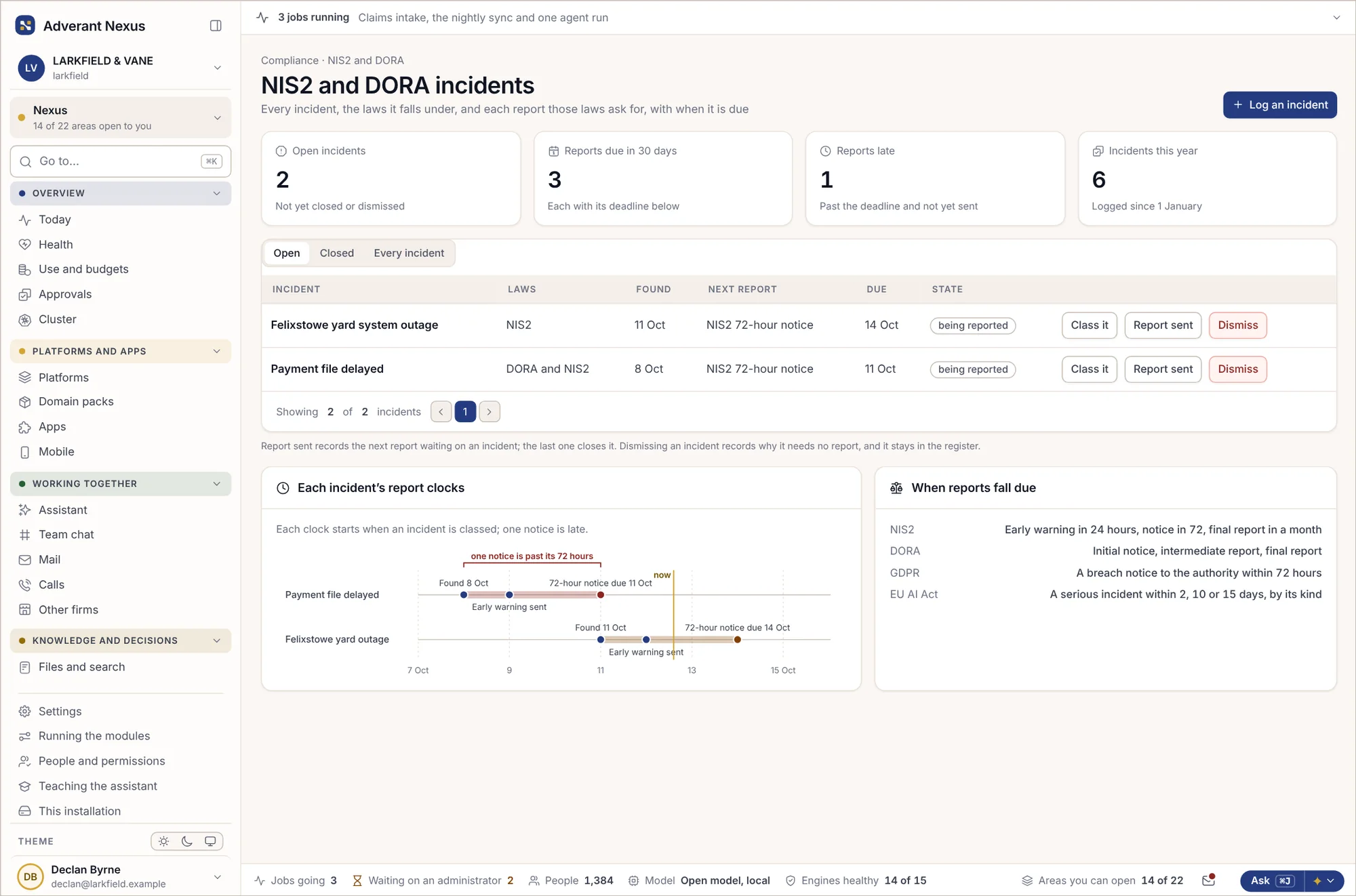
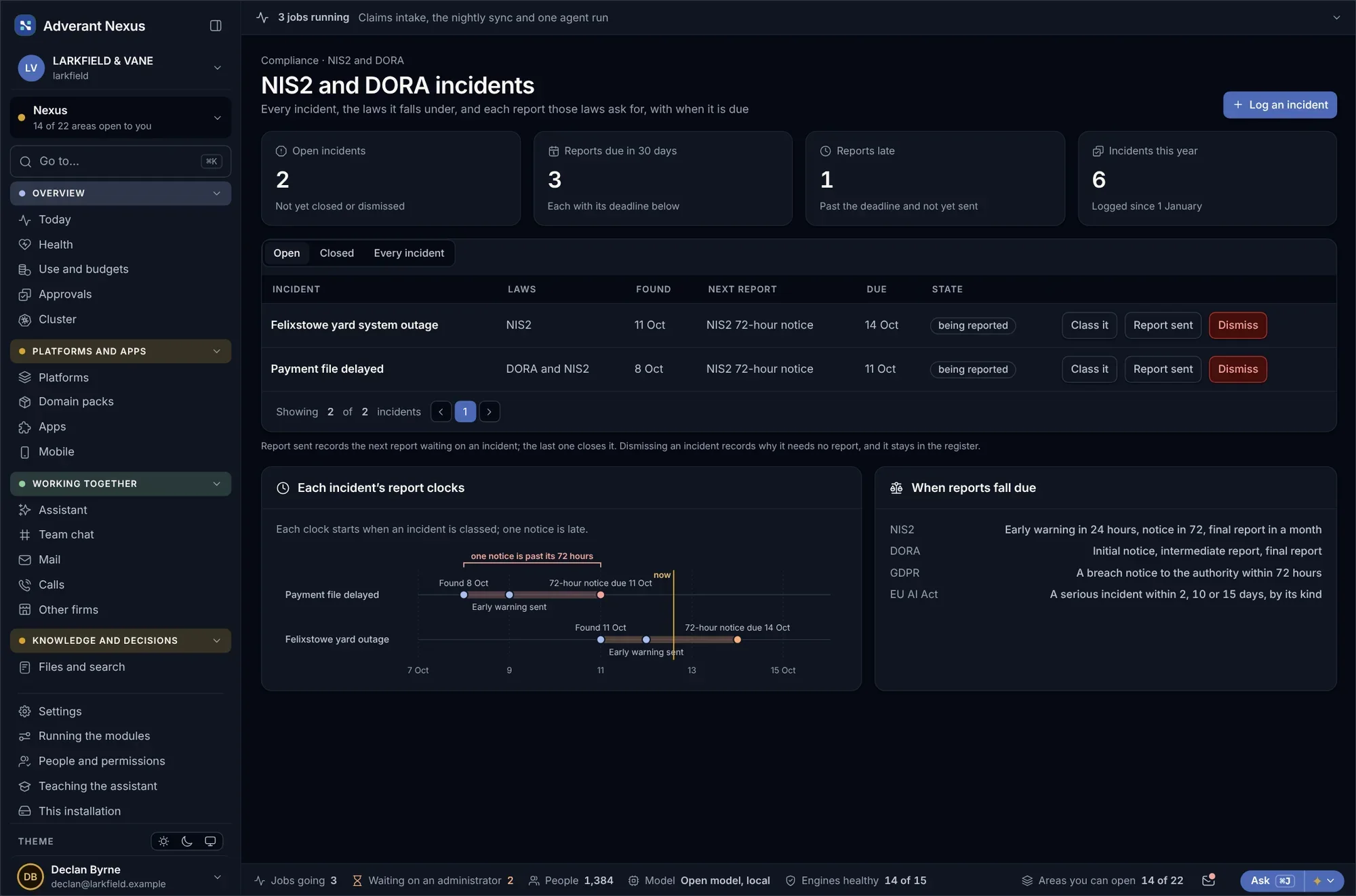
Every clock in one place
When something breaks, the pack starts the right reporting clocks, drafts each report and keeps the evidence that it was sent on time.
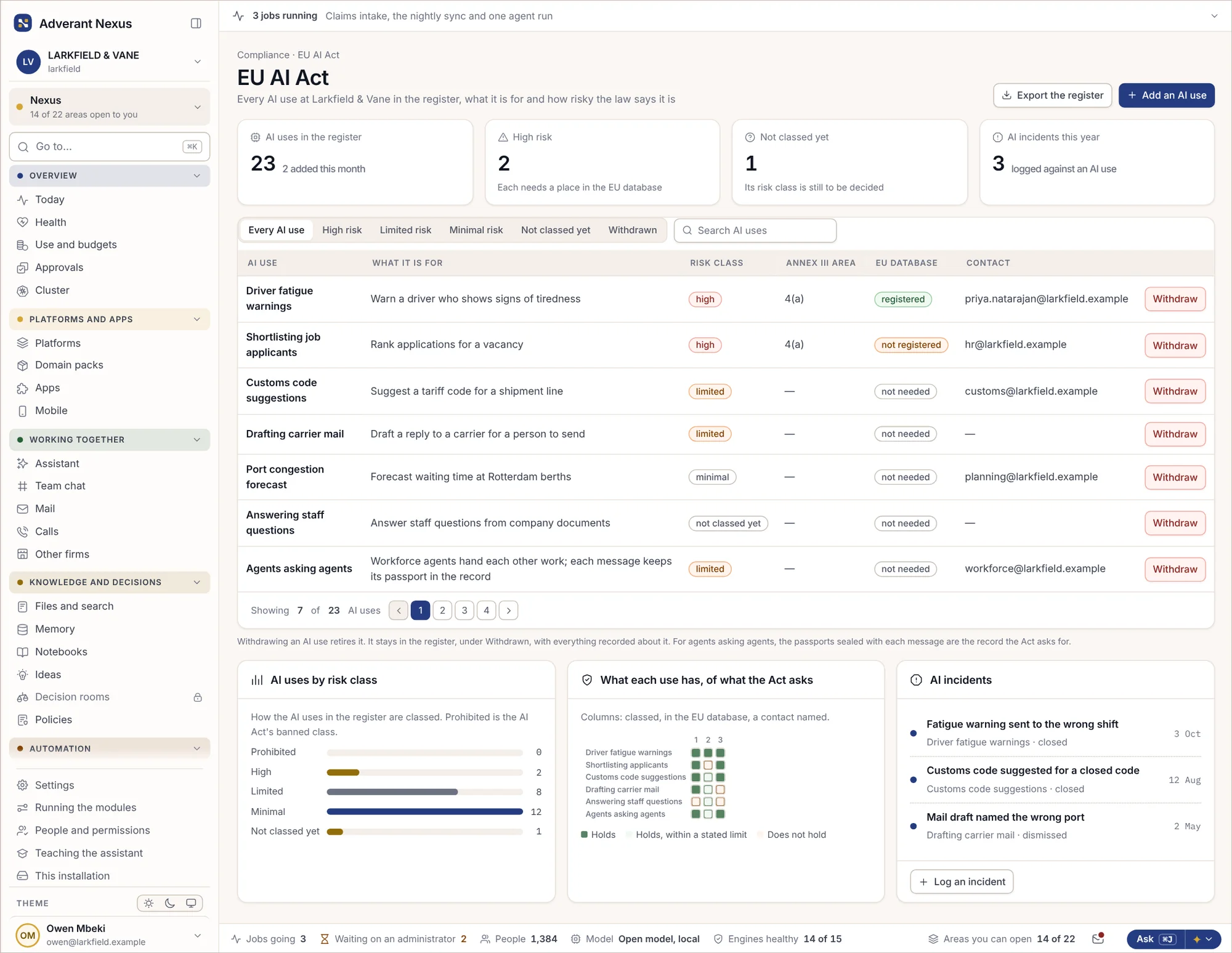
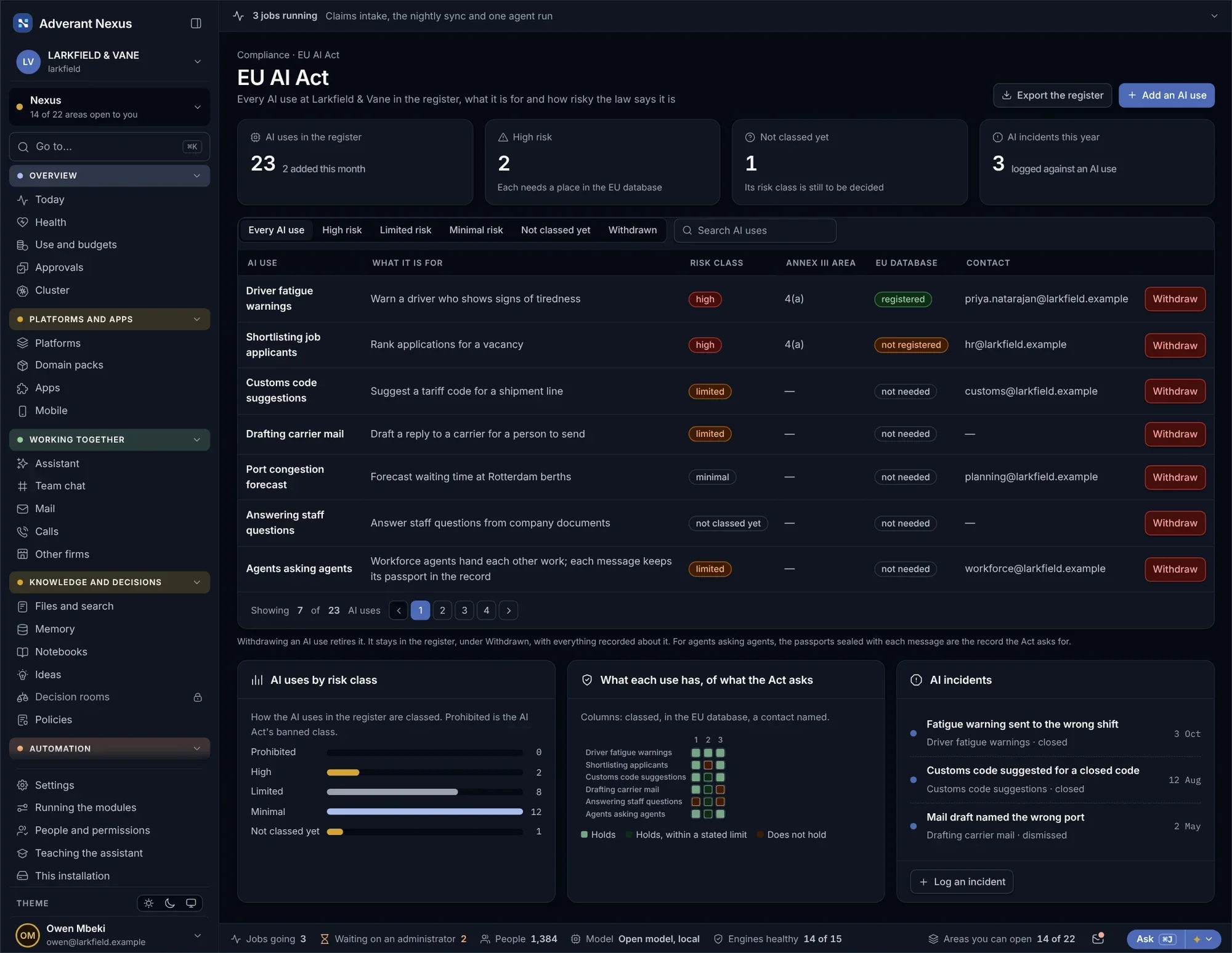
Every AI use, classed
Each AI use in the bank is listed with what it is for, its risk class under the AI Act and who owns it. Credit scoring is marked high-risk, with its evidence.
Each credit decision, sealed with its file.
When a person or committee decides, the decision, the file it rests on, the model that scored it and the rules it answers are sealed together.
- Who decided, with which mandate and limit
- The figures used, each with its source page
- The model and version that scored it, and what it could read
- Policy exceptions and who approved them
- The time stamp, witnessed outside Adverant
Internal audit, the supervisor or the customer's reviewer can check the seal without an account. Try the seal check →
Credit decision · APP-2026-1187SampleMapped to the rules banks answer to.
Each sealed record is linked to the articles it helps answer, so the evidence is ready before the supervisor asks.
- DORARegulation (EU) 2022/2554ICT risk, incident reporting, testing and the register of tech suppliers.
- EU AI ActRegulation (EU) 2024/1689, Annex III 5(b)Credit scoring of people is high-risk AI from 2 December 2027. Fraud detection is not.
- Anti-money launderingRegulation (EU) 2024/1624 (AMLR)One EU rulebook for customer checks, applying from 10 July 2027.
- Consumer creditDirective (EU) 2023/2225Creditworthiness checks and a right to human review of automated decisions, from 20 November 2026.
- Loan originationEBA/GL/2020/06How loans are assessed, approved, priced and monitored, including automated models.
- GDPRRegulation (EU) 2016/679, Art. 22Limits on decisions based solely on automated processing.
AI Act dates as amended by Regulation (EU) 2026/1744, the Digital Omnibus, published in the Official Journal on 24 July 2026. Not legal advice. Certification and legal opinions stay between you and your advisers.
Seven modules. One bank-wide record.
Each module runs on the same Nexus core, so the customer, the file and the decision are the same everywhere. Open a module to see what goes in, what comes out and who signs off.
Application intake
Takes applications from web, branch and brokers and opens one file per customer.
- Goes in
- Forms, uploads, broker packs
- Comes out
- A file with what is missing and a drafted request
- Signs off
- Relationship manager
Customer due diligence
Checks identity, ownership and screening, and keeps the evidence for each.
- Goes in
- eID, registries, screening lists
- Comes out
- Checks with findings and reasons
- Signs off
- Onboarding reviewer
Transaction monitoring
Flags unusual payments with the pattern and the history behind them.
- Goes in
- Payments, customer profile
- Comes out
- Alerts with reasons and a drafted report
- Signs off
- AML analyst, then the MLRO
Credit file builder
Reads accounts, ledgers and bank data and tests them against your credit policy.
- Goes in
- Accounts, ledgers, open banking data
- Comes out
- A credit file with sources and policy tests
- Signs off
- Credit analyst
Credit committee
Runs the committee: papers, the case for and against, votes and the ruling.
- Goes in
- Credit files waiting on a decision
- Comes out
- A ruling with reasons, ready to seal
- Signs off
- Committee chair
Model oversight
Keeps each scoring model with its owner, tests, drift and explanations.
- Goes in
- Models, outcomes, overrides
- Comes out
- Evidence for model risk and the AI Act
- Signs off
- Model risk owner
DORA register and incidents
Keeps the supplier register and runs the reporting clocks when something breaks.
- Goes in
- Suppliers, contracts, incidents
- Comes out
- Register entries and reports with proof of timing
- Signs off
- Head of ICT risk
Runs where your supervisor allows.
Run the pack in our EU cloud or on your own Kubernetes. Models can stay on your own hardware.


Our EU cloud
Each bank in its own private space. Data stays in Europe.
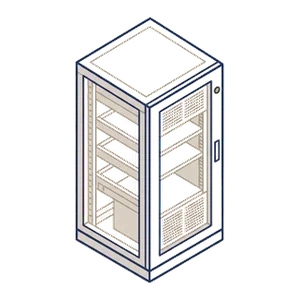

Your data centre
On your own Kubernetes, next to your core banking systems.
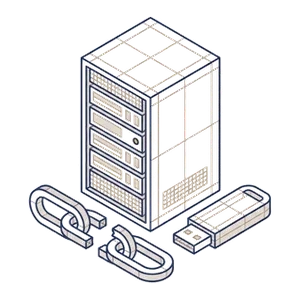
Fully offline
For ring-fenced books and sensitive work that cannot connect.
An appliance
A sealed box in your own rack, for smaller banks and branches.
Questions banks ask.
Does the AI approve loans?
No. Models can score and the pack can recommend, but a person or committee decides, within the mandate the bank gave them. The record shows who.
Can a customer ask for a human review?
Yes. Every automated step is marked, and a review request opens the file for a person with the full history.
How does it help with DORA?
Nexus keeps its own supplier register entries, incidents and test evidence, and the pack keeps the bank's. Reports are drafted with their deadlines and the proof they were sent.
Which models does it use?
The models you approve, through the AI switchboard. Credit models can stay on your own hardware and never leave it.
Does it replace our core banking system?
No. Core banking stays the system of record. The pack reads from it and writes decisions back where you allow.
Can we use our own credit policy?
Yes. Your policy is loaded as rules in plain words, tested on past files before it goes live, and versioned.
Other packs
See the banking pack on your own files.
Bring an anonymised credit file or an onboarding case. We will show you how it runs on Nexus, end to end.