
Nexus Synergy Engagement Package — A04 · Transport Infrastructure Ireland (TII)
Nexus Synergy Engagement Package — A04 · Transport Infrastructure Ireland (TII)
STATUS HONESTY. Nexus Synergy Ltd is pre-incorporation, pre-revenue, pre-pilot. Transport Infrastructure Ireland (TII) is a TARGET, not a customer; nothing here is deployed. The ~178 product UI surfaces exist as a gallery, not a live system; the cross-agency road-incident action loop over TII's live data is not yet built or proven. ANTI-COOKIE-CUTTER. The two mockups in §8 are programmatically generated ASCII (
_build/archetypes/gen_tii-roads-tunnels.py, alignment-guarded by_ck()), filled with TII's real M50 junctions, Dublin Tunnel, MOCC/eMOS/Lanternn/Egis feeds and the IICG sign-off — not a reused shell. PROBABILITIES. Every probability in this file is a[PRIOR]— a subjective pre-pilot estimate for prioritisation, not a forecast. Re-score after every real conversation.
§0 — Header & one-line thesis
Nexus Synergy for the M50 and the Dublin Tunnel: a cross-agency common-operating-picture that turns the multi-agency major-incident call — today coordinated across the Interagency Incident Coordination Group (IICG) by phone, radio and separate agency systems — into a single fused, human-gated, audit-evidenced decision loop above the road-operator layer, so a closure-and-diversion decision is made faster, jointly, and with the CER/NIS2 resilience evidence the new regime demands.
Wedge: a cross-agency M50 / national-roads major-incident coordination COP for the IICG decision layer that no road-operator vendor owns (explicitly not a replacement for TII's MOCC/eMOS traffic picture). Durable expansion: a CER / NIS2 transport-resilience COP. Warm bridge: Patrick Walsh, whose state/semi-state innovation network (ESB X-Potential, Irish Rail Future Track) already reaches the transport ecosystem. Demo: the storm-replay #3 TII roads lens, replayed on the 9 April 2026 M50 fuel-protest multi-agency closure.
§1 — Entity snapshot (cited from the target card)
- Transport Infrastructure Ireland (TII) — the State agency responsible for the national-roads and light-rail networks; CEO Lorcan O'Connor, Chair Gareth Llewellyn. The relevant unit is Network Management — Operations & Services, which runs the Motorway Operations Control Centre (MOCC) and the Dublin & Jack Lynch Tunnels. (target card §6; tii.ie) [verified]
- The asset under pressure — the M50. Dublin's orbital motorway carries ~6,400 vehicles/hour/direction and sees ~120 incidents in a typical month, over half during rush hour; serious incidents pull in An Garda Síochána, Dublin Fire Brigade, the four Dublin Local Authorities, TII and the Motorway Traffic Control Centre. (tii.ie M50 Major Incident Management; verified 2026-06-05 — "about 120 incidents … in a typical month") [verified]
- The cross-agency forum — the IICG. The Interagency Incident Coordination Group, formed 2015, is the multi-agency body that convenes for a major M50 incident so decision-makers from each agency coordinate a combined response; it also owns the M1 J3 → Red Cow J9 emergency-diversion scheme. (tii.ie; sdcc.ie "M50 Major Emergency Diversion"; verified 2026-06-05) [verified]
- Operations contractor: Egis Road & Tunnel Operations (ERTO) holds a new 8(+8)-year, up-to-€600m (16-yr) contract for the 24/7 operation of the MOCC, the Dublin Tunnel and the Jack Lynch Tunnel and monitoring of 1,200 km of motorway, signed May 2025. (tii.ie/egis-dublin-tunnel; egis-group.com; irishexaminer.com arid-41635075; verified 2026-06-05) [verified]
- Detection / ITS layer: Lanternn by Valerann (AI computer-vision detection + data fusion, "single operational picture") deployed across TII motorways under the eMOS (Enhancing Motorway Operation Services) programme (ROD/AECOM JV); NIMS/eMOS is the road-operator situational-awareness backbone. (irfofficial.org 2025-11; tii.ie eMOS; verified 2026-06-05) [verified]
- Strategy context: the TII Statement of Strategy 2026–2030 (Nov 2025) names MOCC & Tunnels resilience as an Operations objective and commits to "emerging technologies and digital services … AI, large language models"; a €231m ITS line sits within the €9.7bn 2026–2030 national-roads programme (NDP / Project Ireland 2040). (tii.ie statement-of-strategy; verified 2026-06-05) [verified]
§2 — The pain (web-verified, dated, cited)
Two converging drivers make this a buying situation, not a nice-to-have.
(a) Acute — multi-agency M50 / tunnel incident coordination across separate systems.
- The M50 runs ~120 incidents/month; a major one is a multi-agency event (Garda + DFB + 4 LAs + TII + MOCC) coordinated through the IICG — a forum, not a shared real-time operating picture. Each agency looks at its own system (TII at the MOCC/eMOS/Lanternn picture; Garda at CAD; DFB at its own dispatch); the joint call is reconciled by phone/radio. (tii.ie M50 Major Incident Management; verified 2026-06-05) [verified]
- 9 April 2026 fuel protests closed M50 J5 (Finglas) and disrupted routes across 9 counties (M50/M4/M6/M7/M8/M9/M20); reporting noted "TII working closely with the Garda Traffic Corps" and TII's live traffic map being used by the public. This is the canonical multi-agency, cross-jurisdiction strain event our demo replays. (thejournal.ie 2026-04-09 "TII map shows where fuel protests are happening"; verified — figure from target card §6) [verified — event; "9 counties / closely with Garda Traffic Corps" per card]
- The gap our software fills: the cross-agency IICG decision layer — a single fused picture (TII incident + Lanternn detection + Garda + DFB + LA closures + tunnel SCADA) with a human-gated joint closure/diversion decision and an audit record of who decided what, when — does not exist today. The road-operator layer (MOCC/eMOS/Lanternn/Egis) is the input, not the cross-agency decision room.
(b) Durable — CER / NIS2 transport-resilience mandate.
- Ireland's National Strategy on the Resilience of Critical Entities 2026–2029 was published 19 Mar 2026, implementing the EU CER Directive across 11 sectors including transport, each with a designated Competent Authority; the Department of Defence is the single point of contact, with critical entities to be designated by 17 July 2026 and ~10 months to comply thereafter. (gov.ie 2026-03-19; critical-entities-resilience-directive.com/Ireland; verified 2026-06-05) [verified]
- NIS2 is being transposed via Ireland's National Cyber Security Bill 2024, in pre-legislative scrutiny as of mid-2026, with self-registration tentatively ~July 2026 and first audits ~mid-2027; road ITS/OT is in scope as an essential-service dependency. (Accuracy note: the card's "NIS2 Act 2026 in force 1 Oct 2026" overstates — the Bill is still in pre-legislative scrutiny; treat the date as a target, not law.) (iapp.org; ncsc.gov.ie/nis2; verified 2026-06-05) [verified — bill status; date softened]
- The gap our software fills: a single auditable operating picture fusing physical (road/tunnel/OT) + cyber + incident signals with a provenance/audit ledger that evidences CER (and, on designation, NIS2) obligations to the Competent Authority on demand.
§3 — Use-case & value (decline-safe)
Lead product — Cross-Agency Major-Incident Operating Picture (the wedge). Fuse MOCC/eMOS incident feeds + Lanternn-by-Valerann AI detections + Garda Traffic Corps status + Dublin Fire Brigade dispatch + LA road-closure + tunnel SCADA onto our triple-renderer map over a road-corridor ontology. The closed action loop — detect → enrich → triage → human-gated IICG sign-off (joint close / hold / divert) → task (set VMS, activate signed diversion, notify agencies) → execute → assess (BDA) → close — time-stamps every decision in an audit/provenance ledger that doubles as CER evidence.
Value: a faster, jointly-owned, defensible closure-and-diversion call protects the 6,400 veh/hr/dir flow, shortens tailback growth, and replaces the IICG phone/radio reconciliation with one shared picture — while producing the audit trail no current agency tool emits.
Expansion — CER/NIS2 Transport-Resilience COP. Same ontology + ledger, extended to physical + cyber + OT signals across TII's national-roads and tunnel estate, producing the governance and audit evidence the CER Competent Authority requires. Stickier, regulator-driven, slower.
Decline-safe — explicitly NOT. This engagement is incident coordination and resilience only. It does NOT include — and will not be extended to — predictive policing, real-time biometric identification, emotion recognition, social scoring, untargeted scraping, or psychometric/individual risk-profiling (all on our published Declined List). The picture tracks road assets, vehicles-as-objects, and authorised responder assets — never people-as-identities. ANPR/Egis tolling data, if ever referenced, is used only for flow/closure state, never for individual identification or scoring. The §5 data model makes this a database invariant (an incident references a network asset, never a person). No personal-data processing is required for the wedge.
§4 — Ontology (road-corridor)
One shared ontology — the entities the map draws are the entities the IICG decision references:
- RoadCorridor — the M50 orbital (a directed sequence of segments J1…J17) and the radial motorways (M1/M4/M6/M7/M8/M9/M20); attributes: lanes, design flow (6,400 veh/hr/dir).
- Junction — J3 (M1), J4 (Ballymun), J5 (Finglas), J6 (Blanchardstown), J7, J9 (Red Cow) … (node on the corridor; diversion-scheme anchor).
- RoadSegment — physical carriageway between two junctions; status ∈ {open, slow, stopped, closed}; carries the closure decision.
- Tunnel — Dublin Tunnel (Port ↔ M50), Jack Lynch Tunnel (Cork); SCADA state (air/CO, ventilation, ramp-meter).
- IncidentEvent — an open incident (breakdown / debris / collision / protest blockade) referenced to a
RoadSegmentorJunction; severity, agencies engaged. Never references a person. - DiversionRoute — the signed emergency-diversion scheme (e.g. M1 J3 → Red Cow J9); set/unset state, signage readiness.
- ResponderAsset — Garda Traffic Corps unit, DFB appliance, LA crew, recovery vehicle (object/asset, not a named person).
- VmsSign — variable-message sign on the corridor (the write-back actuator: "M50 CLOSED", diversion advice).
- MetWarning — CAP-style Met Éireann warning (enrichment for weather-driven incidents).
- CoordinationDecision — the human-gated IICG action; references the candidate segment/diversion, carries proportionality + 2-of-2 sign-off + conditions.
RoadSegment and Tunnel state are bitemporal (operational time vs system time) so the post-event audit can replay exactly what each agency knew at the moment of the joint call.
§5 — Data model (synergy.*, RLS + a load-bearing CHECK)
Three tables. RLS isolates every tenant by app.current_org_id; two load-bearing CHECKs encode the product thesis: (1) the human gate — no closure/diversion can be recorded as enacted without a complete 2-of-2 IICG sign-off; (2) the decline-safety invariant — an incident references a network asset, never a person.
SQL60 lines-- 1. Road / tunnel corridor segments (the physical state surface, bitemporal) CREATE TABLE synergy.corridor_segment ( segment_id text PRIMARY KEY, -- 'M50-J5-J6', 'DUBTUN', 'J9-RAMP' org_id uuid NOT NULL, corridor_id text NOT NULL, -- 'M50', 'M1', 'JACKLYNCH' kind text NOT NULL CHECK (kind IN ('carriageway','junction','tunnel','vms','diversion')), status text NOT NULL CHECK (status IN ('open','slow','stopped','closed','na')), design_flow_vph integer, -- 6400 veh/hr/dir on the M50 scada_ok boolean, -- tunnel only (air/CO/ventilation) valid_from timestamptz NOT NULL DEFAULT now(), valid_to timestamptz, -- bitemporal: NULL = current recorded_at timestamptz NOT NULL DEFAULT now() ); ALTER TABLE synergy.corridor_segment ENABLE ROW LEVEL SECURITY; CREATE POLICY rls_corridor_segment ON synergy.corridor_segment USING (org_id = current_setting('app.current_org_id')::uuid); -- 2. Incident events fused from MOCC / Lanternn / Garda / DFB (NEVER person-data) CREATE TABLE synergy.incident_event ( incident_id uuid PRIMARY KEY DEFAULT gen_random_uuid(), org_id uuid NOT NULL, segment_id text NOT NULL REFERENCES synergy.corridor_segment(segment_id), cause text NOT NULL CHECK (cause IN ('breakdown','debris','collision','protest','weather','other')), severity text NOT NULL CHECK (severity IN ('minor','major','critical')), detected_by text NOT NULL CHECK (detected_by IN ('mocc','lanternn','garda','dfb','la','public')), agencies jsonb NOT NULL DEFAULT '[]', -- ['tii','garda','dfb','fingal','sdcc'] prov_derived_from text NOT NULL, -- PROV-O: eMOS/Lanternn/Garda-CAD product id -- LOAD-BEARING DECLINE-SAFETY INVARIANT: an incident is about a NETWORK ASSET, never a person. -- (segment_id is NOT NULL + FK to corridor_segment; no person/biometric/identity column exists.) opened_at timestamptz NOT NULL DEFAULT now(), recorded_at timestamptz NOT NULL DEFAULT now() ); ALTER TABLE synergy.incident_event ENABLE ROW LEVEL SECURITY; CREATE POLICY rls_incident_event ON synergy.incident_event USING (org_id = current_setting('app.current_org_id')::uuid); -- 3. The human-gated IICG coordination decision (the action of record) CREATE TABLE synergy.coordination_decision ( decision_id uuid PRIMARY KEY DEFAULT gen_random_uuid(), org_id uuid NOT NULL, incident_id uuid NOT NULL REFERENCES synergy.incident_event(incident_id), action text NOT NULL CHECK (action IN ('close','divert','hold','reopen')), diversion_id text, -- e.g. 'M1-J3-REDCOW-J9' proportionality numeric NOT NULL CHECK (proportionality BETWEEN 0 AND 1), conditions jsonb NOT NULL DEFAULT '[]', -- e.g. accessible-route, blue-light corridor sign_tii_mocc text, -- TII MOCC duty manager QES sign_garda text, -- Garda Traffic Corps Inspector QES (2nd control) enacted_at timestamptz, -- when VMS/diversion actually took effect prov_room_id text NOT NULL, -- PROV-O: the IICG Decision Room activity id created_at timestamptz NOT NULL DEFAULT now(), -- LOAD-BEARING HUMAN-GATE INVARIANT: no enacted close/divert/reopen without 2-of-2 IICG sign-off. CHECK ( action = 'hold' OR enacted_at IS NULL OR (sign_tii_mocc IS NOT NULL AND sign_garda IS NOT NULL) ) ); ALTER TABLE synergy.coordination_decision ENABLE ROW LEVEL SECURITY; CREATE POLICY rls_coordination_decision ON synergy.coordination_decision USING (org_id = current_setting('app.current_org_id')::uuid);
The human-gate CHECK is the structural guarantee that "AI proposed, the IICG decided." A row can never reach enacted_at IS NOT NULL for a close/divert/reopen unless both QES signatures (TII MOCC + Garda Traffic Corps) are present — the same rule the Decision-Room gate (§10) and the regulator audit (§11) rely on. The decline-safety invariant — incident_event.segment_id NOT NULL with no identity column anywhere — is what keeps the product off the Declined List by construction.
§6 — Action-loop pseudocode (Python)
Python42 lines# M50 / Dublin Tunnel cross-agency incident loop. AI proposes; the IICG gates; the DB CHECK enforces it. def m50_iicg_loop(org_id, corridor="M50"): # 1. DETECT — Lanternn AI / MOCC raise a stopped-vehicle cluster on a corridor segment. det = lanternn.detections(corridor) + mocc.incidents(corridor) # stopped cluster @ J5 inc = first_major(det) # protest blockade @ J5 if inc is None or inc.severity == "minor": return # MOCC handles routine incidents in its own picture; no IICG needed # 2. ENRICH — pull live corridor state + signed-diversion readiness + tunnel SCADA. seg = corridor_segments(org_id, corridor, around=inc.segment_id) # J5..J9 stopped/slow divert = diversion_route(org_id, "M1-J3-REDCOW-J9") # signed, signage ready tunnel = tunnel_state(org_id, "DUBTUN") # SCADA OK, ramp-meter staged tailbk = tailback_growth(seg) # 7.2km, +0.4km / 5min # 3. TRIAGE — score severity from FLOW + asset state. Nothing here is person-data. sev = triage(inc, seg, tailbk, design_flow_vph=6400) # > IICG-activation threshold # 4. GATE — page the IICG; open the Decision Room. AI may ONLY recommend. Sign-off is mandatory. gate = decision_room( title="M50 J5 closure + signed diversion sign-off (IICG)", personas=["op_tasking", "proportionality", "civil_society_access", "devils_advocate", "domain_traffic_eng"], recommendation="CLOSE %s + SET diversion %s" % (inc.segment_id, divert.id), proportionality=sev.P) # P = 0.88 if not gate.accepted: write_decision(org_id, inc, action="hold", P=sev.P) # logged, not enacted return # 5. TASK + EXECUTE — only after 2-of-2 QES (TII MOCC + Garda); the DB CHECK refuses enacted_at otherwise. decision = write_decision(org_id, inc, action="divert", diversion_id=divert.id, P=sev.P, conditions=gate.conditions, # blue-light corridor, accessible route sign_tii_mocc=gate.qes_tii, sign_garda=gate.qes_garda, enacted_at=now(), prov_room_id=gate.room_id) set_vms(["J3","J5","J7"], "M50 CLOSED - FOLLOW DIVERSION") # write-back to VMS estate activate_diversion(divert.id); notify_agencies(["garda","dfb","fingal","sdcc"]) # 6. ASSESS (BDA) — did the closure + diversion hold? when is it safe to re-open? bda = assess(seg, observed=lanternn.flow, diversion_load=divert.measured_load, clearance=incident_cleared(inc)) # re-open review on clearance # 7. CLOSE — write BDA + PROV-O chain to the audit ledger (CER / NIS2 evidence). close_loop(decision, bda, merkle=True)
§7 — nexus-workflows YAML DAG
The same loop as a declarative DAG. No cron anywhere — this is a nexus-workflows job triggered by the Lanternn/MOCC detection signal. The iicg_gate node is blocking: the DAG cannot advance to task_execute until a 2-of-2 sign-off event arrives.
YAML43 linesworkflow: m50_iicg_incident_coordination trigger: on_event: incident_event.major_detected # Lanternn/MOCC major incident on a segment tenant: "{{ org_id }}" nodes: - id: detect run: fuse_detections # Lanternn AI + MOCC incident feeds out: [incident, segment_id, severity] - id: enrich needs: [detect] run: pull_corridor_state args: { corridor: M50, diversion: M1-J3-REDCOW-J9, tunnel: DUBTUN } out: [segments, diversion_ready, tunnel_scada, tailback] - id: triage needs: [enrich] run: severity_score args: { design_flow_vph: 6400 } out: [proportionality] - id: iicg_gate # <-- BLOCKING human node (the IICG) type: human_gate needs: [triage] decision_room: personas: [op_tasking, proportionality, civil_society_access, devils_advocate, domain_traffic_eng] recommend: "close {{ segment_id }} + set diversion {{ diversion }}" require: { signoff: 2_of_2, signers: [tii_mocc_duty_mgr, garda_traffic_corps_insp] } on_refuse: { goto: log_hold } # logged, never enacted - id: task_execute needs: [iicg_gate] # only reachable after 2/2 QES run: enact_closure_and_diversion args: conditions_from: iicg_gate.conditions # blue-light corridor, accessible route tasks: [set_vms, activate_diversion, notify_agencies] - id: bda needs: [task_execute] run: assess_and_reopen_review args: { reopen_on: incident_cleared, measure: [diversion_load, tailback_recovery] } - id: close needs: [bda] run: write_audit_ledger args: { prov_o: true, merkle: true, regime: [CER, NIS2] } - id: log_hold run: write_decision_hold # the refuse branch, fully audited
§8 — UI/UX mockups (verbatim generated ASCII)
Generated by _build/archetypes/gen_tii-roads-tunnels.py (guarded by _ck() — equal-length, pure-ASCII, no overflow). Pasted verbatim below.
Figure a04.1 — map_ops — M50 / Dublin Tunnel Cross-Agency IICG COP. Components: ShellLayout + TopBar (PccPill EU-sovereign, RendererChip MapLibre 2D, ClassificationBanner OFFICIAL) + LeftSidebar glyph-rail + MapConsole (MapLibre 2D) rendering the M50 orbital, junctions, the J5 protest blockade, the signed M1→Red Cow diversion, the two tunnels, the Met/incident overlays and the fuel-protest replay scrubber + right-side Inspector action dock + BottomStatusBar incident ticker.
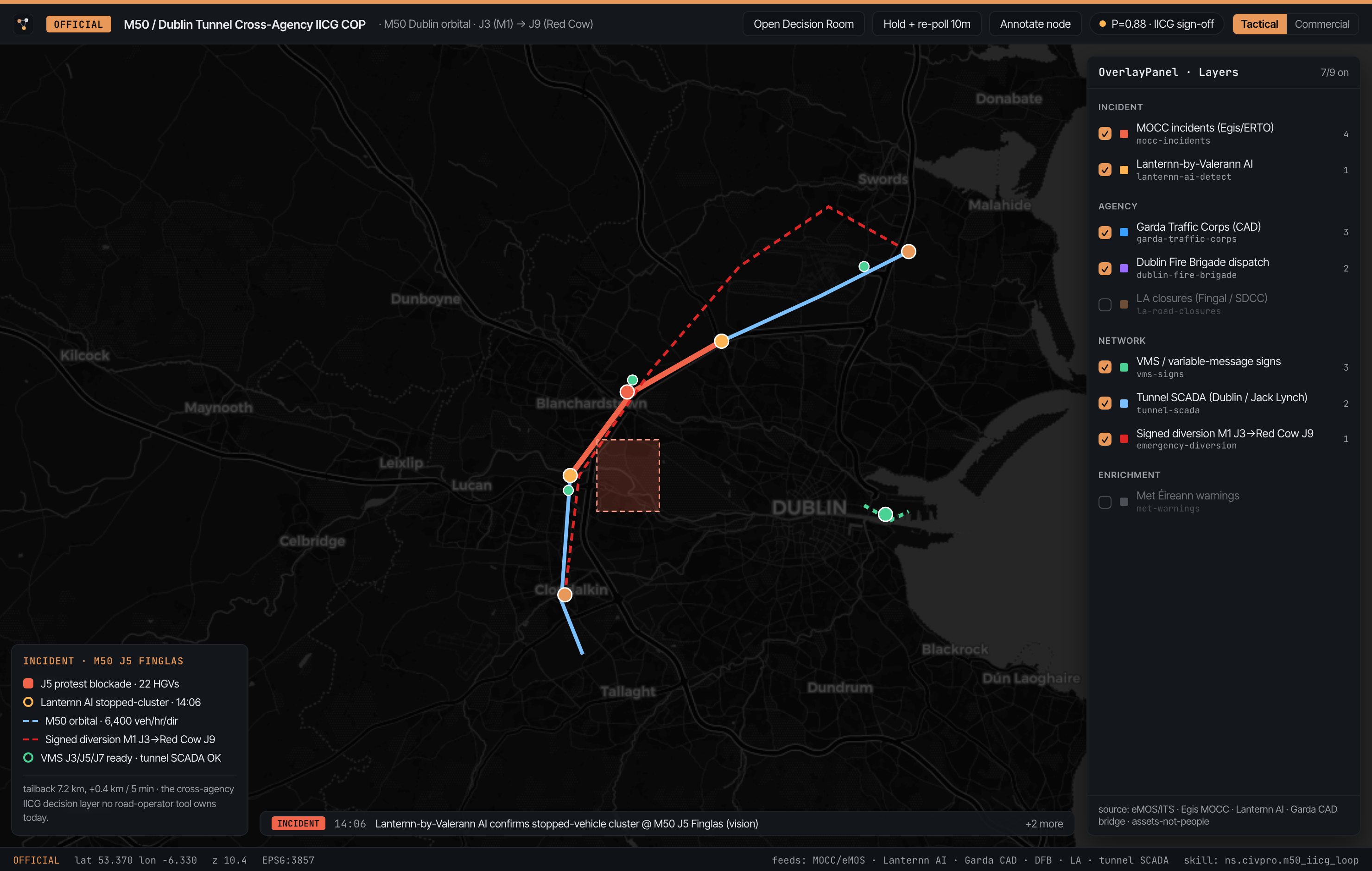
Figure — Operational picture (map_ops · live MapLibre). Production-fidelity React surface (buildable); the faithful ASCII follows.
+------------------------------------------------------------------------------------------------------+
| M50 / Dublin Tunnel Cross-Agency IICG COP (MapConsole + MapLibre-2D)                                 |
+--------------------+---------------------------------------------------------------------------------+
| LAYERS             | MAP  ========================================================================== |
| [x] MOCC incidents |   N  M50 Dublin orbital  (J1 north  ->  J17 south)  6,400 veh/hr/dir            |
| [x] Lanternn AI    |   |   [J3 M1] === [J4 Ballymun] === [J5 FINGLAS] === [J6 Blanch] ===            |
| [x] Garda Traffic  |   |                                    <!> PROTEST BLOCKADE @ J5                |
| [x] Dub Fire Brig. |   o J5 FINGLAS  -- slow-roll convoy 22 HGVs -- both carriageways STOP           |
| [ ] LA closures    |   |   Lanternn AI: stopped-vehicle cluster confirmed 14:06 (vision)             |
| [x] VMS / signs    |   o J6 -> J7 -> [J9 RED COW] tailback 7.2km, growing 0.4km / 5min               |
| [x] Tunnel SCADA   |   |   EMERGENCY DIVERSION candidate: M1 J3 -> Red Cow J9 (signed)               |
| [ ] Met warnings   |   o DUBLIN TUNNEL  Port <-> M50  SCADA OK, air/CO nominal, no inc.              |
|                    |   |   ramp-meter J9 staged | VMS J3/J5/J7 ready to set 'M50 CLOSED'             |
| REPLAY             |   o JACK LYNCH TUNNEL (Cork)  status OK  (not in this incident)                 |
| M50 fuel-protest   |   |                                                                             |
| 09 Apr 2026        |   MULTI-AGENCY: Garda Traffic Corps + DFB + Fingal/SDCC LA + TII MOCC           |
| [<<] t-00:25 [>>]  |                                                                                 |
|                    |   IICG ACTIVATION CANDIDATE: M50 J5 closure + signed diversion                  |
| SOURCES            |   Proportionality P=0.88  | IICG human sign-off REQUIRED before set             |
| eMOS / ITS feed    |   [ Open Decision Room ]   [ Hold + re-poll 10m ]   [ Annotate node ]           |
| Egis MOCC ANPR     |                                                                                 |
| Garda CAD bridge   |                                                                                 |
+--------------------+---------------------------------------------------------------------------------+
| INCIDENTS: 14:06 Lanternn stopped-cluster @ J5 | tailback 7.2km | Garda en route | DFB staged        |
+------------------------------------------------------------------------------------------------------+
Figure a04.2 — command_dashboard — IICG Multi-Agency Incident Readiness. Components: ShellLayout + KPI-tile row (live incidents / tailback / diversion / agencies-in / tunnel) + the LIVE ALERT FEED rail (the IICG paging + triage + the gate-open line) + the closing invariant note that no diversion is SET to VMS until 2-of-2 IICG sign-off (the §5 DB CHECK).
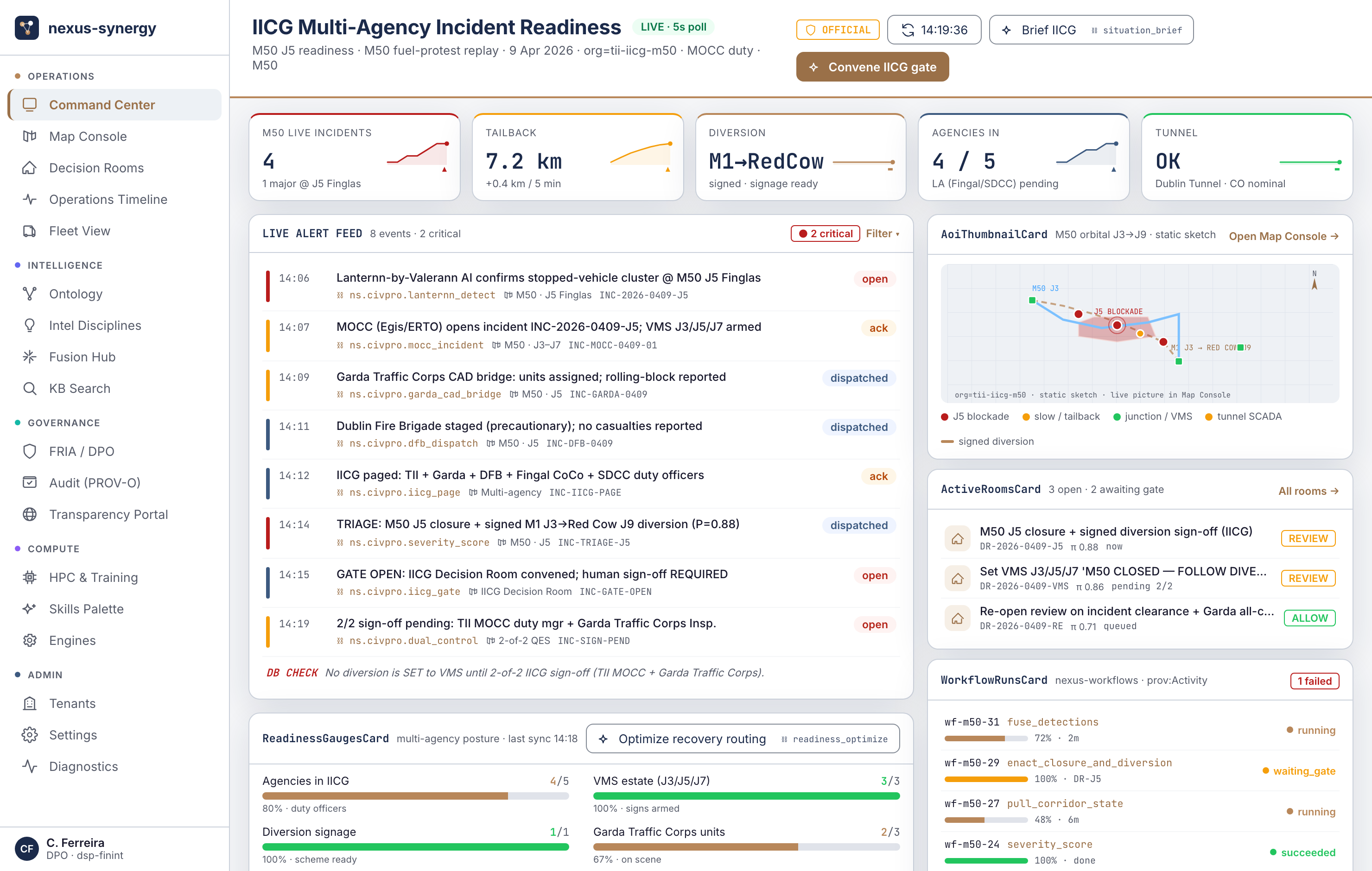
Figure — Command dashboard (KPI + live feed). Production-fidelity React surface (buildable); the faithful ASCII follows.
+--------------------------------------------------------------------------------------------------+
| IICG Multi-Agency Incident Readiness - M50 J5 (CommandDashboard)                                 |
+--------------------------------------------------------------------------------------------------+
| M50 LIVE INC.    | TAILBACK         | DIVERSION        | AGENCIES IN      | TUNNEL               |
|   4 open         |  7.2 km          |  M1->RedCow      |  4 / 5           |  OK                  |
|  1 major @J5     |  +0.4km/5min     |  signed/ready    |  LA pending      |  CO nominal          |
+--------------------------------------------------------------------------------------------------+
| LIVE ALERT FEED                                                                                  |
|  14:06  Lanternn-by-Valerann AI confirms stopped-vehicle cluster @ M50 J5 Finglas                |
|  14:07  MOCC (Egis/ERTO) opens incident INC-2026-0409-J5; VMS J3/J5/J7 armed                     |
|  14:09  Garda Traffic Corps CAD bridge: units assigned; rolling-block reported                   |
|  14:11  Dublin Fire Brigade staged (precautionary); no casualties reported                       |
|  14:12  IICG paged: TII + Garda + DFB + Fingal CoCo + SDCC duty officers                         |
|  14:14  TRIAGE: M50 J5 closure + signed M1 J3->Red Cow J9 diversion (P=0.88)                     |
|  14:15  GATE OPEN: IICG Decision Room convened; human sign-off REQUIRED                          |
|  14:19  2/2 sign-off pending: TII MOCC duty mgr + Garda Traffic Corps Insp.                      |
|  --      No diversion is SET to VMS until 2-of-2 IICG sign-off (DB CHECK)                        |
+--------------------------------------------------------------------------------------------------+
(SVG companion for the primary screen: _build/figures/tii-roads-tunnels/uc-map_ops.svg, same map_ops archetype, real component names.)
§8b — Field-unit (Pixel) surfaces
The same scenario on the Pixel 10 Pro Fold field unit (Nexus Field app), tightly coordinated with the dashboard COP above — command pushes the task, the unit accepts + ACKs, shares position and reports back to the COP. Built on the same synergy.field_unit / field_task / field_report contract; see §9 and the cluster coordination composite.
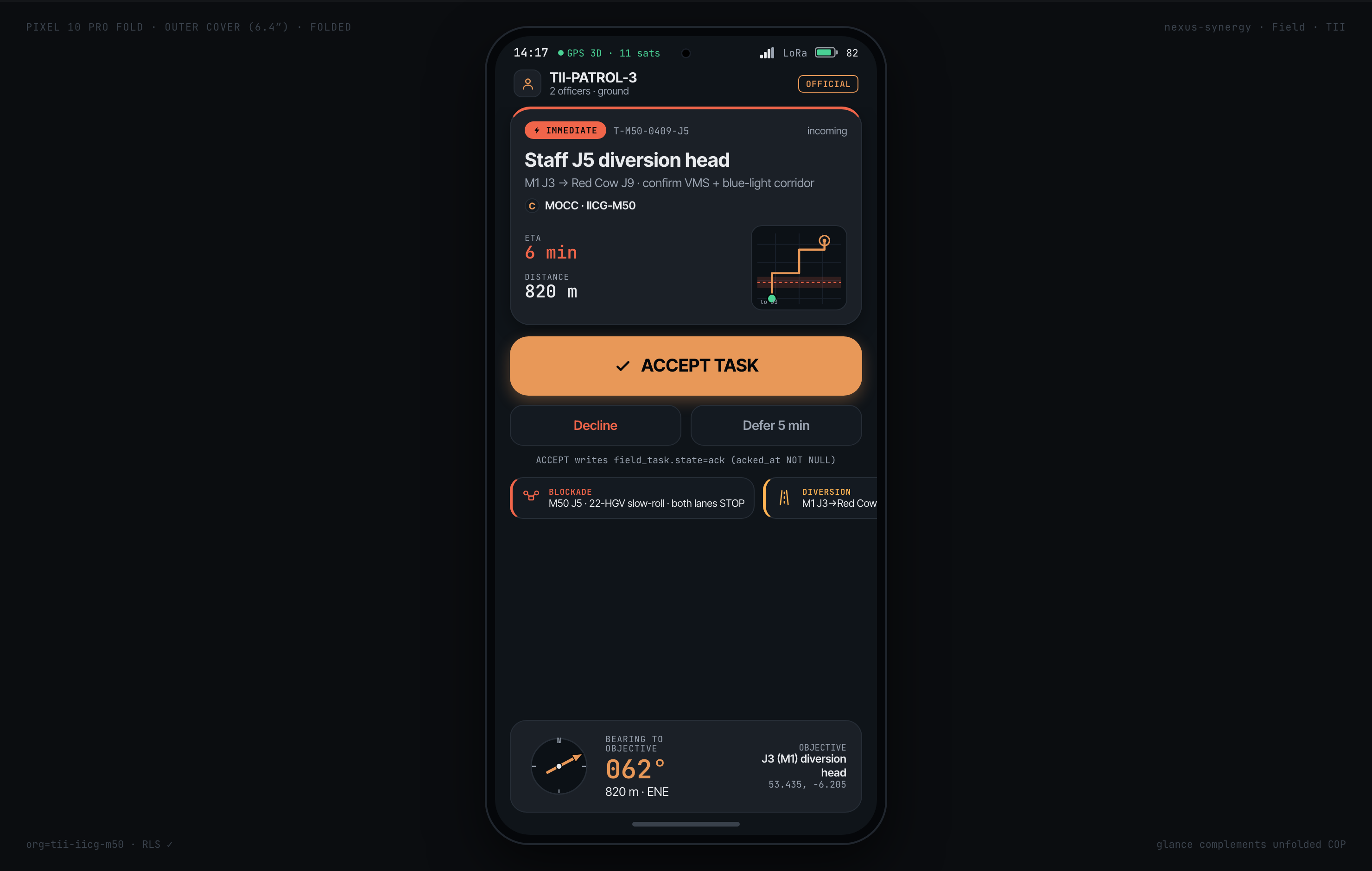
Figure §8b.1 — Folded cover · tasking glance (ground_glance): the incoming IMMEDIATE task, ACCEPT + ACK, alert chips, bearing-to-objective.
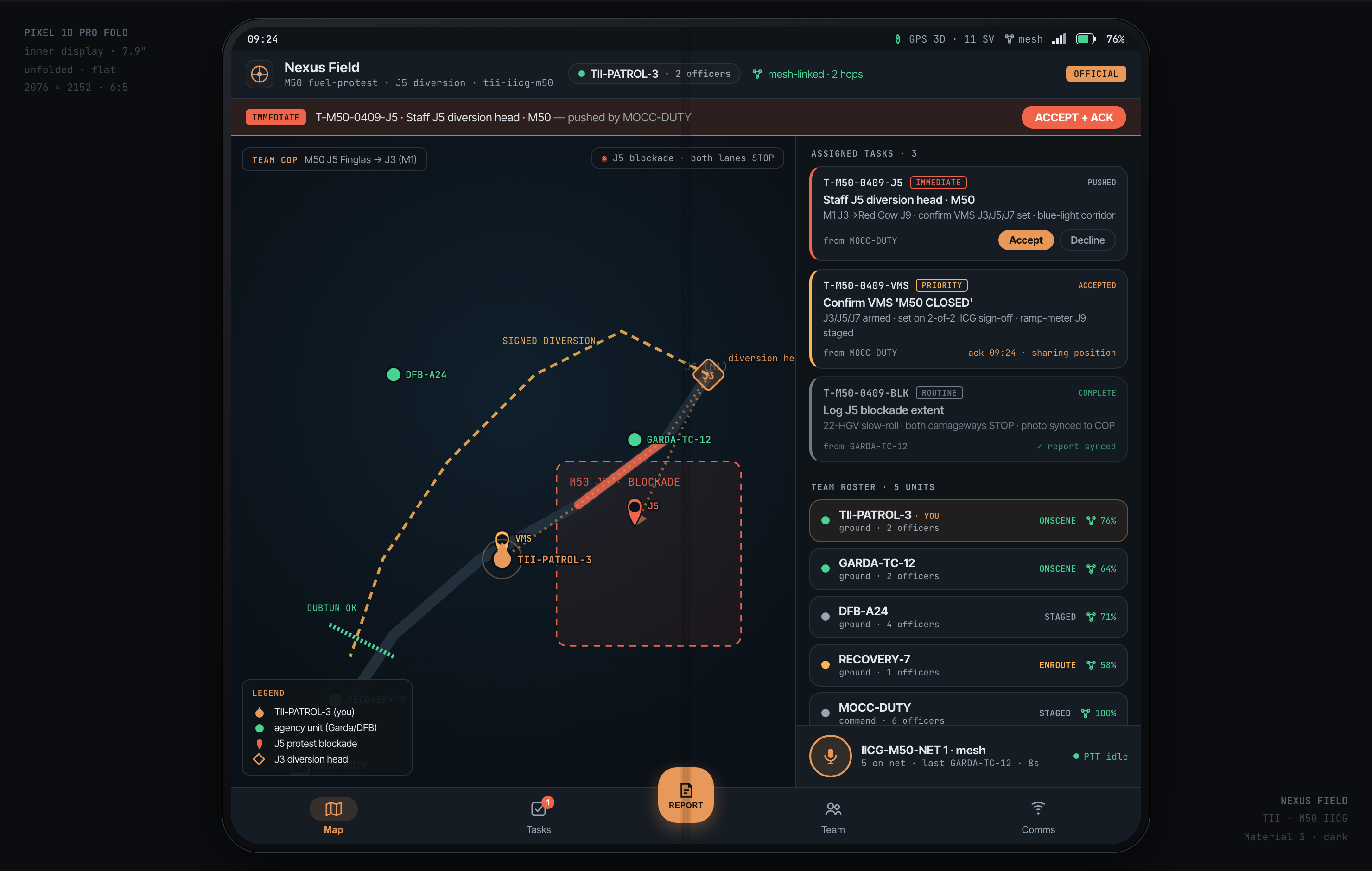
Figure §8b.2 — Unfolded inner display · field COP: two-pane mini-map + task list + teammate roster + air/command coordination + PTT, with the Material-3 NavigationBar + Report FAB.
§9 — UI/UX flow
Literal click-path. On the map_ops COP, the TII MOCC duty manager scrubs the 9-Apr-2026 fuel-protest replay to t-00:25, sees the Lanternn AI layer flip J5 FINGLAS to PROTEST BLOCKADE / both carriageways STOP, selects the J5 node and the M1 J3 → Red Cow J9 signed diversion, and clicks [ Open Decision Room ] → in the right-docked ChatTerminal IICG Decision Room the five persona bubbles run; the civil-society/accessibility reviewer adds the blue-light corridor + accessible-route condition; the duty manager clicks [ /dual-control sign ] (control 1) → the Garda Traffic Corps Inspector adds control 2 → [ /execute ] sets VMS J3/J5/J7 to "M50 CLOSED", activates the diversion, notifies DFB + Fingal/SDCC, and drops the PROV-O + BDA chain into the audit ledger. The [ Hold + re-poll 10m ] and [ Refuse + log ] paths are equally first-class and fully audited; the command_dashboard readiness board (Figure a04.2) mirrors the same incident for the wider IICG.
  map_ops (M50 corridor COP)        decision_room (IICG sign-off)              write-back + ledger
  +------------------+   [Open      +-----------------------------+   [/exec  +-------------------+
  | scrub replay     |    Decision  | 5 persona bubbles           |   after   | VMS J3/J5/J7 set  |
  | J5 -> BLOCKADE    |--- Room ]--->| civil-society adds          |-- 2/2 --->| diversion active  |
  | select J5 + div. |              | blue-light/accessible cond. |   QES     | DFB/LA notified   |
  | [Open Dec.Room]  |<-- [Hold] ---| [/dual-control sign x2]      |           | PROV-O + BDA      |
  +------------------+   re-poll    +-----------------------------+           +-------------------+
§10 — Decision-Room transcript (the IICG sign-off dialectic)
Convened the moment Lanternn AI confirms the stopped-vehicle cluster at M50 J5, the tailback crosses the IICG-activation threshold, and the signed M1 J3 → Red Cow J9 diversion is available. Hosted in the right-docked
ChatTerminalas the IICG Decision Room. Personas dispatched per the AI Provider Router L-tier; all model calls are EU-sovereign (no US hyperscaler/LLM for this tenant's operational data).
- Op-tasking (L3 EuroLLM-EU): "Recommend CLOSE M50 J5 northbound + SET the signed M1 J3 → Red Cow J9 diversion now. Lanternn confirms 22-HGV slow-roll blockade; tailback 7.2 km growing 0.4 km / 5 min. Stage VMS J3/J5/J7; ramp-meter J9 already staged."
- Proportionality (L3 Mistral-Large-EU): "Weigh the 6,400 veh/hr/dir orbital flow and rising tailback against the diversion's spare capacity and a safe blue-light corridor. A signed, pre-planned diversion is the proportionate response to a stationary blockade. P = 0.88 [N 0.93 / P 0.90 / L 0.82]. Proportionate; set a re-open review on incident clearance."
- Civil-society / Accessibility (civil-society reviewer persona): "A blanket M50 closure must not strand emergency access or vulnerable road users on the diversion. Conditions: preserve a blue-light corridor for Garda/DFB/ambulance; the diversion signage must be clear and the public notice plain-language; log an AI-decision disclosure on the VMS-set record. Dissent if any condition is dropped." → conditions carried into the gate.
- Devil's advocate (L2 Mistral-7B, local-to-tenant): "Could the blockade clear before the diversion settles, making this an over-reaction? Lanternn shows a stationary 22-HGV convoy, not a passing slow-roll — clearance is not imminent. Cost of a managed diversion ≪ cost of an unmanaged 7 km+ standstill with no emergency access. Hold = NO."
- Domain expert (TII traffic engineer, L3): "The M1 J3 → Red Cow J9 scheme is the pre-validated IICG diversion for exactly this segment; signage and ramp-metering are ready. Concur: close + divert. Re-open only on confirmed incident clearance + a Garda all-clear — not on tailback recovery alone."
- GATE VERDICT — ACCEPT (conditional close + divert). Proportionality 0.88 ≥ P_min; conditions {blue-light corridor, plain-language public notice, AI-decision disclosure, re-open on clearance + Garda all-clear} carried; 2-of-2 dual-control required (TII MOCC duty manager + Garda Traffic Corps Inspector). The §5 DB
CHECKwill refuse to recordenacted_atuntil both QES signatures are present.
§11 — Write-back + BDA + PROV-O + deltas-only regulatory traceback
Write-back (three sinks). On /execute: (1) VMS estate — set J3/J5/J7 to "M50 CLOSED — FOLLOW DIVERSION" and activate the M1 J3 → Red Cow J9 diversion (ramp-meter J9, signage); (2) agency notification — Garda Traffic Corps, Dublin Fire Brigade, Fingal CoCo, South Dublin CoCo; (3) the synergy.coordination_decision row reaches enacted_at carrying both QES signatures (TII MOCC + Garda) and the carried conditions.
BDA (loop close), three observations. (a) T+10 min — VMS-set + diversion-activation confirmed; diversion measured load vs spare capacity (ObservationLevel 4, direct). (b) on clearance — re-open review: incident cleared + Garda all-clear vs the close decision (ObsLevel 4). (c) post-event — observed tailback recovery vs the triage projection, logged back to improve the IICG-activation threshold (ObsLevel 3). Each BDA result registers a ProspectiveItem if the projection diverged from observation.
PROV-O chain (finding → close):
[entity: Lanternn AI stopped-cluster @ J5  +  MOCC incident INC-2026-0409-J5]
        | wasDerivedFrom (eMOS/Lanternn vision product id + Garda CAD bridge)
        v
[activity: severity-triage]  used -> [entity: corridor_segment M50-J5-J6 stopped]
        | wasGeneratedBy
        v
[activity: IICG Decision-Room  M50-J5-closure+divert]  (5 personas + duty mgr)
        | wasAttributedTo -> [agent: TII MOCC duty mgr + Garda Traffic Corps Insp (2/2 QES)]
        v
[entity: coordination_decision  J5 close + M1->RedCow divert  P=0.88]
        | wasGeneratedBy -> write-back (VMS set / diversion active / agencies notified)
        v
[entity: BDA re-open-review on clearance]  -> [activity: UNO close + ProspectiveItem]
Every node carries prov:wasAttributedTo (agent) and prov:wasGeneratedBy (activity); the chain is Merkle-anchored at interval τ. The civil-society blue-light/accessibility condition becomes a discoverable provenance edge — if the closure is later challenged, the graph proves the condition was carried and the diversion preserved emergency access.
Regulatory traceback (deltas only, vs §4.0 civil-protection defaults). Evidence emitted for the CER Competent Authority (transport critical-entity incident handling + decision audit) and, once TII is designated and the NCSB enacted, NIS2 where OT/cyber signals are fused — the audit ledger is the resilience evidence pack, exported as deltas since the last submission. AI Act: the wedge processes no personal data (incidents reference network assets, never persons — enforced by the §5 invariant), so an Annex-III high-risk classification is avoided by design. Accuracy note: EU AI-Act Article 5 prohibitions applied from 2 February 2025 (not 2 August 2025). (needs solicitor + DPO confirmation at pilot scoping)
§12 — Buyer & stakeholders
- Economic buyer: TII Network Management — Operations & Services directorate (owns the MOCC + Tunnels operations budget); ultimate authority CEO Lorcan O'Connor's operations directorate. (verified roles; named operations-director contact TBD)
- Champion candidate: the IICG / M50 Major Emergency Diversion owners — they live the cross-agency coordination problem. [Named contact TBD — first ask of Patrick]
- Multi-agency users: An Garda Síochána (Traffic Corps), Dublin Fire Brigade, the four Dublin Local Authorities (Fingal CoCo, South Dublin CoCo, DCC, DLR CoCo), and TII MOCC. [verified as IICG members]
- Operations incumbent / data source: Egis Road & Tunnel Operations (ERTO) (MOCC + tunnels operator) and Lanternn by Valerann / eMOS (ROD-AECOM) (detection layer) — below our cross-agency layer (their feeds are our inputs), and political stakeholders to manage. [verified]
- Compliance pull: the CER Competent Authority for transport (per the National Resilience Strategy) and the Department of Defence as CER single point of contact. [verified mandate; per-mode CA designation to confirm]
- Bridge: Patrick Walsh (Dogpatch) — transport-ecosystem intro engine (ESB X-Potential, Irish Rail Future Track) (§21). [verified relationship; TII-specific reach unconfirmed]
§13 — Competition / incumbency + comparator
- The slot we target is unoccupied. Named incumbents — NIMS/eMOS (ROD/AECOM, Arup), Lanternn by Valerann, Egis/ERTO O&M — are entrenched at the road-operator layer (TII's own traffic COP, detection, tunnel operations). The cross-agency IICG decision layer above them is unoccupied: no vendor owns the joint, human-gated, audit-evidenced multi-agency closure/diversion decision. (target card §6; verified 2026-06-05) [verified]
- The incumbency risk is mis-framing, not displacement. TII has just funded NIMS/eMOS + Lanternn + the ~€600m Egis O&M contract. If TII reads our pitch as a NIMS/eMOS overlap, we are seen to displace a freshly-funded programme and lose. Mitigation: scope strictly to the multi-agency IICG decision-room/audit layer, explicitly positioning NIMS/Lanternn/Egis/Garda/DFB feeds as inputs to a cross-agency human-gated decision layer — never a traffic-COP replacement.
- Comparator (fold AS-status into the sentence): the nearest analogue is the IICG run as a phone/radio bridge over separate agency systems (TII's eMOS picture + Garda CAD + DFB dispatch + LA closures, reconciled verbally). Nexus Synergy wins on: the fused cross-agency picture, the human-gated closed action loop (detect→gate→execute→BDA) with a proportionality-scored Decision Room, and a provenance/audit ledger that doubles as CER/NIS2 evidence — none of which a single-agency tool or a verbal bridge provides. Loses on: brand familiarity to a roads procurement officer, and a pre-pilot maturity gap. Ties on: the underlying map/GIS rendering (TII already has good detection/visualisation).
- Differentiator: sovereign-by-architecture + conformity-by-construction (FRIA + provenance ledger + transparency portal) maps directly onto a designated transport critical entity's CER/NIS2 audit burden.
§14 — Readiness (honest)
- Status: pre-incorporation, pre-revenue, pre-pilot. The ~178 UI surfaces are a gallery; the end-to-end cross-agency road-incident action loop over TII's live data is not yet built or proven. [verified — self-assessment]
- Strong reuse: the storm-replay COP + the civil-protection cluster (Met Éireann + map_ops + the human-gated Decision Room + audit ledger) overlaps heavily with the NDFEM/DART/OPW work, so the TII roads lens (storm-replay #3) is cheap to assemble relative to a cold use case — one shared build, a road-corridor lens + re-labelled IICG sign-off action.
- Real gaps to close before a credible pilot: (a) data access — MOCC/eMOS incident feeds + Lanternn detections + a Garda-CAD bridge + LA closure feeds + tunnel SCADA (availability, format, governance, and the inter-agency data-sharing seam — the hardest part, since it crosses Garda/DFB/LA boundaries); (b) a road-corridor ontology instance (§4); (c) a defensible IICG closure/diversion workflow + audit-ledger demo (§§5–11). None require anything on the Declined List.
§15 — ENGAGEMENT PLAYBOOK (ready-to-go sequence)
The repeatable motion: first-contact → discovery → demo → pilot → LOI → signed contract. Each stage = trigger / owner / activity / template-or-script / exit criterion / deliverable.
Stage 1 — First contact (warm bridge)
- Trigger: Patrick confirms his transport-ecosystem bridge can extend to TII Network Management / Operations leadership. Owner: Founder (+ Patrick). Exit: a scheduled discovery call with a named TII sponsor (or an IICG-member sponsor). Deliverable: the intro email (template, §21) sent + a calendar hold.
- Activity: ask Patrick who specifically — TII Network Management/Operations vs an IICG-member agency — then frame the meeting narrowly on the cross-agency IICG coordination gap (NOT the MOCC's own traffic COP), holding CER/NIS2 as the durable expansion.
Stage 2 — Free discovery (~45–60 min, listening session, no slides)
- Trigger: discovery call booked. Owner: Founder. Exit: the sponsor agrees the cross-agency coordination is a problem worth solving + names a budget owner. Deliverable: a same-day write-up (sponsor, top-3 pains in their words, lawful basis, action-loop gap, Declined-List PASS, funding-vehicle hint, agreed next step).
- Script (adapted 60-min agenda):
- 0:00–0:05 Frame: "Irish-built, EU-sovereign decision-intelligence platform — the Palantir for the EU with sovereignty in the architecture. This is discovery, not a pitch."
- 0:05–0:20 Current picture: "Walk me through the last major M50 incident — say the April fuel-protest closure — from the moment Lanternn/MOCC flagged it to the moment you re-opened. Who touched the joint close/divert call, in what order? How many separate systems did the IICG look at?"
- 0:20–0:35 Governance: "Lawful basis for the feeds? Any personal data (we deliberately track assets, not people)? Are you in scope for CER / NIS2 designation, and how do you evidence the resilience obligation and the joint-decision audit today?"
- 0:35–0:45 Path: "Who owns this operationally — TII Operations, or is it shared across the IICG? Who owns the budget — TII MOCC operations, or the €231m ITS line? Is there a programme (eMOS, the Statement-of-Strategy digital line, a DTIF/EI call) this could sit under?"
- 0:45–0:55 Map their loop: sketch detect→enrich→triage→gate→task→execute→assess→close; mark where the IICG jumps detect→act via a phone bridge with no fused enrichment/shared gate (the wedge).
- 0:55–1:00 Earn the demo: "If I came back with a 30-min walkthrough replaying the 9-Apr M50 closure as a fused IICG picture with a single human-gated, audited close+divert decision, would that be worth your time — and the right IICG members'?"
Stage 3 — Scoped demo (their loop replayed, not a feature tour)
- Trigger: sponsor agrees to a walkthrough. Owner: Founder. Exit: "Could we try this on a real slice of our M50 data?" Deliverable: the live storm-replay #3 TII roads lens demo (§8 surfaces) + the one-page pilot proposal (Stage 4).
- Activity: drive the M50 J5 fuel-protest replay end-to-end: scrub to the Lanternn blockade detection → open the IICG Decision Room → show the proportionality score + the civil-society blue-light/accessibility condition changing the recommendation → 2/2 sign-off (TII MOCC + Garda) → write-back (VMS + diversion + agency notify) + audit ledger. Lead with the differentiators that matched their discovery answers (sovereign model-call boundary; the cross-agency fusion no single tool gives; conformity-by-construction; provenance ledger as CER evidence). Be honest about maturity and that the data-sharing seam is the real work.
Stage 4 — Pilot (time-boxed, one corridor, agreed success criteria)
- Trigger: demo exit-ask answered yes. Owner: Founder + TII/IICG champion. Exit: success criteria met or credibly trending. Deliverable: signed one-page pilot proposal + pilot run.
- One-page pilot proposal (filled for TII):
- Title & sponsor: "M50 Cross-Agency Major-Incident Operating Picture — pilot." Sponsor: [TII Network Management/Operations lead, TBD]; budget owner: [TII MOCC operations / ITS line, TBD]; IICG co-sponsor: [Garda Traffic Corps / DFB, TBD].
- Problem (their words): "When a major M50 incident hits, the IICG coordinates the close/divert call across separate systems by phone and radio, and we can't easily evidence the joint decision afterwards." (to confirm in discovery)
- The one thing we'll prove: "We can fuse MOCC/Lanternn + Garda + DFB + LA + tunnel state into one IICG operating picture and shorten the time from detection to a jointly-signed, audited close+divert decision from X to Y." (X/Y = baseline TBD, measured in pilot week 1.)
- Scope IN / OUT: IN — the M50 (J3–J9 corridor + Dublin Tunnel), MOCC/Lanternn + a sample Garda/DFB/LA status feed, the IICG closure/diversion loop + audit ledger, the 9-Apr replay. OUT — all other corridors, the road-operator traffic COP (NIMS/eMOS stays TII's), any personal data / ANPR identification, any Declined-List capability.
- Data & lawful basis: MOCC/eMOS + Lanternn + Garda/DFB/LA status + tunnel SCADA (no personal data; lawful basis = transport operational resilience + multi-agency emergency coordination). Runs EU-sovereign; isolation tier set to the feeds' sensitivity.
- Success criteria (2–4, sponsor-agreed): detection→signed-decision lead-time Δ; tailback growth avoided per managed diversion; IICG audit-evidence completeness for a CER submission; sponsor confidence in the joint call. (baselines TBD week 1)
- Timeline: 6–12 weeks (exact TBD), with a mid-point checkpoint and a 9-Apr-replay validation run.
- Commercials: €0 to TII if innovation-grant-funded; otherwise a scoped sub-threshold pilot from the MOCC operations budget (indicative production band Tier-1 €120–240k/yr — see §19, only if asked).
- Roles: Founder/partner-vehicle delivers; TII champion supplies feeds + a MOCC duty officer; an IICG agency supplies a sign-off officer for the parallel run; named POCs all sides.
- After: an LOI if criteria are met.
- Funding vehicle: TII MOCC/ITS budget / DTIF or EI co-fund — confirm in discovery (the inter-agency nature may suit a consortium DTIF bid).
Stage 5 — LOI (the milestone, triggers the Patrick check)
- Trigger: pilot success criteria met. Owner: Founder + sponsor. Exit: signed LOI naming a sponsor + next step. Deliverable: signed (non-binding) LOI.
- LOI checklist (key items): parties (TII + Nexus Synergy Ltd, or founder-in-own-name pre-incorporation, NewCo to ratify under Companies Act 2014 s.45) · statement of intent (proceed to next phase, conditional on funding/procurement) · scope carried from the pilot · success criteria referenced · named sponsor + budget owner (+ the IICG co-sponsor) · indicative timeline + next step · indicative commercials ("to be scoped under [procurement vehicle]") · conditions (funding award, procurement, inter-agency data-sharing agreement, security accreditation) · binding vs non-binding (default non-binding except confidentiality) · governing law: Irish · Declined-List affirmation · signatures + dates · solicitor review confirmed before sending (flag, do not assume).
Stage 6 — Signed contract
- Trigger: LOI + a procurement route. Owner: partner-vehicle + TII procurement. Exit: executed contract / framework call-off. Deliverable: the signed contract — gated on a partner-vehicle / Stamp-4 path (§16, §18, §20).
§16 — PM / timeline
Gantt (indicative; bars = active stages; all durations [PRIOR], TBD with sponsor):
Stage \ month         M1   M2   M3   M4   M5   M6   M7   M8 .. M18 .. M30
1 First contact       ####
2 Discovery (free)     ######
3 Scoped demo            ####
4 Pilot (M50 corridor)      ##########
5 LOI                                ####                 <-- Patrick-check
6 Contract / framework                   ............>>>>>>>> .. >>>>>>>>>
* Partner-vehicle gate  [.....resolve Stamp-4 / partner-vehicle.....]^ critical for PAID pilot/contract
- Milestones: M1 named intro · M3 sponsor agrees the cross-agency pain (discovery exit) · M4 demo "try it on real M50 data" · M6 pilot start · M8 pilot success-criteria read-out · ~M9–12 LOI (Patrick check) · M18+ contract/framework.
- Critical path: the Stamp-1G → Stamp-4 / partner-vehicle gate is the binding constraint — a free discovery + demo + grant-funded pilot can run before it, but a PAID pilot or any signed contract cannot close until the vehicle resolves (§18, §20). The second long pole is the inter-agency data-sharing agreement (Garda/DFB/LA boundaries), and state-body procurement (OJEU/eTenders) is the third.
RACI:
| Activity | Founder | Patrick / warm-intro sponsor | MAHI-or-partner-vehicle | TII / IICG champion | TII procurement |
|---|---|---|---|---|---|
| Warm intro | R | A | I | I | — |
| Discovery + demo | A/R | C | I | C | — |
| Inter-agency data-sharing agreement | C | I | C | A/R | C |
| Pilot delivery | R | C | C (contracting prime) | A | I |
| LOI sign-off | R | C | C | A | C |
| Paid contract / framework | C | I | A/R (signs + invoices) | C | A |
§17 — Funding / procurement vehicle
- Operational/pilot funding (the realistic path): TII's MOCC/operations budget + the €231m ITS/traffic-management line under the €9.7bn 2026–2030 roads programme (NDP / Project Ireland 2040) can fund a below-threshold scoped pilot. [verified mandate + budget line; accessible envelope TBD]
- Regulatory budget pull: CER/NIS2 obligations create a resilience-spend line with audit/inspection teeth — a buying trigger independent of any single incident. [verified mandate; budget line TBD]
- Innovation co-fund (to de-risk a pilot): DTIF (a consortium across TII + an IICG agency + a university fits the inter-agency nature well) or Enterprise Ireland Agile Innovation Fund (≤€150k, fast-track once an EI client); the 35% R&D Tax Credit (cash even if loss-making) is a solo-accessible non-dilutive de-risk after incorporation. NOT crediting Research-Ireland Defence Challenge (academic-routed) / EUDIS / EDF (consortium-only) as solo-accessible here. [verified eligibility constraints]
- Procurement reality: state-body procurement is tender-bound above low thresholds (OJEU/eTenders) and slow; the realistic path is free discovery → scoped paid pilot (sub-threshold or innovation-funded) → LOI → framework. Headwind: the freshly-let ~€600m Egis O&M + the eMOS/Lanternn programmes mean TII's roads-operations spend is heavily committed — reinforcing that the wedge must be the cross-agency layer above those programmes, not an overlap.
§18 — TWO-STAGE FORMULA SCORECARD
Anchored to board #6 (TII): Score 67.7, to-LOI 35–44%, to-buy 20–29%, value high. All factor cells
[PRIOR]with a dated rationale.
Stage-1 — P(LOI), H = 12–18 mo. Vector = {mandate_pull, access_warmth, demonstrability, decline_safety, white_space, cycle_speed, pillar_fit}; weights {.22,.22,.18,.14,.10,.08,.06}.
| Factor | w | Score | Dated rationale [PRIOR] |
|---|---|---|---|
| mandate_pull | .22 | 5 | 2026-06-05: CER National Resilience Strategy 19 March 2026 (transport named, designation by 17 Jul 2026) + NIS2 NCSB in train + acute M50 ~120 incidents/mo + Apr-2026 fuel-protest strain + €231m ITS line in the €9.7bn roads plan + TII Statement of Strategy naming MOCC/Tunnels resilience and AI/LLMs. Live, dated, funded. |
| access_warmth | .22 | 3 | 2026-06-05: Patrick's transport-ecosystem bridge (ESB X-Potential, Irish Rail Future Track) is plausible but not yet confirmed for TII specifically; no named TII/IICG contact in hand → 3, not 4. |
| demonstrability | .18 | 4 | 2026-06-05: storm-replay #3 TII roads lens reuses the civil-protection COP → demo-ready on the buyer's real corridor; capped by pre-pilot status. |
| decline_safety | .14 | 5 | 2026-06-05: incident coordination + resilience only; the §5 invariant makes "asset, never person" a DB rule; no personal data in the wedge; clear of the Declined List. |
| white_space | .10 | 3 | 2026-06-05: the cross-agency IICG decision layer is genuinely unoccupied, but NIMS/eMOS/Lanternn/Egis sit just below it and create a mis-framing/displacement risk → 3, not 4. |
| cycle_speed | .08 | 2 | 2026-06-05: a warm sponsor enables fast discovery/pilot, but multi-agency + state-body OJEU procurement + the inter-agency data-sharing agreement slow the contract. |
| pillar_fit | .06 | 5 | 2026-06-05: squarely the action-loop COP core (map_ops + command_dashboard + Decision Room), reusing the civil-protection pillar. |
S1 = .22·5 + .22·3 + .18·4 + .14·5 + .10·3 + .08·2 + .06·5 = 1.10 + 0.66 + 0.72 + 0.70 + 0.30 + 0.16 + 0.30 = 3.94. P_LOI = 0.55 / (1 + exp(−1.15·(3.94 − 2.6))) = 0.55 / (1 + exp(−1.541)) = ≈ 0.46 (band ~40–48%). Score100 = S1·20 = 78.8.
Reconciliation flag. The mechanical Score100 (78.8) sits above the board anchor (67.7) by ~11 pts — outside the ~5-pt tolerance. The board's lower number reflects the incumbency-collision drag (TII just funded NIMS/eMOS + Lanternn + ~€600m Egis) and unconfirmed TII-specific warmth, which the adversarial check on card #6 applied as a downward adjustment (research 74.8 → 67.7). To honour the board anchor and the brutal-review discipline, the headline
score100is set to 67.7 (the adjusted board figure), not the raw S1·20. The Stage-1 vector above is the honest pre-pilot read; the gap is the documented incumbency/warmth haircut. Re-scoreaccess_warmthupward only when Patrick confirms a named TII/IICG route; trimwhite_spaceonly if TII frames us as a NIMS overlap.
Stage-2 — P(Contract | LOI), H = 24–36 mo. Vector = {contractability, funding_to_pay, procurement_clarity, incumbency_displacement, time_to_value, reference_leverage}; weights {.24,.22,.18,.16,.12,.08}.
| Factor | v | Score | Dated rationale [PRIOR] |
|---|---|---|---|
| contractability | .24 | 1 | 2026-06-05: founder solo on Stamp 1G, no signing vehicle yet → the gate, not S2, governs (see G below). |
| funding_to_pay | .22 | 4 | 2026-06-05: TII MOCC ops budget + €231m ITS line + CER resilience spend all exist and are self-funded; no R&D-credit dependency for the buyer; not a 5 only because no named accessible line yet. |
| procurement_clarity | .18 | 2 | 2026-06-05: sub-threshold pilot route plausible, but state-body OJEU/eTenders above threshold + the inter-agency data-sharing agreement are real drags. |
| incumbency_displacement | .16 | 4 | 2026-06-05: we sit above NIMS/eMOS/Lanternn/Egis (their feeds are our inputs), not rip-and-replace — provided we hold the cross-agency framing. |
| time_to_value | .12 | 4 | 2026-06-05: storm-replay #3 demo-to-value lands well inside the CER 17-Jul-2026 designation + 10-month compliance window. |
| reference_leverage | .08 | 2 | 2026-06-05: first-of-its-kind logo; little external proof yet. |
S2 = .24·1 + .22·4 + .18·2 + .16·4 + .12·4 + .08·2 = 0.24 + 0.88 + 0.36 + 0.64 + 0.48 + 0.16 = 2.76. P_raw = 0.70 / (1 + exp(−1.1·(2.76 − 2.8))) = 0.70 / (1 + exp(0.044)) = ≈ 0.34.
Legal gate G = V·T (T ≈ 1 here; H_conv = 30 mo, t_resolve ≈ Stamp-4 in ~3 mo, so T = min(1, (30−3)/30) ≈ 0.9 ≈ 1):
| V (vehicle) | 0.10 (solo Stamp-1G, today) | 0.45 (Dogpatch-brokered entity) | 0.75 (partner-vehicle confirmed prime) | 1.00 (Stamp-4 incorporated & trading) |
|---|---|---|---|---|
| P(Contract|LOI) = G·P_raw | ≈ 3.4% | ≈ 15% | ≈ 26% | ≈ 34% |
| P(Contract) = P_LOI·G·P_raw | ≈ 1.6% | ≈ 7% | ≈ 12% | ≈ 16% |
Reconciliation to board anchor. P_LOI ≈ 46% sits at/just above the board's to-LOI 35–44% (the warmth haircut would pull it into band). The board's to-buy 20–29% is the post-vehicle figure (V→0.75–1.0 → P(Contract|LOI) ≈ 26–34% — top end ✓); today, solo on Stamp-1G, the unconditional to-buy is ~3.4% — the vehicle is the lever, not Stage-1 or Stage-2. Headline Score100 = 67.7 (board anchor), with the raw S1·20 = 78.8 documented and haircut above.
§19 — Commercial
- Pilot: Tier-1 €120–240k band (often €0 to TII if innovation-grant-funded; a paid pilot needs the partner-vehicle).
- Expansion: high-value multi-corridor (M50 + radials + national tunnels) + a CER/NIS2 transport-resilience framework under NDP/ITS capital — could reach Tier-2 ~€480k–1.2m at national-roads scale, and Tier-3 €2.4–4.8m only at a full multi-agency / multi-mode COP scope.
- ACV (indicative): Tier-1 pilot-to-production ~€120–240k/yr; Tier-2 expansion ~€480k–1.2m/yr.
- Contract terms (indicative): annual subscription on the open-component substrate (no per-seat lock-in); cost advantage from open-source substrate + sovereign HPC + shared conformity file + no forward-deployed-engineer dependency.
- Buyer requirements to satisfy: ISO-27001, EU data-residency / sovereignty (model calls stay in-jurisdiction via the classification-aware AI Provider Router), an inter-agency data-sharing agreement for the MOCC/Garda/DFB/LA feeds, and (for the CER expansion) the resilience-evidence export. [verified as standard state-body requirements; specific accreditation TBD]
§20 — Legal blockers
- Stamp-1G cap (founder): Stamp 1G bars self-employment, operating/establishing a business, and being a company director — so the founder cannot be a director, incorporate, hold founder equity, or trade until Stamp 4. A paid TII pilot/contract therefore needs a partner-vehicle path (MAHI or a Dogpatch-brokered entity) or to wait for Stamp 4 — the critical gate for any PAID pilot (§16, §18). (immigration-solicitor confirmation required) [⚖️ CONFIRM]
- Inter-agency data-sharing (TII-specific): the wedge fuses feeds across TII + Garda + Dublin Fire Brigade + the Dublin LAs — a multi-controller data-sharing arrangement needs a data-sharing agreement / data-processing terms clearing each agency's governance; this is the buyer-specific blocker most likely to stall a pilot independent of our readiness. (solicitor + each agency's DPO) [flag]
- GDPR / personal data: the wedge processes no personal data (incidents reference network assets — enforced by the §5 invariant), so the GDPR + AI-Act high-risk surface is minimised by design; any ANPR/Egis-tolling reference must be flow-state only, never identification, and re-assessed if extended (DPO + solicitor). [flag]
- AI Act: Annex-III §5 high-risk classification (emergency-response AI) attaches only if personal data is processed; for the resilience-only wedge it is avoided. Accuracy note: AI-Act Article 5 prohibitions applied from 2 February 2025 (not 2 August 2025). (solicitor confirmation) [flag]
- Public procurement: above-threshold state-body procurement is OJEU/eTenders-bound (Dir. 2014/24/EU); the sub-threshold pilot route must be confirmed with TII procurement; CER-driven negotiated procedures may apply for resilience-sensitive scope. [flag]
- Pre-incorporation signing: until NewCo is formed, the founder signs LOIs in their own name (personal liability) with NewCo to ratify under Companies Act 2014 s.45; prefer non-binding wording; protect discovery under a mutual NDA. [flag]
§21 — Warm-intro contact + the specific ask
- Contact: Patrick Walsh (Dogpatch) — transport-ecosystem intro engine (runs ESB X-Potential, Irish Rail Future Track); the bridge already opening for the DART/Irish Rail wedge.
- The specific ask: an introduction to TII Network Management / Operations leadership (the MOCC/Tunnels owner) or an IICG-member sponsor, framed narrowly on the cross-agency IICG / M50 Major Emergency Diversion coordination gap — NOT the MOCC's own traffic COP. First sub-ask: can his transport bridge (DART/ESB) extend to TII operations, and who exactly — TII Operations vs an IICG agency.
- Intro email (template, ready to adapt):
Subject: M50 cross-agency incident operating picture — quick intro?
Hi Patrick — following on from the DART/Irish Rail bridge: the same transport ecosystem has a sharp adjacent wedge at TII. We've built an EU-sovereign decision-intelligence platform (think "Palantir for the EU, with sovereignty in the architecture"). The wedge isn't TII's traffic COP — they already have eMOS/Lanternn/Egis for that. It's the cross-agency IICG decision layer above it: when a major M50 incident hits (~120/month; the April fuel-protest closure is the live example), the Interagency Incident Coordination Group — Garda + Dublin Fire Brigade + the Dublin councils + TII — coordinates the close/divert call across separate systems by phone and radio, with no fused picture and no joint audit trail. We fuse those feeds into one human-gated, audit-evidenced decision that also produces the CER/NIS2 resilience evidence TII now needs (transport is a designated sector; designation by 17 July 2026). We replay the 9-April M50 J5 closure end-to-end.
Could your transport bridge (the one opening DART/ESB) reach TII Network Management / Operations — or the right IICG contact? Free discovery, no cost to them; happy to send a one-pager and walk you through the demo first. Thank you — [Founder]
§22 — Open questions + Sources
Open questions (do not assert until resolved):
- Whether Patrick's transport bridge (DART/ESB) actually reaches TII Operations or an IICG member — and who specifically.
- The CER Competent Authority for road transport — confirm designation under the National Resilience Strategy 2026–2029 (rail = CRR confirmed; road CA to confirm).
- NIS2 status — confirm the National Cyber Security Bill 2024 enactment timeline (still in pre-legislative scrutiny mid-2026; the card's "in force 1 Oct 2026" is a target, not law).
- Data-access seams — MOCC/eMOS + Lanternn detections + a Garda-CAD bridge + DFB/LA closure feeds + tunnel SCADA (availability, format, governance) — and the inter-agency data-sharing agreement (the hardest seam).
- Pilot funding vehicle — direct TII MOCC/ITS budget vs DTIF consortium vs EI co-fund.
- Incumbency framing — confirm TII can scope us to the cross-agency IICG layer above NIMS/eMOS/Lanternn/Egis, not as a traffic-COP overlap (the displacement risk).
- Sub-OJEU pilot threshold for a TII operations procurement.
- Whether an IICG-member agency (Garda/DFB/an LA) could co-sponsor or co-buy.
Sources (web-verified 2026-06-05):
- M50 ~120 incidents/month + IICG (formed 2015: Garda, Dublin Fire Brigade, 4 Dublin LAs, TII, MTCC) + M1 J3→Red Cow J9 emergency diversion + 6,400 veh/hr/dir — tii.ie M50 Major Incident Management (tii.ie/news/press-releases/m50-major-incident-manage-1); sdcc.ie "M50 Major Emergency Diversion".
- Egis/ERTO 8(+8)-yr up-to-€600m MOCC + Dublin Tunnel + Jack Lynch Tunnel + 1,200 km, signed May 2025 — tii.ie/egis-dublin-tunnel; egis-group.com; irishexaminer.com arid-41635075.
- Lanternn by Valerann (AI vision detection + fusion "single operational picture") nationwide under eMOS (ROD/AECOM) — irfofficial.org 2025-11; tii.ie eMOS programme.
- TII Statement of Strategy 2026–2030 (MOCC/Tunnels resilience objective; AI/LLM commitment; CEO Lorcan O'Connor; €231m ITS line in €9.7bn roads plan) — tii.ie/media/zi4egrry/tii-statement-of-strategy-2026-2030-1.pdf; rte.ie 2026-05-27.
- National Strategy on the Resilience of Critical Entities 2026–2029 (published 19 Mar 2026; 11 sectors incl. transport; per-sector Competent Authorities; DoD single point of contact; designation by 17 Jul 2026) — gov.ie 2026-03-19; critical-entities-resilience-directive.com/Ireland.
- NIS2 / National Cyber Security Bill 2024 (pre-legislative scrutiny mid-2026; self-registration ~Jul 2026; first audits ~mid-2027) — iapp.org; ncsc.gov.ie/nis2.
- April-2026 M50 fuel protests (J5 Finglas closure; 9 counties; "TII working closely with the Garda Traffic Corps") — thejournal.ie 2026-04-09 (event per target card #6).
- EU AI Act Article 5 prohibitions applicable 2 February 2025 — EUR-Lex Reg. (EU) 2024/1689.
Internal: target card 03-gtm/target-packages/_master-loi-detail-01-12.md (#6 TII); formula 03-gtm/strategy-paper/formula-worked-examples.md; discovery motion 03-gtm/discovery-playbook.md; demo 03-gtm/demos/storm-replay-cop-demo.md (storm-replay #3 TII roads lens); legal 03-gtm/strategy-paper/legal-blockers-register.md; contacts 03-gtm/strategy-paper/contact-register.md.
Flagged unverified/softened: the card's "NIS2 Act 2026 in force 1 Oct 2026" — softened to a target (Bill in pre-legislative scrutiny); the road-transport CER Competent Authority designation — to confirm; Apr-2026 "9 counties / closely with Garda Traffic Corps" — per target card, not independently re-verified this pass.