
Nexus Synergy Engagement Package — A02 · Iarnród Éireann (Irish Rail) + National Transport Authority (NTA)
Nexus Synergy Engagement Package — A02 · Iarnród Éireann (Irish Rail) + National Transport Authority (NTA)
STATUS HONESTY. Nexus Synergy Ltd is pre-incorporation, pre-revenue, pre-pilot. Iarnród Éireann / the NTA are a TARGET, not a customer; nothing here is deployed. ~178 product UI surfaces exist as a gallery, not a live system; the rail-corridor action loop over live data is not yet built or proven. ANTI-COOKIE-CUTTER. The two mockups in §8 are programmatically generated ASCII (
_build/archetypes/gen_dart-irish-rail.py, alignment-guarded by_ck()), filled with DART's real corridor, sea-wall cells, feeds and closure decision — not a reused shell. PROBABILITIES. Every probability in this file is a[PRIOR]— a subjective pre-pilot estimate for prioritisation, not a forecast. Re-score after every real conversation.
§0 — Header & one-line thesis
Nexus Synergy for the coastal DART: a storm-replay common-operating-picture that turns the "when do we close the line?" call — run today on phone trees, email and spreadsheets — into a single fused, human-gated, audit-evidenced decision loop that protects the tens of thousands of journeys at risk per high-tide closure [journey count unverified — see §2] and produces the resilience evidence the CER/NIS2 regime now demands.
Wedge: a coastal-flood / severe-weather DART disruption COP (reusing our OPW + Met Éireann flood pillar). Durable expansion: a CER / NIS2 critical-infrastructure resilience picture. Warm bridge: Patrick Walsh, who has offered to introduce and co-sponsor a pilot. Demo: the Storm-Chandra Seapoint→Blackrock coastal-closure replay.
§1 — Entity snapshot (cited from the target card)
- DART — Dublin Area Rapid Transit, the electrified commuter spine of Greater Dublin, operating since 1984. The coastal stretch (broadly Merrion Gates → Seapoint → Blackrock → Booterstown and south) is the exposed asset. (target card §1) [verified]
- Operator / likely economic buyer: Iarnród Éireann (Irish Rail) — runs the network and owns the resilience, operations and IT/OT-security functions. [verified]
- Strategy & capital funder: National Transport Authority (NTA) / Transport for Ireland, under Project Ireland 2040 / National Development Plan. [verified]
- Rail regulator / CER competent authority: Commission for Railway Regulation (CRR) — safety/economic rail regulator and the confirmed CER-Directive competent authority for rail under SI 559/2024; its NIS2-Directive designation is the one still to be finalised. [verified CER; NIS2 to confirm]
- Investment context: the DART+ Programme is set to double rail capacity and treble electrification in the Greater Dublin Area; fleet via an Alstom X'trapolis framework for up to 750 electric/battery-electric carriages over 10 years, 185 carriages on order (155 battery-electric), entering passenger service 2027–2028 (battery-pack redesign pushed the first trains to Q2 2027). (Alstom press 2024-11; Irish Rail / NTA / TFI news 2025–26) [verified]
§2 — The pain (web-verified, dated, cited)
Two converging drivers make this a buying situation, not a nice-to-have.
(a) Acute — coastal-flood / severe-weather DART disruption.
- Storm Chandra (26–27 Jan 2026) battered the east coast; in the days that followed, a high-tide overtopping event on 7–8 Feb 2026 breached ageing Victorian sea walls and flooded/submerged track on the coastal DART (reported between Seapoint and Blackrock), closing the line for several hours at peak. A single high-tide coastal closure of this kind disrupts tens of thousands of passenger journeys [unverified — no published Irish Rail figure for high-tide closures specifically; the widely-cited ~40,000-journey figure relates to a 2015 service disruption, not a coastal closure]. (met.ie 2026-01-27; visahq.com 2026-02-08; irishtimes.com 2026-02-23) [verified for the events; journey count unverified]
- The coastal corridor has lost 20–30 m of coast in places over the last decade to erosion/overtopping. (Irish Rail ECRIPP; rte.ie 2025-09-15) [verified]
- >€200m East Coast Railway Infrastructure Protection Projects (ECRIPP) — concrete wave walls, rock armour and concrete footpaths along the ~65 km corridor (Merrion Gates → Wicklow Harbour, across five coastal-cell areas); a 4 km Merrion Gates → Seapoint stretch raised ~1.3 m, designed to a 1-in-200-year event for 50 years (to 2075); funded by DoT via NTA under Project Ireland 2040 + EU Connecting Europe Facility; planning applications targeted for early 2027, with construction to follow detailed design and procurement. (irishrail.ie/ecripp; irishtimes.com 2026-02-23; railjournal.com) [verified]
- The gap our software fills: ECRIPP is a multi-year concrete programme. It does nothing for the operational decision in the next storm — when to pre-emptively close, how to coordinate Met Éireann + OPW + Local Authorities + Coast Guard, when to safely re-open, and how to evidence each call afterwards.
(b) Durable — CER / NIS2 critical-infrastructure resilience mandate.
- EU (Resilience of Critical Entities) Regulations 2024 took effect 17 Oct 2024; Ireland's National Strategy on the Resilience of Critical Entities 2026–2029 was published 19 Mar 2026, implementing the CER Directive across 11 sectors including transport, each with a designated Competent Authority; the Department of Defence is the single point of contact. (gov.ie 2026-03-19; computerweekly.com; Office of Emergency Planning) [verified]
- Rail/public transport is a named essential service: under the CER framework operators must demonstrate physical and operational resilience with audit evidence, while the complementary NIS2 Directive carries the cyber-resilience obligation. Sector pain: legacy/OT maturity gaps, fragmented governance, supplier dependency. [verified]
- The gap our software fills: a single auditable operating picture fusing physical (track / sea-wall / power / OT) + cyber + incident signals, with a provenance/audit ledger that evidences CER obligations to the Competent Authority on demand.
§3 — Use-case & value (decline-safe)
Lead product — Severe-Weather Disruption Operating Picture (the wedge). Fuse Met Éireann warnings + tide/wave/surge + ECRIPP sensor data (where instrumented) + live track/asset status onto our triple-renderer map over a rail-corridor ontology. The closed action loop — detect → enrich → triage → human-gated sign-off (controller decides close / hold / re-open) → task (alert crews, update passenger info, stand up bus-bridge) → execute → assess (BDA) → close — time-stamps every decision in an audit/provenance ledger.
Value: earlier and defensible closure/re-open calls protect the tens of thousands of journeys at risk per closure [count unverified — see §2], reduce safety exposure on flooded track, and shorten re-open time; a single multi-agency view (OPW / Met Éireann / Local Authorities / Coast Guard) replaces the phone-tree.
Expansion — CER/NIS2 Critical-Entity Resilience Picture. Same ontology + ledger, extended to physical + cyber + OT signals, producing the governance and audit evidence the CER Competent Authority requires. Stickier, regulator-driven, slower.
Decline-safe — explicitly NOT. This engagement is resilience, safety and asset protection only. It does NOT include biometric ID, predictive policing, emotion recognition, social scoring, or untargeted scraping (all on our published Declined List). Any station/incident-safety extension is framed strictly as asset/incident coordination — never person-identification or prediction. No personal-data processing is required for the wedge.
§4 — Ontology (rail-corridor)
The corridor instance the COP renders and the Decision Room reasons over (one shared ontology — the entities the map draws are the entities the closure decision references):
- RailLine — the coastal DART line (a directed sequence of corridor segments); attributes: electrified, DART+ status.
- Station — Seapoint, Salthill/Monkstown, Blackrock, Booterstown, Sydney Parade … (node on the line; accessibility attributes for the bus-bridge proportionality check).
- TrackSegment — the physical track between two stations; status ∈ {ok, watch, flooded, closed}; carries the closure decision.
- SeaWallCell — ECRIPP/legacy wall sections SW-12…SW-18; attributes: era (Victorian | ECRIPP-raised), raised_m, design return-period, overtop-observed.
- LevelCrossing — e.g. XR-03; barrier state, pump capacity.
- SubStation — traction power feed; status (links to ESB outage layer).
- TideGauge / SurgeForecast — Dublin Bay water-level + Met Éireann surge (enrichment, not a track asset).
- MetWarning — CAP-style Met Éireann warning (colour, type, validity window).
- ClosureDecision — the human-gated action; references the candidate TrackSegment span, carries proportionality + sign-off + conditions.
SeaWallCell and TrackSegment are bitemporal (operational time vs system time) so the post-event audit can replay exactly what was known at the moment of the call.
§5 — Data model (synergy.*, RLS + a load-bearing CHECK)
Three tables. RLS isolates every tenant by app.current_org_id; the load-bearing CHECK forbids ever recording a closure (or re-open) as enacted without a complete 2-of-2 human sign-off — the human gate is a database invariant, not just UI.
SQL57 lines-- 1. Sea-wall / track corridor cells (the physical exposure surface, bitemporal) CREATE TABLE synergy.corridor_cell ( cell_id text PRIMARY KEY, -- 'SW-17', 'XR-03' org_id uuid NOT NULL, line_id text NOT NULL, -- 'DART-COASTAL' kind text NOT NULL CHECK (kind IN ('sea_wall','track','level_crossing','sub_station')), era text CHECK (era IN ('victorian','ecripp_raised','rock_armour','na')), raised_m numeric, -- ECRIPP raise height (NULL if not raised) status text NOT NULL CHECK (status IN ('ok','watch','flooded','overtopped','closed')), valid_from timestamptz NOT NULL DEFAULT now(), valid_to timestamptz, -- bitemporal: NULL = current recorded_at timestamptz NOT NULL DEFAULT now() ); ALTER TABLE synergy.corridor_cell ENABLE ROW LEVEL SECURITY; CREATE POLICY rls_corridor_cell ON synergy.corridor_cell USING (org_id = current_setting('app.current_org_id')::uuid); -- 2. Tide / surge / Met enrichment (recorded_at-only time series) CREATE TABLE synergy.coastal_signal ( signal_id bigserial PRIMARY KEY, org_id uuid NOT NULL, source text NOT NULL CHECK (source IN ('met_warning','tide_gauge','surge_forecast','esb_outage')), metric text NOT NULL, -- 'water_level_m','surge_m','warning_colour' value text NOT NULL, observed_at timestamptz NOT NULL, prov_derived_from text NOT NULL, -- PROV-O: Met Eireann / Marine Inst product id recorded_at timestamptz NOT NULL DEFAULT now() ); ALTER TABLE synergy.coastal_signal ENABLE ROW LEVEL SECURITY; CREATE POLICY rls_coastal_signal ON synergy.coastal_signal USING (org_id = current_setting('app.current_org_id')::uuid); -- 3. The human-gated closure / re-open decision (the action of record) CREATE TABLE synergy.closure_decision ( decision_id uuid PRIMARY KEY DEFAULT gen_random_uuid(), org_id uuid NOT NULL, line_id text NOT NULL, span_from text NOT NULL, -- station code, e.g. 'SEAPOINT' span_to text NOT NULL, -- 'BLACKROCK' action text NOT NULL CHECK (action IN ('close','hold','reopen')), proportionality numeric NOT NULL CHECK (proportionality BETWEEN 0 AND 1), conditions jsonb NOT NULL DEFAULT '[]', -- e.g. accessible bus-bridge, Irish notice sign_ops_do text, -- IE Network-Ops duty officer QES sign_nta_duty text, -- NTA duty manager QES (2nd control) enacted_at timestamptz, -- when the action actually took effect prov_room_id text NOT NULL, -- PROV-O: the Decision Room activity id created_at timestamptz NOT NULL DEFAULT now(), -- LOAD-BEARING INVARIANT: no enacted close/reopen without 2-of-2 human sign-off. CHECK ( action = 'hold' OR enacted_at IS NULL OR (sign_ops_do IS NOT NULL AND sign_nta_duty IS NOT NULL) ) ); ALTER TABLE synergy.closure_decision ENABLE ROW LEVEL SECURITY; CREATE POLICY rls_closure_decision ON synergy.closure_decision USING (org_id = current_setting('app.current_org_id')::uuid);
The CHECK is the structural guarantee that "AI proposed, a human decided." A row can never reach enacted_at IS NOT NULL for a close/reopen unless both QES signatures are present — the same rule the Decision-Room gate (§10) and the regulator audit (§11) rely on.
§6 — Action-loop pseudocode (Python)
Python41 lines# Coastal-DART storm-closure action loop. AI proposes; a human gates; the DB CHECK enforces it. def coastal_dart_loop(org_id, line="DART-COASTAL"): # 1. DETECT — Met warning escalates + tide/surge crosses threshold for the coastal span. wx = met_eireann.latest_warning(area="Dublin coastal") # orange wind+rain tide = marine_institute.dublin_bay_level() + met_eireann.surge_m() # 4.31m + 0.9m if not (wx.colour in ("orange", "red") and tide >= THRESHOLD_M): return # nothing to decide yet # 2. ENRICH — pull live corridor state + sea-wall exposure for the exposed span. cells = corridor_cells(org_id, line, between=("SEAPOINT", "BOOTERSTOWN")) overtops = [c for c in cells if c.status in ("overtopped", "flooded")] # SW-17 @ Blackrock span = exposed_span(overtops) # SEAPOINT..BLACKROCK # 3. TRIAGE — score severity; nothing here is person-data, nothing predictive about people. sev = triage(wx, tide, overtops, journeys_at_risk=40000) # > closure threshold # 4. GATE — open the Decision Room; AI may ONLY recommend. Human sign-off is mandatory. gate = decision_room( title="Coastal-DART closure sign-off", personas=["op_tasking", "proportionality", "civil_society_accessibility", "devils_advocate", "domain_hydrology"], recommendation="pre-emptive CLOSE %s<->%s" % (span.frm, span.to), proportionality=sev.P) # P = 0.91 if not gate.accepted: write_decision(org_id, action="hold", span=span, P=sev.P) # logged, not enacted return # 5. TASK + EXECUTE — only after 2-of-2 QES; the DB CHECK refuses enacted_at otherwise. decision = write_decision(org_id, action="close", span=span, P=sev.P, conditions=gate.conditions, # accessible bus-bridge... sign_ops_do=gate.qes_ops, sign_nta_duty=gate.qes_nta, enacted_at=now(), prov_room_id=gate.room_id) notify_crews(span); push_passenger_info(span); stand_up_bus_bridge(span, gate.conditions) notify_partners(["OPW", "Coast Guard", "DLR CoCo"]) # 6. ASSESS (BDA) — did the closure hold? when is it safe to re-open? bda = assess(span, observed=marine_institute.dublin_bay_level, pump_status=pumps(span), survey=track_walk(span)) # T+90m re-open review # 7. CLOSE — write BDA + PROV-O chain to the audit ledger (CER/NIS2 evidence). close_loop(decision, bda, merkle=True)
§7 — nexus-workflows YAML DAG
The same loop as a declarative DAG. No cron anywhere — this is a nexus-workflows job triggered by the Met/tide signal. The human_gate node is blocking: the DAG cannot advance to task_execute until a 2-of-2 sign-off event arrives.
YAML43 linesworkflow: coastal_dart_storm_closure trigger: on_event: coastal_signal.threshold_breach # Met orange/red + tide >= threshold tenant: "{{ org_id }}" nodes: - id: detect run: met_tide_threshold_check out: [warning, tide_m, surge_m] - id: enrich needs: [detect] run: pull_corridor_cells args: { line: DART-COASTAL, span: [SEAPOINT, BOOTERSTOWN] } out: [exposed_cells, exposed_span] - id: triage needs: [enrich] run: severity_score args: { journeys_at_risk: 40000 } out: [proportionality] - id: human_gate # <-- BLOCKING human node type: human_gate needs: [triage] decision_room: personas: [op_tasking, proportionality, civil_society_accessibility, devils_advocate, domain_hydrology] recommend: "pre-emptive close {{ exposed_span }}" require: { signoff: 2_of_2, signers: [ie_network_ops_do, nta_duty_manager] } on_refuse: { goto: log_hold } # logged, never enacted - id: task_execute needs: [human_gate] # only reachable after 2/2 QES run: enact_closure args: conditions_from: human_gate.conditions # accessible bus-bridge, Irish notice tasks: [notify_crews, push_passenger_info, stand_up_bus_bridge, notify_partners] - id: bda needs: [task_execute] run: assess_and_reopen_review args: { reopen_review_after: 90m, requires: [pump_down, track_survey] } - id: close needs: [bda] run: write_audit_ledger args: { prov_o: true, merkle: true, regime: [CER, NIS2] } - id: log_hold run: write_decision_hold # the refuse branch, fully audited
§8 — UI/UX mockups (verbatim generated ASCII)
Generated by _build/archetypes/gen_dart-irish-rail.py (guarded by _ck() — equal-length, pure-ASCII, no overflow). Pasted verbatim below.
Figure a02.1 — map_ops — DART Coastal Corridor COP. Components: ShellLayout + TopBar (PccPill) + LeftSidebar glyph-rail + MapConsole (MapLibre 2D) rendering the coastal line, ECRIPP sea-wall cells, Met/tide/surge overlays and the Storm-Chandra replay scrubber + right-docked ChatTerminal + BottomStatusBar.
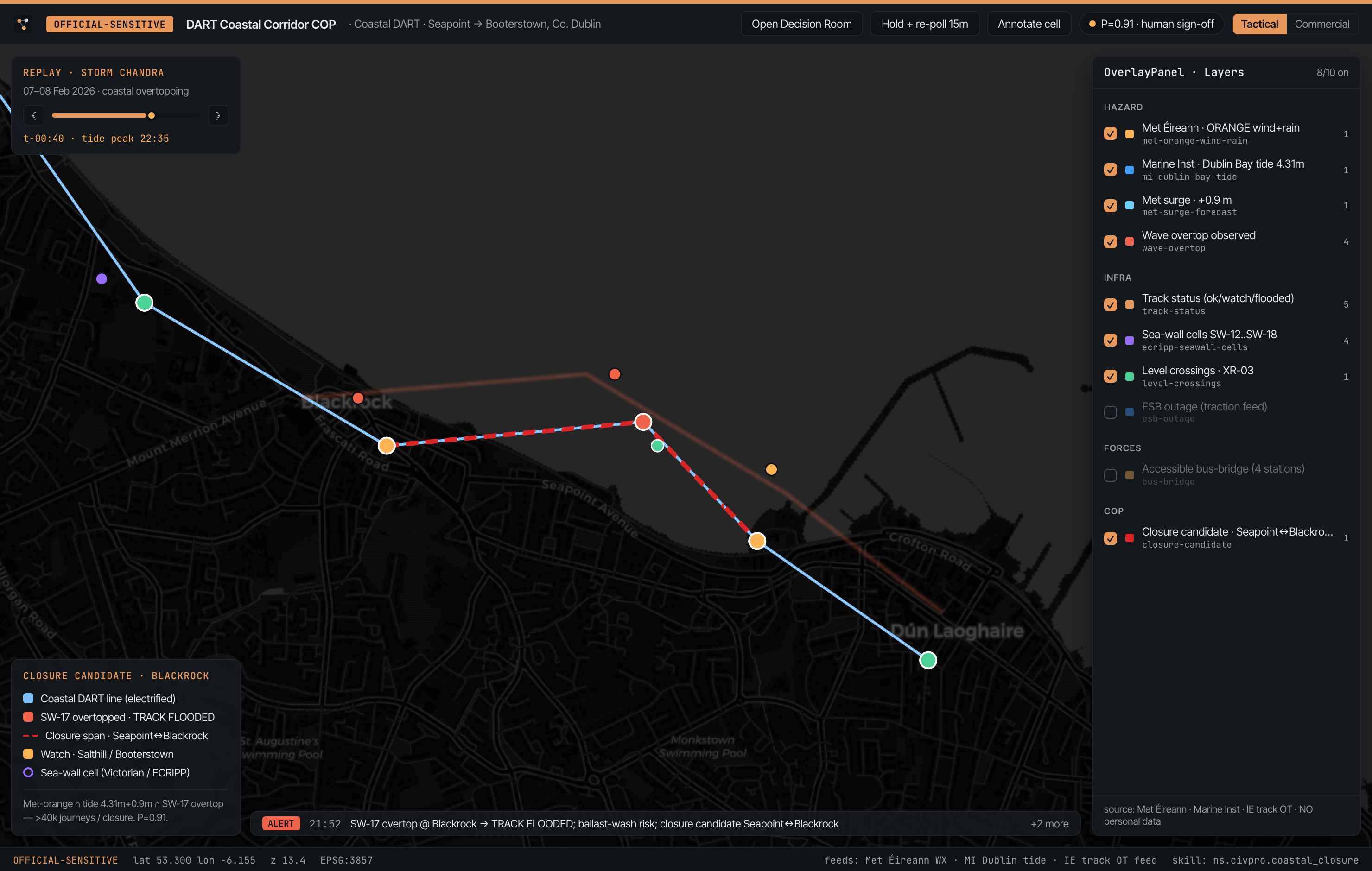
Figure — Operational picture (map_ops · live MapLibre). Production-fidelity React surface (buildable); the faithful ASCII follows.
+------------------------------------------------------------------------------------------------------+
| DART Coastal Corridor COP - Seapoint/Blackrock (MapConsole + MapLibre-2D)                            |
+--------------------+---------------------------------------------------------------------------------+
| LAYERS             | MAP  ========================================================================== |
| [x] Met warnings   |   N  Dublin Bay (coastal DART line / DART+ electrified spine)                   |
| [x] Tide / surge   |   |   ~~~~~~~ HIGH TIDE 4.31m + 0.9m surge  (Met orange wind+rain) ~~~~~        |
| [x] Track status   |   |   ~~~^^^~~~ WAVE OVERTOP ~~~^^^~~~   sea-wall cells SW-12..SW-18            |
| [x] Sea-wall cells |   o SEAPOINT ===[SW-12 ECRIPP raised +1.3m]=== track DRY (status OK)            |
| [ ] ESB outage     |   |                                                                             |
| [x] Level crossings|   o SALTHILL/MONKSTOWN ==[SW-14 Victorian wall, NOT yet raised]== WATCH         |
| [ ] Sub-stations   |   |   <!> overtopping observed 21:50 - ballast wash risk                        |
| [x] Wave overtop   |   o BLACKROCK ===[SW-17 overtopped]=== TRACK FLOODED  <STOP/CLOSE>              |
|                    |   |   level-crossing XR-03 barriers DOWN / pumps at capacity                    |
| REPLAY             |   o BOOTERSTOWN  ==[SW-18 rock-armour toe]== WATCH (rising)                     |
| Storm Chandra      |   |                                                                             |
| 07-08 Feb 2026     |   o SYDNEY PARADE -> city  (Merrion Gates 4km raised stretch holds)             |
| [<<] t-00:40 [>>]  |                                                                                 |
|                    |   CLOSURE CANDIDATE: Seapoint <-> Blackrock  (>40k journeys / closure)          |
| SOURCES            |   Proportionality P=0.91  | human sign-off REQUIRED before close                |
| Met Eireann WX     |   [ Open Decision Room ]   [ Hold + re-poll 15m ]   [ Annotate cell ]           |
| MI Dublin tide     |                                                                                 |
| IE track OT feed   |                                                                                 |
+--------------------+---------------------------------------------------------------------------------+
| INCIDENTS: 21:52 SW-17 overtop @ Blackrock | tide peak 22:35 | crews staged | Coast Guard notified   |
+------------------------------------------------------------------------------------------------------+
Figure a02.2 — decision_room — Coastal-DART Closure Sign-off. Components: ChatTerminal Decision Room hosting the 5 persona bubbles (op-tasking, proportionality, civil-society/accessibility = AlgorithmWatch, devil's advocate, domain hydrologist) + the right-rail gate meter + the [ /dual-control sign ] [ /execute ] [ Refuse + log ] action bar.
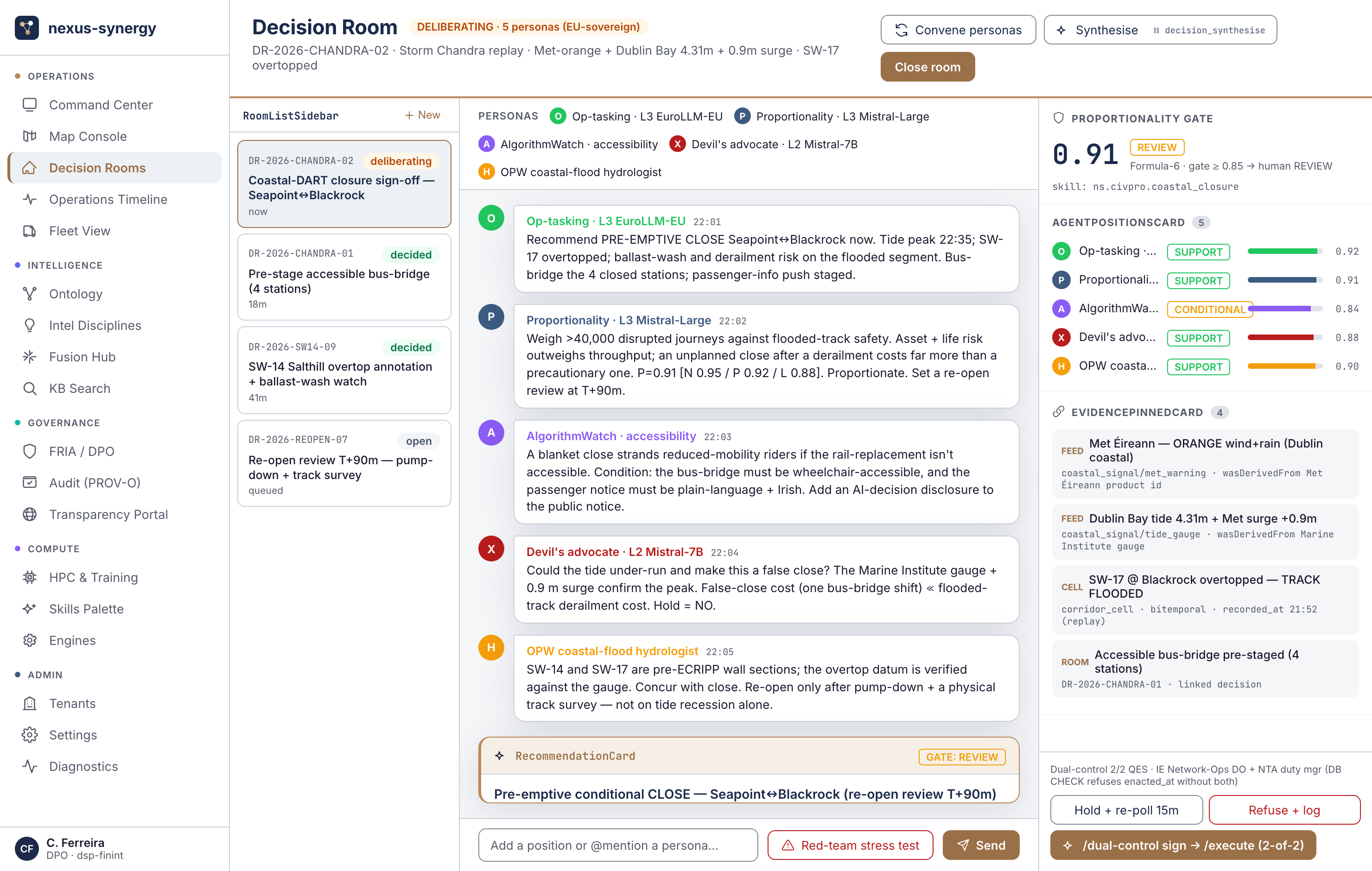
Figure — Decision Room (persona transcript + gate). Production-fidelity React surface (buildable); the faithful ASCII follows.
+------------------------------------------------------------------------------------------+
| Coastal-DART Closure Sign-off - Storm Chandra replay (ChatTerminal Decision Room)        |
+----------------------------------------------------------+-------------------------------+
| [Op-tasking | L3 EuroLLM-EU]                             | GATE: human-required          |
|  Recommend PRE-EMPTIVE CLOSE Seapoint<->Blackrock now;   | ------------------            |
|  tide peak 22:35, SW-17 overtopped, ballast-wash risk.   | Proportionality P=0.91        |
|  Bus-bridge 4 stations; passenger info push staged.      |  [N:0.95 P:0.92 L:0.88]       |
|                                                          |                               |
| [Proportionality | L3 Mistral-Large-EU]                  | Conditions carried:           |
|  >40k journeys disrupted vs flooded-track safety.        |  + accessible bus-bridge      |
|  Asset+life risk outweighs throughput. P=0.91.           |  + Irish/plain notice         |
|  Close is proportionate; set re-open review T+90m.       |  + re-open survey T+90m       |
|                                                          |                               |
| [Civil-society / Accessibility | AlgorithmWatch]         | DUAL-CONTROL 2/2 QES          |
|  Bus-bridge must be wheelchair-accessible; add           |  sign 1: IE Net-Ops DO        |
|  plain-language + Irish notice; no rail-replacement      |  sign 2: NTA duty mgr         |
|  gap for reduced-mobility riders. -> condition added.    |                               |
|                                                          | CHECK enforces:               |
| [Devil's advocate | L2 Mistral-7B local]                 |  no CLOSE write-back          |
|  Could tide under-run? MI gauge +0.9m surge CONFIRMS.    |  without 2/2 sign-off         |
|  False-close cost < flooded-track derail cost. Hold=NO.  |                               |
|                                                          | Audit: CER/NIS2               |
| [Domain expert | OPW coastal-flood hydrologist]          |  evidence -> ledger           |
|  SW-14/SW-17 pre-ECRIPP; overtop datum verified.         |                               |
|  Concur: close. Re-open only after pump-down + survey.   | Verdict: ACCEPT               |
|                                                          |  (conditional close)          |
+----------------------------------------------------------+-------------------------------+
|  [ /dual-control sign ]   [ /execute ]   [ Refuse + log ]                                |
+------------------------------------------------------------------------------------------+
§8b — Field-unit (Pixel) surfaces
The same scenario on the Pixel 10 Pro Fold field unit (Nexus Field app), tightly coordinated with the dashboard COP above — command pushes the task, the unit accepts + ACKs, shares position and reports back to the COP. Built on the same synergy.field_unit / field_task / field_report contract; see §9 and the cluster coordination composite.
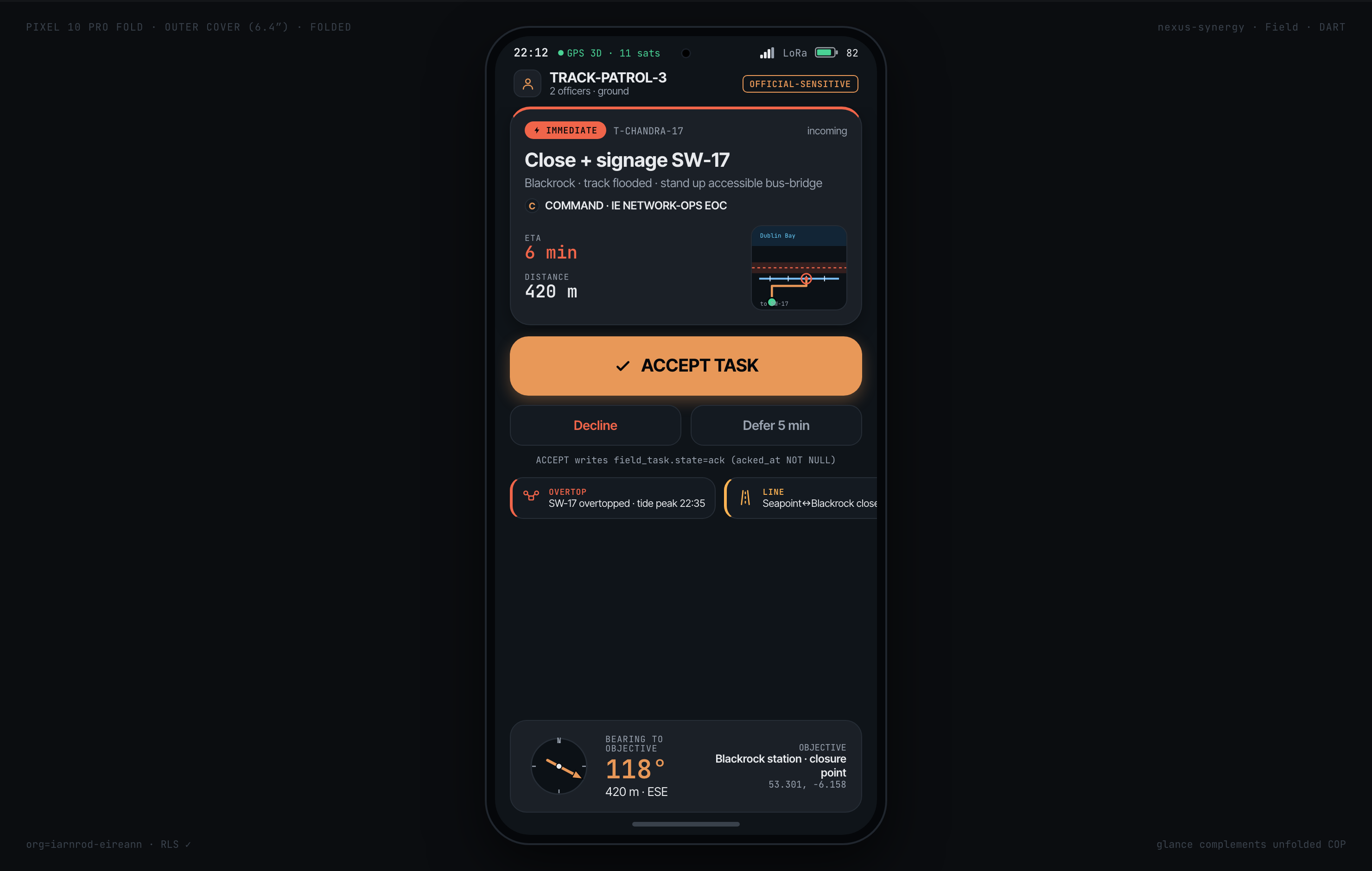
Figure §8b.1 — Folded cover · tasking glance (ground_glance): the incoming IMMEDIATE task, ACCEPT + ACK, alert chips, bearing-to-objective.
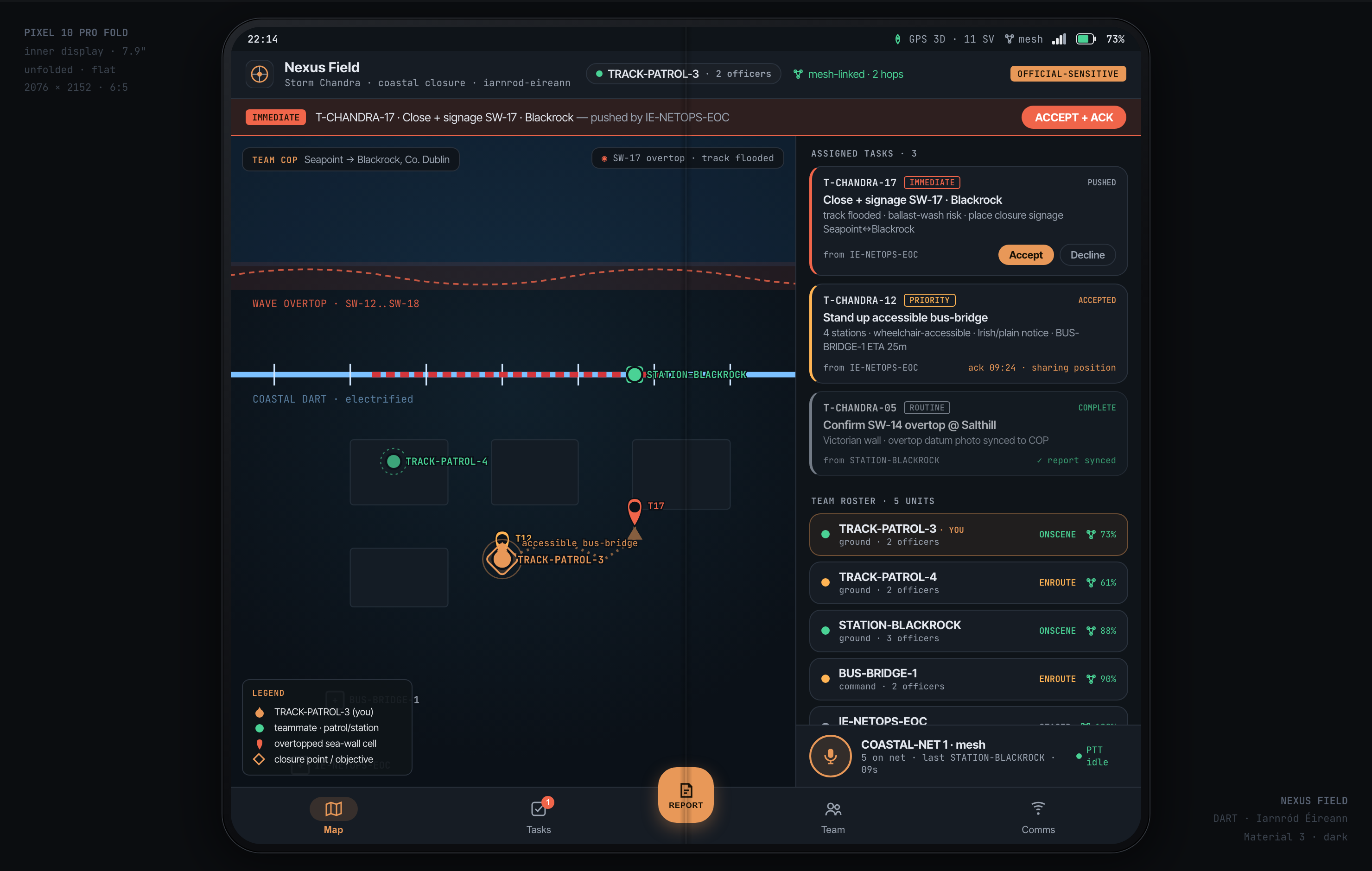
Figure §8b.2 — Unfolded inner display · field COP: two-pane mini-map + task list + teammate roster + air/command coordination + PTT, with the Material-3 NavigationBar + Report FAB.
§9 — UI/UX flow
Literal click-path. On the map_ops COP, the duty officer scrubs the Storm-Chandra replay to t-00:40, sees SW-17 @ Blackrock flip to TRACK FLOODED, selects the Seapoint↔Blackrock span and clicks [ Open Decision Room ] → in the decision_room ChatTerminal the five persona bubbles run; the AlgorithmWatch accessibility objection adds the accessible bus-bridge + Irish/plain-language notice condition; the officer clicks [ /dual-control sign ] (control 1) → the NTA duty manager adds control 2 → [ /execute ] enacts the conditional close, which writes back to passenger-info + crews + partners and drops the PROV-O + BDA chain into the audit ledger. A [ Hold + re-poll 15m ] or [ Refuse + log ] path is equally first-class and fully audited.
  map_ops (corridor COP)            decision_room (closure sign-off)          write-back + ledger
  +------------------+   [Open      +-----------------------------+   [/exec  +-------------------+
  | scrub replay     |    Decision  | 5 persona bubbles           |   after   | passenger-info    |
  | SW-17 -> FLOODED  |--- Room ]--->| AlgorithmWatch adds         |-- 2/2 --->| crews / bus-bridge|
  | select span      |              | accessibility condition     |   QES     | OPW/CoastGuard    |
  | [Open Dec.Room]  |<-- [Hold] ---| [/dual-control sign x2]      |           | PROV-O + BDA      |
  +------------------+   re-poll    +-----------------------------+           +-------------------+
§10 — Decision-Room transcript (the closure dialectic)
Convened the moment the Met orange wind+rain warning + the Dublin Bay tide (4.31 m) + Met surge (+0.9 m) cross the coastal threshold and the COP shows
SW-17 @ Blackrockovertopped. Hosted in the right-dockedChatTerminal. Personas dispatched per the AI Provider Router L-tier; all model calls are EU-sovereign (no US hyperscaler/LLM for this tenant's restricted operational data).
- Op-tasking (L3 EuroLLM-EU): "Recommend pre-emptive close Seapoint↔Blackrock now. Tide peak 22:35; SW-17 overtopped; ballast-wash and derailment risk on the flooded segment. Bus-bridge the 4 closed stations; passenger-info push staged."
- Proportionality (L3 Mistral-Large-EU): "Weigh >40,000 disrupted journeys against flooded-track safety. Asset + life risk outweighs throughput; an unplanned close after a derailment costs far more than a precautionary one. P = 0.91 [N 0.95 / P 0.92 / L 0.88]. Proportionate. Set a re-open review at T+90m."
- Civil-society / Accessibility (AlgorithmWatch persona): "A blanket close strands reduced-mobility riders if the rail-replacement isn't accessible. Condition: the bus-bridge must be wheelchair-accessible, and the passenger notice must be plain-language + Irish. Add an AI-decision disclosure to the public notice." → condition carried into the gate.
- Devil's advocate (L2 Mistral-7B, local-to-tenant): "Could the tide under-run and make this a false close? The Marine Institute gauge + 0.9 m surge confirm the peak. False-close cost (one bus-bridge shift) ≪ flooded-track derailment cost. Hold = NO."
- Domain expert (OPW coastal-flood hydrologist, L3): "SW-14 and SW-17 are pre-ECRIPP wall sections; the overtop datum is verified against the gauge. Concur with close. Re-open only after pump-down + a physical track survey — not on tide recession alone."
- GATE VERDICT — ACCEPT (conditional close). Proportionality 0.91 ≥ P_min; conditions {accessible bus-bridge, Irish/plain notice, T+90m re-open survey} carried; 2-of-2 dual-control required (IE Network-Ops duty officer + NTA duty manager). The §5 DB
CHECKwill refuse to recordenacted_atuntil both QES signatures are present.
§11 — Write-back + BDA + PROV-O + deltas-only regulatory traceback
Write-back (three sinks). On /execute: (1) passenger-information + crew dispatch (close the Seapoint↔Blackrock span, stand up the accessible bus-bridge); (2) partner notification (OPW, Coast Guard, DLR County Council); (3) the synergy.closure_decision row reaches enacted_at carrying both QES signatures and the carried conditions.
BDA (loop close), three observations. (a) T+30 min — closure enacted + passenger-info delivery confirmed (ObservationLevel 4, direct). (b) T+90 min — re-open review: pump-down state + physical track-survey result vs the close decision (ObsLevel 4). (c) post-event — observed overtop vs the tide/surge forecast that triggered the call, logged back to improve the threshold (ObsLevel 3). Each BDA result registers a ProspectiveItem if the forecast diverged from observation.
PROV-O chain (finding → close):
[entity: Met-warning orange + Dublin-Bay tide 4.31m + surge 0.9m]
        │ wasDerivedFrom (Met Eireann / Marine Institute product ids)
        ▼
[activity: severity-triage]  used → [entity: corridor_cell SW-17 overtopped]
        │ wasGeneratedBy
        ▼
[activity: Decision-Room coastal-DART-closure]  (5 personas + IE-DO)
        │ wasAttributedTo → [agent: IE Network-Ops DO + NTA duty mgr (2/2 QES)]
        ▼
[entity: closure_decision  Seapoint<->Blackrock  action=close  P=0.91]
        │ wasGeneratedBy → write-back (passenger-info / bus-bridge / partners)
        ▼
[entity: BDA re-open-review T+90m]  → [activity: UNO close + ProspectiveItem]
Every node carries prov:wasAttributedTo (agent), prov:wasGeneratedBy (activity); the chain is Merkle-anchored at interval τ. The AlgorithmWatch accessibility condition becomes a discoverable provenance edge — if a resident later challenges the closure, the graph proves the accessibility + Irish-notice condition was carried.
Regulatory traceback (deltas only, vs §4.0 civil-protection defaults). Evidence emitted for the CER Competent Authority (physical-resilience incident handling + decision audit) and NIS2 where OT/cyber signals are fused — the audit ledger is the resilience evidence pack, exported as deltas since the last submission. AI Act: if the COP carries any personal data it would touch Annex III §5(d) (emergency-response/dispatch) — but the wedge processes no personal data, so the high-risk classification is avoided by design (asset/incident coordination only). (needs solicitor + DPO confirmation at pilot scoping)
§12 — Buyer & stakeholders
- Economic buyer: Iarnród Éireann senior leadership — most likely Infrastructure / Network Operations and/or the IT-OT security function (resilience sits across both). (named contact TBD — first ask of Patrick)
- Acute-pain owner / champion candidate: the ECRIPP programme + network operations / control leadership — they live the storm-closure problem.
- Strategy + capital: NTA (programme funder; the route to scaled capital under Project Ireland 2040).
- Compliance pull: CRR as the confirmed CER competent authority for rail (SI 559/2024), with its NIS2 designation still to finalise; Dept of Defence as CER single point of contact / national-strategy owner.
- Multi-agency users (flood angle): OPW, Met Éireann, Marine Institute, Local Authorities (DLR CoCo), Irish Coast Guard.
- Bridge / pilot co-sponsor: Patrick Walsh — offered to introduce and co-sponsor a pilot (§21).
§13 — Competition / incumbency + comparator
- No evidence of an entrenched Palantir-class incumbent for an integrated rail resilience/disruption COP (verify). Current practice appears fragmented: SCADA/OT systems, GIS, Met/tide feeds and manual phone-tree coordination — not one fused, auditable action loop.
- Adjacent players are complementary: large engineering/SI firms already on rail (Jacobs is engaged on ECRIPP coastal-erosion civils) and OT/SCADA vendors supply sensors and concrete — below our software layer, not a COP competitor — though a big SI could try to bundle a dashboard. [likely]
- Comparator (fold AS-status into the sentence): the nearest analogue is a generic SCADA/GIS dashboard + a manual major-incident bridge. Nexus Synergy wins on: the human-gated closed action loop (detect→gate→execute→BDA) with a proportionality-scored Decision Room and a provenance/audit ledger that doubles as CER/NIS2 evidence — none of which a SCADA/GIS stack provides. Loses on: brand familiarity to a rail procurement officer and a pre-pilot maturity gap. Ties on: the underlying map/GIS rendering.
- Differentiator: sovereign-by-architecture + conformity-by-construction (FRIA + provenance ledger + transparency portal) maps directly onto a regulated essential-service operator's CER/NIS2 audit burden.
§14 — Readiness (honest)
- Status: pre-incorporation, pre-revenue, pre-pilot. The ~178 UI surfaces are a gallery; the end-to-end rail-corridor action loop over live data is not yet built or proven. [verified — self-assessment]
- Strong reuse: the flood/disaster pillar (Met Éireann + OPW + tide/wave + the storm-replay COP) overlaps heavily with the maritime/NDFEM work, so this demo is cheap to assemble relative to a cold use case.
- Real gaps to close before a credible pilot: (a) data access — Met Éireann + Marine Institute tide/surge + Irish Rail track/OT + any ECRIPP sensor feeds (availability, format, governance — an integration seam); (b) a rail-corridor ontology instance (§4); (c) a defensible closure/re-open decision workflow + audit-ledger demo (§§5–11). None require anything on the Declined List.
§15 — ENGAGEMENT PLAYBOOK (ready-to-go sequence)
The repeatable motion: first-contact → discovery → demo → pilot → LOI → signed contract. Each stage = trigger / owner / activity / template-or-script / exit criterion / deliverable.
Stage 1 — First contact (warm bridge)
- Trigger: Patrick confirms he can introduce a specific Irish Rail / NTA contact. Owner: Founder (+ Patrick). Exit: a scheduled discovery call with a named sponsor. Deliverable: the intro email (template, §21) sent + a calendar hold.
- Activity: ask Patrick who specifically — Irish Rail Network-Ops vs IT/OT-security vs the ECRIPP programme vs NTA — then frame the meeting around the flood-disruption COP (concrete, costly, multi-agency), holding CER/NIS2 as the durable expansion.
Stage 2 — Free discovery (~45–60 min, listening session, no slides)
- Trigger: discovery call booked. Owner: Founder. Exit: named sponsor agrees there is a problem worth solving + names a budget owner. Deliverable: a same-day discovery write-up (sponsor, top-3 pains in their words, lawful basis, action-loop gap, Declined-List PASS, funding-vehicle hint, agreed next step).
- Script (adapted 60-min agenda):
- 0:00–0:05 Frame: "Irish-built, EU-sovereign decision-intelligence platform — the Palantir for the EU with sovereignty in the architecture. This is discovery, not a pitch."
- 0:05–0:20 Current picture: "Walk me through the last storm closure from the moment Met issued the warning to the moment you re-opened. Who touched the close/re-open call, in what order? How many systems did you look at?"
- 0:20–0:35 Governance: "Lawful basis for the feeds? Any personal data? Are you in scope for CER / NIS2 audit, and how do you evidence the resilience obligation today?"
- 0:35–0:45 Path: "Who owns this operationally? Who owns the budget — Irish Rail ops, or NTA capital? Is there a programme (ECRIPP, DART+, a DTIF/EI/CEF call) this could sit under?"
- 0:45–0:55 Map their loop: sketch detect→enrich→triage→gate→task→execute→assess→close; mark where they jump detect→act with no enrichment/gate (the wedge).
- 0:55–1:00 Earn the demo: "If I came back with a 30-min walkthrough replaying a Storm-Chandra coastal closure in our platform, would that be worth your time?"
Stage 3 — Scoped demo (their loop replayed, not a feature tour)
- Trigger: sponsor agrees to a walkthrough. Owner: Founder. Exit: "Could we try this on a real slice of our data?" Deliverable: the live storm-replay COP demo (§8 surfaces) + the one-page pilot proposal (Stage 4).
- Activity: drive the Seapoint→Blackrock Storm-Chandra replay end-to-end: scrub to overtop → open Decision Room → show the proportionality score + the AlgorithmWatch accessibility objection changing the recommendation → 2/2 sign-off → write-back + audit ledger. Lead with the differentiators that matched their discovery answers (sovereign model-call boundary; conformity-by-construction; provenance ledger as CER evidence). Be honest about maturity.
Stage 4 — Pilot (time-boxed, one corridor, agreed success criteria)
- Trigger: demo exit-ask answered yes. Owner: Founder + Irish Rail champion. Exit: success criteria met or credibly trending. Deliverable: signed one-page pilot proposal + pilot run.
- One-page pilot proposal (filled for DART):
- Title & sponsor: "Coastal-DART Storm-Disruption Operating Picture — pilot." Sponsor: [Irish Rail Network-Ops lead, TBD]; budget owner: [Irish Rail ops / NTA, TBD].
- Problem (their words): "When the coastal line floods, the close/re-open call is run on phone trees and spreadsheets, and we can't easily evidence it afterwards." (to confirm in discovery)
- The one thing we'll prove: "We can fuse Met + tide/surge + track status into one operating picture and shorten the time from warning-issued to a defensible, signed-off closure decision from X to Y." (X/Y = baseline TBD, measured in pilot week 1.)
- Scope IN / OUT: IN — the coastal DART corridor (Seapoint→Booterstown), Met + tide/surge + a sample track-status feed, the closure/re-open loop + audit ledger. OUT — all other lines, any personal data, any Declined-List capability.
- Data & lawful basis: Met Éireann + Marine Institute + Irish Rail track/OT (no personal data; lawful basis = operational resilience). Runs EU-sovereign; isolation tier set to the feeds' sensitivity.
- Success criteria (2–4, sponsor-agreed): decision lead-time Δ; journeys-protected per closure; audit-evidence completeness for a CER submission; sponsor confidence in the re-open call. (baselines TBD week 1)
- Timeline: 6–12 weeks (exact TBD), with a mid-point checkpoint and a Storm-replay validation run.
- Commercials: €0 to Irish Rail if innovation-grant-funded; otherwise scoped sub-threshold pilot (indicative production band Tier-1 €120–240k/yr — see §19, only if asked).
- Roles: Founder/partner-vehicle delivers; Irish Rail champion supplies feeds + a duty officer for the parallel run; named POCs both sides.
- After: an LOI if criteria are met.
- Funding vehicle: NTA pilot budget / DTIF or EI / CEF co-fund — confirm in discovery.
Stage 5 — LOI (the milestone, triggers the Patrick check)
- Trigger: pilot success criteria met. Owner: Founder + sponsor. Exit: signed LOI naming a sponsor + next step. Deliverable: signed (non-binding) LOI.
- LOI checklist (key items): parties (Irish Rail + Nexus Synergy Ltd, or founder-in-own-name pre-incorporation, NewCo to ratify under Companies Act 2014 s.45) · statement of intent (proceed to next phase, conditional on funding/procurement) · scope carried from the pilot · success criteria referenced · named sponsor + budget owner · indicative timeline + next step · indicative commercials ("to be scoped under [vehicle]") · conditions (funding award, procurement, data-sharing agreement, security accreditation) · binding vs non-binding (default non-binding except confidentiality) · governing law: Irish · Declined-List affirmation · signatures + dates · solicitor review confirmed before sending (flag, do not assume).
Stage 6 — Signed contract
- Trigger: LOI + a procurement route. Owner: partner-vehicle + Irish Rail/NTA procurement. Exit: executed contract / framework call-off. Deliverable: the signed contract — gated on a partner-vehicle / Stamp-4 path (§16, §18, §20).
§16 — PM / timeline
Gantt (indicative; bars = active stages; all durations [PRIOR], TBD with sponsor):
Stage \ month         M1   M2   M3   M4   M5   M6   M7   M8 .. M18 .. M30
1 First contact       ####
2 Discovery (free)     ######
3 Scoped demo            ####
4 Pilot (1 corridor)        ##########
5 LOI                                ####                 <-- Patrick-check
6 Contract / framework                   ............>>>>>>>> .. >>>>>>>>>
* Partner-vehicle gate  [.....resolve Stamp-4 / partner-vehicle.....]^ critical for PAID pilot/contract
- Milestones: M1 named intro · M3 sponsor agrees pain (discovery exit) · M4 demo "try it on real data" · M6 pilot start · M8 pilot success-criteria read-out · ~M9–12 LOI (Patrick check) · M18+ contract/framework.
- Critical path: the Stamp-1G → Stamp-4 / partner-vehicle gate is the binding constraint — a free discovery + demo + grant-funded pilot can run before it, but a PAID pilot or any signed contract cannot close until the vehicle resolves (§18, §20). Public-utility procurement is the second long pole.
RACI:
| Activity | Founder | Patrick / sponsor | MAHI-or-partner-vehicle | Irish Rail champion | IE / NTA procurement |
|---|---|---|---|---|---|
| Warm intro | R | A | I | I | — |
| Discovery + demo | A/R | C | I | C | — |
| Pilot delivery | R | C | C (contracting prime) | A | I |
| Data-sharing agreement | C | I | C | A/R | C |
| LOI sign-off | R | C | C | A | C |
| Paid contract / framework | C | I | A/R (signs + invoices) | C | A |
§17 — Funding / procurement vehicle
- Operational/pilot funding: NTA capital under Project Ireland 2040 (the envelope funding DART+ and ECRIPP) is the natural home for a scaled deployment; a small scoped pilot can likely be run by Irish Rail operations directly. [likely]
- Regulatory budget pull: CER/NIS2 obligations create a resilience-spend line with audit/inspection teeth — a buying trigger independent of any single storm. [verified mandate; budget line TBD]
- Innovation co-fund (to de-risk a pilot): possibly DTIF (consortium with Met Éireann / OPW / a university) or Enterprise Ireland; ECRIPP already draws EU Connecting Europe Facility money, so an EU resilience/innovation co-fund is plausible. (specific vehicle TBD)
- Procurement reality: public-utility procurement is slow and tender-bound above low thresholds; the realistic path is free discovery → scoped paid pilot (sub-threshold or innovation-funded) → LOI → framework. Headwind: the reported ~€50m Indra TMS write-off froze Irish Rail digital procurement — a real drag on procurement clarity (verify the figure and current status). [unverified — flag]
§18 — TWO-STAGE FORMULA SCORECARD
Anchored to board #2 (DART): Score 72, to-LOI 30–42%, to-buy 21–29%. All factor cells
[PRIOR]with a dated rationale.
Stage-1 — P(LOI), H = 12–18 mo. Vector = {mandate_pull, access_warmth, demonstrability, decline_safety, white_space, cycle_speed, pillar_fit}; weights {.22,.22,.18,.14,.10,.08,.06}.
| Factor | w | Score | Dated rationale [PRIOR] |
|---|---|---|---|
| mandate_pull | .22 | 4 | 2026-06-05: CER Regs in force 17 Oct 2024 + National Resilience Strategy 19 Mar 2026 (transport named) + funded >€200m ECRIPP / DART+ / Project Ireland 2040; the CRR is the confirmed CER competent authority for rail (SI 559/2024) — not a 5 only because the parallel NIS2 designation is still to finalise. |
| access_warmth | .22 | 4 | 2026-06-05: Patrick offered to bridge and co-sponsor a pilot (strongest lever); not 5 because the exact Irish Rail/NTA contact is unnamed. |
| demonstrability | .18 | 4 | 2026-06-05: storm-replay COP + flood pillar reuse → demo-ready on the buyer's real corridor; capped by pre-pilot status. |
| decline_safety | .14 | 5 | 2026-06-05: pure resilience/safety/asset protection; no personal data in the wedge; clear of the Declined List. |
| white_space | .10 | 2 | 2026-06-05: no evident Palantir-class COP incumbent, but the ~€50m Indra TMS write-off froze IE digital procurement, trimming the open slot. |
| cycle_speed | .08 | 2 | 2026-06-05: warm sponsor enables fast discovery/pilot, but the procurement freeze + tender-bound utility procurement slow the contract. |
| pillar_fit | .06 | 4 | 2026-06-05: squarely the action-loop COP core (map_ops + decision_room), one step off maritime/NDFEM. |
S1 = .22·4 + .22·4 + .18·4 + .14·5 + .10·2 + .08·2 + .06·4 = 3.72. P_LOI = 0.55 / (1 + exp(−1.15·(3.72 − 2.6))) = ≈ 0.41 (band 33–46%). Score100 = S1·20 = 74 (board anchor 72 ✓, within rounding).
Stage-2 — P(Contract | LOI), H = 24–36 mo. Vector = {contractability, funding_to_pay, procurement_clarity, incumbency_displacement, time_to_value, reference_leverage}; weights {.24,.22,.18,.16,.12,.08}.
| Factor | v | Score | Dated rationale [PRIOR] |
|---|---|---|---|
| contractability | .24 | 1 | 2026-06-05: founder solo on Stamp 1G, no signing vehicle yet → the gate, not S2, governs (see G below). |
| funding_to_pay | .22 | 3 | 2026-06-05: NTA capital + CER resilience budgets exist, but no named accessible line and the IE digital-procurement freeze. |
| procurement_clarity | .18 | 1 | 2026-06-05: standout drag — the ~€50m Indra TMS write-off froze IE digital procurement. |
| incumbency_displacement | .16 | 4 | 2026-06-05: we sit above SCADA/GIS/SI civils (Jacobs/ECRIPP), not rip-and-replace. |
| time_to_value | .12 | 4 | 2026-06-05: storm-replay demo-to-value lands well inside the CER reporting window. |
| reference_leverage | .08 | 2 | 2026-06-05: first-of-its-kind logo; little external proof yet. |
S2 = .24·1 + .22·3 + .18·1 + .16·4 + .12·4 + .08·2 = 2.36. P_raw = 0.70 / (1 + exp(−1.1·(2.36 − 2.8))) = ≈ 0.27.
Legal gate G = V·T (T ≈ 1 here, H_conv = 30 mo, t_resolve ≈ Stamp-4 in ~3 mo):
| V (vehicle) | 0.10 (solo Stamp-1G, today) | 0.45 (Dogpatch-brokered entity) | 0.75 (partner-vehicle confirmed prime) | 1.00 (Stamp-4 incorporated & trading) |
|---|---|---|---|---|
| P(Contract|LOI) = G·P_raw | ≈ 2.7% | ≈ 12% | ≈ 20% | ≈ 27% |
| P(Contract) = P_LOI·G·P_raw | ≈ 1.1% | ≈ 5% | ≈ 8% | ≈ 11% |
Reconciliation to board anchor. P_LOI ≈ 41% sits inside the board's to-LOI 30–42%. The board's to-buy 21–29% is the post-vehicle figure (V→1.0 → P(Contract|LOI) ≈ 27%, top of band ✓); today, solo on Stamp-1G, the unconditional to-buy is ~2.7% — the vehicle is the lever, not Stage-1 or Stage-2. Score100 = 74 ≈ board 72.
§19 — Commercial
- Pilot: Tier-1 €120–240k band (often €0 to Irish Rail if innovation-grant-funded; a paid pilot needs the partner-vehicle).
- Expansion: high-value multi-corridor + CER/NIS2 resilience framework under NTA capital — could reach very-high at full-network scale.
- Contract terms (indicative): annual subscription on the open-component substrate (no per-seat lock-in); cost advantage from open-source substrate + sovereign HPC + shared conformity file + no forward-deployed-engineer dependency.
- Buyer requirements to satisfy: ISO-27001, EU data-residency / sovereignty (model calls stay in-jurisdiction via the classification-aware AI Provider Router), a data-sharing agreement for Met/tide/track feeds, and (for the CER expansion) the resilience-evidence export. [verified as standard public-utility requirements; specific accreditation TBD]
§20 — Legal blockers
- Stamp-1G cap (founder): Stamp 1G bars self-employment, operating/establishing a business, and being a company director — so the founder cannot be a director, incorporate, hold founder equity, or trade until Stamp 4 (applied for, ~3 mo out). A paid Irish Rail pilot/contract therefore needs a partner-vehicle path (MAHI or a Dogpatch-brokered entity) or to wait for Stamp 4. (immigration-solicitor confirmation required) [flag]
- Indra write-off procurement freeze: the reported ~€50m IE TMS write-off appears to have frozen Irish Rail digital procurement — a contract-stage blocker independent of our readiness. (verify figure + current status) [unverified — flag]
- GDPR / personal data: the wedge processes no personal data, so the GDPR + AI-Act high-risk surface is minimised by design; any future station/incident extension touching personal data must be re-assessed (DPO + solicitor). [flag]
- AI Act: high-risk classification (Annex III §5(d), emergency-response/dispatch AI) would attach only if personal data is processed; for the resilience-only wedge it is avoided. Note for accuracy: AI-Act Art-5 prohibitions applied from 2 Feb 2025 (not 2 Aug). (solicitor confirmation) [flag]
- Pre-incorporation signing: until NewCo is formed, the founder signs LOIs in their own name (personal liability) with NewCo to ratify under Companies Act 2014 s.45; prefer non-binding wording; protect discovery under a mutual NDA. [flag]
§21 — Warm-intro contact + the specific ask
- Contact: Patrick Walsh (Dogpatch) — offered to bridge the connection and help run a pilot (a strong warm path + potential co-sponsor).
- The specific ask: an introduction to the Irish Rail Network-Operations / ECRIPP resilience lead (the owner of the storm-closure problem), with Patrick co-sponsoring a scoped flood-disruption pilot. First sub-ask: who exactly — Network-Ops vs IT/OT-security vs ECRIPP vs NTA.
- Intro email (template, ready to adapt):
Subject: Coastal-DART storm-closure operating picture — quick intro?
Hi Patrick — following up on your offer to bridge Irish Rail / NTA. We've built an EU-sovereign decision-intelligence platform (think "Palantir for the EU, with sovereignty in the architecture"). The wedge for Irish Rail is a storm-replay common operating picture for the coastal DART — fusing Met Éireann + tide/surge + track status so the close/re-open call (run today on phone trees) becomes one fused, human-gated, audit-evidenced decision that protects the >40k journeys per closure and produces the CER/NIS2 resilience evidence. We replay Storm Chandra (Seapoint→Blackrock) end-to-end.
Could you introduce me to whoever owns the storm-closure decision / ECRIPP resilience at Irish Rail (or the right NTA contact)? You mentioned possibly co-sponsoring a pilot — I'd love to scope a short, grant-fundable one. Happy to send a one-pager. Thank you — [Founder]
§22 — Open questions + Sources
Open questions (do not assert until resolved):
- Exact contact Patrick can bridge — Irish Rail Network-Ops vs IT/OT-security vs ECRIPP vs NTA.
- NIS2 competent authority for rail — the CRR is the confirmed CER competent authority (SI 559/2024); confirm whether it also takes the NIS2 cyber-resilience designation or whether that sits elsewhere.
- Lead use case — flood-disruption (recommended wedge) vs CER/NIS2 compliance (durable expansion).
- Data-access seams — Met Éireann + Marine Institute tide/surge + Irish Rail track/OT + any ECRIPP sensor feeds (availability, format, governance).
- Pilot funding vehicle — direct Irish Rail ops budget vs NTA pilot vs DTIF/EI/CEF co-fund.
- Incumbency — confirm no existing integrated rail-resilience COP contract; check Jacobs/SI scope on ECRIPP.
- Procurement threshold — the value below which a scoped pilot runs without full OJEU tender.
- Indra TMS write-off — confirm the ~€50m figure and whether the digital-procurement freeze is current.
Sources (web-verified 2026-06-04/05): Storm Chandra (26–27 Jan 2026) + the 7–8 Feb 2026 Seapoint→Blackrock coastal-overtopping DART closure — met.ie 2026-01-27, visahq.com 2026-02-08, irishtimes.com 2026-02-23; ECRIPP >€200m / ~65 km Merrion Gates→Wicklow Harbour scope (five coastal-cell areas) / NTA + Project Ireland 2040 + EU CEF funding / 4 km Merrion Gates→Seapoint +1.3 m / 1-in-200-yr-50-yr design / planning applications targeted early-2027 — irishrail.ie/ecripp, railjournal.com, rte.ie 2025-09-15, irishtimes.com 2026-02-23; National Strategy on the Resilience of Critical Entities 2026–2029 (published 19 Mar 2026; 11 sectors incl. transport; per-sector Competent Authorities; DoD single point of contact) — gov.ie 2026-03-19, computerweekly.com; EU (Resilience of Critical Entities) Regulations 2024 in force 17 Oct 2024, CRR confirmed CER competent authority for rail under SI 559/2024 — gov.ie Office of Emergency Planning; DART+ capacity-double / electrification-treble + Alstom 750-carriage framework / 185 on order / 2027–28 service — alstom.com 2024-11, irishrail.ie, transportforireland.ie. Internal: target card 03-gtm/target-packages/dart-irish-rail.md; formula 03-gtm/strategy-paper/formula-worked-examples.md (worked example B); discovery motion 03-gtm/discovery-playbook.md. Flagged unverified: ~€50m Indra TMS write-off / IE digital-procurement freeze — confirm before relying on it.