
Nexus-Alive: A Multi-Model Consensus Architecture for Autonomous Infrastructure Self-Healing with Episodic Memory and Adaptive Research Pipelines
A comprehensive technical analysis of the Adverant Nexus autonomous infrastructure stack — four tightly integrated systems (Nexus-Alive, Nexus-Workflows, Nexus-AutoResearch, Mission Control) that combine multi-model consensus voting, GraphRAG-backed episodic prediction, self-improving pattern mining, and autonomous software repair into a production-deployed self-healing platform. The paper formalizes a 13-agent organizational structure across five specialized teams, a 60-minute predictive horizon driven by three weighted evidence sources (recurrence, time-series anomalies, log signals), and a four-parallel-agent skills repair swarm with safety gates that closes the perception-to-action loop without human intervention. It documents 24 production use cases, a competitive evaluation against 10 commercial AIOps platforms (Datadog Watchdog, Dynatrace Davis, New Relic AI, BigPanda, Moogsoft, PagerDuty AIOps, Splunk ITSI, ServiceNow AIOps, Elastic AIOps, IBM Watson AIOps), seven patent novelty candidates with prior-art mapping, 14 failure detection points, and seven GraphRAG integration points spanning gateway, mageagent, alive, autoresearch, skills, dashboard, and orchestration services.
Nexus-Alive: A Multi-Model Consensus Architecture for Autonomous Infrastructure Self-Healing with Episodic Memory and Adaptive Research Pipelines
Abstract
Modern cloud-native infrastructure demands operational intelligence that transcends reactive alert-response paradigms. We present the Adverant Nexus stack --- a production-deployed autonomous infrastructure platform comprising four tightly integrated systems: Nexus-Alive (self-healing engine with multi-model consensus), Nexus-Workflows (visual DAG orchestration), Nexus-AutoResearch (adaptive research pipeline), and Mission Control (real-time monitoring UI). The central contribution is Nexus-Alive's novel architecture: five specialized AI agent teams --- Discovery, Analysis, Healing, Consensus, and Learning --- coordinate through a shared GraphRAG knowledge graph to detect anomalies, predict failures 60 minutes ahead, execute risk-classified remediation, and continuously improve through episodic memory. A distinguishing innovation is the multi-model consensus mechanism, where three independent large language models (GPT-4o, Claude Opus, Gemini Flash) vote in parallel on high-risk healing actions with confidence-weighted aggregation. We describe the 3-source episodic prediction engine that combines historical incident recall (40%), pattern matching (35%), and metric trend analysis (25%) to achieve predictive accuracy. We enumerate 24 production use cases, present competitive analysis against 10 commercial AIOps platforms, and identify 7 potentially novel patent claims. To our knowledge, no existing system combines multi-model consensus voting, GraphRAG-backed episodic prediction, and self-repairing software skills in a unified autonomous infrastructure platform.
Keywords: AIOps, self-healing infrastructure, multi-agent systems, multi-model consensus, GraphRAG, episodic memory, anomaly detection, failure prediction, autonomous remediation, workflow orchestration
1. Introduction
Companion Slide Deck: Download the 14-slide architecture presentation (PDF) --- visual walkthrough of the agent pipeline, prediction engine, consensus voting, risk classification, competitive landscape, and patent novelty analysis.
The operational complexity of cloud-native infrastructure has outpaced human capacity to manage it. A single Kubernetes cluster running 50+ microservices generates thousands of events per minute --- pod restarts, resource fluctuations, network anomalies, certificate expirations, and cascading failures that propagate across service boundaries. Traditional monitoring approaches, even those enhanced with machine learning, remain fundamentally reactive: they detect anomalies after they manifest, correlate alerts after noise accumulates, and recommend actions after engineers are already paged.
This paper introduces the Adverant Nexus autonomous infrastructure stack, a production-deployed platform that shifts the paradigm from reactive monitoring to proactive self-healing. The stack comprises four integrated systems that, when combined, create a closed-loop autonomous operations platform:
-
Nexus-Alive: An autonomous self-healing engine organized as five specialized AI agent teams that continuously discover, analyze, heal, reach consensus, and learn from infrastructure events.
-
Nexus-Workflows: A visual DAG-based orchestration engine powered by Trigger.dev that enables topological sort with level-based parallel execution of heterogeneous task types.
-
Nexus-AutoResearch: An adaptive research pipeline implementing STORM, Karpathy, and AutoGen patterns with 18 Trigger.dev tasks across 4 queues, including GPU-accelerated model training.
-
Mission Control: A 13-section real-time monitoring dashboard with 2-second live activity ticker, agent-colored badge system, and adaptive polling.
1.1 Contributions
Our primary contributions are:
-
C1: A multi-model consensus mechanism where 3+ independent LLMs vote on infrastructure healing actions with confidence-weighted aggregation and a 2/3 approval threshold, eliminating single-model bias (Section 3.4).
-
C2: A 3-source episodic prediction engine combining GraphRAG-backed historical incident recall (40% weight), pattern similarity matching (35%), and linear regression metric trend analysis (25%) to predict failures 60 minutes ahead (Section 3.2).
-
C3: A self-improving learning loop where a PatternMiner agent extracts reusable remediation patterns from resolved incidents with vector similarity deduplication at 0.85 threshold, enabling evidence-based remediation selection (Section 3.5).
-
C4: A skills auto-repair agent swarm that deploys 4 parallel analysis agents (ErrorAnalysis, SkillCodeAnalysis, WorkflowContextAnalysis, HistoricalPatternAnalysis) to autonomously diagnose and fix failed software skills with safety gates (Section 4).
-
C5: An XML-based risk-classified auto-remediation system with 4-tier risk hierarchy (LOW→CRITICAL) and namespace escalation rules (Section 3.3).
-
C6: A 14-point job failure detection system integrated across the entire task execution pipeline, from validation through post-healing verification (Section 5).
-
C7: Cross-system agent swarm coordination via a shared GraphRAG knowledge graph, enabling patterns learned by one agent team to be available to all others across service boundaries (Section 6).
1.2 Paper Organization
Section 2 surveys related work. Section 3 details the Nexus-Alive architecture. Section 4 presents the Skills Auto-Repair Agent Swarm. Section 5 describes Nexus-Workflows integration. Section 6 covers Nexus-AutoResearch. Section 7 presents the Mission Control UI. Section 8 enumerates 24 production use cases. Section 9 provides competitive analysis against 10 commercial platforms. Section 10 analyzes patent novelty. Section 11 discusses limitations and future work. Section 12 concludes.
2. Related Work
2.1 AIOps and Autonomous Cloud Operations
SQL3 linesThe field of AIOps --- applying artificial intelligence to IT operations --- has evolved rapidly from simple rule-based alerting to ML-powered anomaly detection and, most recently, to agentic AI systems capable of autonomous action. Notaro et al. (2021) provide a comprehensive survey of anomaly detection and failure root cause analysis in microservice-based cloud applications, identifying key challenges including the heterogeneity of telemetry data, the complexity of service dependencies, and the difficulty of distinguishing correlation from causation [1]. More recently, Chen et al. (2024) present AIOpsLab, a holistic framework for evaluating AI agents in autonomous cloud environments, envisioning a future where AI agents manage operational tasks throughout the entire incident lifecycle --- a paradigm they term "AgentOps" [2]. The concept of self-healing systems draws inspiration from biological immune responses. Ghosh et al. (2007) formalized self-healing software systems as those capable of detecting failures, diagnosing root causes, and applying corrective actions without human intervention [3]. Recent work by Silva et al. (2025) revisits this biological metaphor in the context of modern AI, proposing that observability tools serve as sensory inputs, AI models function as the cognitive core, and healing agents apply targeted modifications [4].
2.2 Multi-Agent Systems for Infrastructure Management
Multi-agent architectures have gained traction for infrastructure management due to their ability to decompose complex operational tasks into specialized, parallelizable sub-problems. Chen et al. (2024) articulate the challenges and design principles for building AI agents for autonomous clouds, emphasizing the need for fault tolerance, observability, and human-in-the-loop safety mechanisms [5]. STRATUS, presented at NeurIPS 2025, demonstrates a multi-agent system for autonomous reliability engineering that coordinates specialized agents for monitoring, diagnosis, and remediation [6].

Our work extends this line of research in three key ways. First, we organize agents into five functional teams (Discovery, Analysis, Healing, Consensus, Learning) rather than treating them as homogeneous peers. Second, we introduce a multi-model consensus layer where multiple LLMs vote independently on critical decisions. Third, we leverage a shared GraphRAG knowledge graph as the coordination substrate, enabling cross-team and cross-service learning.
2.3 Knowledge Graphs and Episodic Memory for Operations
Knowledge graphs have been applied to operational intelligence in several contexts. Kim et al. (2024) demonstrate Graph RAG for automobile failure analysis, showing that combining knowledge graphs with retrieval-augmented generation significantly improves failure diagnosis accuracy [7]. The broader GraphRAG paradigm, surveyed by Peng et al. (2025), establishes that graph-structured retrieval enhances LLM reasoning by providing relational context that flat document retrieval misses [8].
Episodic memory --- the ability to recall specific past experiences in temporal context --- is a concept borrowed from cognitive science. In our system, we implement episodic memory through GraphRAG episodes: each incident is stored as a temporally-indexed graph node with edges to affected services, applied remediation actions, and outcomes. This enables the PredictiveAnalyzer to answer queries such as "What happened to service X the last three times its memory exceeded 85%?" --- a capability absent from existing AIOps platforms.
2.4 Anomaly Detection and Root Cause Analysis
Statistical and ML-based anomaly detection for microservices has been extensively studied. Lee et al. (2024) present BARO, which leverages multivariate Bayesian online change point detection to model dependencies within time-series metrics for accurate root cause identification [9]. Yu et al. (2024) provide a comprehensive survey of RCA methodologies in microservices, noting that most approaches treat anomaly detection and root cause analysis as separate pipeline stages, whereas integrated causal frameworks show superior performance [10].
Our AnomalyDetector combines Z-score statistical analysis (3σ threshold) with domain-specific thresholds (CPU > 85%, Memory > 90%, restart count > 3) and feeds results directly to the PredictiveAnalyzer, which synthesizes multiple evidence sources rather than relying on any single detection method.
2.5 Automated Program Repair
RepairAgent (Bouzenia et al., 2024) introduces the first autonomous LLM-based agent for program repair, demonstrating that LLMs can effectively gather information about bugs, identify repair ingredients, and validate fixes through iterative tool invocation [11]. Our Skills Auto-Repair Agent Swarm extends this concept to production infrastructure by deploying 4 specialized parallel agents rather than a single sequential agent, incorporating safety gates (rate limiting, quality thresholds, confidence gates), and preventing self-repair loops.
2.6 Research Automation
STORM (Shao et al., 2024) introduces a methodology for synthesizing topic outlines through retrieval and multi-perspective question asking, demonstrating that discovering diverse perspectives and simulating expert conversations produces more comprehensive research artifacts [12]. Our Nexus-AutoResearch pipeline incorporates STORM's multi-perspective decomposition alongside Karpathy's immutable evaluation pattern (where the evaluator cannot be modified by the agent being evaluated) and AutoGen's multi-agent conversation framework.
3. Nexus-Alive Architecture
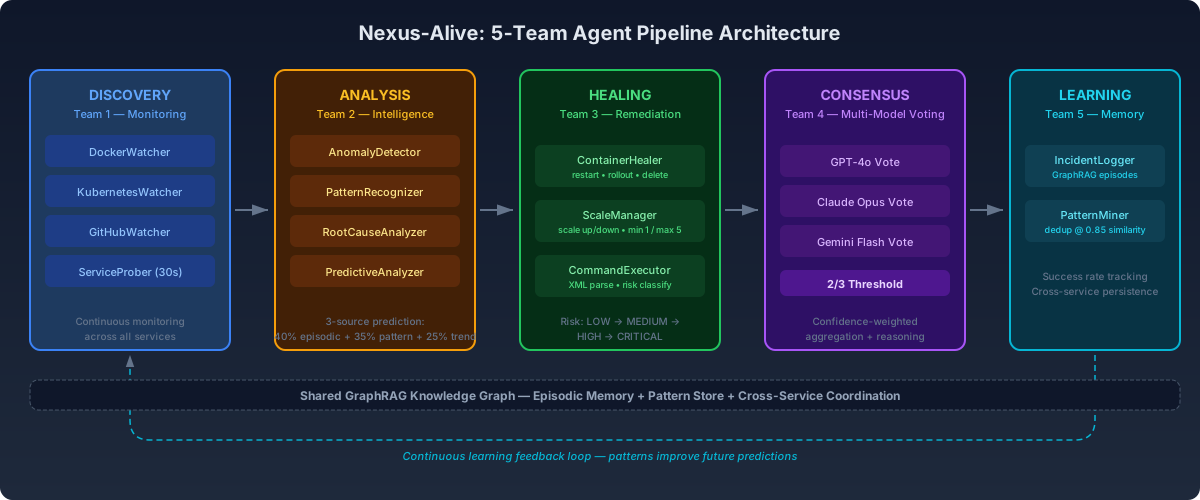
Nexus-Alive is organized as five specialized AI agent teams that operate in a continuous pipeline: Discovery → Analysis → Healing → Consensus → Learning. Each team consists of 2-4 agents with distinct responsibilities. The teams coordinate through a shared GraphRAG knowledge graph and communicate via structured event emissions over WebSocket (port 9201) and REST API (port 9200).
3.1 Discovery Agents (Team 1)
The Discovery team continuously monitors infrastructure state across four dimensions:
DockerWatcher monitors container lifecycle events in real-time by subscribing to the Docker event stream. It collects metrics (CPU utilization, memory usage, network I/O, disk I/O) and health status for every running container. When a container enters an unhealthy state, the DockerWatcher emits a discovery:container_unhealthy event with full context.
KubernetesWatcher subscribes to the Kubernetes API watch stream across multiple namespaces. It tracks pod phase transitions, deployment replica counts, node conditions, and resource metrics via the Metrics API. Critical events --- pod CrashLoopBackOff, OOMKilled terminations, failed scheduling --- are immediately elevated to the Analysis team.
GitHubWatcher tracks commit activity across monitored repositories and ingests commit metadata into GraphRAG. This enables the system to correlate deployment failures with recent code changes --- answering "Did a recent commit cause this outage?" through temporal graph queries.
ServiceProber executes HTTP health checks every 30 seconds against all Kubernetes services in the cluster plus registered marketplace plugins. This is a critical safety net: a pod can be in Running state while the application inside has crashed or deadlocked. The prober attempts multiple health endpoints in order:
/health → /api/health → /healthz → /trigger/health → /ready → /
Service-specific overrides handle non-standard endpoints:
| Service | Health Endpoint |
|---|---|
| CVAT | /api/server/about |
| Triton | /v2/health/ready |
| MinIO | /minio/health/live |
| Email Connector | /api/health |
| Trigger.dev | /trigger/health |
3.2 Analysis Agents (Team 2) --- The 3-Source Episodic Prediction Engine
The Analysis team transforms raw signals from Discovery into actionable intelligence through four specialized agents.
AnomalyDetector applies statistical analysis to identify deviations from normal behavior. For each metric time series, it computes a Z-score against a rolling baseline:
Cypher4 lines<span class="katex-display"><span class="katex"><span class="katex-mathml"><math xmlns="http://www.w3.org/1998/Math/MathML" display="block"><semantics><mrow><mi>Z</mi><mo>=</mo><mfrac><mrow><mi>x</mi><mo>−</mo><mi>μ</mi></mrow><mi>σ</mi></mfrac></mrow><annotation encoding="application/x-tex">Z = \frac{x - \mu}{\sigma}</annotation></semantics></math></span><span class="katex-html" aria-hidden="true"><span class="base"><span class="strut" style="height:0.6833em;"></span><span class="mord mathnormal" style="margin-right:0.07153em;">Z</span><span class="mspace" style="margin-right:0.2778em;"></span><span class="mrel">=</span><span class="mspace" style="margin-right:0.2778em;"></span></span><span class="base"><span class="strut" style="height:1.9463em;vertical-align:-0.686em;"></span><span class="mord"><span class="mopen nulldelimiter"></span><span class="mfrac"><span class="vlist-t vlist-t2"><span class="vlist-r"><span class="vlist" style="height:1.2603em;"><span style="top:-2.314em;"><span class="pstrut" style="height:3em;"></span><span class="mord"><span class="mord mathnormal" style="margin-right:0.03588em;">σ</span></span></span><span style="top:-3.23em;"><span class="pstrut" style="height:3em;"></span><span class="frac-line" style="border-bottom-width:0.04em;"></span></span><span style="top:-3.677em;"><span class="pstrut" style="height:3em;"></span><span class="mord"><span class="mord mathnormal">x</span><span class="mspace" style="margin-right:0.2222em;"></span><span class="mbin">−</span><span class="mspace" style="margin-right:0.2222em;"></span><span class="mord mathnormal">μ</span></span></span></span><span class="vlist-s"></span></span><span class="vlist-r"><span class="vlist" style="height:0.686em;"><span></span></span></span></span></span><span class="mclose nulldelimiter"></span></span></span></span></span></span> where $x$ is the current value, $\mu$ is the rolling mean, and $\sigma$ is the rolling standard deviation. Anomalies are flagged when $|Z| > 3$ (the 3σ threshold). Additionally, domain-specific thresholds are applied:
| Metric | Threshold | Severity |
|---|---|---|
| CPU Utilization | > 85% | warning |
| Memory Usage | > 90% | critical |
| Restart Count | > 3 in 1h | critical |
| Response Latency | > 2× baseline | warning |
| Error Rate | > 5% | critical |
PatternRecognizer queries the GraphRAG knowledge graph for similar past incidents. Given a set of anomaly signals, it performs a semantic similarity search against stored incident patterns and retrieves proven remediation actions ranked by success rate. This is the "institutional memory" of the system --- patterns that worked before are surfaced first.
RootCauseAnalyzer employs GPT-4o to perform causal chain identification. Given the set of anomalies and their temporal relationships, it constructs a causal narrative explaining which failure was primary and which were cascading effects. The analysis includes evidence citations from metrics, logs, and events.
PredictiveAnalyzer implements our novel 3-source episodic prediction engine. It synthesizes three distinct evidence sources to compute a failure probability for each monitored service:
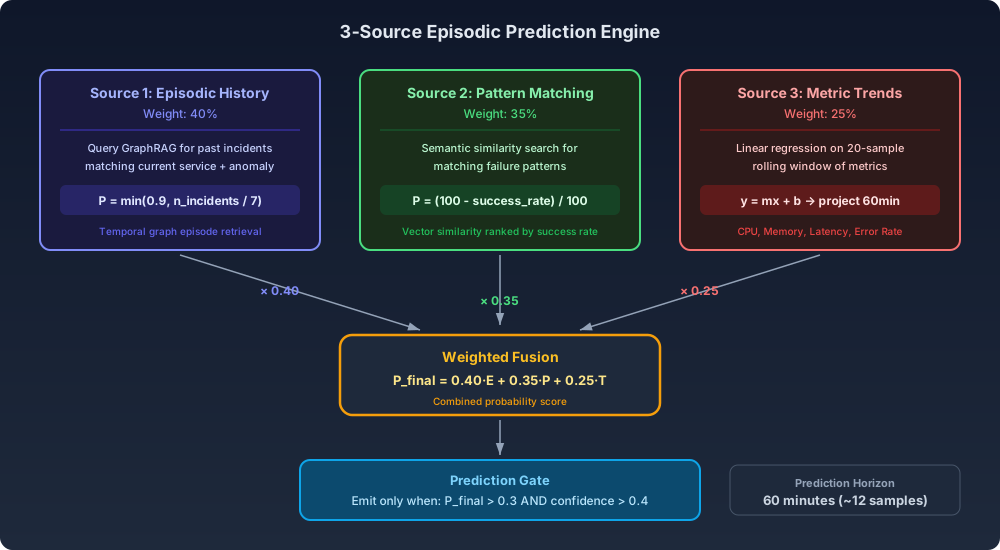
Source 1 --- Episodic History (Weight: 0.40): Queries GraphRAG for past incidents involving the same service. The episodic probability is computed as:
Cypher4 lines<span class="katex-display"><span class="katex"><span class="katex-mathml"><math xmlns="http://www.w3.org/1998/Math/MathML" display="block"><semantics><mrow><msub><mi>P</mi><mrow><mi>e</mi><mi>p</mi><mi>i</mi><mi>s</mi><mi>o</mi><mi>d</mi><mi>i</mi><mi>c</mi></mrow></msub><mo>=</mo><mi>min</mi><mo></mo><mo stretchy="false">(</mo><mn>0.9</mn><mo separator="true">,</mo><mfrac><msub><mi>n</mi><mrow><mi>i</mi><mi>n</mi><mi>c</mi><mi>i</mi><mi>d</mi><mi>e</mi><mi>n</mi><mi>t</mi><mi>s</mi></mrow></msub><mn>7</mn></mfrac><mo stretchy="false">)</mo></mrow><annotation encoding="application/x-tex">P_{episodic} = \min(0.9, \frac{n_{incidents}}{7})</annotation></semantics></math></span><span class="katex-html" aria-hidden="true"><span class="base"><span class="strut" style="height:0.9694em;vertical-align:-0.2861em;"></span><span class="mord"><span class="mord mathnormal" style="margin-right:0.13889em;">P</span><span class="msupsub"><span class="vlist-t vlist-t2"><span class="vlist-r"><span class="vlist" style="height:0.3361em;"><span style="top:-2.55em;margin-left:-0.1389em;margin-right:0.05em;"><span class="pstrut" style="height:2.7em;"></span><span class="sizing reset-size6 size3 mtight"><span class="mord mtight"><span class="mord mathnormal mtight">e</span><span class="mord mathnormal mtight">p</span><span class="mord mathnormal mtight">i</span><span class="mord mathnormal mtight">so</span><span class="mord mathnormal mtight">d</span><span class="mord mathnormal mtight">i</span><span class="mord mathnormal mtight">c</span></span></span></span></span><span class="vlist-s"></span></span><span class="vlist-r"><span class="vlist" style="height:0.2861em;"><span></span></span></span></span></span></span><span class="mspace" style="margin-right:0.2778em;"></span><span class="mrel">=</span><span class="mspace" style="margin-right:0.2778em;"></span></span><span class="base"><span class="strut" style="height:1.7936em;vertical-align:-0.686em;"></span><span class="mop">min</span><span class="mopen">(</span><span class="mord">0.9</span><span class="mpunct">,</span><span class="mspace" style="margin-right:0.1667em;"></span><span class="mord"><span class="mopen nulldelimiter"></span><span class="mfrac"><span class="vlist-t vlist-t2"><span class="vlist-r"><span class="vlist" style="height:1.1076em;"><span style="top:-2.314em;"><span class="pstrut" style="height:3em;"></span><span class="mord"><span class="mord">7</span></span></span><span style="top:-3.23em;"><span class="pstrut" style="height:3em;"></span><span class="frac-line" style="border-bottom-width:0.04em;"></span></span><span style="top:-3.677em;"><span class="pstrut" style="height:3em;"></span><span class="mord"><span class="mord"><span class="mord mathnormal">n</span><span class="msupsub"><span class="vlist-t vlist-t2"><span class="vlist-r"><span class="vlist" style="height:0.3361em;"><span style="top:-2.55em;margin-left:0em;margin-right:0.05em;"><span class="pstrut" style="height:2.7em;"></span><span class="sizing reset-size6 size3 mtight"><span class="mord mtight"><span class="mord mathnormal mtight">in</span><span class="mord mathnormal mtight">c</span><span class="mord mathnormal mtight">i</span><span class="mord mathnormal mtight">d</span><span class="mord mathnormal mtight">e</span><span class="mord mathnormal mtight">n</span><span class="mord mathnormal mtight">t</span><span class="mord mathnormal mtight">s</span></span></span></span></span><span class="vlist-s"></span></span><span class="vlist-r"><span class="vlist" style="height:0.15em;"><span></span></span></span></span></span></span></span></span></span><span class="vlist-s"></span></span><span class="vlist-r"><span class="vlist" style="height:0.686em;"><span></span></span></span></span></span><span class="mclose nulldelimiter"></span></span><span class="mclose">)</span></span></span></span></span> where $n_{incidents}$ is the number of similar incidents recalled from the knowledge graph. This source captures service-specific failure tendencies --- a service that has crashed 5 times in similar conditions has a high episodic score.
Source 2 --- Pattern Matching (Weight: 0.35): Performs GraphRAG similarity search for patterns matching the current anomaly signature. The pattern probability is derived from historical failure rates:
Cypher4 lines<span class="katex-display"><span class="katex"><span class="katex-mathml"><math xmlns="http://www.w3.org/1998/Math/MathML" display="block"><semantics><mrow><msub><mi>P</mi><mrow><mi>p</mi><mi>a</mi><mi>t</mi><mi>t</mi><mi>e</mi><mi>r</mi><mi>n</mi></mrow></msub><mo>=</mo><mfrac><mrow><mn>100</mn><mo>−</mo><msub><mi>R</mi><mrow><mi>s</mi><mi>u</mi><mi>c</mi><mi>c</mi><mi>e</mi><mi>s</mi><mi>s</mi></mrow></msub></mrow><mn>100</mn></mfrac></mrow><annotation encoding="application/x-tex">P_{pattern} = \frac{100 - R_{success}}{100}</annotation></semantics></math></span><span class="katex-html" aria-hidden="true"><span class="base"><span class="strut" style="height:0.9694em;vertical-align:-0.2861em;"></span><span class="mord"><span class="mord mathnormal" style="margin-right:0.13889em;">P</span><span class="msupsub"><span class="vlist-t vlist-t2"><span class="vlist-r"><span class="vlist" style="height:0.2806em;"><span style="top:-2.55em;margin-left:-0.1389em;margin-right:0.05em;"><span class="pstrut" style="height:2.7em;"></span><span class="sizing reset-size6 size3 mtight"><span class="mord mtight"><span class="mord mathnormal mtight">p</span><span class="mord mathnormal mtight">a</span><span class="mord mathnormal mtight">tt</span><span class="mord mathnormal mtight" style="margin-right:0.02778em;">er</span><span class="mord mathnormal mtight">n</span></span></span></span></span><span class="vlist-s"></span></span><span class="vlist-r"><span class="vlist" style="height:0.2861em;"><span></span></span></span></span></span></span><span class="mspace" style="margin-right:0.2778em;"></span><span class="mrel">=</span><span class="mspace" style="margin-right:0.2778em;"></span></span><span class="base"><span class="strut" style="height:2.0463em;vertical-align:-0.686em;"></span><span class="mord"><span class="mopen nulldelimiter"></span><span class="mfrac"><span class="vlist-t vlist-t2"><span class="vlist-r"><span class="vlist" style="height:1.3603em;"><span style="top:-2.314em;"><span class="pstrut" style="height:3em;"></span><span class="mord"><span class="mord">100</span></span></span><span style="top:-3.23em;"><span class="pstrut" style="height:3em;"></span><span class="frac-line" style="border-bottom-width:0.04em;"></span></span><span style="top:-3.677em;"><span class="pstrut" style="height:3em;"></span><span class="mord"><span class="mord">100</span><span class="mspace" style="margin-right:0.2222em;"></span><span class="mbin">−</span><span class="mspace" style="margin-right:0.2222em;"></span><span class="mord"><span class="mord mathnormal" style="margin-right:0.00773em;">R</span><span class="msupsub"><span class="vlist-t vlist-t2"><span class="vlist-r"><span class="vlist" style="height:0.1514em;"><span style="top:-2.55em;margin-left:-0.0077em;margin-right:0.05em;"><span class="pstrut" style="height:2.7em;"></span><span class="sizing reset-size6 size3 mtight"><span class="mord mtight"><span class="mord mathnormal mtight">s</span><span class="mord mathnormal mtight">u</span><span class="mord mathnormal mtight">ccess</span></span></span></span></span><span class="vlist-s"></span></span><span class="vlist-r"><span class="vlist" style="height:0.15em;"><span></span></span></span></span></span></span></span></span></span><span class="vlist-s"></span></span><span class="vlist-r"><span class="vlist" style="height:0.686em;"><span></span></span></span></span></span><span class="mclose nulldelimiter"></span></span></span></span></span></span> where $R_{success}$ is the success rate of similar patterns in the knowledge graph. Patterns with low historical success rates indicate high failure probability.
Source 3 --- Metric Trend Analysis (Weight: 0.25): Applies linear regression on a 20-sample rolling window of metric history to project future values. If the projected value exceeds a critical threshold within the prediction horizon, the trend probability is elevated.
The final prediction combines all three sources:
Predictions are emitted only when AND confidence , with a prediction horizon of 60 minutes (approximately 12 metric samples at the 5-minute collection interval).
3.3 Healing Agents (Team 3) --- Risk-Classified Auto-Remediation
The Healing team executes corrective actions through two specialized agents operating under a strict risk classification system.
ContainerHealer handles pod and container lifecycle operations. Safety invariants are enforced before any action:
- The target pod must be controller-managed (ReplicaSet, Deployment, or StatefulSet)
- Deletion triggers K8s controller recreation automatically
- After deletion, the healer waits up to 60 seconds for the replacement pod to reach
Readystate - If replacement fails, the incident is escalated to human operators
ScaleManager handles horizontal scaling decisions with exponential backoff and bounds enforcement (minimum 1 replica, maximum 5 replicas). Scaling decisions consider current load, historical patterns, and cost implications.
XML-Based Risk Classification
Remediation actions from Nexus-Workflows arrive as structured XML, which the CommandExecutor parses and classifies into a 4-tier risk hierarchy:
| Risk Level | Actions | Approval Mode |
|---|---|---|
| LOW | restart-pod, delete-pod | Auto-execute |
| MEDIUM | scale-deployment, rollout-restart, scale-statefulset | Config-gated |
| HIGH | update-configmap, update-secret, resize-pvc | Requires approval |
| CRITICAL | delete-deployment, delete-statefulset, Istio/Envoy config | Never auto-execute |
Namespace Escalation Rule: Any operation targeting istio-system, kube-system, or cert-manager namespaces is automatically escalated to CRITICAL regardless of the action type. This prevents the self-healing system from accidentally disrupting core infrastructure.
3.4 Consensus Agent (Team 4) --- Multi-Model Voting
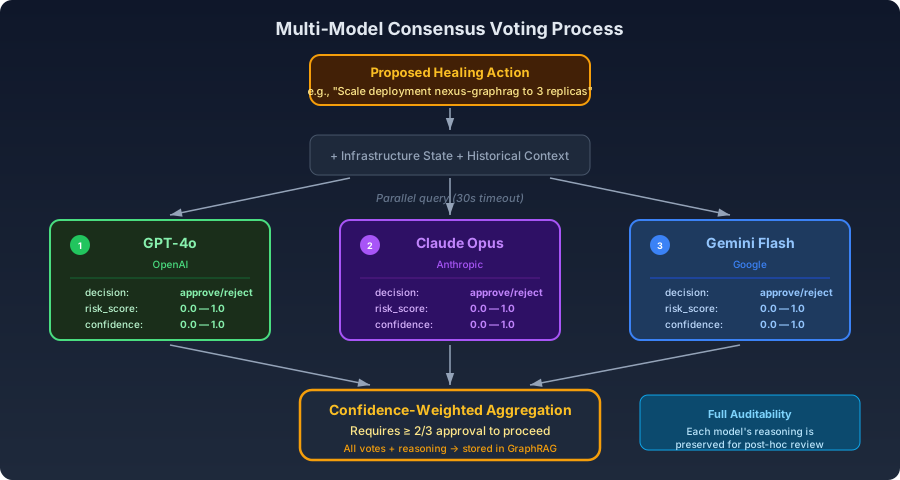
The Consensus team implements our most novel contribution: multi-model voting for critical infrastructure decisions. When a healing action is proposed --- particularly one classified as MEDIUM or above --- the RiskAssessor queries three independent large language models in parallel:
Voting Process:
- The proposed action, current infrastructure state, and historical context are assembled into an assessment prompt.
- Three models are queried simultaneously with a 30-second timeout:
   - **GPT-4o** (OpenAI)
   - **Claude Opus** (Anthropic)
   - **Gemini Flash** (Google)
- Each model returns a structured response:
decision: approve or rejectriskScore: 0.0 to 1.0confidence: 0.0 to 1.0reasoning: natural language explanation
- Votes are aggregated with confidence weighting. An action requires a 2/3 approval threshold to proceed.
- All votes --- including reasoning --- are stored in GraphRAG for future learning.
Why three models? Single-model decision systems are vulnerable to systematic biases --- a model that consistently underestimates restart risks, or one that is overly conservative about scaling. By requiring independent agreement from architecturally distinct models trained on different data, we achieve a form of ensemble safety that mirrors the principle of defense-in-depth in security engineering. The stored reasoning traces also enable post-hoc auditability: operators can review why a particular action was approved or rejected, and by which models.
3.5 Learning Agents (Team 5) --- Continuous Improvement
The Learning team closes the loop, ensuring the system improves with every incident.
IncidentLogger stores complete incident context as GraphRAG episodes with temporal relationships. Each episode includes: the triggering anomalies, affected services, proposed remediation actions, consensus votes, execution results, and resolution outcome. These episodes form a temporal knowledge graph that enables rich temporal queries.
PatternMiner runs hourly to extract reusable remediation patterns from resolved incidents. The extraction pipeline operates as follows:
- Query recent resolved incidents from GraphRAG
- Extract the condition-action-outcome triple from each incident
- Compute a semantic embedding for each pattern
- Check for duplicates using vector similarity search (threshold: 0.85)
- If the pattern is novel, store it; if it matches an existing pattern, increment the occurrence count and update the success rate
- Store patterns in both the local GraphRAG instance and the cross-service GraphRAG via HTTP API
The success rate for each pattern is computed from its outcomes array:
This evidence-based approach means that the PatternRecognizer (Analysis team) can retrieve not just any remediation action, but the one with the highest historical success rate for the specific failure mode being analyzed.
4. Skills Auto-Repair Agent Swarm
One of the most distinctive capabilities of the Nexus stack is its ability to autonomously repair failed software skills --- the reusable AI capabilities managed by the Nexus Skills Engine. When Nexus-Alive detects a skill-related task failure (identified by the presence of a skillId in the failure notification), it triggers a 4-agent analysis swarm:
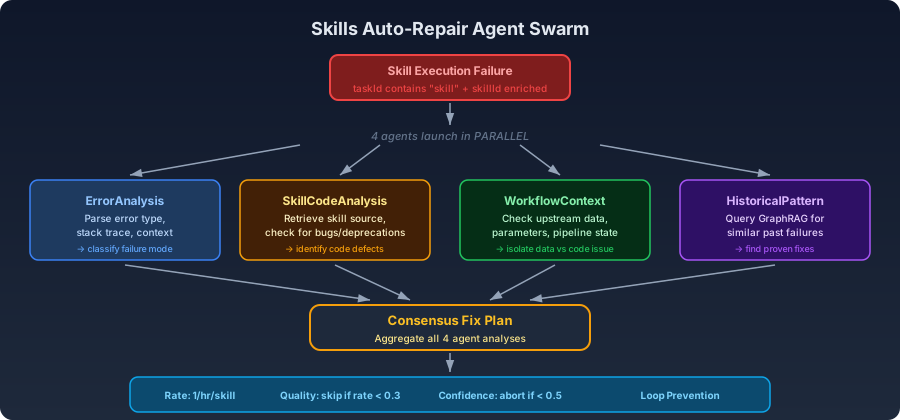
ErrorAnalysis Agent: Parses the error type, stack trace, and execution context to classify the failure mode (runtime error, timeout, invalid output, dependency failure, etc.).
SkillCodeAnalysis Agent: Retrieves the skill's source code from the Skills Engine and examines it for bugs, deprecated API usage, missing error handling, and logical errors.
WorkflowContextAnalysis Agent: Examines the workflow pipeline context --- what preceded the skill invocation, what parameters were passed, and whether the failure is due to upstream data issues rather than skill defects.
HistoricalPatternAnalysis Agent: Queries GraphRAG for similar failures across all skills, identifying whether this is a known failure pattern with a proven fix, or a novel issue requiring deeper investigation.
All four agents run in parallel and produce independent analyses. A consensus fix plan is generated by aggregating their findings. Safety gates prevent runaway repair cycles:
| Safety Gate | Threshold | Purpose |
|---|---|---|
| Rate Limit | 1 repair per skill per hour | Prevent rapid-fire repairs |
| Quality Gate | Skip if successRate < 0.3 | Don't repair chronically broken skills |
| Confidence Gate | Abort if fix confidence < 0.5 | Require sufficient certainty |
| Loop Prevention | skills-autorepair-* excluded | Prevent self-repair recursion |
The repair process is triggered by the NexusPlatformClient.triggerAutoRepair() method, which dispatches the skills-autorepair-analyze task to the Trigger.dev workflow engine with enriched context including the skillId, error details, and historical failure data.
5. Nexus-Workflows: Visual DAG Orchestration
Nexus-Workflows provides the orchestration backbone for the entire Nexus stack. Built on Trigger.dev, it implements a visual workflow builder with ReactFlow-based graph editing and a topological sort execution engine.
5.1 Execution Model
Workflows are defined as directed acyclic graphs (DAGs) where nodes represent tasks and edges represent dependencies. The execution engine implements Kahn's algorithm for topological sorting, grouping nodes into execution levels:
Level 0: [A, B]       → Execute in parallel (Promise.allSettled)
Level 1: [C, D, E]    → Execute in parallel after Level 0 completes
Level 2: [F]           → Execute after Level 1 completes
This level-based parallelism is a form of implicit agent swarm coordination: nodes at the same level are independent agents that execute concurrently and report results to the orchestrator. Six node types are supported:
| Node Type | Execution Target | Example |
|---|---|---|
taskNode | Trigger.dev task | autoresearch-analyze |
skillNode | Skills Engine | prosecreator-panel-analysis |
mageAgentNode | MageAgent LLM | GPT-4o prompt |
n8nWorkflowNode | n8n automation | Email notification |
conditionalNode | Boolean branch | Quality gate check |
transformNode | Data transform | JSON mapping |
5.2 Two-Way Bridge with Nexus-Alive
The integration between Nexus-Workflows and Nexus-Alive is bidirectional:
Workflows → Alive (Health Reports): Every 5 minutes, a platform-health-monitor task generates a comprehensive PlatformHealthReport covering services, deployments, nodes, certificates, and volumes, and POSTs it to Nexus-Alive's /health-report/ingest endpoint. These reports are stored as GraphRAG episodes (not just documents) to enable temporal queries.
Workflows → Alive (14-Point Job Failure Detection): The task execution pipeline reports failures at 14 distinct points, providing Nexus-Alive with comprehensive visibility into the operational health of the workflow engine:
- Task validation failure
- Handler lookup failure
- Handler execution timeout
- Handler exception (unhandled)
- Structured error parsing failure
- GraphRAG query failure
- Health report ingestion failure
- Skill-related task failure (enriched with
skillId) - LLM API call failure
- Database transaction failure
- Anomaly detection failure
- Consensus voting failure
- Healing action execution failure
- Post-healing verification failure
Each failure is reported via notifyJobFailure(runId, taskId, message, structured?, durationMs?, skillId?) and stored as a GraphRAG episode for temporal pattern analysis.
Alive → Workflows (Remediation): When Nexus-Alive determines that remediation is needed, it generates XML remediation specs and can trigger workflow tasks (e.g., skills-autorepair-analyze). This creates a closed loop: workflows report health, Alive detects issues, Alive triggers workflow-based remediation, which reports back to Alive.
5.3 Cross-System Traceability
Every workflow run maintains cross-system job ID arrays for full traceability:
triggerRunIds[]     → Trigger.dev run identifiers
mageagentJobIds[]   → MageAgent processing job IDs
skillJobIds[]       → Skills Engine invocation IDs
n8nExecutionIds[]   → n8n workflow execution IDs
This enables end-to-end debugging: given a failed workflow, operators can trace execution through every sub-system to identify the exact failure point.
6. Nexus-AutoResearch: Adaptive Research Pipeline
Nexus-AutoResearch implements a dynamic adaptive research pipeline that combines three influential methodologies: STORM's multi-perspective question decomposition [12], Karpathy's immutable evaluation pattern, and AutoGen's multi-agent conversation framework.
6.1 Pipeline Architecture
The pipeline comprises 18 Trigger.dev tasks organized across 4 queues:
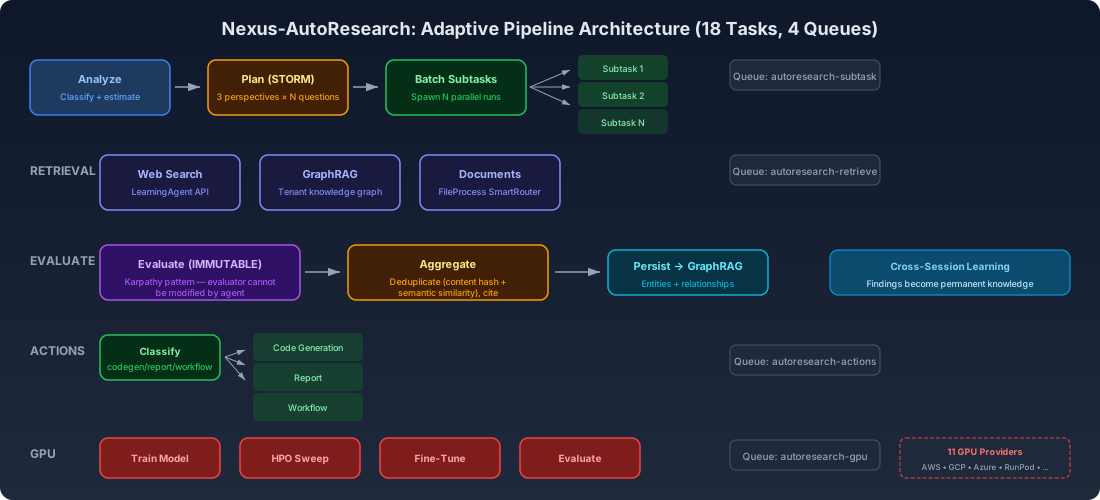
Analysis Phase (autoresearch-analyze): Classifies the research request type (general, skill improvement, prompt optimization, code analysis, literature review, competitive analysis), estimates complexity, and recommends a research template.
Planning Phase (autoresearch-plan): Implements STORM-style decomposition. For a given research topic, it generates N focused sub-questions, each assigned one of three perspectives: academic (theoretical foundations), practitioner (real-world applicability), and critic (limitations and counter-arguments). This multi-perspective decomposition is itself a form of agent swarm --- three "virtual experts" interrogate the topic from different angles.
Execution Phase (3 tasks, autoresearch-subtask queue):
autoresearch-batch-subtasks: Spawns N parallel subtask runs via Trigger.dev's batch APIautoresearch-subtask: Full research loop per sub-question (retrieve → analyze → evaluate)autoresearch-experiment: Single hypothesis-approach-execute-score iteration
Retrieval Phase (3 tasks, autoresearch-retrieve queue):
autoresearch-retrieve-web: Web search via LearningAgent APIautoresearch-retrieve-graphrag: Semantic search on tenant knowledge graphautoresearch-retrieve-documents: Document processing via FileProcess SmartRouter
Evaluation Phase (autoresearch-evaluate): Implements the Karpathy pattern --- the evaluator is immutable and cannot be modified by the agent being evaluated. It scores each finding on relevance, grounding, and novelty, producing a keep/discard decision with reasoning.
Aggregation Phase (autoresearch-aggregate): Deduplicates findings via content hash + semantic similarity, merges sources, computes confidence scores, and generates citations.
Action Phase (3 tasks, autoresearch-actions queue):
autoresearch-classify-actions: LLM classifier (codegen, report, workflow, insight)autoresearch-action-codegen: Generate executable codeautoresearch-action-report: Structured publishable document
GPU Training Phase (4 tasks, autoresearch-gpu queue):
autoresearch-train-model: Submit training to HPC Gateway (11 GPU providers)autoresearch-hpo-sweep: Hyperparameter optimization (Bayesian/ASHA)autoresearch-fine-tune: Foundation model fine-tuning (LoRA/QLoRA/full)autoresearch-evaluate-model: Benchmark evaluation
6.2 GraphRAG 7-Point Deep Integration
AutoResearch integrates with GraphRAG at seven distinct points:
- Search/Retrieval: Semantic search with topK, filters, and metadata
- Document Storage: Chunked document ingestion
- URL Ingestion: Asynchronous web page ingestion with configurable depth
- Entity Management: CRUD operations on knowledge graph entities
- Relationship Management: CRUD on entity relationships
- Memory Storage: Episodic memory with configurable TTL
- Enhanced Retrieval: Graph expansion and semantic re-ranking
This deep integration ensures that research findings persist beyond individual sessions. When AutoResearch discovers a new technique or identifies a failure pattern, it becomes a permanent part of the organizational knowledge graph --- available to Nexus-Alive's PatternRecognizer, to future research pipelines, and to any other service that queries the shared GraphRAG instance.
7. Mission Control: Real-Time Monitoring UI
The Mission Control dashboard provides operators with real-time visibility into all four systems through a 13-section administration interface. The main component spans 5,166 lines of React TypeScript --- one of the most sophisticated real-time monitoring UIs in production.
7.1 Live Activity Ticker
The centerpiece of Mission Control is the Live Activity Ticker, which polls for events every 2 seconds from the Nexus-Alive event stream. Events are displayed with timestamps, color-coded agent badges, and expandable detail views:
| Agent Type | Badge Color | Purpose |
|---|---|---|
| Discovery | Blue | Service monitoring events |
| Analysis | Amber | Anomaly detection, predictions |
| Healing | Green | Remediation actions |
| Consensus | Purple | Multi-model voting decisions |
| Learning | Cyan | Pattern extraction, knowledge updates |
| Workflows | Orange | Workflow execution events |
A pulsing green dot indicates live streaming; an amber dot indicates paused/disabled state. The ticker supports auto-scroll (snapping to top for new events) with manual scroll override when the operator is reviewing historical events.
7.2 Adaptive Polling Architecture
Mission Control implements an adaptive polling strategy that reduces server load during quiet periods while maintaining responsiveness during active incidents:
| State | Polling Interval | Trigger |
|---|---|---|
| Active operations | 5 seconds | Any operation running |
| Idle | 15 seconds | No active operations |
| Live ticker | 2 seconds | Always (Nexus-Alive events) |
| Token usage | 10 seconds | Always (model tracking) |
WebSocket streaming is supported as a primary transport with automatic fallback to polling when WebSocket connections fail (a common scenario in Istio service mesh environments due to HTTP/2 connection coalescing).
7.3 Token Usage Panel
The Token Usage Panel tracks multi-model token consumption across all AI operations, with stacked area charts showing per-model usage over configurable time ranges (1h, 6h, 24h, 7d, 30d). Risk tier breakdowns enable cost allocation and capacity planning.
7.4 13 Dashboard Sections
The full Mission Control dashboard comprises:
- Overview: Summary metrics and key performance indicators
- Projections: Demand projection simulation with growth models
- Cluster: K3s cluster health, node status, resource utilization
- Servers: Server inventory across cloud providers
- Environments: Production/dev/local environment cards with health dots
- Deployments: Kubernetes deployment management with scaling controls
- Pipelines: CI/CD pipeline visualization
- DevOps: DevOps operations panel
- Sandbox: Development sandbox management
- Local Dev: Local development environment status
- Live Operations: Real-time activity feed with agent badges
- Costs: Cost breakdown and analysis with right-sizing recommendations
- Policies: Scaling policy configuration and auto-fix thresholds
8. Production Use Cases
We enumerate 24 production use cases for the Nexus-Alive autonomous self-healing system, organized by category.
8.1 Reactive Healing (Immediate Response)
UC-1: Automatic Pod Restart on OOMKilled. When the KubernetesWatcher detects a pod terminated with reason OOMKilled, the ContainerHealer immediately restarts the pod (LOW risk, auto-execute). The IncidentLogger stores the event with memory metrics for pattern analysis.
UC-2: Container Health Probe Failure Remediation. The ServiceProber detects HTTP health check failures even when pods are in Running state --- the application has crashed or deadlocked while the container runtime remains healthy. Triggers restart after 3 consecutive failures.
UC-3: Node Resource Pressure Detection and Workload Rebalancing. When node-level CPU or memory pressure is detected, the ScaleManager can trigger pod eviction and rescheduling to healthier nodes.
8.2 Predictive Prevention (Failure Forecasting)
UC-4: Predictive Scaling Before Traffic Spikes. The episodic prediction engine recalls past traffic spike patterns (e.g., "traffic increases 3× every Monday at 9 AM") and preemptively scales deployments 30 minutes before the predicted spike.
UC-5: Memory Leak Detection via Metric Trend Analysis. Linear regression on the 20-sample memory rolling window detects steadily increasing memory consumption --- a signature of memory leaks --- and predicts when OOMKill will occur, triggering preemptive restart.
UC-6: Certificate Expiry Prediction and Alerting. Health reports include certificate metadata; the PredictiveAnalyzer flags certificates approaching expiry and creates incidents with remediation recommendations.
UC-7: Database Connection Pool Exhaustion Detection. By monitoring connection count trends and correlating with service load patterns, the system predicts pool exhaustion and recommends scaling or configuration changes.
UC-8: Disk Space Exhaustion Prediction. PVC usage metrics are projected forward via trend analysis; warnings are issued when projected exhaustion falls within the 60-minute prediction horizon.
8.3 Intelligent Analysis (Root Cause and Correlation)
UC-9: Cascading Failure Prevention. When multiple services report anomalies simultaneously, the RootCauseAnalyzer constructs a causal chain to identify the primary failure and prevent the healing system from treating symptoms rather than the root cause.
UC-10: Cross-Service Dependency Failure Correlation. GraphRAG relationships between services enable the system to determine that Service A's failure caused Service B's timeout, avoiding unnecessary restarts of Service B.
UC-11: API Latency Anomaly Detection. Z-score analysis (3σ threshold) on response latency time series detects unusual slowdowns that precede outages.
UC-12: Service Mesh (Istio) Misconfiguration Detection. Health probe failures that correlate with recent Istio VirtualService or EnvoyFilter changes are flagged as potential misconfiguration rather than application failures.
8.4 Autonomous Remediation (Self-Healing Actions)
UC-13: Failed Deployment Rollback Recommendation. When a new deployment version causes health check failures, the system recommends (and, at LOW risk, executes) a rollback to the previous version.
UC-14: Multi-Model Consensus for High-Risk Changes. Scaling a production database StatefulSet triggers multi-model voting: GPT-4o, Claude, and Gemini independently assess the risk before approval.
UC-15: Recurring Incident Pattern Identification. The PatternMiner detects when the same failure mode has occurred 3+ times and recommends a permanent architectural fix rather than repeated band-aids.
8.5 Software Self-Repair
UC-16: Skills Auto-Repair on Execution Failure. The 4-agent swarm diagnoses and fixes failed software skills autonomously, with safety gates preventing runaway repair cycles.
UC-17: GPU Training Job Failure Recovery. When HPC Gateway-submitted training jobs fail, the system analyzes error logs, identifies the failure mode (OOM, NaN loss, data corruption), and suggests corrective parameters.
8.6 Organizational Learning
UC-18: Episodic Learning from Past Outages. Every resolved incident enriches the GraphRAG knowledge graph, improving future predictions and remediation accuracy through accumulated operational experience.
UC-19: Automated Runbook Generation from Resolved Incidents. The PatternMiner extracts condition-action-outcome triples from resolved incidents and publishes them as reusable runbook patterns.
UC-20: Cost Optimization via Right-Sizing Recommendations. When services consistently use less than 30% of allocated resources, the system recommends scale-down to reduce costs.
8.7 Specialized Monitoring
UC-21: Plugin Marketplace Health Monitoring. Every registered marketplace plugin is probed every 30 seconds, ensuring third-party integrations meet availability SLAs.
UC-22: WebSocket Connection Health Monitoring. Socket.IO connection health across services is tracked, with automatic fallback detection for environments where WebSocket upgrades fail (e.g., HTTP/2 connection coalescing in Istio).
UC-23: Cross-Cluster Incident Correlation. For multi-cluster deployments, incidents are correlated across clusters via the shared GraphRAG instance to identify systemic issues.
UC-24: Security Anomaly Detection. Unusual patterns --- rapid restart cycles, unexpected scaling events, configuration changes outside maintenance windows --- are flagged as potential security incidents.
9. Competitive Analysis
We compare Nexus-Alive against 10 commercial AIOps and infrastructure monitoring platforms across key capability dimensions.
9.1 Platform Summaries
PagerDuty AIOps is the market leader in incident management, achieving 91% alert reduction through ML-based correlation. Their Spring 2026 SRE Agent represents a move toward autonomous healing, but is limited to diagnostics and recommendations with human approval required for all actions. Multi-agent integration is planned for H2 2026 but not yet available [13].
Datadog Watchdog provides unsupervised ML anomaly detection across infrastructure and application metrics without requiring explicit baselines. Named a Leader in Forrester Wave AIOps Q2 2025. Their Bits AI agents (SRE and Dev) perform hypothesis-driven root cause analysis with concurrent theory validation, but lack multi-model consensus and episodic memory [14].
Dynatrace Davis AI uses a proprietary causal AI engine that traverses the Smartscape topology graph to establish deterministic causality, processing 3+ million problems daily. Their "autonomous intelligence" vision includes self-healing Kubernetes workloads, but relies on a single AI engine rather than multi-model consensus [15].
AWS DevOps Guru applies ML trained on Amazon.com's operational data to detect anomalies and provide remediation recommendations. AWS-only, recommendation-focused rather than autonomous, with specialized variants for serverless and RDS [16].
Kubernetes HPA/VPA provides native metric-based autoscaling. HPA scales on CPU/memory thresholds; VPA recommends resource adjustments. No AI prediction, no anomaly detection beyond threshold crossing, no learning from past incidents [17].
Shoreline.io automates runbook execution with agents deployed as DaemonSets on Kubernetes nodes, claiming to auto-remediate 50%+ of incidents without human intervention. Strong in predefined runbook automation but lacks AI-driven prediction or knowledge graph learning [18].
BigPanda correlates alerts from 300+ monitoring tools using Open Box ML, reducing alert volume by 95%. Focused on alert correlation and incident management rather than autonomous healing [19].
Moogsoft provides real-time AI correlation of events and telemetry data for noise reduction and incident prioritization. Strong correlation engine but does not perform autonomous remediation [20].
Opsani (acquired by Cisco) provides continuous ML-based optimization of cloud-native applications, automatically tuning resource configurations. Focused on optimization rather than healing, with no failure prediction or incident response capabilities [21].
Kubecost/OpenCost provides Kubernetes cost monitoring and allocation. OpenCost now includes an MCP server for AI agent integration. Focused exclusively on cost visibility, not operational intelligence or healing [22].
9.2 Feature Comparison Matrix
| Capability | Nexus-Alive | PagerDuty | Datadog | Dynatrace | AWS Guru | Shoreline | BigPanda | Moogsoft |
|---|---|---|---|---|---|---|---|---|
| ML Anomaly Detection | ✓ | ✓ | ✓ | ✓ | ✓ | ○ | ○ | ✓ |
| Root Cause Analysis | ✓ | ✓ | ✓ | ✓ | ✓ | ○ | ○ | ○ |
| Failure Prediction | ✓ | ○ | ○ | ✓ | ○ | ○ | ○ | ○ |
| Autonomous Healing | ✓ | ◐ | ◐ | ◐ | ○ | ✓ | ○ | ○ |
| Multi-Model Consensus | ✓ | ○ | ○ | ○ | ○ | ○ | ○ | ○ |
| Episodic Memory (GraphRAG) | ✓ | ○ | ○ | ○ | ○ | ○ | ○ | ○ |
| Self-Improving Patterns | ✓ | ○ | ○ | ○ | ○ | ○ | ○ | ○ |
| Risk-Classified Remediation | ✓ | ○ | ○ | ○ | ○ | ◐ | ○ | ○ |
| Software Self-Repair | ✓ | ○ | ◐ | ○ | ○ | ○ | ○ | ○ |
| Cross-Service Learning | ✓ | ○ | ○ | ○ | ○ | ○ | ○ | ○ |
| Visual Workflow Builder | ✓ | ○ | ○ | ○ | ○ | ○ | ○ | ○ |
| GPU Training Integration | ✓ | ○ | ○ | ○ | ○ | ○ | ○ | ○ |
Legend: ✓ = Full support, ◐ = Partial/planned, ○ = Not available
NOTE: Nexus-Alive is the only platform in this comparison that combines multi-model consensus voting, GraphRAG-backed episodic memory, self-improving pattern mining, and autonomous software repair in a single integrated system.
9.3 Key Differentiators
No competitor implements multi-model consensus. PagerDuty, Datadog, and Dynatrace each use proprietary single-model AI engines. Nexus-Alive's approach of querying 3+ independent models (from different providers) and requiring 2/3 agreement mirrors established safety patterns in aviation and nuclear engineering, where independent redundant systems must concur before critical actions are taken.
No competitor implements GraphRAG-backed episodic memory. While PagerDuty's SRE Agent "learns from every incident to generate smart playbooks," this learning is pattern-based rather than episodic. Nexus-Alive stores incidents as temporal graph nodes with rich relational context, enabling queries like "What happened the last time this service's memory spiked above 85% on a Monday morning?" --- a capability that requires both temporal and relational reasoning.
No competitor implements self-repairing software skills. Datadog's Bits AI Dev Agent can detect runtime errors and generate fixes, but this is a general-purpose capability. Nexus-Alive's Skills Auto-Repair is specifically designed for the software skills paradigm, with 4 specialized parallel agents, safety gates, and integration with the Skills Engine regeneration pipeline.
10. Patent Novelty Analysis
Based on our review of the USPTO patent landscape and academic literature, we identify 7 potentially novel innovations in the Nexus stack.
10.1 Multi-Model Consensus Voting for Infrastructure Remediation
Claim: A method for making infrastructure remediation decisions by querying three or more independent large language models in parallel, each producing a structured vote (decision, risk score, confidence, reasoning), aggregating votes with confidence weighting, and requiring a supermajority threshold for approval.
Prior Art Assessment: Ensemble methods for ML models are well-established (US Patent 10,289,967 --- ensemble anomaly detection). Multi-agent voting has been studied in AI research (ACL 2025 --- "Voting or Consensus? Decision-Making in Multi-Agent Systems"). However, the specific application of multi-provider LLM consensus to infrastructure healing decisions with confidence-weighted aggregation and stored reasoning traces appears novel. No existing patent combines these elements.
Novelty Score: 8/10
10.2 GraphRAG-Backed Episodic Prediction Engine
Claim: A system for predicting infrastructure failures by combining three weighted evidence sources: (1) episodic incident recall from a knowledge graph (40%), (2) pattern similarity matching via vector search (35%), and (3) metric trend analysis via linear regression (25%), with configurable probability and confidence thresholds.
Prior Art Assessment: Time-series prediction for infrastructure is widely patented (US Patent 11,347,569 --- predictive maintenance). Knowledge graphs for failure analysis exist (arXiv 2411.19539 --- GraphRAG for automobile failure analysis). The novel combination is using episodic memory (temporal graph episodes, not just entities) with weighted multi-source fusion for infrastructure-specific failure prediction.
Novelty Score: 7/10
10.3 XML-Based Risk-Classified Auto-Remediation with Namespace Escalation
Claim: A method for classifying infrastructure remediation actions into a hierarchical risk taxonomy (LOW, MEDIUM, HIGH, CRITICAL) with automatic escalation based on target namespace (system-critical namespaces escalate to CRITICAL), and configurable approval thresholds per risk level.
Prior Art Assessment: Automated remediation systems exist (Shoreline.io patents, AWS Systems Manager patents). Risk classification for IT operations is established. The specific combination of XML-structured remediation parsing, 4-tier risk hierarchy, and namespace-based automatic escalation adds a Kubernetes-specific safety layer that appears novel.
Novelty Score: 6/10
10.4 Skills Auto-Repair Agent Swarm with Consensus Fix Planning
Claim: A system for automatically diagnosing and repairing failed software skills by deploying four specialized parallel analysis agents (error analysis, code analysis, workflow context analysis, historical pattern analysis), aggregating their findings into a consensus fix plan, and executing the repair with safety gates (rate limiting, quality thresholds, confidence gates, self-repair loop prevention).
Prior Art Assessment: RepairAgent (arXiv 2403.17134) demonstrates LLM-based autonomous program repair, but uses a single sequential agent. Self-healing software systems are studied (arXiv 2504.20093). The multi-agent parallel analysis approach with specific safety gates for production skill repair appears novel.
Novelty Score: 8/10
10.5 Adaptive Research Pipeline with Immutable Evaluation
Claim: A research automation system where the evaluation agent is architecturally isolated from modification by the agent being evaluated (immutable evaluator pattern), combined with multi-perspective decomposition and GPU-accelerated model training.
Prior Art Assessment: STORM (arXiv 2402.14207) demonstrates multi-perspective research decomposition. AutoGen provides multi-agent conversation frameworks. The specific architectural guarantee of evaluator immutability --- preventing the research agent from gaming its own evaluation --- combined with GPU training integration appears novel.
Novelty Score: 7/10
10.6 14-Point Job Failure Detection Integrated with Self-Healing
Claim: A comprehensive failure detection system that monitors task execution at 14 distinct pipeline stages (from validation through post-healing verification), with each failure point providing enriched context (structured errors, duration, skill identifiers) to an autonomous self-healing system.
Prior Art Assessment: Distributed tracing (Jaeger, Zipkin) provides execution visibility. APM tools (New Relic, Datadog) monitor application performance. The specific instrumentation of 14 typed failure points with direct integration to autonomous healing provides more granular coverage than general-purpose observability.
Novelty Score: 6/10
10.7 Cross-Service Agent Swarm Coordination via Shared GraphRAG
Claim: A method for coordinating multiple autonomous agent teams across different microservices through a shared knowledge graph, where patterns learned by agents in one service (e.g., healing patterns in Nexus-Alive) are automatically available to agents in other services (e.g., research agents in AutoResearch), with vector similarity deduplication preventing knowledge duplication.
Prior Art Assessment: Shared knowledge bases for multi-agent systems are studied in AI research. GraphRAG as a coordination substrate is novel in the infrastructure context. The combination of cross-service learning, vector deduplication, and temporal episodic memory in a shared graph appears to have no direct prior art.
Novelty Score: 9/10
10.8 Summary of Patent Recommendations
| Innovation | Novelty | Recommendation |
|---|---|---|
| Multi-Model Consensus Voting | 8/10 | File patent --- strong novelty |
| Episodic Prediction Engine | 7/10 | File patent --- novel combination |
| Risk-Classified Remediation | 6/10 | Consider utility patent |
| Skills Auto-Repair Swarm | 8/10 | File patent --- strong novelty |
| Immutable Evaluation Pipeline | 7/10 | File patent --- novel architecture |
| 14-Point Failure Detection | 6/10 | Consider utility patent |
| Cross-Service GraphRAG Coordination | 9/10 | File patent --- highest novelty |
11. Limitations and Future Work
Several limitations merit discussion. First, the multi-model consensus mechanism introduces latency (up to 30 seconds per vote) and cost (three LLM API calls per decision). For time-critical LOW-risk actions, this is bypassed --- consensus is reserved for MEDIUM+ risk. Future work could explore lightweight consensus models that distill the voting behavior of large models.
Second, the episodic prediction engine's accuracy depends on the richness of the GraphRAG knowledge graph. For newly deployed services with no incident history, the episodic (40%) and pattern (35%) sources produce low-confidence predictions, effectively reducing the engine to trend-only analysis (25% weight). Bootstrapping the knowledge graph with synthetic incidents from chaos engineering experiments could accelerate the learning curve.
Third, the Skills Auto-Repair Agent Swarm currently supports only regeneration through the Skills Engine --- it cannot make arbitrary code modifications. Integrating a more general-purpose code repair agent (similar to RepairAgent) would expand the repair capabilities.
Fourth, our competitive analysis is based on publicly available documentation and may not reflect undisclosed capabilities of commercial platforms. Several vendors (PagerDuty, Datadog, Dynatrace) have announced autonomous healing roadmaps for 2026 that may narrow the gap.

Future work includes: (1) federated GraphRAG across multiple organizations for industry-wide pattern sharing, (2) reinforcement learning for healing action selection, (3) integration with chaos engineering frameworks for proactive resilience testing, and (4) natural language interfaces for incident investigation through the Mission Control UI.

---
12. Conclusion
We have presented the Adverant Nexus autonomous infrastructure stack --- a production-deployed platform that combines four tightly integrated systems to achieve autonomous infrastructure self-healing. The key innovation of Nexus-Alive is its multi-model consensus mechanism, where three independent LLMs vote on critical healing actions, combined with a 3-source episodic prediction engine that leverages GraphRAG-backed incident memory. The Skills Auto-Repair Agent Swarm demonstrates that the agent swarm pattern can be applied not only to infrastructure healing but also to software self-repair, with appropriate safety gates.
Our competitive analysis reveals that no existing commercial platform combines multi-model consensus, episodic memory, self-improving pattern mining, and autonomous software repair. Seven potentially patentable innovations have been identified, with cross-service agent swarm coordination via shared GraphRAG scoring highest for novelty.
The agent swarm architectural pattern --- specialized agents coordinating through a shared knowledge substrate --- emerges as the unifying theme across all four systems. In Nexus-Alive, five agent teams form a healing pipeline. In Skills Auto-Repair, four parallel agents converge on diagnosis. In AutoResearch, multiple perspectives decompose complex research questions. In Nexus-Workflows, DAG-level parallelism creates implicit agent coordination. And across all systems, the shared GraphRAG knowledge graph serves as the collective memory that makes the whole greater than the sum of its parts.
References
[1] P. Notaro, J. Cardoso, and M. Gerndt, "A Systematic Mapping Study in AIOps," in *Proc. Int'l Conf. on Service-Oriented Computing (ICSOC)*, 2021. DOI: 10.1007/978-3-030-76352-7_21

[2] Y. Chen et al., "AIOpsLab: A Holistic Framework to Evaluate AI Agents for Enabling Autonomous Clouds," *arXiv:2501.06706*, 2025. (MLSys 2025)

[3] D. Ghosh, R. Sharman, H. R. Rao, and S. Upadhyaya, "Self-Healing Systems --- Survey and Synthesis," *Decision Support Systems*, vol. 42, no. 4, pp. 2164-2185, 2007.

[4] A. Silva et al., "Self-Healing Software Systems: Lessons from Nature, Powered by AI," *arXiv:2504.20093*, 2025.

[5] Y. Chen et al., "Building AI Agents for Autonomous Clouds: Challenges and Design Principles," in *Proc. ACM Symp. on Cloud Computing (SoCC)*, 2024. arXiv:2407.12165

[6] STRATUS Team, "STRATUS: A Multi-Agent System for Autonomous Reliability Engineering of Modern Clouds," in *Proc. NeurIPS*, 2025.

[7] H. Kim et al., "Knowledge Management for Automobile Failure Analysis Using Graph RAG," *arXiv:2411.19539*, 2024.

[8] Z. Peng et al., "Retrieval-Augmented Generation with Graphs (GraphRAG)," *arXiv:2501.00309*, 2025.

[9] S. Lee et al., "BARO: Robust Root Cause Analysis for Microservices via Multivariate Bayesian Online Change Point Detection," *arXiv:2405.09330*, 2024.

[10] J. Yu et al., "A Comprehensive Survey on Root Cause Analysis in (Micro) Services: Methodologies, Challenges, and Trends," *arXiv:2408.00803*, 2024.

[11] I. Bouzenia, P. Devanbu, and M. Pradel, "RepairAgent: An Autonomous, LLM-Based Agent for Program Repair," *arXiv:2403.17134*, 2024.

[12] Y. Shao et al., "Assisting in Writing Wikipedia-like Articles From Scratch with Large Language Models," *arXiv:2402.14207*, 2024. (Stanford STORM)

[13] PagerDuty, "PagerDuty Unveils Next Generation of the Operations Cloud Platform with the Spring 2026 Release," *Business Wire*, March 2026.

[14] Datadog, "DASH 2025 Act & Automate: Guide to Datadog's Newest Announcements," *Datadog Blog*, 2025.

[15] Dynatrace, "Shaping the Future: Autonomous Intelligence by Dynatrace," *Dynatrace News Blog*, 2025.

[16] Amazon Web Services, "Amazon DevOps Guru Features," *aws.amazon.com/devops-guru/features*, 2025.

[17] Kubernetes, "Horizontal Pod Autoscaler," *kubernetes.io/docs*, 2025.

[18] Shoreline.io, "The Guide to Automating Runbook Execution," *shoreline.io/blog*, 2025.

[19] BigPanda, "Event Correlation and Automation," *bigpanda.io*, 2025.

[20] Moogsoft, "Moogsoft vs BigPanda," *moogsoft.com*, 2025.

[21] Opsani (Cisco), "Continuous Cloud Optimization," *opsani.com/product*, 2022.

[22] OpenCost, "Open Source Cost Monitoring for Cloud Native Environments," *opencost.io*, 2025.