
From ProseCreator to Inkvelo: A Quality-Gated, Near-Zero-Marginal-Cost Architecture for AI-Native Book Creation, Autonomous Go-to-Market, and Marketplace Distribution
A market-rebrand systems-and-strategy paper making the case for relaunching the ProseCreator platform as Inkvelo (inkvelo.com). It describes the platform from the customer's perspective, analyses the writer/publisher/bookstore audiences and the readers who monetise the marketplace, specifies a bootstrapped cost architecture (zero capital, self-hosted infrastructure, fixed-cost development, self-hosted Kokoro TTS), conditionally incorporates an autonomous go-to-market engine ('Inkvelo Campaign Genesis') and the NexusROS growth/revenue platform, rebuilds a five-year P&L showing break-even moving from year three to year one on cost structure alone, lays out a phased predominantly-organic go-to-market and per-audience marketing, catalogues the risks, and specifies a 26-item UI/UX inventory. Every load-bearing figure is tagged [V] verified, [O] observed-in-platform, [P] projection, or [D] internal-document claim; Appendix C is the manual verification audit.
From ProseCreator to Inkvelo: A Quality-Gated, Near-Zero-Marginal-Cost Architecture for AI-Native Book Creation, Autonomous Go-to-Market, and Marketplace Distribution
A Market-Rebrand Systems and Strategy Paper
Authors: Adverant Research Team Affiliation: Adverant Limited, Dublin, Ireland Correspondence: [research contact — to be supplied] Document type: Research paper (systems + position hybrid) · Status: Working paper, link-only distribution Version: 1.1 · Date: 7 June 2026 (v1.0: 6 June 2026) Domain: Digital Publishing Systems / Platform Strategy & Economics Companion papers: The Inkvelo GTM Execution Playbook (Adverant Research, June 2026 — the executable companion to this paper); ProseCreator Marketplace Platform (Adverant Research, April 2026); Revenue Pipeline Templates for Autonomous Book Go-to-Market (Adverant Research, April 2026)
v1.1 changes: brand updated ProseCreator→Inkvelo; six elements deepened with live-searched, cited research (competitors + TAM/SAM/SOM; research-backed creativity/productivity; per-segment reach-modality maps with reachability/difficulty scores; channel economics; per-package revenue contribution; quantified risk weights); a new §11 Package Success Probability (PSP) model added; charts and KaTeX math added throughout; Appendix C extended and Appendix I (PSP assumptions ledger) added.
Abstract
Independent publishing has inverted. The bottleneck has moved off the page. Where a writer once waited on agents, acquisitions editors, and a marketing department, the modern indie author confronts a different obstacle course: a fragmented stack of five to eight disconnected tools for drafting, formatting, distribution, advertising, and analytics — and a marketplace increasingly saturated with undifferentiated AI-generated content that erodes reader trust as fast as it expands supply. This paper presents the case for rebranding ProseCreator, a shipping AI-native writing and publishing platform, as Inkvelo (inkvelo.com), and specifies the platform, audience, go-to-market, revenue, and product-design architecture of that relaunch.
We make seven contributions. First, we describe the platform from the customer's vantage point — the writer's journey from ideation through creation, refinement, world-building, delivery, and publication — grounded in the platform's actual capability surface (a multi-stage generation pipeline spanning forty-eight job types, twenty format-specific writing modes, thirty-one analytical inspector panels, multi-persona "Writers Rooms," a persistent narrative-memory layer, and an integrated ebook/audiobook marketplace). Second, we analyse the three principal audiences — writers, publishers, and bookstores/libraries — alongside the readers who close the loop, and the distinct value each derives. Third, we specify a cost architecture under an unusual but verifiable economic premise: a venture begun with zero external capital, hosted on fixed-price self-managed infrastructure, built with a fixed-cost (effectively zero-marginal) development model, and producing audiobooks with self-hosted neural text-to-speech at near-zero variable cost. Fourth, we incorporate — conditionally, and only where it respects a quality-first posture — an autonomous go-to-market engine ("Inkvelo Campaign Genesis") drawn from companion research, and a sibling automation platform (NexusROS) that displaces the marketing, growth, and revenue-operations functions a comparable startup would otherwise staff or license. Fifth, we rebuild a five-year profit-and-loss model under this cost structure and contrast it with the marketplace platform's published baseline, finding that the cost-side restructuring moves break-even forward by roughly two years while leaving the revenue trajectory — the genuine source of risk — untouched and explicitly flagged. Sixth, we present a phased, predominantly organic go-to-market portfolio and a user-experience specification for the rebrand's new and changed surfaces. Seventh, we introduce a Package Success Probability (PSP) model — a seven-factor, research-grounded scoring model that ranks each go-to-market package by a calibrated probability of success, with quality-of-reach and ease drawn directly from live-searched per-segment reach data, a documented sentiment/news index, Monte-Carlo uncertainty, and Thompson-sampling budget allocation — and apply it package-by-package in a companion GTM Execution Playbook.
We are deliberate about epistemic status. Throughout, every load-bearing figure is tagged: [V] for claims verified against a primary or reputable secondary source; [O] for facts observed directly in the shipping platform or its source code (true, but internal and not independently verifiable by a reader); [P] for projections and modelling assumptions; [D] for claims drawn from internal companion documents, which we treat as projections and footnote accordingly. This paper is not an empirical study of Inkvelo's market performance — the platform's revenue curve is unobserved, and we say so plainly. It is a systems-and-strategy synthesis intended to inform a launch decision, with the cost architecture and competitive positioning resting on verifiable ground and the demand-side projections clearly demarcated as the open question they are.
Keywords: AI-native publishing, self-publishing economics, book marketplace, neural text-to-speech, autonomous go-to-market, quality scoring, audience segmentation, bootstrapped unit economics, creator tooling, platform rebranding
A note on method and verification
This paper was produced under an academic research methodology mandating zero fabrication: no invented authors, citations, organisations, or data. Literature and market claims were gathered through web search and cross-checked against named primary sources; competitor pricing, legal developments, and adoption statistics were each confirmed against a cited source with an access date of 6 June 2026.
The methodology's automated grounded-verification gate (which re-checks each claim against live search before final generation) requires a Gemini API credential that was unavailable in this environment. We therefore substituted a manual, source-by-source verification pass: every load-bearing external claim was independently checked against a primary or reputable secondary source, and the resulting verdicts — including several corrections to figures carried in the companion documents — are recorded in Appendix C. Where a figure could not be confirmed (for example, an unsourceable "ebook unit-share" statistic), it was removed rather than retained. Readers should treat Appendix C as the audit trail for the paper's factual claims, and the [V]/[O]/[P]/[D] tags in the body as a compact statement of each number's provenance.
Executive summary
For the executive reader, the paper's answers in brief:
- The platform (RQ1). Inkvelo is a single workspace that carries a book from idea to a published, distributed, audio-narrated product — generation across forty-eight job types, twenty writing modes, thirty-one critique inspectors, a persistent narrative memory, a quality-scoring engine, a free audiobook pipeline, and an integrated marketplace.
- The audiences (RQ2). Writers (professional and emerging), publishers (brands and small presses), and bookstores/libraries — plus the readers who monetise the marketplace. Each gets a distinct value: writers reclaim time and money, publishers gain leverage without headcount, the trade channel gains trustworthy supply, readers get a quality signal and audio abundance.
- Go-to-market (RQ3, RQ7). A phased, predominantly organic portfolio — free-audiobook wedge and community first, then SEO / BookTok / serials / referrals, then trade distribution and self-funding paid — with a distinct message per audience and a reader-facing brand that never leads with "AI."
- Competition and watch-outs (RQ4). No incumbent integrates writing + a quality signal + free audiobooks + distribution + a marketplace; that integration is the moat. The watch-outs are real: author AI-skepticism, marketplace trust, copyright litigation, an as-yet-unshipped self-hosted-audio dependency, and — above all — an unproven revenue curve.
- Creativity and productivity (RQ5). Inkvelo accelerates writers less by generating words than by removing everything that is not writing — tool-switching, bookkeeping, feedback latency, formatting, and marketing.
- Revenue and non-negotiables (RQ6). A bootstrapped cost architecture (zero capital, self-hosted infrastructure, fixed-cost development, self-hosted audio) makes the platform profitable far earlier than a conventional model — the rebuilt five-year P&L moves break-even from year three to year one and lifts cumulative profit roughly 60% on cost structure alone. Six non-negotiables protect that result; the revenue curve is the one variable that must be tested rather than assumed.
The one-sentence thesis: a verified near-zero-marginal-cost structure, plus quality made visible and a brand built for trust, lets Inkvelo afford a level of generosity and quality that a higher-cost rival cannot match — provided the demand curve, the single genuine open question, is validated cheaply before it is bet on.
1. Introduction
1.1 The inversion of the publishing bottleneck
For most of the trade's history, the scarce resource in book publishing was access. A manuscript had to survive a gauntlet of human gatekeepers before it could reach a reader, and the economics of print imposed a minimum viable scale that excluded all but a curated few. That world is gone. The global book market reached an estimated $151.0 billion in 2024 and is projected to grow at roughly 4.2% annually to about $192.1 billion by 2030 [V] (Grand View Research, 2024). Inside that aggregate, self-publishing has become structurally significant rather than marginal: industry output surpassed four million new titles in 2025 [V] (Publishers Weekly, 2026), and self-published works now account for roughly 31% of Amazon ebook unit sales [V] (WordsRated, 2024–2026). The gatekeepers did not so much fall as become optional.
But disintermediation does not abolish scarcity; it relocates it. Two new bottlenecks have replaced the old one, and they are the subject of this paper.
The first is operational fragmentation. A writer who has, with the help of AI-assisted tools, produced a finished manuscript still faces a marketing labyrinth — "5 to 8 disconnected platforms spanning advertising consoles, newsletter services, social media schedulers, and analytics dashboards" [D] (Adverant Research, 2026b). Each tool has its own data model and its own optimisation loop; none of them talk to one another; and the author is conscripted as the integration layer, a role demanding marketing expertise most writers lack and time most cannot spare. The cost is not hypothetical. Amazon's contemporary ranking algorithm evaluates a new title over an approximately thirty-day velocity window, so an author who cannot coordinate simultaneous promotion, advertising, and review-generation inside that window absorbs a durable ranking penalty [D] (Adverant Research, 2026b).
The second bottleneck is trust under abundance. As the supply of books has exploded, the supply of signal has not kept pace. Roughly 90% of self-published books sell fewer than 100 copies [V] (WordsRated, 2024–2026) — a long tail so heavy that discovery, not creation, is the binding constraint on author income. Generative AI has simultaneously lowered the cost of producing plausible-looking text to nearly zero, which means the marketplace's central problem is no longer "can this person write a book?" but "can a reader tell which books are worth their time?" The platforms that solve discovery in this environment will not be the ones that produce the most content. They will be the ones that produce the most credible content — and can prove it.
1.2 Why rebrand, and why now
ProseCreator already addresses the creation side of this equation comprehensively, and increasingly the distribution side as well: it pairs a deep AI-writing studio with a quality-scoring engine, a free AI-audiobook pipeline, and an integrated marketplace. Yet the name describes a tool, not a destination. "ProseCreator" names a function — it tells a writer what the software does to a draft. It does not name a place a reader would browse, a brand a publisher would license, or a marketplace a bookstore would source from. As the platform's centre of gravity shifts from authoring tool toward two-sided marketplace and publishing destination, the name has become a constraint on the very audiences the business now needs.
Inkvelo is proposed as the rebrand. We treat the name as decided — the brief and the registered domain (inkvelo.com) settle that — but we do not treat it as self-justifying. Section 3 sets out the rationale: why a destination brand outperforms a function brand for a marketplace, how "Inkvelo" reads across the three audiences, and what a migration from the incumbent name must preserve (existing users, marketplace continuity, search equity) and what it can discard.
1.3 Research questions
This paper answers seven questions posed by the rebrand's executive sponsor, augmented by an expanded economic and product brief. We state them as research questions and map each to the sections that address it.
- RQ1 — Platform. What is the platform, and how do its features move a writer from ideation through creation, refinement, and delivery to publication? (§4)
- RQ2 — Audiences. Who benefits — writers, publishers, bookstores — and how does each take advantage of the platform? (§8)
- RQ3 — Go-to-market. What does go-to-market look like for each target audience? (§9)
- RQ4 — Competition and watch-outs. Who are the competitors, and what risks could derail the relaunch? (§2, §12)
- RQ5 — Creativity and productivity. How does the platform accelerate a writer's creativity and productivity? (§4.6)
- RQ6 — Revenue and non-negotiables. What are the revenue opportunities, and what are the critical non-negotiables for maximising them? (§10)
- RQ7 — Marketing per audience. How should the platform be marketed to each audience? (§9)
The expanded brief adds four constraints that shape every quantitative claim in the paper: the venture is modelled as bootstrapped from zero external capital; infrastructure runs on fixed-price self-managed servers; development is performed under a fixed-cost, effectively zero-marginal model; and growth is driven by a sibling automation platform used at no incremental licence cost. These are not rhetorical flourishes — they are the load-bearing assumptions of the cost architecture in §5 and the profit-and-loss model in §10, and we test them rather than assert them.
1.4 Contributions
- A customer-facing platform synthesis (§4) that translates a forty-eight-job-type generation pipeline and thirty-one analytical panels into the language of the writer's journey, grounded in the platform's actual capability surface.
- A three-audience value analysis (§8) covering writers, publishers, and bookstores/libraries, plus the readers who monetise the marketplace.
- A bootstrapped cost architecture (§5) that itemises self-managed infrastructure at three scale points and explains why marginal development and audiobook-production costs collapse toward zero.
- A conditional incorporation of autonomous go-to-market (§6, §7): the "Inkvelo Campaign Genesis" engine and the NexusROS automation platform, admitted only where they respect a quality-first, reader-trust-preserving posture, with the conflicting elements explicitly firewalled.
- A rebuilt five-year P&L (§10) under the bootstrapped cost structure, contrasted against the companion marketplace platform's published baseline, with sensitivity analysis and an honest account of where the optimism lives.
- A go-to-market portfolio and UX specification (§9, §13): a phased, predominantly organic channel plan and a twenty-six-item interface inventory for the rebrand's new and changed surfaces, designed to reuse the platform's existing design system.
- A quantitative Package Success Probability (PSP) model (§11): a seven-factor scoring model — grounded in researched per-segment reach and sentiment data — that ranks the go-to-market packages by a calibrated probability of success, propagates uncertainty through Monte-Carlo, and reallocates budget by Thompson sampling. The model is specified here and applied package-by-package in a companion GTM Execution Playbook.
1.5 What this paper is and is not
This is a systems-and-strategy paper, not an empirical performance study. We have observed the platform's capabilities directly, in code and in its live marketplace surface, and those claims are firm. We have not observed Inkvelo's market outcomes — the author-acquisition curve, the paid-conversion rate, the audiobook attach rate — because the rebranded platform has not yet been run at scale. Every revenue figure in this paper is therefore a projection inherited from companion modelling and clearly tagged [D] or [P]. The contribution of the cost architecture (§5, §10) is precisely that it is robust to this uncertainty: it lowers the break-even threshold so far that the venture survives a wide range of demand outcomes. That is a defensible claim. "Inkvelo will reach $44 million in revenue by year five" is not — it is a scenario, and we treat it as one.
1.6 Organisation
Section 2 surveys the competitive landscape and market opportunity. Section 3 makes the rebrand case. Section 4 describes the platform from the customer's perspective and answers the creativity-and-productivity question. Section 5 specifies the bootstrapped cost architecture. Sections 6 and 7 incorporate the autonomous go-to-market engine and the NexusROS growth platform. Section 8 analyses the audiences. Section 9 presents the go-to-market and per-audience marketing portfolio. Section 10 builds the revenue model and identifies the non-negotiables. Section 11 specifies the Package Success Probability (PSP) scoring model that ranks and reallocates the portfolio. Section 12 catalogues the risks. Section 13 specifies the user-experience changes. Sections 14–16 discuss implications, limitations, and conclusions. Appendices A–I provide the evidence map, competitor pricing, the verification audit, financial assumptions, the messaging matrix, the full mockup specifications, the NexusROS capability map, the cost-displacement schedule, and the PSP model's assumptions ledger.
2. Background, Related Work, and Market Opportunity
A market-rebrand paper does not have a "related work" section in the conventional sense. What it has instead is a competitive landscape: the body of existing products and platforms against which the relaunched platform must be positioned, and the market data that establishes whether the opportunity is real. We treat both with the rigour a literature review demands — every competitor profiled from a current source, every market figure attributed to a named firm and presented as a range where firms disagree.
2.1 Market opportunity: sizing the prize, honestly
Market-sizing in publishing is treacherous because the category definitions are fluid and the research firms diverge by wide margins. We therefore present each figure as a named-firm estimate, not a consensus number, and we flag the divergences rather than papering over them.
Table 2.1 — Market sizing by segment (named-firm estimates).
| Segment | Current value | Projection | CAGR | Source | Status |
|---|---|---|---|---|---|
| Global book market | $151.0B (2024) | $192.1B (2030) | 4.2% | Grand View Research (2024) | [V] |
| Self-publishing (broad) | $3.8B (2025) | $8.1B (2034) | 8.8% | Dataintelo (2025) | [V] |
| Self-publishing services | $1.2–3.5B (2024) | $3.5–7.8B (2032–33) | 10.5–12.5% | Verified Market Research (2024) | [V] (range) |
| Ebooks (worldwide) | — | ~$15.9B (2030) | ~1.2% | Statista (2026) | [V] |
| Audiobooks (aggressive) | — | $35.5B (2030) | 26.2% | Grand View Research (2024) | [V] |
| Audiobooks (conservative) | $8.7B (2026) | $14.3B (2031) | 10.6% | Mordor Intelligence (2026) | [V] |
| Generative AI in content creation | $14.8B (2024) | $80.1B (2030) | 32.5% | Grand View Research (2024) | [V] |
| AI writing-assistant software | $1.75B (2024) | $10.3B (2032) | 24.8% | Credence Research (2025) | [V] |
Three observations follow. First, the headline is the growth rate, not the level. Whether one prefers Mordor's conservative $14.3B audiobook market or Grand View's aggressive $35.5B, the segment is compounding at double digits — and audiobooks are the segment where Inkvelo's free-production capability is most disruptive (§4.5, §5.4). Second, the ebook market is mature and nearly flat (~1.2% CAGR per Statista), which has a strategic consequence the companion marketplace document understates: ebook unit economics are a commodity, and the defensible margin lies in adjacent, faster-growing layers — audiobooks, quality signal, and discovery. Third, the AI-tooling layer is the fastest-growing of all (24.8–32.5% CAGR), which is precisely why competition there is intensifying and why a pure AI-writing-tool positioning is the weakest of the available strategies (§2.3).
We explicitly correct two figures carried in the companion documents. The claim that "ebooks command 51% of unit share" of self-publishing could not be sourced to any reputable dataset and has been dropped [V] (Appendix C). And the figure of "2.6 million self-published titles" is a 2023 number; output dipped to roughly 2.5 million in 2024 before surging past four million in 2025 [V] (Publishers Weekly, 2026). The trajectory is even steeper than the companion document claimed — which strengthens, rather than weakens, the case that discovery is the binding constraint.
The demand side has scale that the dollar figures alone obscure. BookTok-attributed content influenced roughly 59 million US print-book sales (about $760 million) in 2024 [V] (Publishers Weekly / Circana, 2025). OverDrive's library network spans more than 92,000 libraries and schools in 115 countries, which recorded over 739 million digital checkouts in 2024 [V] (OverDrive, 2025). Serialized-fiction platforms command enormous reader attention — Wattpad reported roughly 89–90 million monthly active users as a standalone in early 2024, now consolidated within WEBTOON's ~157 million [V] (WEBTOON Entertainment, 2024; 2025). These are the channels through which a discovery-first platform reaches readers, and §9 maps Inkvelo's go-to-market onto them.
The strategic reading of these figures is that the binding scarcity in publishing has shifted from production capacity to reader attention and trust. There is no shortage of books; there is a shortage of credible ways to find good ones. A platform that can both produce quality cheaply (§5) and signal it credibly (§4.4) sits exactly at the point where the market's value is migrating — which is why Inkvelo's thesis is, underneath the publishing-platform framing, a discovery-and-trust thesis.
Sizing the addressable opportunity (TAM/SAM/SOM). The market levels above are top-down category estimates; a strategy needs a bounded, bottoms-up read of what Inkvelo can actually serve. We size it segment-by-segment and triangulate against the category totals. Total output set a new record in 2025 — 642,242 traditional titles (+6.6%) and over 3.5 million self-published titles (+38.7%), total output up roughly a third year-on-year [V] (Bowker / Publishers Weekly, 2026) — which both enlarges the supply-side population and sharpens the discovery problem (§1.1). We compute the funnel as
where is a segment's population, its annual revenue to Inkvelo, are the English-language / AI-tolerant / digitally-reachable fractions, and is the 3–5-year capture share. On the supply side, an active global self-publishing-author population on the order of one to two million [P] (consistent with 3.5M annual self-pub titles at a few titles per active author) at a blended Inkvelo ARPU of roughly $150–400/year (subscription plus royalty share) implies an author-side TAM in the low hundreds of millions of dollars; the AI-tolerant, digitally-reachable, English-language SAM narrows that to the directly-reachable pro-and-semi-pro core of ~30,000–80,000 plus the AI-curious hobbyist funnel of ~4–6 million light users (§8.7) [V]. On the demand side, the reader TAM rides the audiobook and ebook layers of Table 2.1, of which Inkvelo addresses the AI-tolerant, quality-and-audio-seeking slice. The companion baseline's five-year targets — ~35,000 authors and ~32,000 reader subscribers (§10.1) [D] — therefore represent a low-single-digit-percent capture of SAM, which is the honest framing: the prize is large, the modelled capture is modest, and the binding question is demand activation, not headroom. Figure 2.1 places the relevant category layers on a size-versus-growth plane — the strategic point being that the defensible value sits in the fast-growing layers (audiobooks, generative-AI tooling), not the large-but-flat ebook level.
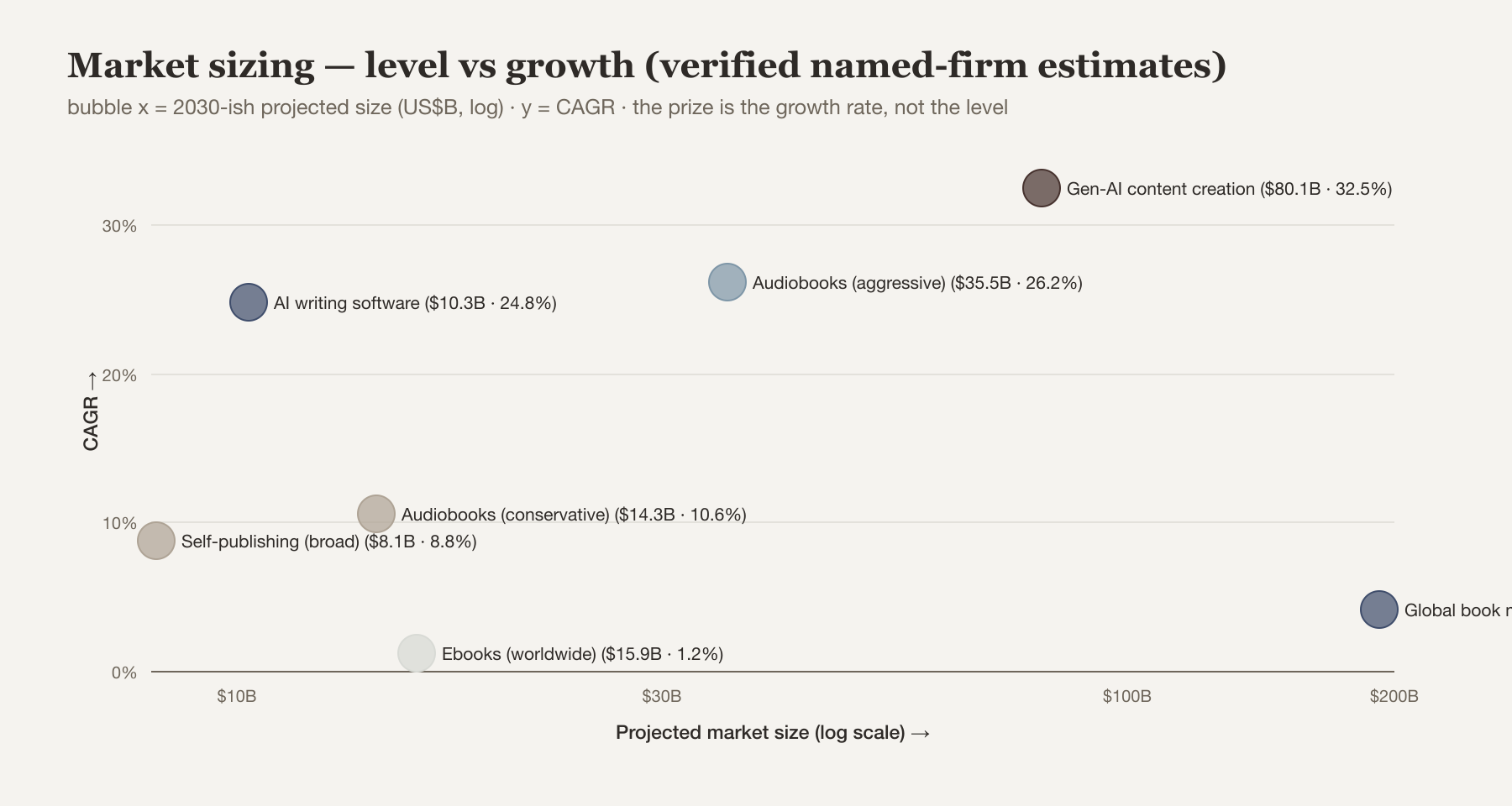
Figure 2.1. Market sizing by layer — projected size (log scale) against CAGR, from the verified named-firm estimates of Table 2.1. The prize is the growth rate, not the level: audiobooks and AI tooling compound at 10–33% while the ebook level is nearly flat.
2.2 The competitive landscape
The platforms an author might use today fall into three bands that, crucially, do not overlap. This non-overlap is the white space.
Band 1 — AI writing and co-authoring tools. These accelerate drafting but stop at the manuscript. Sudowrite — the fiction specialist — prices at $10/$22/$44 per month on annual billing and is widely regarded as best-in-class for prose craft, but it offers no export to publishable formats, no cover or audiobook production, and no distribution [V] (Sudowrite, 2026). Novelcrafter has reached 157,000+ authors on a "bring-your-own-key" model ($4–$20/month plus the author's own LLM API spend), trading low subscription cost for opaque true cost and setup complexity [V] (Novelcrafter, 2026). NovelAI, Squibler, and the marketing-oriented Jasper round out the band; and beneath all of them sits the constant downward pressure of DIY general-purpose models (Claude, ChatGPT) at roughly $20/month, which provide raw generation but none of the continuity scaffolding, formatting, or publishing a finished book requires.
Band 2 — Authoring, formatting, and human-services platforms. These finish the manuscript but do not write it. Atticus ($147 one-time, cross-platform) and Vellum ($199.99 ebook / $249.99 ebook-plus-print, Mac-only) are the dominant formatters [V] (Kindlepreneur, 2025). Scrivener and Dabble serve organisation and drafting. Reedsy is the most strategically interesting incumbent: a free writing-and-formatting studio bolted to a human-freelancer marketplace of 3,500+ vetted professionals serving 1.5 million+ authors, monetised through a 10%-professional / 10%-client commission [V] (Reedsy, 2025). Reedsy proves the marketplace model works — but its marketplace sells human services, not AI tooling or finished-book distribution.
Band 3 — Distribution and reader marketplaces. These sell the book but do not improve it. Amazon KDP dominates discovery (70% ebook royalty in the $2.99–$9.99 band; print royalty cut from 60% to 50% for sub-$9.99 USD titles effective 10 June 2025) [V] (Amazon KDP, 2025). Draft2Digital aggregates to 15+ retailers at roughly 60% blended royalty; Kobo Writing Life pays 45%/70% by price band; IngramSpark reaches bookstores and libraries [V] (Draft2Digital, 2026). At the reader-attention end sit Wattpad and the AI-data-driven publisher Inkitt/Galatea — which has raised roughly $117 million across two rounds ($59M Series B in 2021, $37M Series C in 2024) and monetises reader engagement through its Galatea app at about $6.99/month [V] (TechCrunch, 2021; 2024). Inkitt is the nearest analogue to a vertically integrated AI-publishing play — but its model acquires and owns the IP rather than serving authors as customers, which is a fundamentally different value proposition.
Appendix B provides the full pricing-and-fees matrix across all three bands. Table 2.2 distills the central point: each band occupies one column, and no incumbent spans them.
Table 2.2 — The three bands and the integration gap.
| Capability | AI writing (Band 1) | Authoring / services (Band 2) | Distribution (Band 3) | Inkvelo |
|---|---|---|---|---|
| AI co-writing | ✔ | ✖ | ✖ | ✔ |
| Quality signal to readers | ✖ | ✖ | ✖ | ✔ |
| Free AI audiobook | ✖ | ✖ | ✖ | ✔ |
| Multi-retail distribution | ✖ | partial | ✔ | ✔ |
| Discovery marketplace | ✖ | services only | ✔ | ✔ |
| Serves the author (vs. owns the IP) | ✔ | ✔ | ✔ | ✔ |
The pattern is unmistakable. An author assembling today's best-in-class stack pays Sudowrite to write, Vellum to format, Amazon to distribute, a freelancer to narrate, and a marketing consultant to launch — five relationships, five data silos, five bills, and the author as the integration layer between them. The single-platform alternative is not merely more convenient; it is the only configuration in which the quality signal generated during writing can follow the book all the way to the reader.
To make the positioning operational, Table 2.3 states, for each principal competitor, its position, its price, and the specific weakness Inkvelo's integrated, quality-gated, near-zero-cost model is built to exploit. Pricing is from Appendix B [V]; the exploit column is the strategic reading.
Table 2.3 — Competitor positioning, pricing, and the weakness Inkvelo exploits.
| Competitor | Position | Price | Weakness Inkvelo exploits |
|---|---|---|---|
| Sudowrite | Best-in-class fiction AI co-writer | $10/$22/$44 mo | Stops at the manuscript — no quality signal, no audiobook, no distribution, no marketplace; a writer still needs four more vendors |
| Novelcrafter | BYOK AI writing studio | $4–$20/mo + own LLM key | Opaque true cost and setup complexity; no publishing, audio, or reader-facing surface; serves the author, not the reader |
| Atticus / Vellum | Dominant formatters | $147 / $199–250 one-time | Format only — they finish a manuscript they cannot improve, voice, narrate, or sell |
| Reedsy | Studio + 3,500-pro human marketplace serving 1.5M+ authors | free studio; 10%+10% | Its marketplace sells human services, not AI tooling or finished-book distribution; pivoting to AI would alienate its freelancer supply |
| Amazon KDP | Dominant distribution/discovery | free; 70% ebook, 50% print <$9.99 | Economics depend on volume and on not vouching for titles; AI-disclosure + 3/day cap; cannot run a credible quality gate without contradicting its open model |
| Draft2Digital / Kobo | Wide aggregation | free; ~60% / 45–70% | Distribution only — no creation, quality signal, or audiobook production |
| IngramSpark | Bookstore/library reach | ~$49/yr; ~40–45% net | Reach without improvement, signal, or audio; the trade channel still needs a trust credential Inkvelo supplies (DNA + provenance) |
| Inkitt / Galatea | Vertically-integrated AI publisher; ~$117M raised | Galatea ~$6.99/mo | Acquires and owns the author's IP — a fundamentally less author-friendly bargain than Inkvelo's serve-the-author, 65–75%-royalty, no-exclusivity model |
The pattern across the table is the §2.3 thesis in operational form: every incumbent is strong in exactly one band and structurally unable to span the others without cannibalising its existing business — which is the asymmetry §14.4 develops.
2.3 The white space
Lay the three bands side by side and the gap is stark. No incumbent combines AI co-writing, a credible quality signal, free AI-audiobook production, multi-retail distribution, and a discovery marketplace in one platform. Sudowrite writes but cannot sell. Reedsy sells services but cannot write. Amazon sells books but cannot improve them or vouch for them. Inkitt does integrate — but by owning the author's work rather than empowering the author. The companion marketplace document frames this as Inkvelo's core thesis [D] (Adverant Research, 2026a), and our independent landscape review supports it: the integration itself is the moat, because it is the one thing none of the well-funded incumbents can replicate without abandoning their existing business model.
Two caveats temper the thesis, and §12 develops them. First, Inkitt/Galatea is a genuine and well-capitalised threat moving toward the same vertical integration from the publisher-owned-IP direction. Second, the integration advantage is only durable if each integrated layer is individually credible — an AI co-writer that produces mediocre prose, a quality score readers learn to distrust, or an audiobook that sounds synthetic would each, on its own, undermine the bundle. Integration is necessary but not sufficient; quality at every layer is the actual requirement, which is why the quality-as-incentive posture (§3.2, §6) is not a marketing slogan but the strategic core.
3. The Rebrand: From ProseCreator to Inkvelo
3.1 Why a function name fails a marketplace
A brand is a promise compressed into a word, and the word has to fit the thing it points at. "ProseCreator" is an honest, descriptive name for a writing tool — it tells a prospective user, in two morphemes, exactly what the software does. That precision is an asset for a single-sided product sold to one audience. It becomes a liability the moment the product becomes a two-sided marketplace serving three.
Consider the audiences in turn. A reader browsing for a novel does not want a "prose creator"; the name advertises machinery, not stories, and worse, it foregrounds the very fact — that the books are made with software — that the trust-conscious reader is most wary of. A publisher evaluating a licensing or distribution partner hears a hobbyist tool, not an institution. A bookstore or library sourcing titles hears a content factory, which in the current climate of AI-content anxiety is precisely the wrong signal. Only the writer — the original audience — is well served by the descriptive name, and even for the writer it caps aspiration: it names a step in the process rather than a destination for a career.
The strategic shift driving the rebrand is the migration of the platform's centre of gravity from authoring tool to publishing destination and marketplace. A destination needs a destination name — something a reader can love, a publisher can trust, and a bookstore can stock — and that name should not leak the manufacturing process onto the shelf.
3.2 The Inkvelo name and positioning
"Inkvelo" does this work. The root ink anchors the brand in the craft and heritage of writing — it is warm, human, and analog, a deliberate counterweight to the synthetic associations of AI. The suffix -vello evokes vellum (the prepared surface on which manuscripts were written) and carries a soft, Italianate, almost lyrical cadence; it reads as a place or an object of value rather than a function. The composite is short, pronounceable across languages, available as a clean .com, and — critically — says nothing about how the books are made. It names the shelf, not the press.
A brief look at the competitive naming landscape reinforces the choice. The incumbents cluster around two poles. One pole is blunt function names — Sudowrite, Novelcrafter, Squibler — all of which foreground the writing-machine idea that Inkvelo deliberately avoids, and all of which would be liabilities on a reader-facing storefront. The other pole is neutral platform names — Reedsy, Wattpad, Kobo — which read as destinations rather than tools. Inkvelo sits firmly in the second camp, the correct one for a marketplace, while retaining a literary warmth (the ink and vellum roots) that the more clinical platform names lack. It is a reader's word and a writer's word at once, and conspicuously not a machine's word — which is precisely the register a trust-first, quality-first marketplace needs.
This is not cosmetic. It encodes the platform's central strategic choice, which the companion marketplace document calls "quality as incentive, not enforcement" [D] (Adverant Research, 2026a): rather than policing AI content out of existence (a losing battle) or hiding it (a trust violation), Inkvelo competes on quality made visible. The brand promise is therefore not "AI books" and not "human books" but "books worth your time, and a transparent way to tell." Every downstream decision in this paper — the quality-scoring engine surfaced to readers (§4.4), the truth-constrained autonomous marketing (§6), the human-written-only reader filter that must remain honest (§12.3) — is a consequence of that positioning.
3.3 Messaging architecture
A single brand cannot say the same thing to a novelist, a publisher, and a reader. Inkvelo needs a messaging architecture: one master promise, three audience-specific articulations. Appendix E gives the full matrix; the spine is as follows.
- Master promise: Inkvelo is where good books get made, proven, and found.
- To writers: Write your best book, prove it's good, and reach readers — without assembling eight tools or hiring a marketing team. The emphasis is on the integrated journey and the disappearance of the operational tax.
- To publishers and small presses: A quality-graded catalogue, white-label production, and autonomous go-to-market — the capability of a marketing department without the headcount.
- To bookstores and libraries: Discoverable, quality-verified, provenance-transparent titles you can source with confidence — sold through the trade channels they already use (IngramSpark, OverDrive).
- To readers: Stories worth your time, with an honest signal of quality and the choice of how they were made. The reader-facing brand never leads with "AI"; it leads with story and trust, and offers transparency as a feature rather than a confession.
3.4 Migration: what carries over, what changes
The rebrand is a re-skin and re-positioning of a shipping platform, not a rebuild, and the migration plan must protect three forms of accumulated value while changing the surface.
Preserve. Existing user accounts, projects, and the entire generation/marketplace backend carry over untouched — the rebrand is a brand and presentation layer, and §13 confirms it reuses the existing design system rather than replacing it. The live marketplace's structure (genre, quality, and format facets; editorial rails; the Kobo distribution handoff; the "Human-written only" reader toggle) is sound and remains. Search equity on the incumbent name, such as it is, is preserved through 301 redirects from any ProseCreator-branded URLs to their Inkvelo equivalents.
Change. The wordmark, domain, navigation chrome, and all reader- and partner-facing copy move to the Inkvelo brand and the messaging architecture above (§13, Group 1). The reader-facing surfaces adopt the warmer, literary visual register (serif type, lavender/coral palette) that the existing design system already distinguishes from the author-tool surfaces (§13) — a separation that turns out to be a gift, because it lets the same platform speak in two registers without incoherence.
Sequence. Because the backend is unchanged, the migration can be staged: brand and reader-facing surfaces first (lowest risk, highest external signal), author-tool surfaces second, and the new revenue/growth consoles (§13, Groups 2–3) last, as those depend on capabilities that are partly greenfield (§12.5). The rebrand can therefore launch before the autonomous-GTM machinery is fully built — an important de-risking property, since it decouples the brand relaunch from the most speculative engineering.
4. The Platform from the Customer's Perspective
This section answers RQ1 and RQ5. We describe what a writer actually experiences, stage by stage, and then isolate the mechanism by which the platform accelerates creativity and productivity. The capabilities described here are grounded in the platform's implemented surface — a generation pipeline of forty-eight job types, twenty format-specific writing modes, thirty-one analytical inspector panels, and the marketplace described in §4.5 — rather than in roadmap aspiration; Appendix A maps each capability to its evidence.
4.1 The journey at a glance
Inkvelo's organising idea is that a book is not a document but a journey, and that every tool a writer needs along that journey should live in one place, share one memory, and hand off to the next without friction. The incumbent fragmentation that §1 described — eight tools, no shared state, the author as integration layer — is replaced by a single continuous workspace.
   IDEATION        CREATION        REFINEMENT      WORLD-BUILD     DELIVERY        MARKETPLACE
   ─────────       ─────────       ──────────      ───────────     ─────────       ───────────
   Living          20 writing      31 inspector    World Codex     Multi-format    Quality-graded
   Blueprints      modes           panels          Trope mgmt      export          storefront
   Research        Writing         Writers Rooms   Plot-thread     (EPUB/DOCX/     Free AI
   briefs          Studio          (AI personas)   lifecycle       PDF/screenplay) audiobook
   Visual          Beat/chapter    Digital DNA     Character       Front/back      Royalties +
   canvas          generation      quality score   evolution       matter          payouts
       │               │               │               │               │               │
       └───────────────┴───────────────┴───────────────┴───────────────┴───────────────┘
                              ONE PERSISTENT NARRATIVE MEMORY
                    (characters · plot threads · world rules · voice fingerprint)
Figure 4.1. The Inkvelo writer journey. The horizontal axis is the lifecycle of a book; the bar beneath it is the persistent memory layer that makes the difference between a suite of tools and a single coherent platform — every stage reads from and writes to the same narrative state, so a character's eye colour established in Chapter 1 is enforced in Chapter 30, and a plot thread opened in Book 1 is tracked across a five-book series.
4.2 Ideation and planning
The blank page is where most projects stall, and Inkvelo attacks it with structure rather than a cursor blinking in a void. A writer begins with one of several planning surfaces. Living Blueprints are story plans organised as a Series → Project → Chapter → Beat hierarchy that evolve as the manuscript is written — after each generation the blueprint updates, with version history, drift analysis, and an approval queue so the plan and the prose never silently diverge. A Visual Canvas offers drag-and-drop, node-based planning for characters, settings, and plot elements, with AI-suggested relationships. Research briefs let a writer assemble topic-aware reference material that is then injected into the generation context, so the AI writes from the writer's research rather than from generic priors. And a Project Constitution captures the world's rules, tone, and character-voice guidelines as binding constraints the generator must respect.
The effect is that ideation produces artifacts the rest of the pipeline consumes, not notes the writer must manually transcribe. Planning is not a separate phase abandoned once drafting begins; it is a living layer.
4.3 Creation and drafting
Drafting happens in the Writing Studio, a full-screen editor that adapts to the chosen one of twenty writing modes — novel, screenplay, stage play, comic book, poetry, YouTube script, blog, nonfiction, academic, memoir, short story, speech, and more — each with format-appropriate blocks, slash commands, and inspector panels. Generation operates at the granularity the writer wants: a single beat (a few hundred words), a full chapter, or targeted continuations, with the generator orchestrating multiple specialised passes for narrative structure, character voice, prose quality, and continuity. Output streams in real time over a websocket, so the writer watches the prose arrive and can cancel or redirect mid-generation rather than waiting on an opaque request.
Two properties distinguish this from a generic LLM wrapper. First, voice consistency is enforced, not hoped for: dialogue and narration are matched against established character profiles, and cross-chapter voice validation flags drift. Second, continuity is automatic: prior chapters, plot-thread summaries, and world rules are recalled from the persistent memory layer and injected into context, so the writer does not re-explain their own book to the tool with every prompt. This is the practical payoff of Figure 4.1's memory bar.
4.4 Refinement and quality
Refinement is where Inkvelo's differentiation concentrates, because it is where the trust problem of §1.1 is actually solved.
Thirty-one inspector panels provide focused AI critique across every dimension of craft — dialogue, pacing, narrative technique, plot holes, continuity, timeline, readability, theme, setting, trope execution, and format-specific concerns (screenplay structure, poetic form, SEO for nonfiction). Each panel returns a list of concrete fixes with a side-by-side diff editor, so the writer accepts or rejects each improvement rather than receiving an opaque rewrite. Writers Rooms convene multiple AI personas — an editor, a critic, a genre expert — in a collaborative session scoped to a project, chapter, or beat, giving the solo author something close to the experience of a writers' room. A master narrative audit evaluates structure, character development, pacing, and thematic cohesion holistically, with pass/fail gates. The breadth of the inspector layer is itself a feature — it means the writer's critique needs are met inside the workspace rather than outsourced to beta readers, freelance editors, or guesswork:
Table 4.1 — Inspector-panel coverage (representative, by category).
| Category | Representative panels |
|---|---|
| Craft | Dialogue, speech rhythm, character consistency, pacing, narrative technique |
| Structure | Story arc, plot holes, continuity, timeline, blueprint sync |
| Content | Readability, word count, retention curve, argument structure |
| Voice & reach | Style fingerprint, SEO, content-marketing fit, AI-detection awareness (to keep provenance disclosure honest, §12.3) |
| Format-specific | Screenplay structure, poetic form, comic-script, how-to / technical |
| Holistic | Theme, setting detail, trope checker, world consistency |
Each panel is a focused critic the writer can summon on demand and whose suggestions the writer accepts or rejects line by line — the inverse of an opaque "rewrite my chapter" prompt.
The capability that ties refinement to the marketplace is the Digital DNA Engine: a twelve-dimension analysis (character depth, plot architecture, world coherence, trope execution, voice consistency, pacing, continuity, style fingerprint, dialogue quality, AI-detection score, structural integrity, emotional resonance) that produces a composite 0–100 score and a genre-weighted percentile [D] (Adverant Research, 2026a). The score is not a vanity metric. It gates the marketplace: quality tiers (Developing → Listed → Standard → Quality Verified → Editor's Choice) unlock discoverability and free audiobook production as the score rises [D] (Adverant Research, 2026a). The score is, in other words, the mechanism by which "quality as incentive" becomes operational — and the reason it must be credible to readers, not just authors, a non-negotiable we return to in §10.5 and §12.3.
Underpinning refinement is a world-building layer that the longest projects depend on: a World Codex of structured elements (locations, magic systems, cultures, technologies) with AI-assisted generation and consistency checking; trope management that tracks execution and flags overuse; and a plot-thread lifecycle that creates, tracks, and resolves narrative threads across an entire series. For a multi-book author this layer is where the "infinite memory" of Figure 4.1 delivers its greatest value — it is the difference between a series that stays internally consistent across four hundred thousand words and one that quietly contradicts itself into incoherence.
4.5 Delivery, publication, and the marketplace
When a manuscript is ready, Inkvelo produces the artifacts publication requires rather than handing the writer off to other tools. Multi-format export covers EPUB, DOCX, PDF, LaTeX, and screenplay formats (Fountain, Final Draft), with platform presets for the major distribution targets. AI-generated front and back matter — copyright page, author bio, blurb, dedications — completes the manuscript. A publication-readiness assessment scores structural completeness and formatting compliance before the writer commits.
The free AI-audiobook pipeline is the most economically significant delivery capability, and §5.4 details its economics. It reuses the character-voice profiles already established during drafting to auto-cast multi-voice narration, runs consistency and quality checks, and masters the result to a distributable audiobook — replacing a $5,000–$20,000 professional-narration expense with a near-zero-marginal-cost automated pipeline for titles that clear the quality bar [D] (Adverant Research, 2026a).
Finally, the marketplace closes the loop. Its live surface presents a quality-graded storefront with genre, quality, and format facets; editorial rails (new releases, trending, free-this-week); a book-detail experience surfacing the Digital DNA score and audiobook; cart and checkout; and — tellingly — a "Human-written only" reader filter that lets readers opt into provenance-screened browsing. Authors receive a dashboard with sales, royalties (modelled at 65–75%, no exclusivity), and analytics, plus a distribution handoff to Kobo and the wider retail/library channel. The marketplace is currently seeded with public-domain classics and editorial rails as a quality-proof catalogue; §9 describes how it fills with author titles.
4.6 How Inkvelo accelerates creativity and productivity (RQ5)
It is tempting to answer this question with "AI writes faster," but that is both shallow and the part of the value proposition most exposed to commoditisation by $20/month general models. The defensible answer is more specific, and it has three parts.
It removes the cognitive tax of context-switching. Creative flow is fragile, and the incumbent eight-tool workflow shatters it — every handoff between drafting, formatting, research, and continuity-checking is a context switch that costs the writer momentum. By collapsing the journey into one workspace over one memory (Figure 4.1), Inkvelo keeps the writer in the work. The productivity gain here is not "words per hour" but "hours of uninterrupted flow," which is the scarcer resource. Self-reported data from indie authors using AI tools suggests meaningful productivity uplift, though the specific multipliers circulating in practitioner literature are self-reported and should be treated as indicative rather than measured [P].
It externalises memory so the writer can think. A novelist holding a five-book series in their head spends enormous working memory on bookkeeping — who knows what, which thread is open, whether this scene contradicts that one. Inkvelo's persistent memory and continuity inspectors absorb that bookkeeping, freeing the writer's attention for the parts of creativity that cannot be delegated: voice, theme, the choice of what happens next. This is the deeper meaning of "infinite memory" — not that the AI remembers, but that the writer no longer has to.
It converts critique into a fast, safe loop. The thirty-one inspectors and Writers Rooms turn the slowest, most emotionally fraught part of writing — getting useful feedback — into an instant, private, judgement-free loop the writer controls through accept/reject diffs. Creativity is iterative, and the rate of iteration is bounded by the rate of feedback; Inkvelo raises that rate by orders of magnitude while keeping the writer in authorial control. The Digital DNA score then gives the writer an objective target to iterate toward, converting the vague anxiety of "is this good enough?" into a measurable, improvable signal.
The evidence, quantified. The productivity claim need not rest on self-report. The strongest causal evidence comes from a preregistered randomised experiment of 453 college-educated professionals on incentivised mid-level writing tasks, which found that access to a generative-AI assistant cut average completion time by 40% and raised output quality by 18%, with the largest gains accruing to weaker-skilled writers — compressing the performance gap between novices and experts [V] (Noy & Zhang, 2023, Science). Two corroborating studies extend the pattern: a graded graduate-writing experiment found genAI with targeted instruction reduced writing time by 56.7% while lifting quality from roughly an A− to an A [V] (Wu et al., 2025), and a legal-writing study reported a ~22% reduction in task time [V]. These studies measure professional prose tasks, not full-length fiction, so we treat the exact percentages as evidence of mechanism rather than as a literal multiplier for novel-writing [P] — but the direction and magnitude are consistent and independently replicated, which is more than the practitioner literature alone can claim.
Crucially, the same literature names the failure mode Inkvelo's design is built to avoid. Studies of AI co-writing report cognitive offloading, reduced psychological ownership, and more homogeneous output when the human cedes authorship to the model — with the mitigation being longer, more directive human prompts and retained human control [V] (Reactive Writers, 2026; psychological-ownership studies, 2025). This is precisely why Inkvelo's refinement layer is built around accept/reject diffs and summon-on-demand critics (§4.4) rather than opaque "rewrite my chapter" generation: the writer remains the author of every accepted change, which preserves ownership and voice while still capturing the speed. The platform's productivity advantage is therefore aligned with the research on how to get AI's speed without its homogenisation tax, not in tension with it.
A productivity and iteration-rate model. The mechanism resolves into two simple relations. First, effective creative output is
where is the writer's base drafting rate, the fraction of working time actually spent on craft (rather than tool-switching, formatting, marketing, and feedback-waiting), and a focus multiplier that falls with every context switch. Inkvelo raises less by inflating (the commoditised lever) than by raising — collapsing the eight-tool workflow into one workspace shifts a pro author's week from roughly one-third craft toward two-thirds craft (Figure 4.2) — and raising by keeping the writer in flow. Second, final quality is bounded by the number of refinement iterations a writer can afford before publishing,
where is feedback latency. A beta-reader or freelance-edit loop has on the order of weeks; Inkvelo's inspector and Writers-Room loop has on the order of minutes — a three-to-four-order-of-magnitude reduction that lifts the achievable iteration count from a handful to effectively unbounded within a fixed schedule. Since quality is increasing and concave in , compressing is the single highest-leverage move on output quality at fixed time — and the Digital DNA score (§4.4) gives the writer an explicit target to iterate toward, converting "is this good enough?" into a measurable gradient.
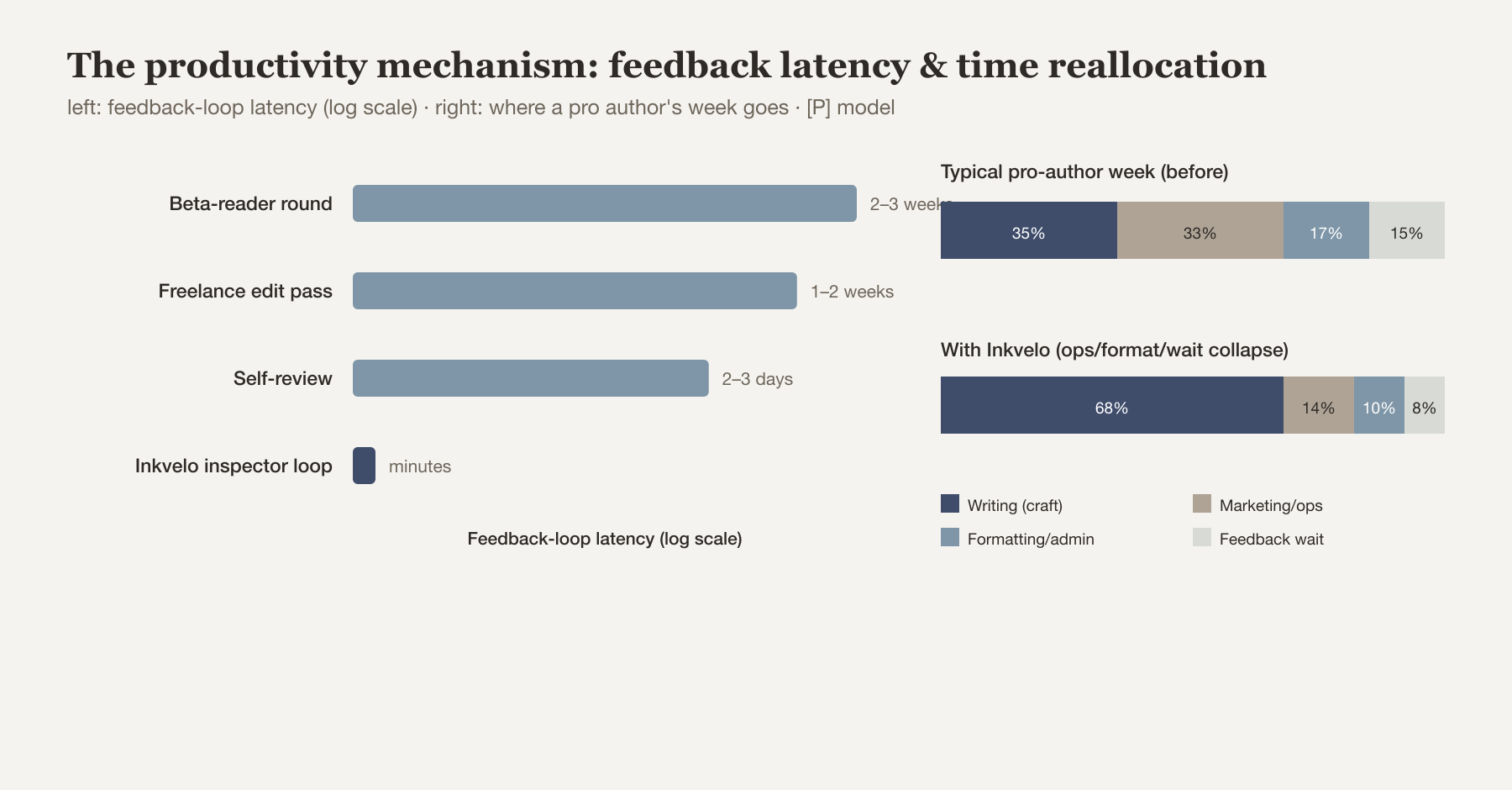
Figure 4.2. The two productivity levers, illustrated [P]. Left: feedback-loop latency on a log scale — the inspector loop compresses weeks to minutes, lifting the affordable iteration count . Right: where a professional author's week goes, before and after — operations, formatting, and feedback-waiting collapse, reallocating roughly a third of the working week back to craft.
Packaged as GTM proof points. For the author-facing messages of §9 and Doc B, this converts the productivity story from assertion into evidence: (i) a peer-reviewed, replicated 40% time reduction / 18% quality lift for AI-assisted professional writing [V]; (ii) the largest gains for emerging writers, which is the exact AI-curious segment Inkvelo most wants (§8.1); (iii) a design that preserves authorship and voice (accept/reject diffs), answering the craft-author's central objection; and (iv) a near-zero-latency feedback loop that no eight-tool stack can match. These are the load-bearing claims behind the "write something you're proud of — and know it's good" message, and they are cited rather than promised.
The synthesis: Inkvelo accelerates creativity less by generating words and more by removing everything that is not writing — the tool-switching, the bookkeeping, the feedback latency, the formatting, the marketing — so that the writer's finite creative attention is spent on the irreducibly human core of the work. That is a productivity story a general-purpose model cannot tell, because it is a story about an integrated system, not a single capability.
5. The Inkvelo Cost Architecture
The expanded brief specifies an unusual economic premise: a venture begun with zero external capital, run on fixed-price self-managed infrastructure, built with a fixed-cost development model, and producing audiobooks with self-hosted neural text-to-speech. This section makes that premise concrete and quantitative, because it is the foundation on which the profit-and-loss model of §10 rests. The thesis of the section is simple and, on the cost side, well-supported: three of the largest cost lines in a conventional publishing-platform P&L collapse toward zero or toward a small fixed value, and they do so without degrading the product.
5.1 The three structural cost collapses
A conventional SaaS-plus-marketplace business of this kind carries three dominant variable or semi-variable cost lines: engineering salaries, per-unit content-production cost (here, audiobook narration), and cloud infrastructure that scales with usage. The Inkvelo model restructures each.
Development cost → fixed and near-zero marginal. Development is performed under a fixed-cost arrangement — a perpetual-licence development capability drawn from the Adverant backplane — rather than a per-engineer-per-month salaried team [O]. In accounting terms this converts a large recurring variable cost into a fixed (and largely sunk) one. The companion baseline model carried roughly $7.3M of team cost over five years [D]; under the Inkvelo model the marginal cost of shipping additional features is effectively zero, because the development capability is already paid for. We are explicit that this is a fixed/sunk-cost framing, not a claim that software writes itself: the capability has a cost, but it does not scale with revenue, so it disappears from the marginal economics that determine break-even.
Audiobook production → self-hosted, near-zero variable. The companion documents model audiobook narration via a commercial TTS vendor at roughly $34–$65 per book [D]. Inkvelo substitutes a self-hosted open-weight neural TTS model (Kokoro) running on the same infrastructure. Under fixed-box capacity, the true marginal cash cost of an audiobook approaches zero — the GPU is already paid for whether it is idle or synthesising — and even on a fully-burdened basis (allocating a share of compute and delivery) the cost is on the order of $1.80 per book [P], a ~97% reduction. We carry the conservative $1.80 fully-burdened figure in the P&L (§10) and note the near-zero marginal reality as upside.
Infrastructure → fixed-price, capacity-decoupled. Rather than usage-metered cloud, Inkvelo runs on fixed-price self-managed servers (the team already operates such infrastructure: a self-managed Kubernetes cluster on fixed-price hardware) [V]. The consequence is that infrastructure cost steps up in discrete increments as capacity is added, rather than rising continuously with every unit of usage — so gross margin improves with scale instead of being held down by metered COGS.
5.2 Itemised infrastructure at three scale points
Table 5.1 itemises the self-managed infrastructure required to run the full Inkvelo stack — application and API services, PostgreSQL, the Neo4j graph and Qdrant vector store that back the narrative-memory layer, Redis, the websocket gateway, and a GPU node for Kokoro TTS synthesis and inference — at three scale points. The figures are estimates built up from the component services the platform actually runs and from current fixed-price hosting rates; they are projections [P] and should be read as order-of-magnitude, not invoice-accurate.
Table 5.1 — Estimated monthly self-managed infrastructure cost by scale [P].
| Component | Small (~500 authors) | Medium (~8,000 authors) | Large (~35,000 authors) |
|---|---|---|---|
| App / API / gateway nodes | $60 | $240 | $600 |
| PostgreSQL (primary + replica) | $30 | $120 | $300 |
| Neo4j + Qdrant (memory layer) | $40 | $160 | $420 |
| Redis / event bus | $15 | $45 | $90 |
| GPU node (Kokoro TTS + inference) | $220 | $440 | $1,100 |
| Object storage + CDN egress | $15 | $120 | $580 |
| Backups / monitoring / misc | $25 | $75 | $200 |
| Monthly total | ~$405 | ~$1,200 | ~$3,290 |
| Annualised | ~$4.9K | ~$14.4K | ~$39.5K |
The key figure is the ratio. At the large scale point — roughly 35,000 authors and a substantial reader base — total annual infrastructure is on the order of $40K [P], against the companion baseline's blended infrastructure-plus-storage line of well over $800K/year at comparable scale [D]. Two effects compound to produce that gap: fixed-price hardware is dramatically cheaper per unit of compute than metered cloud at steady-state utilisation, and capacity-decoupling means the platform pays for headroom in steps rather than paying a metered premium on every request.
5.3 Fixed versus variable: where cost actually lives
Under this architecture the cost structure inverts relative to a conventional platform. The large lines are fixed (development capability, infrastructure boxes), and the variable lines are small. The single cost that genuinely scales with revenue is payment processing — roughly 2.9% + $0.30 per transaction, which blends to about 3% of revenue across the platform's price points (and runs materially higher on low-priced single items, where the fixed $0.30 component dominates) [V] — which is irreducible and, by years four and five of the model, becomes the dominant variable cost line precisely because everything else has been engineered toward zero. Legal and compliance costs are real but modest and largely fixed (§12). This inversion is the central cost result: it is why the platform can be profitable at low volume and why its net margin rises toward the high-90s with scale (§10).
5.4 Audiobook unit economics in detail
Because the free-audiobook capability is both the most disruptive feature (§4.5) and the largest single COGS line in the companion model, its economics deserve precision. Three figures circulate, and they are not contradictory — they measure different things, and the paper must use them consistently:
- ~$0.00 true marginal cash cost under fixed-box capacity. One GPU node sustains a high throughput of Kokoro-synthesised audiobooks per month; within that envelope, an additional audiobook consumes already-purchased compute and costs essentially nothing in cash [P].
- ~$1.80 per book fully-burdened synthesis — the figure we carry in the P&L, allocating a conservative share of GPU time and delivery to each audiobook [P].
- ~$4.30 per book as a managed-cloud artifact — the cost if Kokoro synthesis and compute were rented from a commercial cloud rather than self-hosted (this is distinct from the $34–$65 commercial managed-TTS vendor price noted in §5.1 and §4.5; $4.30 is self-run Kokoro on rented rather than owned GPU) [P]. We note it only to explain the divergence; it is not the Inkvelo number.
We adopt $1.80/book fully-burdened as the P&L convention and treat the ~$0 marginal reality as conservative upside. To make the throughput concrete (an order-of-magnitude estimate, not yet benchmarked — and a Phase-1 measurement deliverable, §15): a single GPU node running Kokoro can synthesise on the order of thousands of audiobook-hours per month, and a typical novel's audiobook runs roughly eight to twelve listening hours — so one node sustains hundreds to low-thousands of full audiobooks monthly within its fixed cost. At the medium scale point of Table 5.1, where audiobook demand is on the order of a few hundred titles per month, the node runs well below capacity, which is exactly why an additional audiobook's marginal cash cost approaches zero and why audiobook breadth — every quality-clearing title, automatically — is a capability that catalogues dependent on human narration structurally cannot match. The strategic point stands regardless of which figure one prefers: against a $5,000–$20,000 professional-narration alternative, or even a $34–$65 commercial-TTS alternative, self-hosted production makes a free quality-gated audiobook economically trivial — and the free audiobook is the wedge that the go-to-market depends on (§9).
5.5 The honest dependency
One load-bearing assumption in this architecture is not yet shipped, and intellectual honesty requires foregrounding it. The audiobook pipeline's committed configuration today points at an external GPU provider, not the planned self-hosted node [O]. The near-zero-COGS thesis therefore depends on a migration to self-hosted Kokoro synthesis that is on the roadmap but not yet in production. Until that migration ships, audiobook COGS is variable and metered, not fixed and near-zero. We treat the self-hosted economics as the target architecture and flag the migration as a critical non-negotiable (§10.5) and a roadmap risk (§12.5), rather than presenting it as accomplished fact. This is the kind of distinction the [V]/[P]/[D] tagging exists to enforce: the capability is real and the target economics are sound, but the current state is one engineering step behind the model.
6. The Autonomous Revenue Engine: "Inkvelo Campaign Genesis"
The expanded brief asks that this paper incorporate a second companion document — Revenue Pipeline Templates for Autonomous Book Go-to-Market (Adverant Research, 2026b) — but with an explicit condition: only where it aligns with the CEO's vision for Inkvelo. That condition is not a formality. The autonomous-revenue concept is powerful and economically central, but parts of it sit in direct tension with the "quality as incentive, not enforcement" posture that defines the brand (§3.2). This section incorporates the engine conditionally, stating plainly what we include, what we reframe, and what we firewall out.
6.1 What the engine is
The companion document describes NexusROS Campaign Genesis, a system that "compresses independent-author book go-to-market from weeks of fragmented manual coordination across 5–8 disconnected tools into hours of autonomous orchestration" [D] (Adverant Research, 2026b). Its four contributions are: (1) Revenue Pipeline Templates — parameterised campaign directed-acyclic-graphs (DAGs) encoding proven launch sequences as reusable, genre-adapted plans; (2) a psychological-profiling closed loop synthesising Big Five, DISC, and Cialdini's principles to generate reader-segment-specific ad creative without manual copywriting; (3) a headless video pipeline producing book trailers by composing AI-generated scene clips, synthesised narration, and procedural music; and (4) closed-loop budget reallocation across 14+ ad platforms using Thompson-Sampling bandits [D] (Adverant Research, 2026b).
The economic claims are the reason it matters to the rebrand. The document models book-trailer production at under $5 per variant (versus $500–$2,000 for a freelancer), a 97.5% reduction in campaign-setup labour (roughly 120 hours to 3 hours), and — most importantly for §10 — a series-economics insight: with a permanently free first-in-series driving substantially higher read-through, the expected lifetime value of a Book-1 reader is around $5.24, well above the $1.50–$4.00 cost-per-lead achievable through paid social [D] (Adverant Research, 2026b). That gap between LTV and acquisition cost is the engine that makes self-funding paid acquisition possible in §9 and §10.
Crucially — and this resolves most of the tension — the engine automates marketing, not writing. It is a go-to-market system that assumes a finished, quality manuscript and orchestrates its launch. It does not mass-produce books. Rebranded for Inkvelo, we call it Inkvelo Campaign Genesis.
6.2 The alignment verdict
Our verdict is conditionally aligned. The engine amplifies the quality flywheel rather than replacing the quality bar — if and only if every autonomous campaign and asset passes through the same Digital DNA quality gate and the same human-approval and AI-disclosure checkpoints that protect reader trust. The framing sentence we propose for the platform, and for this paper, is:
Inkvelo uses the autonomous revenue machine to market quality — not to manufacture volume. Every autonomous campaign and asset passes the same Digital DNA quality gate and human-approval/disclosure checkpoints that protect reader trust.
Table 6.1 makes the incorporation precise.
Table 6.1 — Conditional incorporation of the autonomous-revenue engine.
| Disposition | Elements | Framing for Inkvelo |
|---|---|---|
| INCLUDE (P&L backbone) | Autonomous GTM orchestration; sub-$5 trailer/asset production on self-hosted inference; Book-1 LTV (~$5.24) vs cost-per-lead (CPL; $1.50–$4.00); Thompson-Sampling spend optimisation; first-party owned-catalogue revenue; 65–75% direct royalties | Adopt directly. Swap the document's commercial TTS (ElevenLabs) and commercial video model (Runway) for self-hosted Kokoro and open-weight video to honour the near-zero-COGS architecture of §5. |
| REFRAME (genuine tension) | Human-in-the-loop approval; Cialdini/DISC persuasion; personality-based targeting; "no human direction" creative generation | Elevate human approval to a first-class trust gate (approve-before-spend and approve-before-publish). Constrain persuasion to truth only — no fabricated scarcity or social proof. Make targeting consented and cohort-level (opt-in, GDPR/CCPA/FTC-compliant, aggregate over individual). Keep generative creative quality-gated, AI-disclosed, and human-in-the-loop by default. |
| EXCLUDE / FIREWALL (conflict) | Unverified credibility claims; open-ended mass-generation; any path that omits AI-provenance | Exclude the unverified-claim path entirely (an FTC and trust hazard). Permit autonomous generation only behind the DNA gate and only for (a) first-party catalogue seeding, (b) demonstrations, and (c) opt-in author tooling — never an anonymous content firehose. Propagate AI-provenance metadata so the marketplace's "Human-written only" filter stays honest (§12.3). |
6.3 The anti-flooding throttle is built in
The most important alignment property is that the engine's own quality gate is intended as the anti-flooding mechanism — a design that holds only so long as the score remains reader-credible (§12.3). Because amplification — discoverability, free audiobook production, autonomous campaign spend — is unlocked by the Digital DNA score, content that scores below the threshold receives no amplification. A would-be flooder gains nothing by mass-generating low-quality titles, because the platform simply does not promote them. This is "quality as incentive" working as designed: the system does not need a content-police function because the absence of reward for low-quality volume is itself the deterrent. The autonomous engine, gated this way, increases the throughput of good launches without increasing the supply of marketplace noise.
6.4 How a campaign runs, end to end
The engine's central abstraction is the Revenue Pipeline Template (RPT) — a parameterised campaign directed-acyclic-graph that encodes a proven launch sequence as a reusable, genre-adapted plan covering temporal scheduling, budget curves, platform selection, and milestone-triggered transitions [D] (Adverant Research, 2026b). An author does not configure a campaign from scratch; they instantiate a template with a handful of parameters — genre, series position, budget ceiling, launch date — and the DAG expands into a full multi-week, multi-platform plan. The companion document reports that this collapses campaign setup from roughly 120 hours of manual work across three weeks to about three hours of human input — an initial objective session, a plan-review gate, and a pre-launch approval gate — a 97.5% reduction in coordination labour [D].
The creative layer is generated rather than hand-authored. The engine maps a reader segment's profile (a dominant Big Five trait, a DISC behavioural style, and the highest-scoring Cialdini persuasion lever) onto ad copy and graphics, producing on the order of a dozen or more variants per title per platform; a Thompson-Sampling bandit then concentrates spend on the empirically best performers, converging a launch set of 12–18 variants toward 4–6 survivors over a roughly twelve-week cycle [D] (Adverant Research, 2026b). Book trailers are composed headlessly — generated scene clips, synthesised narration, procedurally selected music, automated compositing — at under $5 per variant against a $500–$2,000 freelance alternative [D]. For Inkvelo, every one of these generation steps inherits the constraints of §6.2: self-hosted inference (not commercial APIs), truth-constrained copy, AI-disclosure, and a human approval gate before any spend or publication.
The mapping the engine applies is drawn from the companion document's profiling stack [D]:
Table 6.2 — Psychographic-to-creative mapping (companion engine) [D].
| Signal | Example value | Creative consequence |
|---|---|---|
| Big Five — high Openness | speculative / literary readers | imagery-led, discovery framing ("worlds that refuse to follow rules") |
| DISC — Steadiness (S) | trust / continuity seekers | calm cadence, reassurance, low-pressure call-to-action |
| DISC — Dominance (D) | fast, decisive readers | terse, high-velocity copy; urgency only where genuine |
| Cialdini — Scarcity | a time-bounded promotion is live | "72 hours at $0.99" — generated only when a real deadline exists |
| Cialdini — Social proof | a strong, verifiable review base | review-led copy — only with real numbers behind it |
For Inkvelo the mapping is retained but its inputs are deliberately changed: targeting operates at the consented cohort level rather than the individual, and every persuasion tactic is gated on a true underlying fact (§6.2) — the scarcity message is generated only when a real countdown is live, the social-proof message only when the ratings are real. This is the operational line between persuasion and manipulation, and it is enforced at the point of generation rather than left to operator discretion.
The projected returns, drawn from the companion document's three scenarios, illustrate the economics. We tag them firmly as projections resting on a preprint with no live case studies [D]:
Table 6.3 — Autonomous-campaign revenue scenarios (companion projection) [D].
| Metric | Conservative | Base | Optimistic |
|---|---|---|---|
| Total investment | $2,340 | $4,350 | $8,040 |
| Units sold (ebook) | 500 | 1,500 | 4,000 |
| Total revenue | $3,432 | $11,343 | $33,040 |
| ROI | 47% | 161% | 311% |
| Break-even | day 72 | day 34 | day 18 |
Even the conservative scenario clears break-even inside the 84-day launch cycle, and the video-production line is effectively free because trailers are produced at infrastructure cost only [D]. We carry these figures as illustrative of the mechanism — autonomous orchestration plus near-zero creative cost — not as forecasts of Inkvelo's results, which depend on the unproven demand curve of §10.4. The honest reading is that the engine makes a well-run launch dramatically cheaper to execute; it does not guarantee that any given book finds its audience.
6.5 The ethical posture, made operational
The companion document already addresses the ethics of autonomous psychological targeting through consent tracking, a relevance-not-exploitation principle, and operator-visible transparency [D] (Adverant Research, 2026b), and it cites the relevant literature — Cialdini's principles of persuasion (Cialdini, 2007), the demonstration that psychological traits are predictable from digital traces (Kosinski et al., 2013), the finding that psychological targeting can raise advertising effectiveness (Matz et al., 2017), and the argument that online service providers bear moral responsibility beyond legal compliance (Taddeo & Floridi, 2016). For Inkvelo we make three of these operational rather than aspirational: (1) truth-constrained persuasion is enforced at the asset-generation layer — scarcity messaging may only be generated when a real, time-bounded constraint exists; (2) cohort-level targeting replaces individual psychographic profiling in the consumer-marketplace context, both for compliance and because the document's profiling infrastructure was built for B2B and does not transfer cleanly to consumer marketing (§7.4); and (3) human approval is the default, not an option — the autonomous engine proposes, a human disposes, and nothing reaches a reader or a paid channel without that gate. The result is an engine that is aggressive about efficiency and conservative about trust — which is precisely the balance the brand requires.
7. NexusROS as Inkvelo's Free Growth and Revenue Operating System
The expanded brief specifies that Inkvelo should use NexusROS — and use it for free — to grow and manage revenue and to create and run go-to-market strategies. This section explains why "free" is a defensible claim, maps the platform's capabilities to specific Inkvelo motions, and quantifies the cost it displaces. It also draws a hard line around what does not transfer, because overclaiming here would undermine the credibility of the P&L that depends on it.
7.1 Why "free" is structurally true
NexusROS is not a vendor Inkvelo would license; it is a sibling system on the same infrastructure. Both run on the same self-managed cluster and share the same underlying services — the unified orchestration layer, the skills registry, the GraphRAG narrative-memory and graph/vector stores, and the AI provider-router [O]. When Inkvelo invokes a NexusROS capability, it is calling a sibling process on already-paid-for infrastructure, not paying a third party. The marginal cost is therefore the marginal compute of the call, not a per-seat or per-campaign licence fee. This is the same structural argument as §5: a capability that is already built and already hosted has zero marginal licence cost, and that is what "free" means here.
There is exactly one leak in this argument, and we name it: some NexusROS go-to-market skills are pinned to call an external language model rather than a self-hosted one, which would re-introduce a small per-token inference cost [O]. The mitigation is a non-negotiable (§10.5): pin all NexusROS go-to-market skills to self-hosted inference. With that done, the "free GTM" claim holds; without it, the claim leaks token cost proportional to campaign volume.
7.2 Capability-to-motion mapping
NexusROS is a large system — its role definitions number in the hundreds (we use "240 defined agent roles" as the code-grounded figure, because the roster code is the executable source of truth while the public marketing site and the manifest lag it, reporting 113 and 135 respectively; the companion autonomous-revenue paper separately describes a "~180-agent swarm" for one subsystem) [O]. For Inkvelo, eight capability clusters map directly onto growth-and-revenue motions.
Table 7.1 — NexusROS capability → Inkvelo motion.
| # | NexusROS capability | Inkvelo motion |
|---|---|---|
| 1 | Master GTM blueprint generation with correlated Monte-Carlo financial modelling | The launch plan and the revenue sensitivity analysis of §10.3 |
| 2 | Account-hunting + account-based-marketing + dossier generation | Writer-supply acquisition (recruiting authors and small presses) |
| 3 | Content engine + web-studio + lifecycle cadences | Reader-demand generation (SEO, social, email) |
| 4 | Persuasion profiling + web experimentation | Marketplace merchandising and conversion-rate optimisation (CRO) |
| 5 | Revenue engine + churn + forecasting + digital-twin simulation | Revenue growth, retention, and planning |
| 6 | Engagement + attribution analytics | The analytics/attribution stack (replacing paid tooling) |
| 7 | Continuous campaign-DAG execution with human-in-the-loop gates | Inkvelo Campaign Genesis execution (§6) |
| 8 | Shared GraphRAG memory loop | Two-way signal between Digital DNA quality data and the growth engine |
The eighth mapping is the most strategically interesting, because it is a flywheel a standalone marketing stack cannot replicate: the Digital DNA quality signals that gate the marketplace also feed the growth engine, so Inkvelo markets its best titles hardest and learns which quality dimensions predict commercial success — closing a loop between quality measurement and revenue generation.
To make the mapping concrete, consider a single motion end to end. When "Maya" (§8.6) finishes a quality-cleared romance, the growth engine — with no marketing hire involved — generates a launch blueprint from the matching Revenue Pipeline Template (§6.4), drafts and quality-gates the advertising and email creative, schedules a twelve-week cadence across the channels her genre and behavioural profile favour, stands up a landing page, and routes every spend decision and publish action to Maya for approval. It then attributes the outcomes, updates the forecast, and writes what it learned about her readership back into the shared memory so her next launch starts smarter. A conventional venture staffs this motion with a growth marketer, a copywriter, an email specialist, and an analyst; Inkvelo runs it as a sibling process on already-paid-for infrastructure, which is the operational meaning of the cost-displacement in §7.3.
7.3 Cost displacement: what NexusROS replaces
The reason NexusROS matters to the P&L is that it displaces an entire category of spend that a comparable venture would either staff or license. Table 7.2 itemises the displaced functions and the market rates avoided. These rates are projections of what the venture would otherwise pay [P]; the point is not the precise figure but the magnitude.
Table 7.2 — Functions displaced by NexusROS (market rates avoided) [P].
| Displaced function | Typical market cost | NexusROS capability |
|---|---|---|
| GTM strategy / fractional CMO | $3–15K/mo agency; $5–12K/mo CMO | GTM Genesis + Blueprint |
| Growth marketer (hire) | $90–150K/yr | Campaign Genesis + playbooks |
| Copywriting / content | $2–8K/mo; tool seats $49–125/mo | Content engine + web studio |
| Landing-page / CRO tooling | $99–1,000+/mo | Web-studio experiments |
| Email / lifecycle (e.g. Klaviyo) | $100–1,500+/mo | Email + cadences |
| CRM (e.g. Salesforce/HubSpot) | ~$75/user/mo | Ledger pillar |
| Analytics / attribution | $0–2,000+/mo | Engagement + attribution |
| Forecasting / FP&A (financial planning & analysis) | $200–2,000/mo | Monte-Carlo + digital-twin |
| Churn / retention | $200–1,000/mo | Churn + expansion models |
| ABM (e.g. Demandbase/6sense) | $20–100K+/yr | ABM + account blueprints |
| Competitive research | $1–5K/mo | Research missions + dossiers |
| Marketing-ops engineer | $100–140K/yr | Orchestration sagas |
The aggregate is the headline. A comparable startup's combined go-to-market, growth, and revenue-operations function costs on the order of $150–400K per year in staff and tooling [P]; for Inkvelo, that function is delivered by an already-built, already-hosted sibling at a net new cash cost of approximately $0 plus fixed infrastructure [P]. This is the single largest reason the rebuilt P&L (§10) eliminates the sales-and-marketing line that dominates a conventional model.
7.4 What does not transfer — the honesty clause
Three caveats keep this from being an overclaim, and the credibility of §10 depends on stating them.
First, the efficacy metrics are unverified. NexusROS's self-reported performance figures (velocity, win-rate, and cost-reduction claims) are vendor-asserted, derived from a B2B context, and have no independent third-party validation [P]. We do not import them into the P&L; we import only the cost displacement (which is a question of avoided spend, not of efficacy) and we let the revenue side stand on the companion documents' own assumptions, clearly tagged.
Second, B2C fit is partial. NexusROS was built primarily for B2B revenue operations. Its sales-execution pillar — the agents oriented toward sales reps, voice outreach, and deal simulation — is largely inapplicable to a consumer book marketplace, and we exclude it from "what Inkvelo uses." The intelligence, content/marketing, and parts of the CRM/ledger pillars transfer; the sales-closing pillar does not. Pretending otherwise would inflate the displaced-cost figure.
Third, the "free" claim is conditional on the inference-pinning non-negotiable of §7.1. We carry it as a stated assumption, not a fact, precisely because a single misconfigured skill would convert "free" into "cheap-but-scaling," which changes the P&L's most attractive property.
8. Audience Analysis
This section answers RQ2: who benefits from Inkvelo, and how does each audience take advantage of it? The platform is genuinely multi-sided, and the analysis must respect that the same capability means different things to a novelist, a publisher, a librarian, and a reader. We treat three principal audiences — writers, publishers, and bookstores/libraries — plus the readers who close the economic loop, because a marketplace with supply but no demand is not a marketplace.
8.1 Writers — the supply side and the original audience
Writers are the foundation: without them there is no catalogue. Two segments dominate, and they want different things.
The professional indie author publishes six to twelve titles a year, often in series, and runs writing as a business. For this segment the binding constraint is operational overhead — the eight-tool workflow, the marketing labour, the audiobook expense — not the writing itself. Inkvelo's value proposition is the collapse of that overhead: one workspace from draft to distribution (§4), free audiobooks that would otherwise cost $5,000–$20,000 per title (§5.4), and an autonomous go-to-market engine that replaces a marketing department (§6). The job to be done is "let me run my catalogue as a business without becoming a full-time marketer," and the LTV economics of series read-through (§6.1) mean this segment is also the most valuable.
The AI-curious hobbyist or emerging author — frequently in the 25–44 band, often earning little or nothing from writing today — wants something different: a credible path from idea to a finished, respectable book, and a way to know whether it is any good. For this segment the Digital DNA score (§4.4) is the primary feature, because it converts the terrifying ambiguity of "is my book good enough?" into a measurable, improvable number, and the quality tiers give a concrete ladder to climb. The job to be done is "help me make something I'm proud of and prove it's worth a reader's time." This segment is the volume of the funnel and the source of the platform's growth, even if its near-term revenue per author is low.
A note on the trust tension this audience creates: the most vocal and AI-skeptical writers are exactly the professional fiction authors Inkvelo most wants. Only about 11% of fiction authors report using AI to create publishable text, even as overall author AI adoption sits near 45% [V] (BookBub, 2025). The brand posture (§3.2) — quality and provenance transparency rather than "AI books" — is the response: Inkvelo must be a platform a craft-proud author is not embarrassed to be associated with.
8.2 Publishers — the leverage side
"Publisher" spans two quite different customers, and both are higher-value, lower-volume than individual writers.
Brand and non-writer publishers — companies, creators, and experts who publish books as lead-generation or credibility assets rather than as a primary revenue stream — want production capability without a production team. Inkvelo offers ghostwriting-grade generation, quality scoring, and audiobook production as a service, letting a brand ship a credible book on a marketing budget. The job to be done is "give us the output of a publishing operation without the headcount."
Small and independent presses want throughput and economics. A small press with a backlist and a handful of staff can use Inkvelo's white-label export, batch audiobook production, and autonomous go-to-market (§6, §7) to operate a catalogue several times larger than its headcount would normally permit. The most concrete near-term play is the backlist-to-audiobook conversion: a press sitting on dozens of ebook-only titles can, at near-zero marginal cost (§5.4), convert the entire backlist to audiobooks and capture the fastest-growing segment in publishing (§2.1). The job to be done is "let our small team run like a big one."
For both publisher types the autonomous-GTM engine (§6) and the NexusROS revenue stack (§7) are the differentiator, because marketing capacity — not content capacity — is the constraint that caps a small publisher's growth.
8.3 Bookstores and libraries — the trust-sensitive channel
This is the audience the incumbent name most repels and the one the rebrand most needs to court, because bookstores and libraries are where curation and trust live in the book ecosystem.
Libraries reach readers at enormous scale through digital lending — OverDrive alone spans 92,000+ libraries and schools with 739M+ checkouts in 2024 [V] (OverDrive, 2025) — and they are increasingly important audiobook channels. Bookstores, especially independents, are curation engines whose endorsement carries trust a marketplace algorithm cannot manufacture. Both, however, are acutely sensitive to AI-content provenance; an undifferentiated flood of AI titles is precisely what they screen against.
Inkvelo's value to this channel is therefore quality-verified, provenance-transparent supply delivered through the trade infrastructure they already use (IngramSpark for bookstores; OverDrive/Libby for libraries). The Digital DNA score and the AI-provenance metadata are not just author features here — they are the trust credential that makes Inkvelo titles sourceable by an institution that must answer to readers and patrons. The job to be done is "give us titles we can stock or lend without staking our reputation on unvetted AI content." This is also why the quality signal must be credible to institutions, not only to readers (§10.5).
8.4 Readers — the demand side that closes the loop
Readers are not in the executive's three-audience framing, but no revenue exists without them, so they belong in the analysis. Two reader segments matter most for Inkvelo's economics.
Audiobook-first consumers skew younger and subscribe to audio services at high rates; they are the demand that Inkvelo's free-production capability is built to serve, because Inkvelo can offer audiobook breadth (every quality-gated title, automatically) that catalogues dependent on expensive human narration cannot match. Web-serial and genre readers — the LitRPG, progression-fantasy, and romance audiences who power Wattpad and Royal Road — are mobile-first, voracious, and series-loyal, which makes them ideal for the read-through LTV economics of §6.1.
The reader value proposition is the brand promise of §3.2 restated from the demand side: stories worth your time, with an honest signal of quality and a choice about how they were made. The "Human-written only" filter, the visible Digital DNA score, and the free audiobooks are the three concrete reasons a reader chooses Inkvelo over an undifferentiated marketplace — and each, not coincidentally, is a direct expression of the quality-as-incentive thesis.
Why would a reader switch from Amazon or a library app at all? Not on catalogue breadth — incumbents win that decisively — but on curation and trust: a marketplace where the quality signal is visible and credible, where audiobooks are abundant rather than rationed by production cost, and where provenance is transparent. For the audiobook-first and genre-serial readers especially, breadth of audio — every quality-clearing title, included with the subscription — is a selection incumbents cannot match, because their audio catalogues are gated by the economics of human narration. Reader acquisition therefore leads with the two things Inkvelo can offer that incumbents structurally cannot: a trustworthy quality signal and audio abundance.
8.5 The two-sided dynamic
The audiences are not independent; they form a flywheel with a known cold-start problem. Writers produce quality-gated titles → readers find trustworthy stories and audiobooks → reader demand and revenue attract more writers → publishers and the library/bookstore channel add distribution and credibility → which attracts more readers. The constraint, as in every marketplace, is which side to solve first. Inkvelo's answer (developed in §9) is supply first: seed a credible quality-proof catalogue and recruit professional authors before pushing reader-side demand, because a marketplace that sends readers to a thin or low-quality catalogue burns the trust the entire brand depends on.
8.6 Persona sketches
Three composite personas make the segments concrete. They are illustrative constructs, not drawn from named individuals.
"Maya," professional indie romance author, 34. Maya publishes a four-book series a year and earns a full-time living from Kindle Unlimited page-reads and wide sales. She spends roughly a third of her working time on marketing she dislikes and on audiobooks she largely cannot afford to produce. Inkvelo's pitch to Maya is time and money reclaimed: a free audiobook for every title that clears the quality bar, an autonomous launch she approves rather than assembles, and 70%-plus royalties with no exclusivity. Her risk to Inkvelo is well-earned skepticism — she has watched AI hype crest before — so the brand must demonstrate craft and respect for her readers, not promise volume.
"Devin," AI-curious first-time author, 28. Devin has a finished draft, no author platform, and no reliable way to judge whether the book is any good. The Digital DNA score is the reason Devin stays: it converts the paralysing question "is this publishable?" into a number with a visible ladder to climb. Devin contributes little near-term revenue but enormous funnel value, and is the segment most sensitive to a quality signal that feels fair and instructive rather than punitive.
"The Hartwell Press," a three-person independent publisher. Hartwell owns a backlist of roughly forty ebook-only titles and a small, loyal readership. Inkvelo's pitch is leverage: convert the entire backlist to audiobooks at near-zero marginal cost (§5.4), run autonomous go-to-market across the catalogue (§6), and operate like a house several times its headcount. Hartwell is a high-value, low-volume account, best reached through account-based marketing (§9) rather than mass channels.
8.7 Reach-modality maps and reachability scores (researched)
The audience analysis above is necessary but not sufficient for go-to-market: knowing who benefits says nothing about where they can actually be reached, how hard it is, and how they feel about AI. We therefore conducted a live-search reach-modality study across all eight segments, mapping for each one the real venues, communities, platforms, events, newsletters, and gatekeepers where it congregates — and resolving every modality to actual, named targets with measured reach. The consolidated result is summarised here as a reachability score and a difficulty score per segment; these are not decorative — they are the direct inputs to the PSP model's quality-of-reach () and ease () factors (§11.1, §11.4), and the full vetted Target-List (specific BookTube channels, subreddits, Discords, newsletters, podcasts, library systems, bookstores, and serial communities, each with a reach metric and a contact path) lives in the companion GTM Execution Playbook. Every figure below was checked against a live source on 2026-06-07; figures that could not be confirmed live are flagged in Doc B as [unverified].
Table 8.2 — Per-segment reach-modality map (researched) [V where sourced; scores P].
| Segment | Reach. | Diff. | Sentiment | Sized reachable population | Top named anchors (verified reach) |
|---|---|---|---|---|---|
| AI-curious / hobbyist writers | 0.78 | 0.42 | +0.15 | ~4–6M across hubs (r/writing 3.4M) | r/WritingWithAI 137k; AI-tool Discords ~83k (NovelAI 55k, Sudowrite 18k, NovelCrafter 9.6k); B. Sanderson YT ~719k; Counter Craft ~19k |
| Web-serial readers | 0.74 | 0.48 | −0.05 | Royal Road ~52.7M visits/mo; Reddit ~4.3M combined | Royal Road (Rising Stars + $55–275 ads); r/Fantasy 3.9M; r/litrpg 142k; Book Barbarian 80k+; pirateaba 6,638 paid patrons |
| Audio-first readers | 0.70 | 0.50 | −0.30 (AI narration) | ~157M US adults have listened (58%); $2.43B, +9% | Spotify Audiobooks (500k+ titles, 52% aged 18–34); Libro.fm 4,419 partners; Audible ~63% share; r/audiobooks 336k |
| Pro-indie authors | 0.62 | 0.55 | +0.30 | ~30k–80k directly reachable; full-time in low tens of thousands | Author Nation ~1,500; ALLi ~1,200 Full Members; NINC 1,000+ vetted; r/selfpublish 80k+; The Creative Penn 10.6M downloads |
| Brand / non-writer publishers | 0.55 | 0.60 | +0.25 | small headcount; ghostwriting market $3.78–4.28B | ForbesBooks/Advantage 2,000+ authors; Gotham 4,000+ writers; Reedsy; Kevin Anderson & Associates |
| Small & independent presses | 0.50 | 0.62 | −0.25 | IBPA ~3,150 members; CLMP 1,192 literary presses | IBPA + Publishing University; Publishers Marketplace ($30/mo); IngramSpark 200,000+; PW 1M+ readers |
| Indie bookstores | 0.48 | 0.66 | −0.15 | ABA 3,783 member locations (+19% YoY) | ABA galley box + Indie Next; Bookshop.org ~2,900 stores ($70M); NetGalley 680k members; Winter Institute ~1,000 |
| Libraries (collection dev) | 0.46 | 0.68 | −0.40 | ~9,000 US public libraries / ~17,000 outlets | OverDrive 820.5M checkouts; LibraryReads; Library Journal ~100k circ; ALA Annual ~14,250; Ingram Library Services |
Four findings shape the go-to-market that follows. First, the most reachable surfaces are the AI-native writer hubs and the web-serial and audio reader platforms — they are large, concentrated, often promo-tolerant, and (on the writer side) pre-sold on AI tooling, which is why they earn the highest and . The AI-curious writer's job-to-be-done — "help me make something I'm proud of and prove it's good" — is met directly by the Digital DNA score (§4.4), and the willingness-to-pay band is the familiar $10–25/month tool tier (ChatGPT Plus $20, NovelAI $10–25) [V], constrained by very low writer income (median book income ~$2,000) [V], so these surfaces are awareness-and-free-trial engines rather than high-ARPU channels.
Second, the institutional channels — small presses, bookstores, and especially libraries — are the hardest and most AI-skeptical, with libraries posting the most negative sentiment in the entire dataset ($s=-0.40$): collection-development librarians are actively screening self-published and small-press titles for AI provenance, and the American Library Association has stood up an AI policy working group [V]. Their reach is real and large (OverDrive recorded 820.5 million digital checkouts in 2025, up 10.9%, audiobooks up 13% [V]; the ABA grew to 3,783 member locations, up 19% [V]), but it is mediated by gatekeepers and editorial/peer-chosen signals (LibraryReads, Indie Next) that cannot be bought. This is exactly why §8.3's argument matters: for these segments, the Digital DNA score and AI-provenance metadata are not author features but the trust credential that makes Inkvelo titles sourceable at all — and why the PSP model (§11.9) correctly ranks the trade channel last for near-term acquisition while affirming its long-term role in institutional credibility.
Third, the timing layer is a live, mixed signal. Catalysts cut both ways: the Anthropic copyright settlement ($1.5B; ~$3,000/title across ~500,000 works) [V], Amazon's AI-disclosure rule and three-titles-per-day cap [V], Google's scaled-content-abuse policy [V], and the March-2025 shutdown of NaNoWriMo after its AI-framing controversy [V] all harden anti-AI sentiment, while Spotify's and Audible's 2025 moves into AI narration create a supply-side tailwind colliding with the reader headwind. The reliable positive is seasonality: Circana's BookScan shows the Q4/week-51 print peak as the strongest selling week of the year [V], which the news-timing factor () rewards for launch sequencing.
Fourth, one channel-class is conspicuously frictionless: the paid-placement marketplaces — Amazon/Meta/BookBub ad networks, the promo-newsletter list (Freebooksy 1.345M readers, Bargain Booksy 365k, Fussy Librarian 550k, Robin Reads 194k [V]), the reader-magnet/swap tools (BookFunnel, StoryOrigin), and the ARC platforms — carry essentially no channel-level AI stigma, because their gate is quality and format, not provenance. That is why the PSP model puts the search/retail-ads and email/reader-magnet packages at the top of the board (§11.9): they combine large reach, high intent, strong automation, and a sentiment environment that is neutral-to-positive. The detailed per-channel benchmarks underpinning these scores — Amazon Ads for Books at CPC $0.38, 18% conversion, 19% ACOS; a Meta reader-magnet subscriber at ~$0.33; BookBub Featured-Deal economics by genre; author-email open rates of ~43% [V] — are carried into §9.1 and the package scorecards of Doc B.
9. Go-to-Market and Per-Audience Marketing
This section answers RQ3 and RQ7 together, because for Inkvelo they are the same question viewed from two angles: what is the go-to-market motion for each audience, and what is the message that drives it. The constraint that shapes everything here is the bootstrapped premise — the venture starts at zero capital — which forces a near-total reliance on organic and automated channels, with paid acquisition admitted only once it can fund itself. This is not a limitation to apologise for; it is a discipline that aligns the go-to-market with the unit economics.
9.1 The costed channel inventory
We evaluated the viable acquisition motions across all four audiences. The organising principle is that almost every motion is either organic (≈$0 cash) or executed by the already-paid-for NexusROS engine (§7); paid advertising is the single non-zero lane, and it is gated behind measured lifetime value. Where a benchmark is verifiable we cite it; where the companion document supplies a projection we tag it [D]/[P].
Table 9.1 — Go-to-market motions by audience (abbreviated; full set in Appendix E).
| Audience | Motion | Who runs it | Cost | Evidence / benchmark |
|---|---|---|---|---|
| Writers | Free-audiobook wedge (lead with the free quality-gated audiobook) | Product | ~$0 | The $5K–$20K narration alternative is the hook [D] |
| Writers | Human-led community (20BooksTo50K, r/selfpublish, Discord) | Human | ~$0 | Community-led growth lifts retention and LTV materially [V] |
| Writers | Author email / lifecycle | NexusROS | ~$0 | Email ROI ≈ $36 per $1 [V] (Litmus) |
| Writers | Founding-story PR / earned media | Human | ~$0 | — |
| Readers | BookTok / short-video flywheel | NexusROS + creators | ~$0 organic | BookTok influenced ~59M US print sales in 2024 [V] |
| Readers | Programmatic SEO (data-rich DNA pages) | NexusROS | ~$0 | Must be data-rich, not thin AI pages (§9.4) |
| Readers | Serial-fiction seeding (Wattpad, Royal Road) | Human + product | ~$0 | Royal Road ≈14M visits/mo (Similarweb, Feb 2025) [V] |
| Readers | Referral / network effects | Product | ~$0 | Referred users convert ~3–5× and retain better [V] |
| Readers | Affiliate program | NexusROS | rev-share | Typical affiliate commissions ~8–30% [V] |
| Publishers | ABM (account-based marketing) to small presses | NexusROS | ~$0 | ABM delivers high ROI at maturity [V] |
| Publishers | Backlist-to-audiobook conversion drive | Product + sales | ~$0 | Near-zero audiobook COGS (§5.4) |
| Bookstores/Libraries | Trade channel (IngramSpark → OverDrive/Libby) | Human + product | channel fees | 92,000+ libraries reachable [V] |
| Bookstores | Indie-bookstore curated feed | Human | ~$0 | Quality/provenance as the trust credential (§8.3) |
| All | Self-funding paid (Thompson-Sampling bandits) | NexusROS | paid (gated) | Gate behind LTV $5.24 > CPL $1.50–4.00 [D] |
The single most important line is the last: paid advertising is the only motion that costs cash, and it is switched on only when the engine has measured that organic series-LTV exceeds the cost per lead. Until that measurement exists, every channel is organic or automated. This is what makes a zero-capital launch coherent rather than wishful — the business does not need a marketing budget to start, because the free-audiobook wedge plus community plus automated lifecycle marketing can fill the funnel, and paid acquisition is introduced later as a self-funding accelerant rather than a prerequisite.
Table 9.2 — Verified channel benchmarks underpinning the portfolio [V].
| Lever | Benchmark | Source |
|---|---|---|
| Email / lifecycle | ≈ $36 return per $1 spent | Litmus |
| Referral | referred users convert ~3–5× the freemium baseline and retain longer | Buyapowa |
| Affiliate | typical commissions ~8–30% of attributed revenue | ReferralCandy |
| BookTok | ~59M US print sales influenced in 2024 | Circana / Publishers Weekly |
| Library channel | 92,000+ libraries reachable via OverDrive | OverDrive |
The portfolio's logic falls directly out of these numbers. With no capital, the highest-leverage spend is the spend that is not cash — owned email, community, referral, and the free-audiobook wedge — and the engine that runs them (NexusROS) is already paid for. Paid acquisition is the only lever that consumes cash, and the series-LTV arithmetic of §10.5 is precisely what tells the optimiser when that lever is finally safe to pull.
9.2 The phased portfolio
Sequencing matters more than channel selection, because the two-sided cold-start (§8.5) punishes a platform that drives reader demand to a thin catalogue. The portfolio therefore solves supply and trust before demand and scale.
Phase 1 — Beta (months 1–3, ~100 authors): prove quality, build the corpus. One hundred percent organic. Lead with the free-audiobook wedge to recruit a founding cohort of professional authors; engage them through human-led presence in established author communities (20BooksTo50K, Reddit); stand up author email and an owned Discord; earn founding-story press. Build only the scaffolding of programmatic SEO (the data-rich quality pages will fill as the catalogue does). The goal is not revenue — it is a credible, quality-proof catalogue and the first loop of Digital DNA data that powers everything downstream.
Phase 2 — Public (months 4–12, ~1,000 authors → ~5,000 readers): turn on demand. Activate the data-backed SEO, the BookTok flywheel, and serial-fiction seeding on Wattpad and Royal Road; open wide distribution through Kobo and Draft2Digital; launch reader subscriptions, referrals, and the affiliate program; begin ABM to small presses. Run an optional micro-test of paid acquisition — restricted to Quality-Verified titles where measured organic series-LTV already exceeds cost-per-lead — to calibrate the bandits before scaling spend.
Phase 3 — Scale (year 2+, ~8,000+ authors): compound and distribute. Push into the trade channel (IngramSpark → OverDrive/Libby) and indie-bookstore curated feeds; offer small-press white-label; run the backlist-to-audiobook conversion drive; and switch on self-funding paid acquisition via Thompson-Sampling bandits, never promoting below-threshold inventory. By this phase the network effects of the marketplace (more titles → more readers → more authors) carry an increasing share of growth.
9.3 Per-audience message
The messaging architecture of §3.3 resolves, channel by channel, into the following emphases (Appendix E gives the full matrix with example copy).
- To professional writers: lead with time and money reclaimed — "Publish your series, get free audiobooks, and let the platform run your launch." The proof points are the eight-tools-to-one collapse and the $5K–$20K narration cost eliminated.
- To AI-curious authors: lead with confidence and craft — "Write something you're proud of, and know it's good." The proof point is the Digital DNA score and the quality ladder.
- To publishers: lead with leverage — "A marketing department and an audiobook studio, without the headcount." The proof points are autonomous GTM and free batch audiobook production.
- To bookstores and libraries: lead with trustworthy supply — "Quality-verified, provenance-clear titles through the channels you already use."
- To readers: lead with story and trust, never AI — "Stories worth your time, with an honest quality signal and free audiobooks." Provenance transparency is offered as a feature, not a disclaimer.
9.4 Channel headwinds we must respect
Three external constraints discipline the plan, and ignoring them would be the fastest way to fail. First, Google's scaled-content-abuse policy (March 2024 core update) decimated thin, mass-produced AI pages [V] (Google Search Central, 2024) — so Inkvelo's programmatic SEO survives only as genuinely data-rich pages built on real Digital DNA statistics, never as templated AI filler. Second, Amazon's AI-disclosure rules and 3-titles-per-day cap [V] (Authors Guild, 2023) mean Inkvelo's strategic value is off-Amazon — its own marketplace plus wide and library distribution — rather than as another KDP funnel. Third, community and BookTok audiences are AI-skeptical, so those channels must be human-led and lead with story, not technology; an automated, AI-forward presence in an author community would backfire. These constraints are not footnotes — they are the reason the portfolio is structured the way it is, and they connect directly to the risk analysis of §12.
9.5 Channel economics (the math) and the pointer to execution
The portfolio's gating rule — paid is switched on only when measured organic series-LTV exceeds cost per lead — is a single inequality. A channel earns spend when its contribution per acquired reader is positive:
with payback period and return on ad spend . Against the conservative Book-1 series-LTV of $5.24 (§6.1, §10.1) [D] and the verified per-channel costs of §9.1 — Amazon Ads for Books at CPC $0.38 / 18% conversion (an effective acquisition cost near $2 per buyer) [V], a Meta reader-magnet subscriber at ~$0.33 [V], BookBub Featured-Deal economics by genre [V] — the high-intent search/retail and owned-email channels clear the inequality with room to spare, while broad-targeting Meta clears it only thinly, which is exactly the ordering the PSP model recovers (§11.9). The portfolio-level problem is then a constrained allocation: choose channel budgets to maximise total contribution subject to — which, under uncertainty and with live feedback, is solved by the Thompson-Sampling allocator of §11.7 rather than by a static spreadsheet.
The free-audiobook wedge has its own arithmetic: because a quality-clearing audiobook costs ~$1.80 fully-burdened (≈$0 marginal) to produce (§5.4), offering it free is a sub-$2 customer-acquisition cost for a professional author whose catalogue lifetime value runs to thousands — the single most favourable LTV:CAC in the entire plan, and the reason the wedge leads Phase 1 (§9.2). The complete, executable specification of each motion — the ad copy, landing pages, email sequences, social and BookTuber outreach, the named target lists, the 90-day timelines, and a per-package PSP scorecard built on the model of §11 — is the subject of the companion GTM Execution Playbook (Doc B). This paper specifies the strategy and the scoring; Doc B specifies the execution.
10. Revenue Model, Full Profit-and-Loss, and Non-Negotiables
This section answers RQ6. It specifies the revenue model, rebuilds the five-year profit-and-loss statement under the bootstrapped cost architecture of §5–§7, contrasts it with the companion baseline, stress-tests it, and identifies the non-negotiables on which the entire opportunity hinges. The honest headline, stated up front: the cost side is robust and well-verified; the revenue side is the unproven variable, and we model it as inherited projection rather than fact.
10.1 The revenue model
Inkvelo earns from two sides of the marketplace. On the author side, a tiered subscription ladder trades monthly fees and royalty share for capability: Explorer (free; one book; 65% royalty), Author ($19/mo; three books; 68%), Storyteller ($39/mo; ten books; 70%), Publisher ($79/mo; unlimited; 72%), and Studio ($199/mo; unlimited plus API; 75%), all without exclusivity [D] (Adverant Research, 2026a). On the reader side, revenue comes from à la carte purchases (ebooks $2.99–$9.99; audiobooks $6.99–$19.99) and subscriptions (ebook Unlimited $9.99/mo; Audio Unlimited $14.95/mo; a bundle at $19.99/mo) [D]. The royalty band (65–75%) is deliberately generous relative to incumbents — Amazon's 70% ebook tier, Google Play's ~52% — and that generosity is itself a recruiting instrument (§9.3), affordable precisely because the cost architecture of §5 leaves room for it.
The operating assumptions that drive the model are inherited from the companion marketplace document and are projections, not observations [D]:
Table 10.1 — Operating assumptions (companion-document baseline) [D].
| Metric | Y1 | Y2 | Y3 | Y4 | Y5 |
|---|---|---|---|---|---|
| Registered authors | 500 | 2,500 | 8,000 | 18,000 | 35,000 |
| Paid conversion | 15% | 18% | 22% | 25% | 28% |
| Reader subscribers | 200 | 1,200 | 5,500 | 15,000 | 32,000 |
| Audiobook generation rate | 35% | 45% | 55% | 62% | 68% |
| Books / author / year | 1.5 | 1.8 | 2.1 | 2.3 | 2.5 |
We hold these assumptions — and therefore the revenue line — identical to the companion baseline, deliberately. The purpose is to isolate the effect of the cost restructuring: by changing only the cost side, the contrast in §10.3 measures the bootstrapped architecture's contribution cleanly, rather than confounding it with more optimistic growth. The revenue curve's own credibility is treated separately, in §10.4 and §15.
A worked example: why series LTV, not single-book price, is the unit. The economics of the revenue model are easiest to see through series read-through, which is also why the autonomous engine (§6.1) optimises against it. Consider a five-book series at $4.99 with a permanently free first book to maximise top-of-funnel acquisition. The companion document models read-through climbing from roughly 60% at Book 2 toward about 80% by Books 4–5 — readers who persist past the second book have self-selected as fans — yielding a per-reader lifetime value on the order of $9 across the series against a single-book royalty near $3.50, roughly a 2.6× multiplier [D] (Adverant Research, 2026b). (This $9 and the $5.24 used in §6.1 and §9.1 describe the same phenomenon at different points on the same curve: $5.24 is the conservative Book-1 expected value net of an assumed ~30% series-completion rate, while ~$9 is the gross series royalty from a reader who completes a five-book series at the higher fan read-through; together they bracket the range.) The consequence is that a cost-per-acquisition which looks unprofitable against a single book (say $4.50 spent to acquire a reader worth $3.49 on Book 1) is comfortably profitable against series LTV. This is the arithmetic that makes self-funding paid acquisition viable in Phase 3 (§9.2): the engine can tolerate a higher Book-1 acquisition cost because it models the downstream revenue from Books 2–5. For Inkvelo the same logic operates one level higher — a writer's catalogue LTV, not any single title, is the unit that justifies the free audiobook and the generous royalty band, and it is why the platform's economics improve precisely for the professional series authors it most wants to recruit (§8.1).
10.2 The rebuilt cost structure
Applying §5–§7, the cost lines rebuild as follows. Development is fixed and excluded from marginal cost; sales-and-marketing is delivered by NexusROS at ≈$0 net new cash; audiobook COGS uses the conservative $1.80/book fully-burdened figure; infrastructure is derived from Table 5.1 and scaled up to cover reader-side traffic and operating headroom (hence the P&L line runs somewhat above the author-only figures of Table 5.1); payment processing is the irreducible ~3% blended (Stripe ≈ 2.9% + $0.30); legal and miscellaneous are modest and largely fixed.
Table 10.2 — Rebuilt annual cost structure ($000s) [P, built on D revenue assumptions].
| Cost line | Y1 | Y2 | Y3 | Y4 | Y5 |
|---|---|---|---|---|---|
| Audiobook COGS (Kokoro, $1.80/bk) | 1 | 4 | 19 | 50 | 108 |
| Infrastructure (self-managed) | 10 | 15 | 30 | 42 | 50 |
| Development / team (fixed, marginal) | 0 | 0 | 0 | 0 | 0 |
| Sales & marketing (NexusROS) | 0 | 0 | 0 | 0 | 0 |
| Payment processing (~3% rev) | 9 | 56 | 223 | 600 | 1,320 |
| Legal / compliance | 60 | 85 | 120 | 160 | 200 |
| Misc / contingency | 15 | 38 | 75 | 150 | 225 |
| Total costs | 95 | 198 | 467 | 1,002 | 1,903 |
By years four and five, payment processing alone is three-fifths to two-thirds of total cost (60% in year four, 69% in year five) — the signature of an architecture in which every controllable line has been driven toward zero, leaving only the transaction fee that scales unavoidably with revenue.
Note on the sales-and-marketing line: the $0 entries assume the §7.1 inference-pinning non-negotiable holds (so NexusROS-run growth carries no per-token cost); the §10.4 conservative variant prices in early paid spend separately and is the figure to use for a cautious plan.
10.3 The rebuilt P&L versus the baseline
Table 10.3 — Rebuilt five-year P&L vs. companion baseline ($000s).
| Metric | Y1 | Y2 | Y3 | Y4 | Y5 |
|---|---|---|---|---|---|
| Revenue (held = baseline) [D] | 312 | 1,850 | 7,446 | 20,000 | 43,993 |
| Total costs — Inkvelo model [P] | 95 | 198 | 467 | 1,002 | 1,903 |
| Net income — Inkvelo model | +217 | +1,652 | +6,979 | +18,998 | +42,090 |
| Cumulative — Inkvelo model | +217 | +1,869 | +8,848 | +27,846 | +69,936 |
| Net margin — Inkvelo model | 70% | 89% | 94% | 95% | 96% |
| Net income — baseline [D] | −492 | −156 | +2,811 | +11,309 | +30,254 |
| Cumulative — baseline [D] | −492 | −648 | +2,163 | +13,472 | +43,726 |
The contrast is stark and, on the cost side, defensible. Break-even moves from month seven of year three in the baseline to profitability within year one under the Inkvelo model. Five-year cumulative profit rises about 60% (roughly +$26 million), and year-five net margin climbs from 69% to 96%. The mechanism is not mysterious: a substantial share of the baseline's five-year costs was the team line (~$7.3M) and the commercial-TTS line [D], and the Inkvelo architecture eliminates the first (fixed/sunk development) and collapses the second (self-hosted synthesis) while flattening infrastructure. None of this requires selling a single additional book; it is purely a cost-structure result, which is exactly why it is the most trustworthy claim in the paper.
10.4 Where the optimism lives — and how we stress it
The cost rebuild is robust. The revenue curve is not — and we will not pretend otherwise. Table 10.1's author counts, conversion rates, and audiobook-attach rates are projections with no observed Inkvelo data behind them, and they are the single largest risk in the entire model (§15). Three analyses discipline this.
Monthly cash-flow, not just accrual. "Profitable in year one" is an accrual statement. The binding reality of a zero-capital launch is cash timing: payment-processor payout lag, reserve holds, and refund float can make an accrual-profitable month cash-negative. A monthly cash-flow model — not merely the annual P&L above — is a required deliverable before launch, and it is the difference between "the model says we are profitable" and "we can make payroll." We flag this as a gap to close (§15), not one we have closed here. To illustrate the shape of the timing gap without overclaiming precision (the items below are illustrative [P], not a forecast):
Table 10.4 — Illustrative accrual-vs-cash timing in the early ramp [P].
| Item | Cash timing relative to accrual |
|---|---|
| Author subscription revenue | recognised and collected the same month |
| Reader purchase revenue | recognised on sale; cash net of processor lag (~2–14 days) and reserve holds |
| Refund float | cash withheld against a rolling refund window |
| Infrastructure | paid monthly, ahead of the revenue it supports |
| Audiobook compute | fixed monthly, independent of attach timing |
The qualitative conclusion is robust even without precise monthly figures: because the fixed costs are small (§5) and the only material variable cost is a ~3% processor fee, the cash gap an Inkvelo launch must bridge is modest — on the order of one to two months of infrastructure plus processor reserves — rather than the multi-quarter burn a salaried, cloud-metered competitor must fund. A zero-capital launch is therefore plausible; but "plausible" must be confirmed by the monthly model showing that no single ramp month dips below zero cash.
Monte-Carlo on revenue. Because the optimism is concentrated in a handful of growth parameters, the right tool is a correlated Monte-Carlo simulation over author-acquisition, conversion, ARPU, and audiobook-attach — exactly the capability NexusROS provides (§7.2, mapping 1). This would convert the single-point projection of Table 10.3 into a probability distribution over outcomes, and it is the honest way to present revenue to a decision-maker. We specify it as the required next analytical step rather than fabricating its output here.
A conservative variant. The S&M = $0 assumption is the most aggressive single input. NexusROS displaces marketing labour and tooling, but a two-sided cold-start often needs some paid spend to ignite, and the inference-pinning caveat (§7.1) implies a small per-token cost. A conservative variant should carry $50–150K/year of early paid acquisition plus modest ROS inference cost; even fully loaded, this variant remains profitable by year two given the cost structure — the architecture is forgiving enough that the conservative case is still a good business, which is the point.
Because the cost structure is nearly fixed, the model's outcome is almost entirely a function of the revenue curve — which makes a simple three-band sensitivity illuminating. Holding the Inkvelo cost structure of Table 10.2 and flexing the inherited revenue assumptions by roughly ±40% gives the following year-five picture (illustrative [P]):
Table 10.5 — Year-five sensitivity to the revenue curve (cost structure held fixed) [P].
| Scenario | Y5 revenue | Y5 total cost | Y5 net income | Y5 net margin |
|---|---|---|---|---|
| Low (~0.6× base) | ~$26.4M | ~$1.3M | ~$25.1M | ~95% |
| Base (companion) | $44.0M | $1.9M | $42.1M | 96% |
| High (~1.4× base) | ~$61.6M | ~$2.6M | ~$59.0M | ~96% |
The striking feature is that margin is nearly invariant to the revenue scenario — because cost is fixed and the only material variable is the ~3% processor fee, every plausible demand outcome is highly profitable if it is reached at all. The risk is therefore binary in character: not "what margin?" but "is the curve reached?" That is the honest framing for the decision-maker, and it is why the Monte-Carlo of §10.4 and the Phase-1 beta validation matter more than any further refinement of the cost model.
10.5 The critical non-negotiables
The executive brief asks specifically for the non-negotiables that must be protected to maximise the opportunity. They are the load-bearing assumptions of everything above, and each maps to a risk in §12.
- A reader-credible Digital DNA score. The quality signal must be trusted by readers and institutions, not just authors. If it is gameable or perceived as marketing, it adds noise instead of trust and the entire quality-as-incentive thesis collapses (§12.3).
- The self-hosted audiobook (Kokoro/GPU) migration must ship. The near-zero-COGS thesis depends on it; until it does, audiobook cost is variable and metered (§5.5, §12.5).
- All NexusROS go-to-market skills pinned to self-hosted inference. Otherwise "free GTM" leaks per-token cost that scales with campaign volume (§7.1).
- Royalty generosity preserved. The 65–75% band is a recruiting instrument; compressing it to fund margin would forfeit the supply-side advantage.
- Anti-flooding and AI-provenance integrity. The DNA gate must continue to withhold amplification from low-quality content, and provenance metadata must propagate so the "Human-written only" filter stays honest (§6.3, §12.3).
- Distribution partnerships (Kobo, IngramSpark/OverDrive) maintained, because the off-Amazon, library, and bookstore channels are where the trust-sensitive demand and the institutional credibility live (§8.3, §9.4).
Protect these six and the cost architecture does the rest. Compromise any one and the corresponding pillar of the model — margin, trust, or growth — weakens in a way the spreadsheet will not immediately show. These six are not left as prose commitments: they are operationalised in the PSP model (§11.5) as hard gating predicates — if any fails, the affected go-to-market package's success score is mechanically capped, so the model cannot reward a play that quietly rests on a broken non-negotiable. And while this section holds the sales-and-marketing line at ≈$0 to isolate the cost effect, the per-package paid-acquisition contribution — when paid is switched on — is modelled explicitly in §11.6 and §11.9, where a $20K 90-day pilot returns a modelled P50 of ~$50K attributed revenue across the ranked packages.
11. The Package Success Probability (PSP) Model
The go-to-market portfolio of §9 lists what Inkvelo will do; it does not say which plays to believe in, how much to spend on each, or when to move money between them. This section supplies the missing quantitative layer: a scoring model that assigns every go-to-market package a 0–100 Package Success Probability (PSP) score and a calibrated probability of success, derives both from a small set of factor sub-scores that are individually grounded in the research of §2 and §8, propagates uncertainty through a Monte-Carlo simulation, and turns the result into a live budget allocator. The model is specified here and applied package-by-package in the companion GTM Execution Playbook (Doc B, The Inkvelo GTM Execution Playbook); the two documents share one assumptions ledger, so every figure reconciles across them.
The design goal is not false precision. It is to make the portfolio legible, monitorable, and improvable — to convert "BookTok feels promising" into a number with a stated formula, a stated input, and a stated uncertainty, so that the decision of where to spend the next dollar is made on evidence rather than enthusiasm. Every input below is tagged with its provenance, and the model's outputs are projections [P] built on verified [V] research inputs.
11.1 The seven factors
Each package is scored on seven factors, each normalised to $[0,1]$, each with an explicit formula and a cited input. The factors are chosen to be as close to orthogonal as a marketing system allows — market, timing, sentiment, reach quality, ease, unit economics, and automation leverage are genuinely different questions.
Table 11.1 — The PSP factors.
| Symbol | Factor | Formula / definition | Driven by (research) |
|---|---|---|---|
| Market pull | — normalised reachable SAM × demand intensity × growth | §2.1 sizing; segment SAM (§8); Circana genre growth [V] | |
| News / timing | — signed catalyst + seasonality score → $[0,1]$ | platform-policy catalysts + Q4 seasonality (§11.3) [V] | |
| Sentiment | — channel/AI sentiment → $[0,1]$ | the sentiment index (§11.3), grounded in BookBub/APA/BISG [V] | |
| Quality of reach | §8 reachability score (effective reach × audience-fit × message-resonance) | ||
| Ease | — one minus difficulty | §8 difficulty score (cost, complexity, time-to-impact) | |
| Unit economics | anchored to , adjusted for read-through + margin (§11.4) | series-LTV ÷ channel CAC (§9.1, §10.1) [V/P] | |
| Automation leverage | the §7 capability→motion map [O] |
The two factors that most distinguish this model from a generic scoring rubric are and , because they are populated directly by the §8 reach-modality research and the named Target-List of Doc B — not by assumption. A package's is its segment's measured reachability (how large, well-fitted, and resonant the addressable surface is); its is one minus the segment's measured difficulty (how cheap and fast the surface is to access, net of gatekeeping and promo bans). This is the formal mechanism by which "where the customers actually are" enters the score: a play aimed at a large, receptive, promo-tolerant surface (web-serial readers on Royal Road; AI-curious writers in tool Discords) earns a high and , while a play aimed at a small, gatekept, AI-skeptical surface (collection-development librarians) earns a low one — and the PSP falls out of that difference rather than being asserted.
11.2 Composite score and calibrated probability
The raw composite is a convex combination of the factors, with tunable weights that sum to one:
We weight the three factors that most determine whether a marketing dollar returns — market pull, reach quality, and unit economics — at $0.18$ each; ease at $0.14$; sentiment at $0.12$; and news-timing and automation at $0.10$ each:
The raw score is then mapped to a calibrated probability of success through a logistic link, so that the model emits a falsifiable probability rather than an uninterpretable index:
The midpoint is the raw score at which a package is judged a coin-flip; $k=8$ sets the steepness. The success predicate that this probability attaches to is stated per package in Doc B (e.g., "this package reaches a positive contribution margin within the 90-day pilot at the modelled CAC"), so the probability is testable rather than rhetorical — exactly the calibration discipline the companion GTM methodology enforces.
11.3 The sentiment / news index ( and )
The and factors are not vibes; they are computed from a documented, reproducible index built on the survey-and-listening evidence of §2 and §8.
Sentiment . Each channel's text stream (community posts, reviews, news) is scored with an open-source VADER-style lexicon-plus-rule model — a 7,500-feature valence lexicon, per-word scores in $[-4,+4]$, compound normalised to $[-1,+1]$ via Hutto normalisation [V] (Hutto & Gilbert, 2014) — and aggregated as a trailing positive-minus-negative ratio in the manner of a published event-sentiment index [V] (RavenPack). The continuous feed is calibrated against a fixed survey panel of roughly 9,400 respondents (BookBub ; Authors Guild ; BISG/BookNet ; Written Word Media readers ; APA ) [V], so each reading is anchored to a hard number rather than to lexicon drift, then mapped to the factor by .
News/timing . A seasonality term (Google Trends interest + Circana's reliable Q4/week-51 print peak, the strongest selling week of the year [V]) is combined with a catalyst term that flags platform-policy events as signed tailwinds or headwinds and decays each event's weight over time, then squashed to $[0,1]$ by .
The current readings, derived directly from the per-segment sentiment measured in §8, are summarised below. The signal is unambiguous and strategically central: AI in publishing is a net-negative, hardening sentiment environment — authors split 45/48 on use, the trade is 98% concerned, and readers are decisively anti-AI-narration (willingness-to-try fell from 70% to 61% year-on-year) [V]. The one conspicuously positive channel is the paid-placement marketplace layer (ad networks, promo newsletters, ARC platforms), where there is essentially no channel-level AI stigma because the gate is quality and format, not provenance.
Table 11.2 — Sentiment/news index, current per-channel readings [V-grounded].
| Channel | Basis (cited in §2/§8) | ||
|---|---|---|---|
| Paid-placement & ad marketplaces | +0.60 | 0.80 | No provenance gate; quality/format screens only |
| Pro-indie authors | +0.30 | 0.65 | Most AI-receptive cohort (BookBub 45% use; Claude 54% of users) |
| Brand publishers | +0.25 | 0.62 | Pragmatic on augmentation (Gotham 61% use-for-support, 7% generate) |
| AI-curious / hobbyist writers | +0.15 | 0.58 | Bimodal: tool-Discords +0.7, literary mass −0.5 |
| BookTok / BookTube creators | 0.00 | 0.50 | +0.4 to ARC/genre, −0.4 to AI/paid-review |
| Web-serial readers | −0.05 | 0.48 | Receptive to quality serials; −0.5 to undisclosed AI |
| Small & independent presses | −0.25 | 0.38 | "Human Creativity First" (IBPA); literary end most hostile |
| Indie bookstores | −0.15 | 0.43 | +0.4 to human titles, −0.7 to detectable AI |
| Audio-first readers (AI narration) | −0.30 | 0.35 | 80%+ prefer human; <1% prefer AI; SAG-AFTRA opposition |
| Libraries (collection dev) | −0.40 | 0.30 | Most negative; ALA AI working group; active screening |
The strategic reading of Table 11.2 is the spine of the whole portfolio: lead with the channels where the brand promise (quality, human-in-the-loop, provenance-transparent) runs with the sentiment grain, and treat the AI-skeptical institutional channels as trust-credentialed, disclosure-first plays rather than volume plays. This is the quantitative restatement of the §3.2 positioning.
11.4 Unit economics (): series-LTV, LTV:CAC, payback
The unit-economics factor rests on the series read-through arithmetic of §10.1. The lifetime value of an acquired reader is the sum of royalties across a series, weighted by the probability the reader continues:
where is the retained fraction reaching book (read-through), the price, and the royalty share. The per-package LTV is explicit: the reader-acquisition packages carry the conservative Book-1 series expected value of $5.24 [D] (§6.1); the publisher-ABM package carries a per-account LTV of ~$4,200 [P] (a white-label/backlist-to-audiobook engagement, not a single reader); the supply-side author-community package has no per-reader CAC and is scored on catalogue value instead. The reference anchor for the factor is a bounded transform of the modelled LTV-to-CAC ratio,
so that a package at break-even () anchors at $0$ and one at or above a ratio saturates at $1$. The CAC inputs are the verified per-channel benchmarks of §9.1 (Amazon Ads for Books CPC $0.38 at 18% conversion; a reader-magnet subscriber at ~$0.33 on Meta; BookBub Featured-Deal economics by genre) [V]. Like the other six factors, is a grounded sub-score, not a closed-form output: the anchor above sets the floor from the point LTV:CAC, and the assigned in Table 11.3 adjusts it upward where the point ratio understates lifetime value — specifically for series read-through (the $5.24 Book-1 figure is conservative; a completed five-book series yields ~$9–11 of read-through royalty, §10.1) and for contribution margin on near-zero-COGS channels (an owned email list, programmatic SEO). This is why, e.g., the Search package scores $U=0.70$ rather than the bare-ratio anchor of ~0.44: its high-intent Amazon buyers carry strong KENP read-through that the single-book ratio omits. The composite PSP recomputes exactly from the stated sub-scores of Table 11.3; the anchor formula documents how is grounded, it is not a substitute for the read-through and margin evidence that the bare ratio cannot see.
11.5 Non-negotiables as hard gates
The six non-negotiables of §10.5 are not soft preferences in this model; they are gating predicates that hard-cap the score. If a gating predicate fails — the Digital DNA score loses reader credibility, the self-hosted-audio migration slips, provenance metadata breaks — the affected package's PSP is capped regardless of its factor scores:
This mirrors the companion GTM methodology's rule that an unverifiable core claim mechanically caps the dependent section's probability: a brilliant BookTok play built on a quality signal readers have stopped trusting is not a brilliant play, and the model refuses to score it as one.
11.6 Monte-Carlo: the outcome distribution
A point score invites false confidence, so the model is run as a Monte-Carlo simulation. Each factor is treated as a Beta-distributed random variable centred on its point estimate, the composite and probability are recomputed across draws, and a 90-day outcome (sales, revenue) is generated for each draw by sampling CAC log-normally and propagating through the funnel. The result is a distribution — reported as P10/P50/P90 and a — rather than a single number:
for budget . Aggregated across the revenue-bearing packages on a $20,000 90-day pilot budget, the portfolio's modelled 90-day attributed revenue is P10 $40.4K · P50 $50.2K · P90 $62.8K, a blended P50 ROAS of 2.5× [P]. The distribution's shape — not just its median — is the honest object to show a decision-maker.
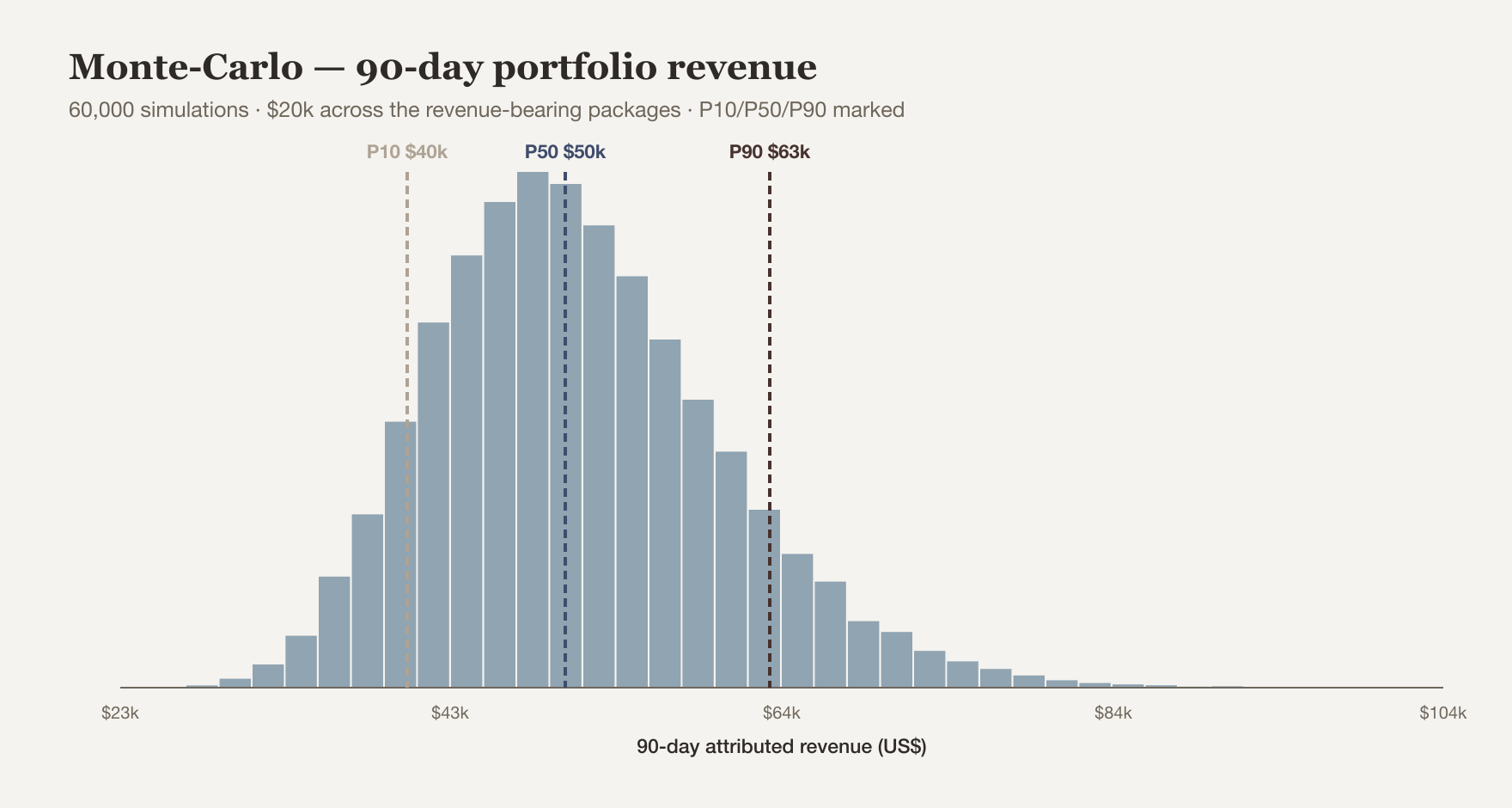
Figure 11.1. Monte-Carlo outcome distribution for the $20K 90-day pilot across the revenue-bearing packages ( simulations). The spread, not the point estimate, is the decision object.
11.7 Bayesian updating and Thompson-sampling allocation
The model is built to learn. Each package's conversion is given a Beta–Binomial conjugate prior; as live results arrive (successes , failures ), the posterior updates in closed form:
Budget is then allocated by Thompson sampling: on each cycle, draw a sample success-rate from every package's posterior and shift the next increment of spend toward the sampled best,
which automatically balances exploiting the proven winners against exploring the uncertain. With no live data yet, the allocator starts from weak priors anchored on each package's , producing the exploratory cold-start split below; as evidence accrues the posteriors sharpen and the allocation concentrates. This is the same Thompson-Sampling mechanism the companion autonomous engine uses across ad platforms (§6.1), lifted one level up to operate across whole packages.
A caveat on commensurability: the ten packages do not all measure success in the same unit — most are per-reader acquisition plays, but the publisher-ABM package counts accounts, the trade package counts institutional placements, and the author-community package is a supply-side seeding play with no per-reader reward signal. The allocator therefore ranks all ten on the unit-agnostic objective-completion probability (each package's own falsifiable success predicate, §11.2), not on a common conversion rate. In practice the author-community, publisher-ABM, and bookstore/library plays are run as fixed credibility-and-supply investments sized by their strategic role rather than as per-reader bandit arms; only the homogeneous reader-acquisition packages (BookTok, BookTuber, Search, Meta, Email, SEO, Serial) are continuously reallocated against each other on live conversion. The cold-start split below reflects that: the heterogeneous plays sit near the exploration floor, and the reader-acquisition bandit competes over the remainder.
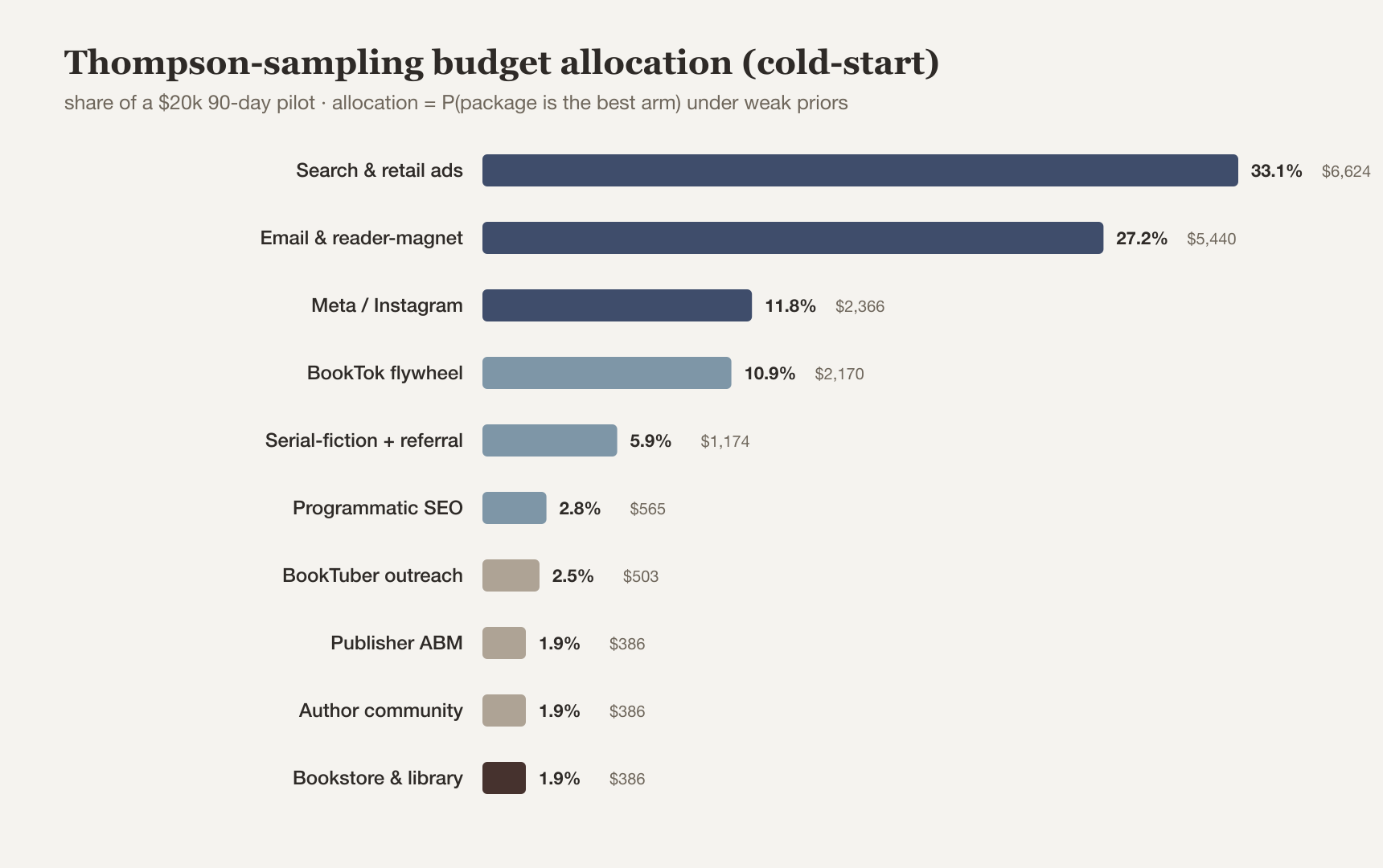
Figure 11.2. Cold-start Thompson allocation of the $20K pilot: ~33% to Search & retail ads, ~27% to the email/reader-magnet funnel, ~12% to Meta, ~11% to BookTok, with the remainder exploring the lower-probability plays. The split is a prior, not a verdict — it moves as live results update the posteriors.
11.8 Sensitivity: which lever moves success most
A one-at-a-time tornado analysis perturbs each factor by ±10% and measures the swing in the mean raw score, an estimate of . The result tells the operator where attention pays off: the three highest-leverage factors are unit economics, market pull, and reach quality — which is the model confirming its own weighting and, more usefully, telling Inkvelo that the fastest way to raise a package's odds is to improve its LTV:CAC or get it in front of a larger, better-fitted audience, not to fiddle with timing or automation.
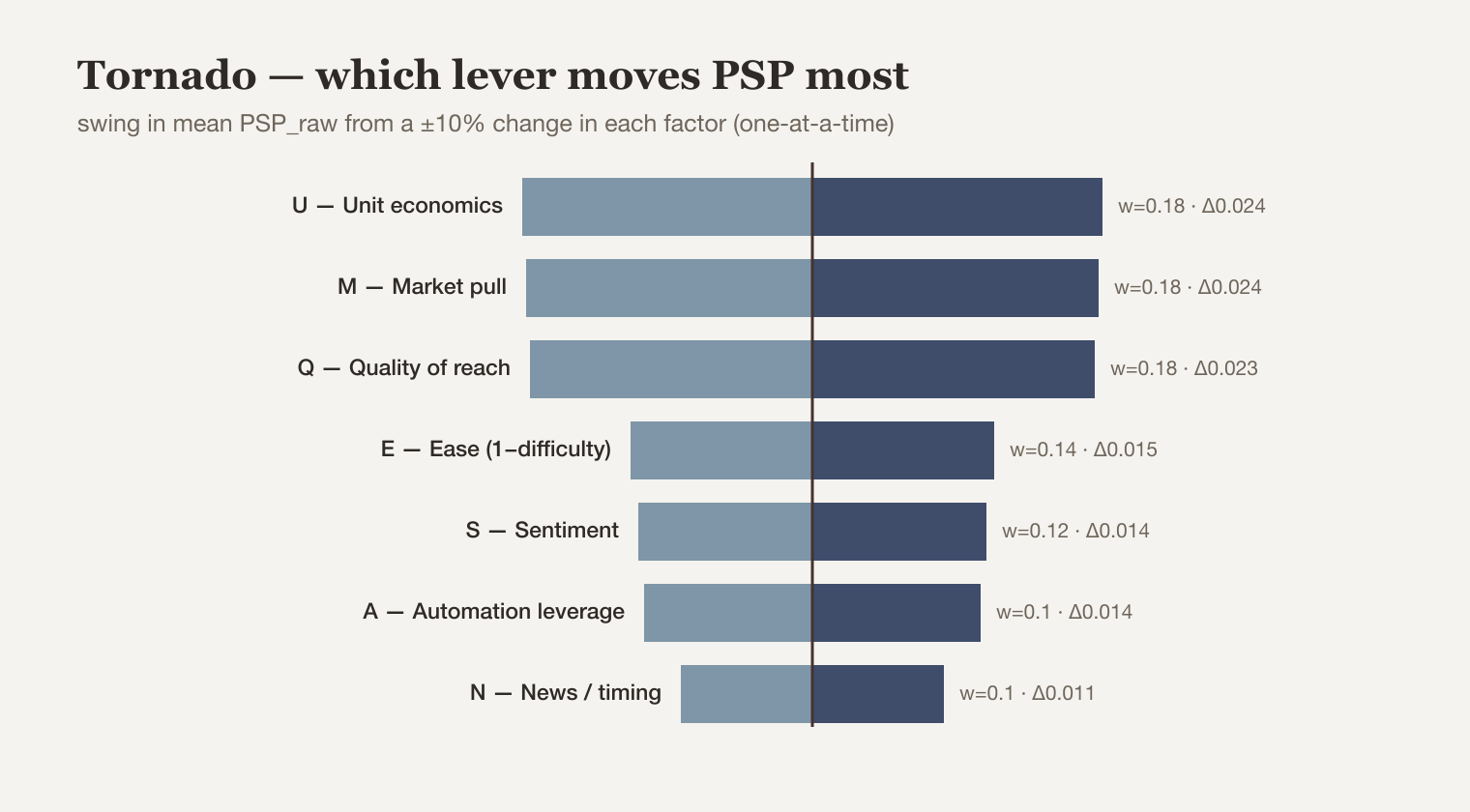
Figure 11.3. Tornado sensitivity: swing in mean from a ±10% change in each factor. , , and dominate.
11.9 The portfolio result
Applying the model to the ten packages of Doc B yields the ranking below. The factor sub-scores are stated so that each PSP recomputes from ; the probability follows from §11.2; the economics from §11.4.
Table 11.3 — PSP portfolio (factor sub-scores → score → probability → economics) [P on V/D inputs].
| # | Package | PSP | CAC | ROAS | Alloc | ||||||||
|---|---|---|---|---|---|---|---|---|---|---|---|---|---|
| 3 | Search & retail ads (Google + Amazon) | .78 | .60 | .80 | .72 | .70 | .70 | .85 | 73.5 | 0.81 | $2.40 | 2.2× | 33% |
| 5 | Email & reader-magnet funnel | .66 | .50 | .80 | .70 | .72 | .78 | .88 | 72.0 | 0.80 | $1.50 | 3.5× | 27% |
| 4 | Meta / Instagram paid + organic | .74 | .55 | .80 | .62 | .62 | .58 | .82 | 66.9 | 0.72 | $3.80 | 1.4× | 12% |
| 1 | BookTok / short-video flywheel | .82 | .70 | .50 | .80 | .45 | .62 | .70 | 66.6 | 0.72 | $2.50 | 2.1× | 11% |
| 10 | Serial-fiction + referral / affiliate | .64 | .55 | .48 | .74 | .62 | .66 | .70 | 63.7 | 0.67 | $1.80 | 2.9× | 6% |
| 7 | Programmatic SEO + Digital-DNA engine | .60 | .45 | .55 | .58 | .55 | .72 | .80 | 61.0 | 0.62 | $0.40 | 13.1× | 3% |
| 2 | BookTuber / YouTube outreach | .68 | .55 | .50 | .66 | .50 | .60 | .72 | 60.6 | 0.61 | $2.20 | 2.4× | 3% |
| 8 | Publisher ABM + backlist→audiobook | .58 | .55 | .60 | .55 | .40 | .82 | .55 | 58.9 | 0.58 | $900/acct | 4.7× | 2% |
| 6 | Author community & founder-led | .55 | .50 | .65 | .62 | .45 | .60 | .50 | 56.0 | 0.52 | — (supply) | — | 2% |
| 9 | Bookstore & library trade | .50 | .45 | .30 | .47 | .33 | .55 | .45 | 44.6 | 0.30 | $6.50 | 0.8× | 2% |
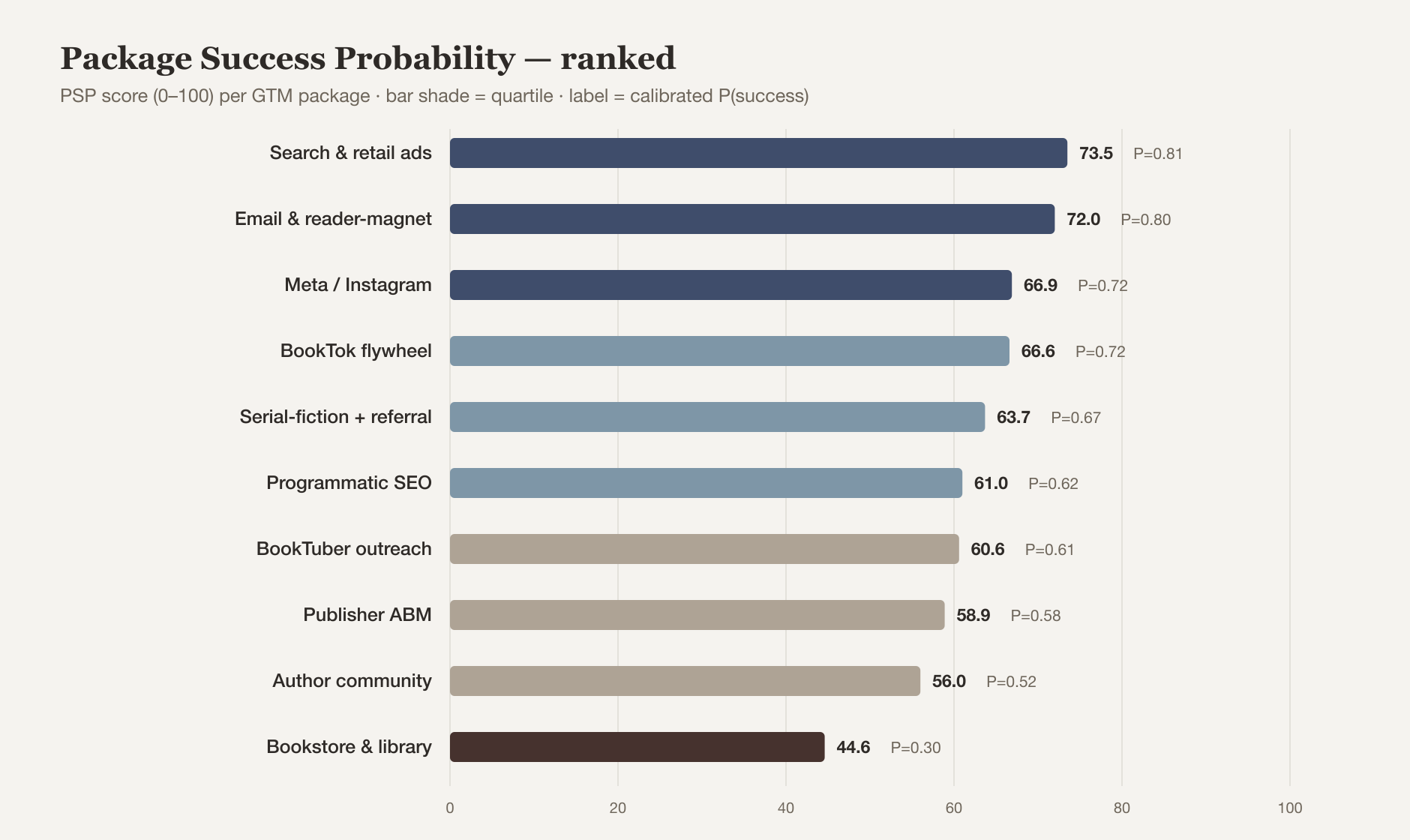
Figure 11.4. The ten packages ranked by PSP score, annotated with calibrated .
Two readings matter. First, the top of the board is the trust-grain-aligned, automatable, high-intent demand machinery — search/retail ads, the owned email funnel, Meta, and BookTok — exactly the plays where sentiment is neutral-to-positive, reach is large, and a NexusROS skill can run most of the work. Second, the bottom of the board is the bookstore-and-library trade (PSP 44.6, 0.30), and the model is right to put it there: it is the segment with the lowest reachability, the highest difficulty, and the most hostile AI sentiment (Table 11.2). That is not an argument to abandon it — it is the segment that confers institutional trust the algorithmic channels cannot — but an argument to run it as a patient, disclosure-first, credential-building play (§9.2, Phase 3) rather than a near-term acquisition bet, and to size its spend accordingly. The reachability-versus-ease view makes the same point geometrically:
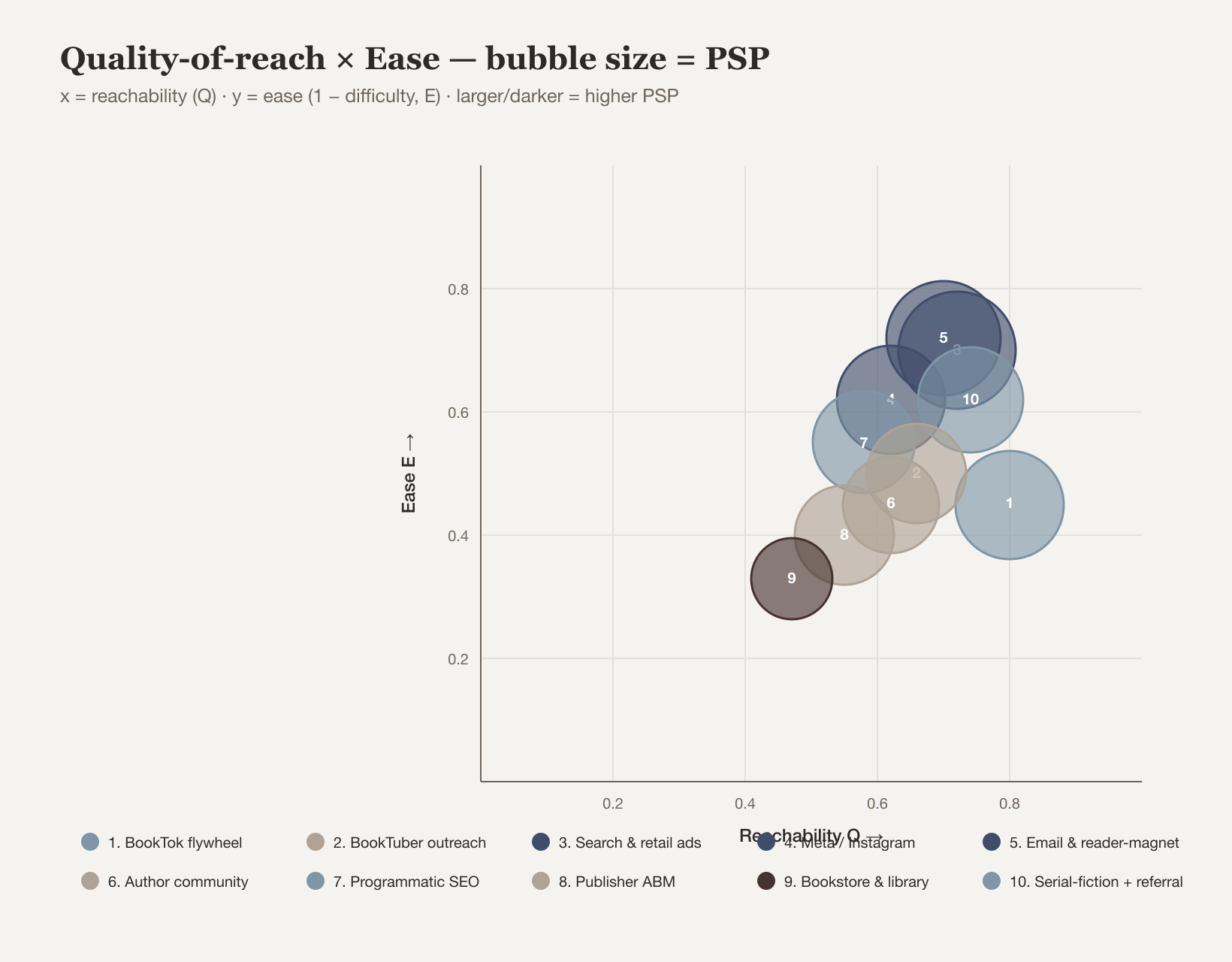
Figure 11.5. Each package plotted by reachability () and ease (), with bubble size proportional to PSP. The demand-side cluster sits top-right (reachable, easy, high-PSP); the institutional trade channel sits bottom-left.
The factor-profile view shows why two high-ranking packages win for different reasons — and why the trade channel lags on nearly every axis:
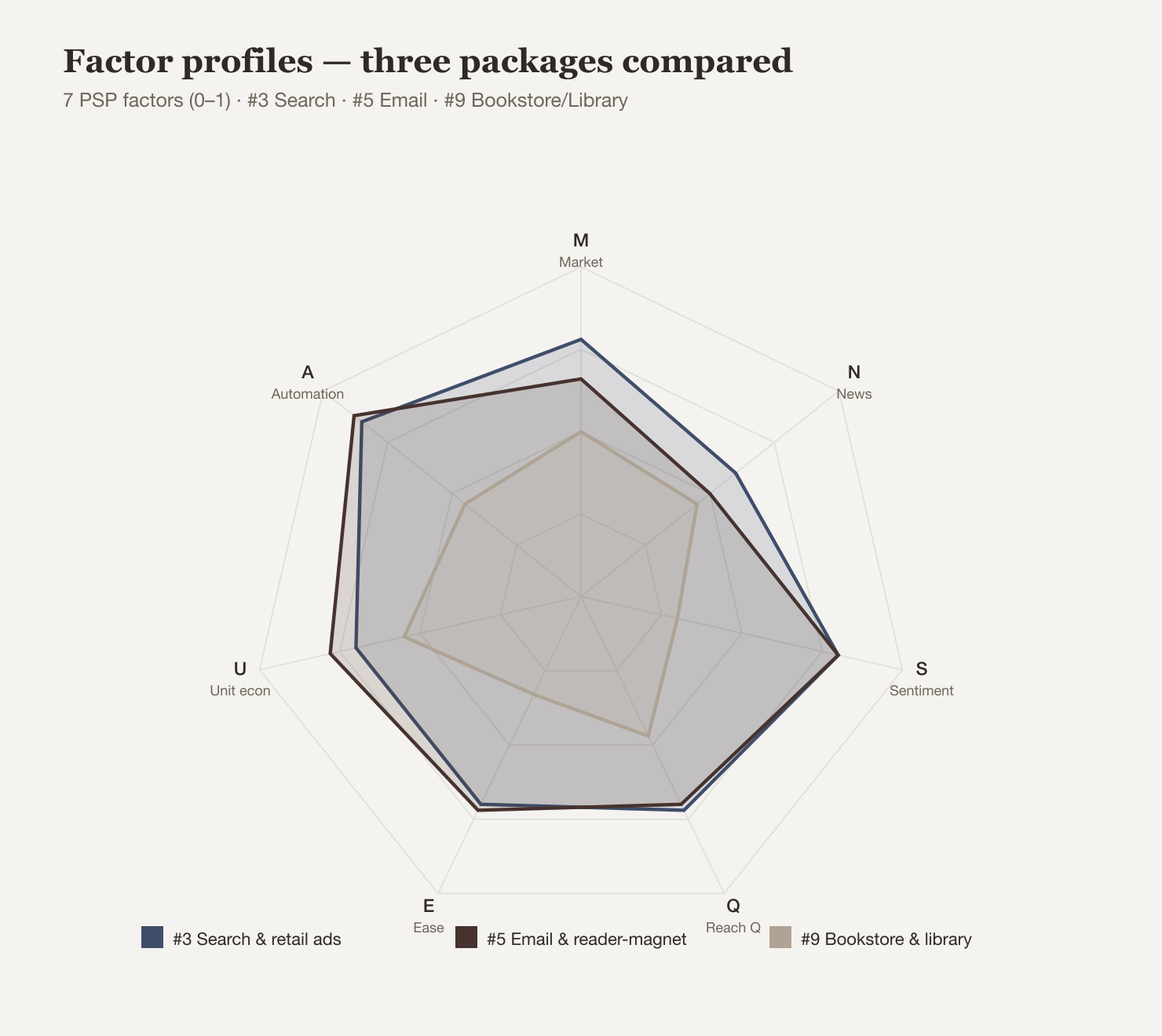
Figure 11.6. Factor profiles for Search (#3), Email (#5), and Bookstore/Library (#9). Search wins on automation and sentiment; Email on unit economics and ease; the trade channel trails on reach, ease, and sentiment alike.
11.10 Monitoring: the live scorecard
A score computed once is a guess; a score recomputed on a cadence is a control system. Every package therefore carries a tracked scorecard with two tiers of key performance indicators — leading (impressions, click-through rate, cost-per-lead, signups, audiobook-attach rate) and lagging (CAC, conversion %, LTV, ROAS, payback period) — and the PSP is recomputed on each cycle as live results update the Beta–Binomial posteriors (§11.7). The Thompson allocator then reallocates the next budget increment toward packages whose PSP is rising, and away from those whose live conversion disconfirms their prior. The non-negotiable gates (§11.5) are re-evaluated each cycle too, so a package is automatically de-amplified the moment a trust or migration predicate fails. This is the operational loop that connects the model to money; the per-package scorecards, with their exact KPI targets and the NexusROS skills that compute them, are specified in Doc B.
The PSP model is, in short, the bridge between strategy and execution: it takes the audiences of §8, the economics of §10, and the non-negotiables of §10.5, and turns them into a ranked, probabilistic, continuously-updated allocation that a small operating team — or the autonomous engine of §6 — can actually run.
12. Risk Analysis and Watch-Outs
This section completes RQ4: the watch-outs that could derail the relaunch. We present each as a named risk with its evidence and a concrete mitigation, ordered roughly from most existential to most operational. Together with the competitive landscape of §2, this section completes RQ4. The recurring theme is that Inkvelo's greatest risks are not technical — the platform works — but trust risks and one unproven assumption (the revenue curve).
12.1 The revenue curve is unproven (the dominant risk)
Every attractive number in §10 sits on a demand curve that has not been observed. The cost architecture is robust to a wide range of outcomes, but the revenue projections — author acquisition, paid conversion, audiobook attach — are inherited assumptions [D], and a marketplace cold-start is notoriously hard to ignite. Mitigation: treat the revenue curve as a hypothesis to be tested cheaply in the Phase-1 beta (§9.2) before committing scale; produce the Monte-Carlo distribution and monthly cash-flow model (§10.4) so the decision is made on a range of outcomes, not a point estimate; and lean on the fact that the cost structure makes even the conservative variant viable. This is the risk the rest of the paper is most careful not to obscure.
12.2 Author backlash against AI-native publishing
The most vocal segment of the author community is wary of AI, and Inkvelo's most valuable supply — professional fiction authors — is the most skeptical: only ~11% of fiction authors use AI for publishable text [V] (BookBub, 2025), and ~90% of authors believe they should be compensated for the use of their work in AI training [V] (Authors Guild, 2023). An AI-forward brand risks alienating exactly the creators it needs. Mitigation: the brand posture of §3.2 — quality and provenance transparency, never "AI books" — plus genuine author empowerment (generous royalties, no exclusivity, author ownership) and human-led community engagement (§9.4). Inkvelo must be a platform a craft-proud author is proud to use, which is a positioning choice as much as a product one.
12.3 Trust-signal gameability and marketplace flooding
The Digital DNA score is the linchpin of the whole strategy, which makes it the highest-value target for gaming. If authors learn to optimise the score without improving the book, or if readers come to see the badge as marketing rather than signal, the quality-as-incentive thesis inverts — the score becomes noise and the marketplace becomes the very undifferentiated flood it was meant to escape. The context is real: marketplaces have already been flooded with low-quality AI content. Mitigation: the score must be validated against reader outcomes (completion, ratings, returns), not just intrinsic text features, so that gaming the text without satisfying readers is self-defeating; the anti-flooding throttle (§6.3) must hold; and AI-provenance metadata must propagate end-to-end so the "Human-written only" filter remains honest. This is non-negotiable #1 and #5 (§10.5), and it is where the most engineering vigilance is warranted.
12.4 Copyright and training-data litigation
The legal ground under all AI-generated content is unsettled. In Bartz v. Anthropic, a $1.5 billion settlement (a floor; roughly $3,000 per work across ~500,000 works) followed Judge Alsup's June 2025 ruling that training on lawfully acquired books is transformative fair use but that pirated copies are not [V] (Authors Guild, 2025; NPR, 2025). In December 2025, six authors opted out of that settlement and sued six major AI firms for $150,000 per work each [V] (Publishers Weekly, 2025; TechCrunch, 2025). Mitigation: Inkvelo's exposure is indirect — it depends on the provenance of the models it relies on — but the prudent posture is to favour models with defensible training provenance, maintain clear AI-disclosure, and keep the platform's own author content cleanly licensed. The litigation is a sector-wide weather system, not an Inkvelo-specific storm, but it must be monitored.
12.5 Single-vendor and unshipped-migration dependency
Two dependency risks compound. First, the near-zero audiobook COGS depends on a self-hosted TTS migration that has not yet shipped — today the pipeline points at an external GPU provider (§5.5), so the most attractive economics in the model are a roadmap item, not current state. Second, any reliance on external inference (for NexusROS GTM skills or for generation) is a concentration risk. Mitigation: prioritise the Kokoro/GPU migration (non-negotiable #2) and the inference-pinning work (non-negotiable #3) as the critical path before scaling audiobook volume or paid campaigns; until then, model audiobook COGS as variable and size paid spend conservatively. Honesty here protects the P&L from a pleasant fiction.
12.6 Platform policy and channel headwinds
Three external policies constrain growth. Amazon requires disclosure of AI-generated content and caps uploads at three titles per day [V] (Authors Guild, 2023); Google's scaled-content-abuse policy penalises thin AI pages [V] (Google Search Central, 2024); and the June 2025 KDP print-royalty cut (60%→50% for sub-$9.99 USD titles) [V] (Amazon KDP, 2025) signals that incumbents are squeezing author economics. Mitigation: these are, on balance, tailwinds for Inkvelo — they make incumbents less attractive and Inkvelo's generous, off-Amazon, quality-first model more so — provided Inkvelo respects them (data-rich SEO not filler; own-marketplace and wide distribution rather than Amazon dependence). §9.4 builds the go-to-market around exactly these constraints.
12.7 DIY substitution and royalty-compression pressure
At the bottom of the market, a $20/month general model plus cheap formatting tools is a real substitute for the writing layer, and incumbents' royalty cuts pressure the whole category's economics. Mitigation: Inkvelo's defence is the integration (§2.3) — the bundled journey from draft to distribution to audiobook to marketplace is worth far more than the sum of assembling free and cheap parts, and the value compounds across a series and a career. The bundle, not any single feature, is the moat; a writer can replicate the drafting with a chatbot, but not the audiobook, the quality signal, the distribution, and the autonomous marketing.
12.8 Competitive response from Inkitt/Galatea and well-capitalised incumbents
Inkitt/Galatea is moving toward the same vertical integration from the publisher-owned-IP direction, with ~$117M in funding behind it [V] (TechCrunch, 2021; 2024), and a well-resourced incumbent could attempt to bolt a quality signal or AI co-writer onto an existing marketplace. Mitigation: Inkvelo's structural advantages are its author-empowerment model (it serves authors rather than acquiring their IP, the opposite of Inkitt) and its cost structure (a bootstrapped near-zero-marginal-cost base that a venture-funded competitor with a salaried team and metered cloud cannot match on price). Speed to a credible quality-proof catalogue (§9.2) is the practical defence — owning the quality-and-trust position before a fast-follower can claim it.
12.9 Key-person and operator concentration
A bootstrapped venture with a fixed-cost development model and an autonomous-operations engine is, by design, run by very few people. That is a strength for cost but a risk for resilience: the same automation that displaces a marketing department also concentrates operational knowledge in a small operator group and in the engine's configuration. Mitigation: treat the autonomous engine's human-in-the-loop gates (§6.2) as documentation as much as control, keep configuration and playbooks in version control, and ensure the platform can be operated — if degraded — without any single individual. The bootstrapped model trades headcount risk for key-person risk, and that trade must be managed explicitly rather than assumed away.
12.10 Reputational tail risk from a high-profile failure
In a trust-first brand, a single visible failure — a promoted title later exposed as plagiarised, fabricated, or offensive, or an autonomous campaign that makes a false claim — can damage the brand out of all proportion to its frequency. The quality gate and truth-constrained marketing (§6) lower the probability but cannot eliminate the tail. Mitigation: maintain rapid takedown and de-amplification capability, keep the human approval gate genuinely in the loop for paid promotion, and treat the "Human-written only" and provenance signals as commitments to be honoured rather than features to be marketed — because the cost of being caught misrepresenting provenance is not a single title but the entire brand.
12.11 Quantified risk weights into the PSP model
The risks above are not free-floating cautions; each maps to a specific term in the PSP model (§11), either down-modulating a factor or acting as a hard gate. Making the mapping explicit is what keeps the scoring honest — a package's success probability should fall when a relevant risk is live, automatically. Table 12.1 states the linkage and an indicative weight.
Table 12.1 — Risk → PSP modulation map.
| Watch-out (§) | PSP linkage | Mechanism / indicative weight |
|---|---|---|
| Revenue curve unproven (§12.1) | Portfolio-level discount | Not per-package; widens the Monte-Carlo spread (§11.6) and is the reason P10 is reported, not just P50 |
| Author AI backlash (§12.2) | on author/community channels | Sentiment factor already prices this ($s=+0.30$ pro-indie, but $-0.5$ literary mass); a flare-up shifts down |
| Trust-signal gameability (§12.3) | Hard gate on all packages | Non-negotiable #1; if DNA reader-credibility fails, every PSP is capped (§11.5) — the highest-consequence single risk |
| Copyright litigation (§12.4) | (news/timing) | Sector-wide headwind term; decays as cases resolve |
| Unshipped audio migration (§12.5) | Hard gate on audio-dependent plays | Non-negotiable #2; caps the free-audiobook-wedge and backlist-to-audiobook packages until the migration ships |
| Platform/channel headwinds (§12.6) | , | Amazon 3/day cap and Google scaled-content policy raise difficulty on KDP-funnel and programmatic-SEO packages |
| DIY substitution (§12.7) | , on tool-only plays | Erodes market pull/economics where the value is just drafting; mitigated by the integration moat (§2.3) |
| Inkitt/incumbent response (§12.8) | Compresses reachable SAM if a well-capitalised rival claims the position first; speed-to-catalogue is the counter | |
| Key-person concentration (§12.9) | reliability | Raises the operational risk on the automation factor; mitigated by version-controlled playbooks and HITL gates |
| Reputational tail (§12.10) | + gate | A single high-profile failure can move sharply and trip the anti-flooding gate; rapid de-amplification is the control |
The practical consequence is that the PSP scores of §11.9 are conditional on the current risk environment, and the monitoring loop (§11.10) re-evaluates both the modulated factors and the hard gates on each cycle — so a package's score falls the moment a relevant risk materialises, rather than after the quarter's numbers come in.
13. User Experience: Rebrand Surfaces and New Features
The expanded brief asks for UI/UX mockups of every new or changed surface, aligned with the existing platform architecture. This section specifies a twenty-six-item inventory across eight groups, states the design-system constraints that keep the new work architecturally consistent, and gives representative ASCII mockups for the highest-novelty surfaces. Full specifications for all twenty-six are in Appendix F. The governing principle is reuse, not reinvention: the rebrand re-skins and extends an existing, coherent design system rather than introducing new visual languages.
13.1 Design-system constraints (honour these)
The existing platform already distinguishes two surface registers, and that separation is an asset the rebrand should preserve rather than flatten [V].
- Two registers, never mixed. Author-tool surfaces use the sans-serif system (Urbanist/Inter), a dark working theme with a light alternate, and four functional section accents (write, develop, review-and-publish, settings). Reader-and-brand surfaces use a literary serif (Libre Baskerville) with warmer lavender/coral bands. The Inkvelo rebrand lives mostly in the reader/brand register externally and the author-tool register internally — and the two must not bleed into each other.
- Quality-tier and AI-label colours come only from the marketplace token source. DNA tiers are read by saturation within a purple-to-coral ramp (developing → listed → standard → quality-verified → editor's-choice), and AI-provenance labels (human / AI-assisted / AI-created) have fixed token colours. No surface invents its own quality colours; they all reference the shared tokens, so the signal stays consistent everywhere it appears.
- Reuse primitives. New surfaces compose existing components — metric tiles, the marketplace book card, the twelve-axis DNA radar, the accept/reject implement button, the TTS controls, the scorecard workbench, and the explainability primitives (a "why" affordance, an explanation drawer, an observation timeline) — rather than new chrome. New dashboards slot into the existing collapsible sidebar information architecture; charts use the existing charting library; primary calls-to-action use the established brand gradient.
13.2 The mockup inventory
Table 12.1 — Rebrand UX inventory (26 items, 8 groups). Fidelity: HIGH = rendered comp; ASCII = wireframe.
| Group | # | Surface | Fidelity |
|---|---|---|---|
| G1 Brand swap | 1–3 | Inkvelo logotype/wordmark; inkvelo.com landing; nav + footer rename | HIGH, HIGH, ASCII |
| G2 Revenue-Machine console (new) | 4–7 | Revenue cockpit; autonomous-agent control panel; agent activity/audit timeline; P&L / unit-economics drill-down | HIGH, HIGH, ASCII, HIGH |
| G3 NexusROS growth dashboards (greenfield) | 8–11 | Growth command center; campaign manager; GTM blueprint viewer; audience / reader-intelligence | HIGH, ASCII, ASCII, HIGH |
| G4 Marketplace | 12–15 | Inkvelo storefront reskin; quality-badge legend; book-detail drawer (DNA + audio + buy); publisher / Kobo + retail handoff | HIGH, HIGH, HIGH, ASCII |
| G5 Royalty / payouts | 16–17 | Royalty & payouts dashboard; royalty-split editor | HIGH, ASCII |
| G6 Quality-DNA (author) | 18–20 | Digital DNA scorecard; DNA gap/improvement inspector; tier-unlock moment | HIGH, ASCII, ASCII |
| G7 Kokoro audiobook | 21–23 | Audiobook production wizard ($0-COGS framing); voice casting + preview; pipeline cost/throughput monitor | HIGH, HIGH, ASCII |
| G8 Cross-cutting | 24–26 | Unified author mission-control; pricing/plans page; onboarding / first-run | HIGH, HIGH, ASCII |
An honest scoping caveat: Groups 2 and 3 (the Revenue-Machine console and the NexusROS growth dashboards) are proposed UI for capabilities that are partly greenfield — the autonomous-revenue console and the ROS growth surfaces are not yet fully built in the product (§5.5, §12.5). We present them as designs to build, clearly distinguished from Groups 1, 4, 5, 6, 7, and 8, which re-skin or extend surfaces that already exist.
13.3 Representative mockups
Three surfaces carry the most novelty and best illustrate the design language.
Mockup 18 — Digital DNA Scorecard (author register). The score made legible and actionable.
┌─ INKVELO ·   Digital DNA ────────────────────────────── "Tideglass" ──┐
│                                                                       │
│   COMPOSITE  78 / 100        Tier: ◗ QUALITY VERIFIED                  │
│   ▰▰▰▰▰▰▰▰▰▱  genre percentile: 84th (Fantasy)                         │
│                                                                       │
│        Character depth ▰▰▰▰▰▰▰▰▱▱ 81     ╭───────────────╮            │
│        Plot architecture ▰▰▰▰▰▰▰▱▱▱ 72    │   12-axis     │            │
│        World coherence ▰▰▰▰▰▰▰▰▰▱ 88      │   DNA radar   │            │
│        Voice consistency ▰▰▰▰▰▰▰▰▱▱ 79    │   (existing   │            │
│        Pacing ▰▰▰▰▰▰▱▱▱▱ 64  ◀ weakest    │   primitive)  │            │
│        … 7 more dimensions                ╰───────────────╯            │
│                                                                       │
│   ▶ Unlock free audiobook at 75+  ✔ unlocked                          │
│   ▶ Editor's Choice at 90+ — 12 points away                           │
│   [ Improve pacing → opens inspector ]   [ ? why this score ]         │
└───────────────────────────────────────────────────────────────────────┘
Mockup 4 — Revenue cockpit (author register, new). The "revenue machine" surfaced as a single pane of glass — proposed for the greenfield engine.
┌─ INKVELO ·   Revenue Cockpit ──────────────────────── this month ─────┐
│  Net revenue   \$4,210  ▲12%   │  Audiobook attach  61%   │ Margin 94% │
│  ─────────────────────────────┼──────────────────────────┼───────────│
│  Campaign Genesis     ● live   │  Catalogue: 7 titles               │
│    ▸ "Tideglass" launch  day 22/84   spend \$310 · ROAS 2.4×          │
│    ▸ Bandit reallocating → TikTok ▲  Meta ▼  (awaiting your approval) │
│                                                                       │
│  [ Approve spend shift ]  [ Hold ]   ⓘ truth-constrained · AI-disclosed│
│  Forecast (Monte-Carlo P50): \$6,900 next mo  [P10 \$4.1k · P90 \$11k]   │
└───────────────────────────────────────────────────────────────────────┘
Mockup 12 — Inkvelo storefront (reader/brand register). The reader-facing reskin — serif, warm, story-first, AI never the headline.
╔═ Inkvelo ═══════════════════  Browse · Audiobooks · Lists · Sign in ═╗
║   "Books worth your time."                                            ║
║   ┌──────────┐  Featured                                              ║
║   │  cover   │  TIDEGLASS — A. Rivers   ◗ Quality Verified            ║
║   │          │  ★ 4.6 · Fantasy · 🎧 Free audiobook                   ║
║   └──────────┘  [ Read sample ]  [ Buy \$4.99 ]                        ║
║   ── Genre ▾  Quality ▾  Format ▾   ☐ Human-written only ─────────────║
║   New Releases ▸    Trending ▸    Free this week ▸                     ║
╚═══════════════════════════════════════════════════════════════════════╝
Mockup 16 — Royalty & payouts (author register). Money the author can read at a glance.
┌─ INKVELO ·   Royalties & Payouts ──────────────────── Maya Rivers ────┐
│  This month   \$3,140 earned     Next payout  Jun 28   ▸ Stripe ••4291 │
│  ──────────────────────────────────────────────────────────────────  │
│  Title              Sales   KU pages   Audiobook    Your share (70%)  │
│  Tideglass           412    88,200     61 listens    \$1,910           │
│  Saltwake (Bk 2)     201    40,110     22 listens    $   930          │
│  …                                                                    │
│  Lifetime: \$41,880   ·   [ Export statement ]   [ Tax docs ]          │
└───────────────────────────────────────────────────────────────────────┘
Mockup 21 — Audiobook production wizard (author register, "free" framing). The $0-COGS capability surfaced as a one-click action.
┌─ INKVELO ·   Make an Audiobook ─────────────────────  "Tideglass" ────┐
│  ✔ Quality Verified (78) — audiobook unlocked, FREE                   │
│  Step 1 ▸ Cast voices    Step 2 ▸ Review    Step 3 ▸ Publish          │
│  ──────────────────────────────────────────────────────────────────  │
│  Narrator (default)  ◐ "Maren", warm alto      [ audition 0:12 ▶ ]    │
│  Character voices auto-cast from your Character Bible:                │
│    Kestrel → "Sable"  ·  Dr. Vane → "Orin"  ·  [ + reassign ]         │
│  Est. length 9h 40m  ·  cost to you: \$0  ·  [ Generate audiobook ]    │
└───────────────────────────────────────────────────────────────────────┘
These five illustrate the registers in practice: the scorecard, cockpit, royalty dashboard, and audiobook wizard speak the author-tool language (functional, metric-dense, dark-themed in the product), while the storefront speaks the reader-brand language (serif, warm, story-first, with the quality badge and provenance toggle as the only nods to the platform's machinery). Appendix F specifies the remaining twenty-one.
14. Discussion
14.1 The architecture is the strategy
The most important finding of this paper is that Inkvelo's defensibility is not any single feature but the interaction between its cost architecture and its quality posture. A near-zero-marginal-cost base (§5) is what makes the generous royalties (§10.1), the free audiobooks (§5.4), and the organic-first go-to-market (§9) simultaneously affordable — and those three are precisely the instruments that recruit supply, attract demand, and do so without capital. A venture-funded competitor with a salaried team, metered cloud, and commercial TTS would, we argue, struggle to match all three at once, because its cost structure forces a choice among them. The bootstrapped architecture is therefore not merely a way to start cheaply; it is a durable competitive position, because it permits a combination of generosity and quality that a higher-cost rival cannot profitably copy.
14.2 Quality as the organising principle
A second thread runs through every section: the resolution of the AI-content trust problem is not enforcement but visible, credible quality. The Digital DNA score gates the marketplace (§4.4), throttles flooding (§6.3), feeds the growth engine (§7.2), and serves as the trust credential for the institutional channel (§8.3). It is the single mechanism that turns the glut of AI content from a threat into an opportunity — because in a market drowning in undifferentiated supply, a credible signal of quality is the scarcest and most valuable thing a platform can offer. This is why the score's credibility is the first non-negotiable (§10.5) and the highest-vigilance risk (§12.3): it is not a feature, it is the foundation.
14.3 Sequencing and the cold-start
The strategy's success hinges on sequencing as much as on capability. The two-sided cold-start (§8.5) means supply and trust must precede demand and scale; the bootstrapped premise means organic and automated channels must precede paid; and the greenfield dependencies (§5.5, §12.5) mean the brand relaunch can — and should — precede the full autonomous-GTM build. The phased portfolio (§9.2) encodes all three sequencing constraints, and the decoupling of the brand relaunch from the most speculative engineering (§3.4) is what makes the plan executable under uncertainty: Inkvelo can launch as a credible rebrand on proven capability while the autonomous machinery matures behind it.
14.4 Why incumbents cannot simply copy the model
It is reasonable to ask why a well-funded incumbent could not bolt a quality signal or an AI co-writer onto an existing marketplace and erase Inkvelo's advantage overnight. The answer is that each incumbent faces a structural conflict the integration would expose. Amazon's economics depend on volume and on not vouching for individual titles; a credible quality gate that withheld amplification from most uploads would contradict its open, take-all-comers model. The writing-tool band (Sudowrite and peers) would have to build distribution, a marketplace, audiobook production, and a reader audience from zero — the hardest and most capital-intensive parts of the stack. Reedsy's marketplace rests on human freelancers, so pivoting to AI tooling would alienate the 3,500 professionals who are its supply side. Inkitt could match the integration, but only inside its publisher-owns-IP model, which is a different and less author-friendly bargain. The point is not that incumbents are incapable; it is that the integration is cheap for Inkvelo and expensive for everyone else — for Inkvelo it is the natural shape of the platform, while for each incumbent it is a cannibalisation of the business it already has. That asymmetry, more than any single feature, is the durable advantage.
15. Limitations and Future Work
We are explicit about what this paper does not establish.
The revenue curve is unobserved. This is the central limitation, repeated here because it is that important. Every revenue figure is an inherited projection [D]; the cost-model contribution is real, but the demand-side outcomes are hypotheses. Future work: run the Monte-Carlo revenue simulation (§10.4), validate the Phase-1 beta assumptions against observed author-acquisition and conversion, and replace the inherited curve with measured data before any scale commitment.
No churn or retention model. The P&L assumes net-add growth without cohort decay on either side. A two-sided marketplace lives or dies on retention. Future work: build explicit author- and reader-retention curves and a payback model.
No monthly cash-flow model. "Profitable in year one" is accrual; the zero-capital constraint is about cash timing (§10.4). Future work: a monthly cash-flow model incorporating payment-processor lag, reserves, and refund float.
Greenfield dependencies presented as target state. The self-hosted audiobook migration and parts of the autonomous-revenue console are roadmap, not production (§5.5, §12.5, §13.2). Future work: ship the Kokoro/GPU migration and the inference-pinning before claiming the associated economics as realised, and benchmark Kokoro audiobook throughput per node to replace the order-of-magnitude estimate of §5.4 with a measured figure.
Compliance is named but not costed. AI-disclosure propagation, GDPR/CCPA for targeting, FTC for ad claims, and institutional AI-acceptance policies are identified (§6, §8.3, §12) but not modelled as a cost line. Future work: a costed compliance plan, especially for the cohort-targeting and autonomous-advertising paths.
Market sizing varies by firm. The ranges in §2.1 are wide enough that strategy should not rest on any single figure; we have presented ranges precisely to avoid false precision.
16. Conclusion
Independent publishing's bottleneck has moved off the page and onto two new constraints: operational fragmentation and trust under abundance. Inkvelo — the rebrand of ProseCreator — is positioned to address both, by integrating the entire journey from draft to distribution in one workspace and by competing on visible, credible quality rather than on volume.
This paper has made the case across seven questions and an expanded economic brief. We described the platform from the customer's perspective and located its productivity advantage in the removal of everything that is not writing (§4). We analysed the three audiences and the readers who close the loop (§8). We specified a bootstrapped cost architecture in which development, audiobook production, and infrastructure costs collapse toward zero or toward small fixed values (§5), incorporated an autonomous go-to-market engine and a sibling growth platform conditionally and with their trust-conflicting elements firewalled (§6, §7), and rebuilt a five-year P&L showing break-even moving forward by roughly two years and cumulative profit rising about 60% on the strength of the cost restructuring alone (§10). We laid out a phased, predominantly organic go-to-market (§9), specified the rebrand's user experience (§13), and catalogued the risks honestly (§12).
The conclusion we draw is disciplined rather than triumphant. The cost side of the thesis is strong and verifiable; the revenue side is the open question, and the right posture is to test it cheaply before betting on it. The architecture's great virtue is that it is forgiving: because the cost base is so low, Inkvelo is a viable business across a wide band of demand outcomes, and a good one if the demand projections prove even partly right. The rebrand's job is to make the platform a destination — a place readers trust, publishers license, and bookstores stock — and the name, the quality signal, and the integrated journey are, together, how it earns that status. What remains is to ship the greenfield dependencies, protect the six non-negotiables, and let the Phase-1 beta turn the revenue hypothesis into evidence.
References
Every external source below was checked against its primary or reputable-secondary origin on 6 June 2026 (see Appendix C). Internal companion documents are marked accordingly and treated as projections.
Academic and scholarly sources
Chamberlain, B. P., Cardoso, A., Liu, C. H. B., Pagliari, R., & Deisenroth, M. P. (2017). Customer lifetime value prediction using embeddings. Proceedings of the 23rd ACM SIGKDD International Conference on Knowledge Discovery and Data Mining. doi.org
Cialdini, R. B. (2007). Influence: The psychology of persuasion (Rev. ed.). HarperCollins. (Original work published 1984)
Costa, P. T., Jr., & McCrae, R. R. (1992). Revised NEO Personality Inventory (NEO-PI-R) and NEO Five-Factor Inventory (NEO-FFI) professional manual. Psychological Assessment Resources.
Goldberg, L. R. (1990). An alternative "description of personality": The Big-Five factor structure. Journal of Personality and Social Psychology, 59(6), 1216–1229. doi.org
Hviid, M., Izquierdo-Sanchez, S., & Jacques, S. (2019). From publishers to self-publishing: Disruptive effects in the book industry. International Journal of the Economics of Business, 26(3), 355–381. doi.org
Kosinski, M., Stillwell, D., & Graepel, T. (2013). Private traits and attributes are predictable from digital records of human behavior. Proceedings of the National Academy of Sciences, 110(15), 5802–5805. doi.org
Marston, W. M. (1928). Emotions of normal people. Kegan Paul, Trench, Trubner & Co.
Matz, S. C., Kosinski, M., Nave, G., & Stillwell, D. J. (2017). Psychological targeting as an effective approach to digital mass persuasion. Proceedings of the National Academy of Sciences, 114(48), 12714–12719. doi.org
Taddeo, M., & Floridi, L. (2016). The debate on the moral responsibilities of online service providers. Science and Engineering Ethics, 22(6), 1575–1603. doi.org
Industry, market, legal, and competitor sources
Amazon KDP. (2025). Changes to royalty rates for print books and color printing costs starting June 10, 2025. kdpcommunity.com
Amazon KDP. (2023–2025). Content guidelines (AI-generated content disclosure). kdp.amazon.com
Authors Guild. (2023, May 15). Survey reveals 90 percent of writers believe authors should be compensated for the use of their books in training generative AI. authorsguild.org
Authors Guild. (2023). Amazon adds to KDP generative AI policy, caps daily self-publishing uploads. authorsguild.org
Authors Guild. (2025). What authors need to know about the $1.5 billion Anthropic settlement. authorsguild.org
BookBub Partners. (2025). How authors are thinking about AI (survey of 1,200+ authors). insights.bookbub.com
Credence Research. (2025). AI writing assistant software market to reach USD 10,298 million by 2032 (24.8% CAGR). prnewswire.com
Dataintelo. (2025). Self-publishing market research report 2034. dataintelo.com
Draft2Digital. (2026). Ebook royalty rates; store partner: Kobo. draft2digital.com
Google Search Central. (2024, March 5). What web creators should know about our March 2024 core update and new spam policies. developers.google.com
Grand View Research. (2024). Books market size, share & trends analysis report (and Global books market to reach $192.12 Bn by 2030). grandviewresearch.com
Grand View Research. (2024). Audiobooks market size to reach $35.47 billion by 2030. grandviewresearch.com
Grand View Research. (2024). Generative AI in content creation market size report, 2030. grandviewresearch.com
Kindlepreneur. (2025). Atticus vs. Vellum: A side-by-side comparison. kindlepreneur.com
Litmus. (n.d.). The ROI of email marketing [infographic]. litmus.com
Mordor Intelligence. (2026). Audiobook market size, share, trends & growth analysis report. mordorintelligence.com
Novelcrafter. (2026). Pricing; What is BYOK? novelcrafter.com
NPR. (2025, June 25). Federal judge rules in AI company Anthropic's favor in landmark copyright lawsuit. npr.org
OverDrive. (2025, January 27). Libraries break digital lending records in 2024 with over 739 million checkouts. company.overdrive.com
Publishers Weekly. (2026). Book output topped four million in 2025 (Bowker data). publishersweekly.com
Publishers Weekly. (2025). Authors file new lawsuit against AI companies seeking more money. publishersweekly.com
Publishers Weekly. (2025). Book industry divided over AI adoption, finds BISG survey. publishersweekly.com
Publishers Weekly / Circana. (2025). TikTok uncertainty prompts the book business to envision an even better future (BookTok BookScan data). publishersweekly.com
Reedsy. (2025). Fees FAQ; Reedsy Studio. reedsy.com
Statista. (2026). eBooks – Worldwide (market forecast). statista.com
Sudowrite. (2026). What plans are available? docs.sudowrite.com
TechCrunch. (2021, October 4). Inkitt books $59M investment. techcrunch.com
TechCrunch. (2024, February 26). Inkitt nabs $37M. techcrunch.com
TechCrunch. (2025, December 23). John Carreyrou and other authors bring new lawsuit against six major AI companies. techcrunch.com
Verified Market Research. (2024). Self-publishing service market size, share & forecast. verifiedmarketresearch.com
WEBTOON Entertainment Inc. (2024). Form S-1 registration statement (Wattpad MAU). U.S. Securities and Exchange Commission. sec.gov
WordsRated. (2024–2026). Self-published books & authors sales statistics. wordsrated.com
WordsRated. (2024–2025). BookTok statistics. wordsrated.com
Additional sources (v1.1 deepening — productivity, reach, benchmarks, sentiment-index method)
Each checked against its primary or reputable-secondary origin on 7 June 2026; corrections recorded in Appendix C.
Noy, S., & Zhang, W. (2023). Experimental evidence on the productivity effects of generative artificial intelligence. Science, 381(6654), 187–192. doi.org
Wu, J., et al. (2025). Generative AI's impact on graduate student professional writing productivity and quality. International Journal of Artificial Intelligence in Education. link.springer.com
Hutto, C. J., & Gilbert, E. (2014). VADER: A parsimonious rule-based model for sentiment analysis of social media text. Proceedings of the International AAAI Conference on Web and Social Media, 8(1). github.com
Reactive writers: How co-writing with AI changes how we engage with ideas (2026). arXiv preprint. arxiv.org — and related work on AI co-writing and psychological ownership (2025).
RavenPack. (n.d.). Introducing the RavenPack Sentiment Index. ravenpack.com
Audio Publishers Association / Edison Research. (2026). Audiobook consumer & sales surveys (US audiobook sales $2.43B, +9%; AI-narration willingness 70%→61%). audiopub.org ; infodocket.com
Written Word Media. (2025; 2026). 2025 Indie Author Survey (n=1,346; marketing spend by income tier) and 2026 Reader Survey (n=3,589; 80%+ prefer human narration). writtenwordmedia.com
Circana BookScan (via infoDOCKET / Publishing Perspectives). (2024–2025). 2024 print results (Fantasy +35.8%, Romance +9%) and holiday/week-51 seasonal peak. infodocket.com
OverDrive. (2026). Libraries break digital lending records in 2025 with over 820 million checkouts. company.overdrive.com
American Booksellers Association. (2025). 2025 Annual Report (3,783 member locations, +19%; via Jane Friedman / PW). janefriedman.com
BISG / BookNet Canada. (2025). AI use across the North American book industry (98% report significant concerns). publishersweekly.com
Gotham Ghostwriters / Bernoff, J. (WOBS LLC). (2025). AI and the writing profession (61% use AI for support; 7% generate). thewritingking.com
Bowker (via Publishers Weekly). (2026). 2025 title output (642,242 traditional; 3.5M+ self-published). publishersweekly.com
Ad Badger. (2026). Amazon advertising statistics (Books-category CPC $0.38, CVR 18%, ACOS 19%). adbadger.com
MailerLite. (2025). Email marketing benchmarks (Authors category: open 43.14%, CTR 2.75%). mailerlite.com
BookBub Partners. (2025). Featured Deals pricing (per-genre fees and expected downloads). bookbub.com
Spotify Newsroom. (2025). Audiobooks in Premium — two-year anniversary (500K+ titles; 52% of audience 18–34). newsroom.spotify.com
Internal companion documents (Adverant Research; treated as projections, [D])
Adverant Research. (2026a). ProseCreator marketplace platform [Working paper, link-only]. Adverant Limited. adverant.ai
Adverant Research. (2026b). Revenue pipeline templates for autonomous book go-to-market: Psychographic targeting, generative creative synthesis, and closed-loop multi-platform optimization [Working paper, link-only]. Adverant Limited. adverant.ai
Appendix A — Feature-to-Capability Evidence Map
The customer-facing capabilities described in §4 correspond to the platform's implemented surface. The mapping below groups capabilities by journey stage; capability claims are grounded in the platform's manifest, job-type schema, route/handler set, and live marketplace surface.
| Journey stage | Customer capability | Platform basis |
|---|---|---|
| Ideation | Living Blueprints; Visual Canvas; Research briefs; Project/Series Constitution | Blueprint generator + routes; canvas job types; research job type; constitution schema |
| Creation | 20 writing modes; Writing Studio; beat/chapter generation; voice consistency; real-time streaming | Modes registry; studio editor; content-generation handler; websocket pipeline |
| Refinement | 31 inspector panels; Writers Rooms (AI personas); master narrative audit; continuity & plot-hole detection; Digital DNA score | Inspector job types + findings; rooms routes; audit handler; continuity engine; DNA engine |
| World-building | World Codex; trope management; plot-thread lifecycle; character evolution | World-building routes; trope job types; plot-thread routes; character-evolution route |
| Delivery | Multi-format export (EPUB/DOCX/PDF/LaTeX/screenplay); front/back matter; publication-readiness | Export routes + service; publication handler; readiness assessment |
| Marketplace | Quality-graded storefront; free AI audiobook; royalties/payouts; Kobo + retail handoff; "Human-written only" filter | Marketplace commerce + Kobo routes; audiobook pipeline; live marketplace surface |
| Cross-cutting | Infinite narrative memory; insights flywheel; editor sync; chat assistant | GraphRAG + Neo4j + Qdrant memory; insights routes; editor-sync routes; chat job type |
Appendix B — Competitor Pricing and Fees Matrix [V]
| Platform | Category | Pricing | Royalty / fee | Note |
|---|---|---|---|---|
| Sudowrite | AI writing | $10/$22/$44 mo (annual) | — | No export/publish/audiobook |
| Novelcrafter | AI writing | $4–$20/mo + own LLM key | — | 157,000+ authors; BYOK |
| NovelAI | AI writing | $10/$15/$25 mo | — | Story + image gen |
| Squibler | AI writing | $9.99/mo | — | Scene image gen |
| Jasper | AI marketing | $49/$69 mo | — | Not narrative fiction |
| Claude / ChatGPT | DIY LLM | ~$20/mo | — | No continuity/publish scaffolding |
| Atticus | Formatter | $147 one-time | — | Cross-platform |
| Vellum | Formatter | $199.99 / $249.99 one-time | — | Mac-only |
| Reedsy | Studio + human marketplace | Free studio | 10% + 10% commission | 1.5M+ authors; 3,500+ pros |
| Amazon KDP | Distribution | Free | 70% ebook ($2.99–9.99); 50% print <$9.99 (Jun 2025) | Discovery; AI-disclosure; 3/day cap |
| Draft2Digital | Aggregator | Free | ~10% (~60% blended) | 15+ retailers |
| Kobo Writing Life | Distribution | Free | 45% (<$2.99) / 70% (≥$2.99) | Library/intl reach |
| IngramSpark | Distribution | ~$49/yr | ~40–45% net | Bookstore/library |
| Inkitt / Galatea | AI publisher | Galatea ~$6.99/mo | Publisher-owns-IP | ~$117M raised |
| Inkvelo | Integrated | Free–$199/mo | 65–75%, no exclusivity | AI write + DNA + free audiobook + marketplace |
Appendix C — Verification Audit (manual gate, checked 2026-06-06)
This appendix is the audit trail substituting for the automated grounded-verification gate (which required an unavailable credential). Each load-bearing external claim was checked against a primary or reputable-secondary source. Corrections applied to the body are bolded.
| Claim | Verdict | Resolution in paper |
|---|---|---|
| Global book market $151B 2024, 4.2% CAGR, →$192.1B 2030 | SUPPORTED | Used as [V] (Grand View Research) |
| Self-publishing market size | SUPPORTED (range) | Presented as named-firm range, §2.1 |
| Ebook market | SUPPORTED | Statista ~$15.9B/2030, ~1.2% CAGR; divergence noted |
| Audiobook market | SUPPORTED (divergent) | Both GVR (26.2%) and Mordor (10.6%) shown |
| "AI in publishing $3.58B/30.8%" | UNVERIFIABLE as stated | Replaced with GVR Generative-AI-in-Content-Creation [V]; doc figure footnoted [D] |
| AI writing-tools market | SUPPORTED (range) | Credence Research 24.8% CAGR cited |
| "2.6M self-pub titles in 2024" | CONTRADICTED | Corrected: 2.6M = 2023; ~2.5M 2024; >4M 2025 (PW/Bowker) |
| "Ebooks 51% of self-pub unit share" | UNVERIFIABLE | Dropped |
| KENP "fixed $0.004689/page" | CONTRADICTED | Corrected: variable, ~$0.0041–0.0050 in 2025 |
| KDP print royalty cut 60%→50% | PARTIALLY CONTRADICTED | Corrected: $9.99 USD threshold ($13.99 CAD), eff. 10 Jun 2025 |
| Self-pub ~31% Amazon ebook sales; 90% sell <100; 67% women | SUPPORTED | Used as [V] (WordsRated) |
| OverDrive 92,000+ libraries | SUPPORTED | Used as [V] |
| Wattpad ~90M MAU | OUTDATED | Reframed: ~89–90M (early-2024 standalone), now within WEBTOON ~157M |
| Royal Road ~14M visits/mo | SUPPORTED (caveat) | Attributed to Similarweb Feb 2025; Semrush divergence noted |
| BookTok ~59M US print sales 2024 | SUPPORTED | Used as [V] (Circana/PW) |
| Bartz v. Anthropic $1.5B / ~$3k/work / ~500k works / Alsup Jun 2025 | SUPPORTED | Used as [V]; $1.5B = floor, order dated 23 Jun 2025 |
| Dec 2025 six-author suit, $150k/work/defendant | SUPPORTED | Used as [V] (PW/TechCrunch) |
| KDP AI-disclosure + 3/day cap (Sep 2023) | SUPPORTED | Used as [V] (Authors Guild) |
| Authors Guild 90% compensation | SUPPORTED | Used as [V]; survey May 2023, n≈1,700+ |
| Google scaled-content-abuse policy (Mar 2024) | SUPPORTED | Used as [V] |
| BookBub 45% authors / 11% fiction publishable | SUPPORTED | Used as [V]; n≈1,229 |
| BISG 46% individuals / 48% orgs | SUPPORTED | Available [V] (not load-bearing in body) |
| Competitor pricing (Sudowrite, Novelcrafter, Atticus, Vellum, Reedsy, D2D, Kobo) | SUPPORTED | Used as [V], Appendix B |
| Inkitt funding "~$59M" | CONTRADICTED (framing) | Corrected: ~$117M cumulative ($59M 2021 + $37M 2024) |
| Email ROI "$36–$42:$1" | SUPPORTED (lower) | Use $36:1 (Litmus); "$42" dropped |
v1.1 verification addendum (checked 2026-06-07). The deepening of §2, §4.6, §8, §9, and §11 drew on a fresh live-search pass across ten audience/channel topics, each independently re-checked by an adversarial fact-checker; corrections are folded into the body and bolded here. The named-target research underlying §8.7 and the Doc B Target-List yielded 166 named targets, of which 136 were confirmed live and 30 are marked [unverified] (private/behind-login membership counts, undisclosed Discord sizes, and a few secondary-sourced claims).
| Claim (v1.1) | Verdict | Resolution |
|---|---|---|
| Gen-AI writing productivity: −40% time, +18% quality | SUPPORTED | [V] Noy & Zhang (2023, Science, n=453 RCT); used as mechanism evidence, transfer to novels tagged [P] |
| Grad-writing −56.7% time; legal −22% time | SUPPORTED | [V] corroborating studies; cited as directionally consistent |
| AI co-writing → offloading / lower ownership; longer prompts help | SUPPORTED | [V] used to justify accept/reject-diff design (§4.6) |
| BookBub: 45% authors use gen-AI; Claude 54% of users; 74% don't disclose | SUPPORTED | [V] (n=1,229, May 2025) |
| Gotham/Bernoff: 61% use AI for support, 7% generate | SUPPORTED | [V] (n=1,481) |
| BISG: 98% of book-industry pros report significant AI concern | SUPPORTED | [V] (n=559) |
| Audiobooks US $2.43B 2025 (+9%); AI-narration willingness 70%→61% | SUPPORTED | Corrected from stale "77%→70%" [V] APA/Edison 2026 |
| 80%+ readers prefer human narrators; <1% prefer AI | SUPPORTED | [V] Written Word Media 2026 (n=3,589) |
| OverDrive 820.5M checkouts 2025 (+10.9%; audio +13%) | SUPPORTED | [V] OverDrive (2026) |
| ABA 3,783 member locations (+19%) | SUPPORTED | [V] ABA 2025 Annual Report |
| 2025 output: 642,242 traditional + 3.5M+ self-published | SUPPORTED | [V] Bowker / PW (2026) |
| Amazon Ads (Books): CPC $0.38, CVR 18%, ACOS 19% | SUPPORTED | [V] Ad Badger (2026) |
| Author email open 43.14% / CTR 2.75% | SUPPORTED | [V] MailerLite 2025 (Authors category) |
| Royal Road ~52.7M visits/mo | SUPPORTED | [V] Semrush; the "~70% male, 18–24" demographic split is [unverified] |
| "BookTok 370B+ views / 52–63M videos" | CONTRADICTED | Corrected: ~200B views / ~42M posts (WordsRated reads 181.7B as of Sept 2023) |
| "ScribbleHub ~3.6M visits/mo" | CONTRADICTED | Corrected: ~21–23M visits/mo (Semrush) |
| "Meta romantasy 2% CTR @ $0.34 CPC" | MIS-ATTRIBUTED | Corrected: that is a BookBub case study, not Meta; verified Meta romance CPM $14.19, ~2× ROAS |
| "FB reader-magnet $1/subscriber" | CONTRADICTED | Corrected: ~$0.33/subscriber (Reedsy/Mark Dawson) |
| Anti-AI author open letter "600+ authors signed" | CONTRADICTED (framing) | Corrected: ~70 prominent signatories; the 600+/1,100+ figure is the accompanying petition |
| NetGalley "700,000+ members / 13.3M pageviews Jan 2026" | PARTIALLY CONTRADICTED | Corrected: 680,000 active members (Oct 2025) |
| IBPA "~3,500–4,000 members" | CONTRADICTED | Corrected: ~3,150 combined (post-PubWest merger) |
| "73% of indies buy paid ads / $250/mo / 150–300% ROI" | UNVERIFIABLE | Not on the primary WWM source; excluded — WTP figures use the verified per-tier marketing-spend ladder instead |
| ALLi "~53% experimented with AI" | UNVERIFIABLE | Not confirmed on a primary ALLi source; excluded |
Appendix D — Financial Assumptions and Sensitivity
Assumptions (all revenue inputs inherited from companion baseline, [D]): see Table 10.1. Cost inputs ([P]): dev = $0 marginal (fixed/sunk); audiobook = $1.80/book fully-burdened (≈$0 true marginal under fixed-box capacity); infrastructure per Table 5.1; S&M = $0 (NexusROS); payment ≈3% of revenue; legal/misc modest and largely fixed.
Sensitivity levers (recommended Monte-Carlo inputs): author-acquisition rate, paid-conversion %, ARPU, audiobook-attach rate (the four revenue drivers — where the optimism lives). Conservative variant: add $50–150K/yr early paid acquisition + per-token ROS inference; remains profitable by Y2. Cash-flow gap (to model): Stripe payout lag, reserve holds, refund float — the binding constraint of a $0-capital launch, distinct from accrual profitability.
Appendix E — Per-Audience Messaging Matrix
| Audience | Master promise → articulation | Primary proof point | Lead channel |
|---|---|---|---|
| Pro writers | "Run your catalogue as a business, not a marketing job." | 8-tools-to-1; $5K–20K narration eliminated | Free-audiobook wedge; 20BooksTo50K |
| AI-curious authors | "Write something you're proud of — and know it's good." | Digital DNA score + quality ladder | Community; SEO; onboarding |
| Brand publishers | "A publishing operation without the headcount." | AI generation + audiobook + autonomous GTM | ABM; direct |
| Small presses | "Run like a big house." | Backlist→audiobook; white-label; autonomous GTM | ABM; trade |
| Bookstores/libraries | "Trustworthy supply through the channels you use." | DNA + provenance; IngramSpark/OverDrive | Trade; curated feed |
| Readers | "Stories worth your time." (never lead with AI) | Quality badge; "Human-written only"; free audiobook | BookTok; serials; referral |
Appendix F — Full Mockup Specifications (26)
Specifications extend Table 12.1. Each item names the surface, register (Author-tool A / Reader-brand R), reused primitives, and key elements.
G1 Brand. (1) Logotype/wordmark [R, HIGH] — ink-rooted mark, lavender/coral. (2) inkvelo.com landing [R, HIGH] — story-first hero, quality promise, dual writer/reader entry. (3) Nav + footer rename [R/A, ASCII] — Inkvelo chrome across surfaces. G2 Revenue-Machine console (greenfield). (4) Revenue cockpit [A, HIGH] — net revenue, attach, margin, live campaign, Monte-Carlo forecast (see §13.3). (5) Autonomous-agent control panel [A, HIGH] — agent roster, run/pause, HITL approval queue. (6) Agent activity/audit timeline [A, ASCII] — every autonomous action, approver, disclosure flag. (7) P&L / unit-econ drill-down [A, HIGH] — Table 10.2/10.3 made interactive. G3 NexusROS growth (greenfield). (8) Growth command center [A, HIGH]. (9) Campaign manager [A, ASCII]. (10) GTM blueprint viewer [A, ASCII]. (11) Audience/reader-intelligence [A, HIGH] — cohort-level (not individual) segments. G4 Marketplace. (12) Storefront reskin [R, HIGH] (see §13.3). (13) Quality-badge legend [R, HIGH] — tier ramp + AI-provenance labels from shared tokens. (14) Book-detail drawer [R, HIGH] — DNA radar, audiobook player, buy. (15) Publisher/Kobo + retail handoff [A, ASCII]. G5 Royalty/payouts. (16) Royalty & payouts dashboard [A, HIGH]. (17) Royalty-split editor [A, ASCII] — co-author/press splits. G6 Quality-DNA. (18) DNA scorecard [A, HIGH] (see §13.3). (19) DNA gap/improvement inspector [A, ASCII] — weakest-dimension → fixes. (20) Tier-unlock moment [A, ASCII] — celebratory unlock of audiobook/discoverability. G7 Kokoro audiobook. (21) Production wizard [A, HIGH] — "free" framing, one-click from manuscript. (22) Voice casting + preview [A, HIGH] — reuse character voices, audition. (23) Pipeline cost/throughput monitor [A, ASCII] — capacity, queue, near-zero marginal cost. G8 Cross-cutting. (24) Unified author mission-control [A, HIGH] — journey hub. (25) Pricing/plans page [R, HIGH] — five tiers, royalty bands. (26) Onboarding/first-run [R/A, ASCII].
Appendix G — NexusROS Capability Map (condensed)
Pillars: Brain (intelligence/data; the majority of agent roles) — research, profiling, forecasting, digital-twin. Megaphone (marketing orchestration) — content, campaigns, web studio, lifecycle. Closer (sales execution) — excluded for Inkvelo: B2B sales-rep orientation does not transfer to a consumer marketplace. Ledger (CRM/revenue) — contacts, attribution, revenue engine. Agent-role count reported as 240 defined roles [V], footnoting the 113 (site) / 135 (manifest) / 240 (code) / ~180 (autonomous-revenue subsystem) discrepancy. All efficacy metrics vendor-asserted [P]; only cost-displacement (Appendix H) imported into the P&L. Eight capability→motion mappings in §7.2.
Appendix H — Cost-Displacement Schedule
See Table 7.2 for the itemised functions and market rates avoided. Aggregate [P]: a comparable startup's combined GTM + growth + revenue-operations function costs ≈ $150–400K/yr in staff and tooling; for Inkvelo it is delivered by an already-built, already-hosted sibling at ≈$0 net new cash + fixed infrastructure. Single leak: per-token inference for any ROS GTM skill routed to a metered external model — neutralised by the inference-pinning non-negotiable (§7.1, §10.5).
Appendix I — PSP Model: Assumptions Ledger
The Package Success Probability model (§11) is a single deterministic computation; this appendix records its parameters and per-package outcome distribution so that every figure in §11 and in the companion GTM Execution Playbook reconciles to one source. The factor sub-scores per package are in Table 11.3; their research grounding is the reach-modality study of §8.7 (for , ), the sentiment index of §11.3 (for , ), the market sizing of §2.1 (for ), the channel CAC/LTV benchmarks of §9.1 (for ), and the §7 capability map (for ).
Model parameters. Weights $w=(M,Q,U,E,S,N,A)=(0.18,0.18,0.18,0.14,0.12,0.10,0.10)$, . Logistic calibration $k=8$, . Unit-economics saturation . Series-LTV anchor $5.24 (Book-1 conservative, §6.1). Monte-Carlo draws (Beta-distributed factors, log-normal CAC and LTV ), seeded for reproducibility. Thompson allocator: cold-start Beta priors with pseudo-count , allocation = with a 2% floor over a $20,000 90-day pilot.
Table I.1 — Per-package budgets and Monte-Carlo outcome distribution (90-day) [P on V/D inputs].
| # | Package | Init. budget | 90-day units P10 / P50 / P90 | Revenue P50 | Thompson budget | |
|---|---|---|---|---|---|---|
| 1 | BookTok / short-video flywheel | $2,500 | 625 / 993 / 1,575 | $5,211 | 0.73 | $2,170 |
| 2 | BookTuber / YouTube outreach | $1,500 | 419 / 674 / 1,086 | $3,546 | 0.73 | $503 |
| 3 | Search & retail ads | $3,000 | 790 / 1,243 / 1,958 | $6,532 | 0.74 | $6,624 |
| 4 | Meta / Instagram | $3,000 | 493 / 783 / 1,238 | $4,108 | 0.73 | $2,366 |
| 5 | Email & reader-magnet | $2,000 | 838 / 1,325 / 2,087 | $6,914 | 0.73 | $5,440 |
| 6 | Author community (supply) | $500 | — (recruits authors) | — | — | $386 |
| 7 | Programmatic SEO + DNA engine | $500 | 771 / 1,240 / 1,985 | $6,504 | 0.73 | $565 |
| 8 | Publisher ABM + backlist→audio | $1,500 | 1 / 1 / 2 (accounts) | $6,966 | 0.73 | $386 |
| 9 | Bookstore & library trade | $2,000 | 179 / 304 / 512 | $1,595 | 0.71 | $386 |
| 10 | Serial-fiction + referral | $1,500 | 517 / 826 / 1,321 | $4,333 | 0.73 | $1,174 |
| — | Portfolio (rev-bearing) | $20,000 | — | P10 $40.4K · P50 $50.2K · P90 $62.8K | — | $20,000 |
Units are acquired paying readers except package 8 (publisher accounts, LTV ~$4,200/account) and package 6 (a supply-side author-recruitment play with no per-reader CAC). The blended portfolio P50 ROAS is ~2.5×. Note on the portfolio total: the portfolio P50 of $50.2K is the median of the summed-outcome distribution, not the arithmetic sum of the per-package P50 medians (which is ~$45.7K). The two differ — and the portfolio figure is the larger — because the per-package outcomes are right-skewed (log-normal CAC), and the median of a sum of right-skewed variables sits above the sum of their medians; summing the column will therefore understate the modelled portfolio median. This is expected, not an inconsistency. Each PSP recomputes from on the Table 11.3 sub-scores; the self-consistency of these figures across this paper and Doc B is a release gate.
End of paper. This is a working paper distributed link-only; figures tagged [V]/[P]/[D] per the verification convention (§ front matter). Companion papers: ProseCreator Marketplace Platform and Revenue Pipeline Templates for Autonomous Book Go-to-Market (Adverant Research, 2026).